
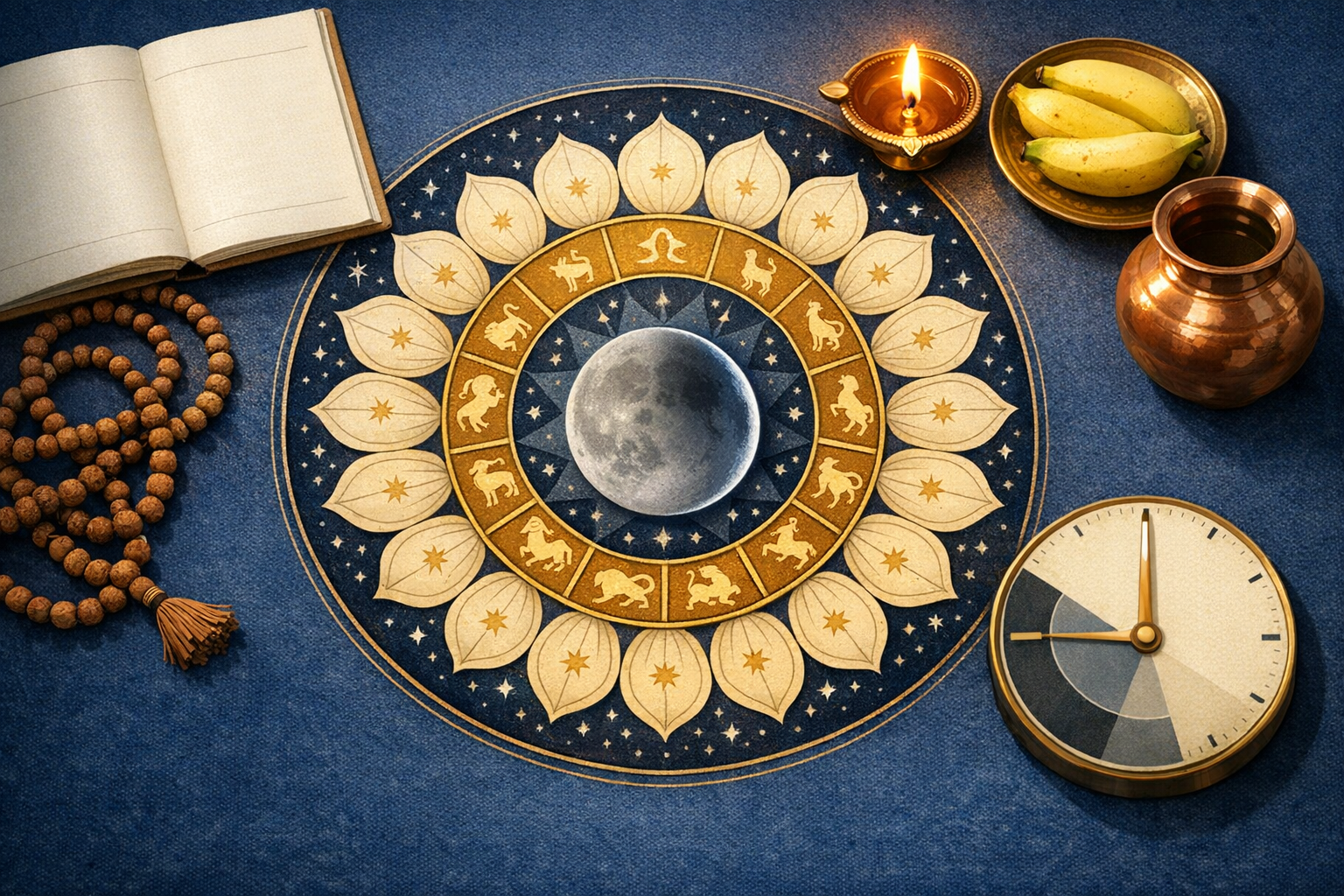
Thursday, June 11, 2026, corresponds to Krishna Paksha Ekadashi in the Hindu calendar (Panchang) across most regions. The Ekadashi tithi prevails until approximately 5:53 PM local time, after which Krishna Paksha Dwadashi begins and continues into the next civil day. This transition is central to vrat observance and the selection of auspicious windows (Shubh Muhurat) for spiritual and routine activities.
In Panchang terminology, Krishna Paksha denotes the waning (dark) fortnight from the full moon (Purnima) to the new moon (Amavasya). Ekadashi is the eleventh lunar day and is traditionally devoted to upavasa (fasting), japa, dhyana, and sattvic discipline, with the vrata formally concluded on Dwadashi (parana) in accordance with local almanac rules. The evening change of tithi on June 11 creates a clear next-morning Dwadashi window for parana in many locations.
Technically, a tithi is defined by the longitudinal separation between the Moon and the Sun in sidereal zodiacal terms. Each tithi spans 12 degrees of this relative separation. Ekadashi ends when the Moon–Sun longitude difference reaches 132°. The stated end time (about 5:53 PM, most regions) reflects the moment of that astronomical threshold for the day; location-specific longitudes, time zones, and daylight saving conventions create small but meaningful variations, which is why regionally issued Panchangs remain authoritative.
Nomenclature for this Ekadashi can differ across the Amanta and Purnimanta month-reckoning traditions followed in various parts of India. In many almanacs, the Krishna Paksha Ekadashi falling around late May to June is recognized as Apara (also called Achala) Ekadashi. The devotional and ethical thrust, however, is uniform: self-restraint, clarity of intention, kindness, and remembrance of dharma.
Vrat determination typically follows sunrise-centric rules. Smārta practice generally observes the Ekadashi fast on the civil day when Ekadashi is present at sunrise; Vaishnava practice avoids the overlap called Dashami-viddha Ekadashi and prefers observance where Ekadashi is cleanly situated. When tithi transitions occur after local sunsetas on June 11many regions find the next sunrise in Dwadashi, which then provides a straightforward parana opportunity.
Parana, the ritual break-fast, is performed on Dwadashi after sunrise and within the Dwadashi tithi window, avoiding the Hari Vasara (the first quarter of Dwadashi) as per Vaishnava guidelines. Fruits, phalahara, or light satvik preparations are commonly taken to close the vrata with gratitude. Those seeking precision should consult the local Panchang for parana start and cutoff times to ensure compliance with sect- and region-specific norms.
Auspicious timing on June 11 benefits from classical muhurta guidance. Abhijit Muhurat, calculated around local solar noon, is often treated as broadly auspicious for dharmic undertakings that cannot be easily scheduled otherwise; it spans roughly 24 minutes before and after the exact solar noon. Beyond Abhijit, practitioners may plan routine tasks by steering clear of Rahu Kaal, Yamaganda, and Gulika Kaal, which are considered inauspicious for initiating new work.
For weekday-based inauspicious segments, daytime is divided into eight equal parts between sunrise and sunset. On Thursdays, Rahu Kaal occupies the sixth segment of daylight; if sunrise is near 6:00 AM and sunset near 6:00 PM, this approximates 1:30 PM to 3:00 PM. Yamaganda on Thursday generally aligns with the first segment (about 6:00 AM to 7:30 AM under a 6-to-6 day), while Gulika Kaal aligns with the third segment (around 9:00 AM to 10:30 AM on a 6-to-6 day). Actual windows must be proportionally adjusted to the day’s true sunrise and sunset.
Some traditions also consult Choghadiya for quick decision-making. Daytime Choghadiyas rotate through Amrit, Shubh, Labh (favorable) and Chal (neutral), alongside Rog, Kal, and Udveg (unfavorable). Aligning small errands or communications with Amrit–Shubh–Labh and avoiding Rog–Kal–Udveg provides a practical, culturally rooted time-management approach complementary to formal muhurta.
The day’s Nakshatra (lunar mansion) and the Moon’s Rashi (Chandra Rashi) are determined by the Moon’s sidereal position at any given time. Because the Moon transits roughly one nakshatra per day and can cross a Rashi boundary around such transitions, exact values are location- and time-dependent. A regional Panchang or reliable Jyotish software will specify the prevailing Nakshatra and Rashi at sunrise and during key observance windows, helping tailor mantra selection, sankalpa, or remedial practices.
Yoga and Karana offer additional granularity. Yoga is computed from the sum of the solar and lunar longitudes divided into 27 equal parts, while Karana represents half-tithi segments. Although highly technical, these elements refine muhurta selection and give context for individual sankalpasespecially useful for those integrating astrological timing into household rites.
Across the wider dharmic family, lunar observances like Ekadashi resonate with shared values of restraint, mindfulness, and compassion. In Buddhism, Uposatha days likewise synchronize ethical renewal with the Moon’s phases; in Jainism, observances such as Posadha and periodic fasting embody ahiṁsa and self-purification; Sikh spiritual life emphasizes simran, seva, and inner discipline that harmonize with the ethical core guiding vrata conduct. Acknowledging these convergences strengthens mutual respect and underscores a living unity within South Asia’s dharmic traditions.
Households marking Ekadashi on June 11 often maintain a sattvic routine: early rising, japa of chosen mantras, brief scriptural reading (such as passages from Bhagavad-Gita or Bhagavata Purana), and acts of dana as feasible. Light, simple foods for those who are not fasting, reverence for elders, and mindful speech contribute to a calm, contemplative atmosphere that makes the vrata meaningful for all family members.
Because timekeeping is inherently local, it is prudent to verify sunrise, sunset, and tithi-change times for one’s specific location. Small differences in longitude, latitude, and time standards (including daylight saving) can shift inauspicious segments and parana windows by meaningful margins. A local Panchang remains the gold standard for this purpose.
In summary, June 11, 2026 presents a clear sequence: Krishna Paksha Ekadashi continues until about 5:53 PM, followed by Dwadashi through the night and into the next morningan arrangement that typically supports a compliant Dwadashi parana after sunrise. With careful attention to Abhijit Muhurat and avoidance of Rahu Kaal, the day’s spiritual and practical endeavors can be harmonized with the Moon’s rhythm. In honoring the shared ethics of fasting, reflection, and kindness, observants participate in a broader dharmic tapestry that values unity in diversity.
Inspired by this post on Hindu Blog.
