
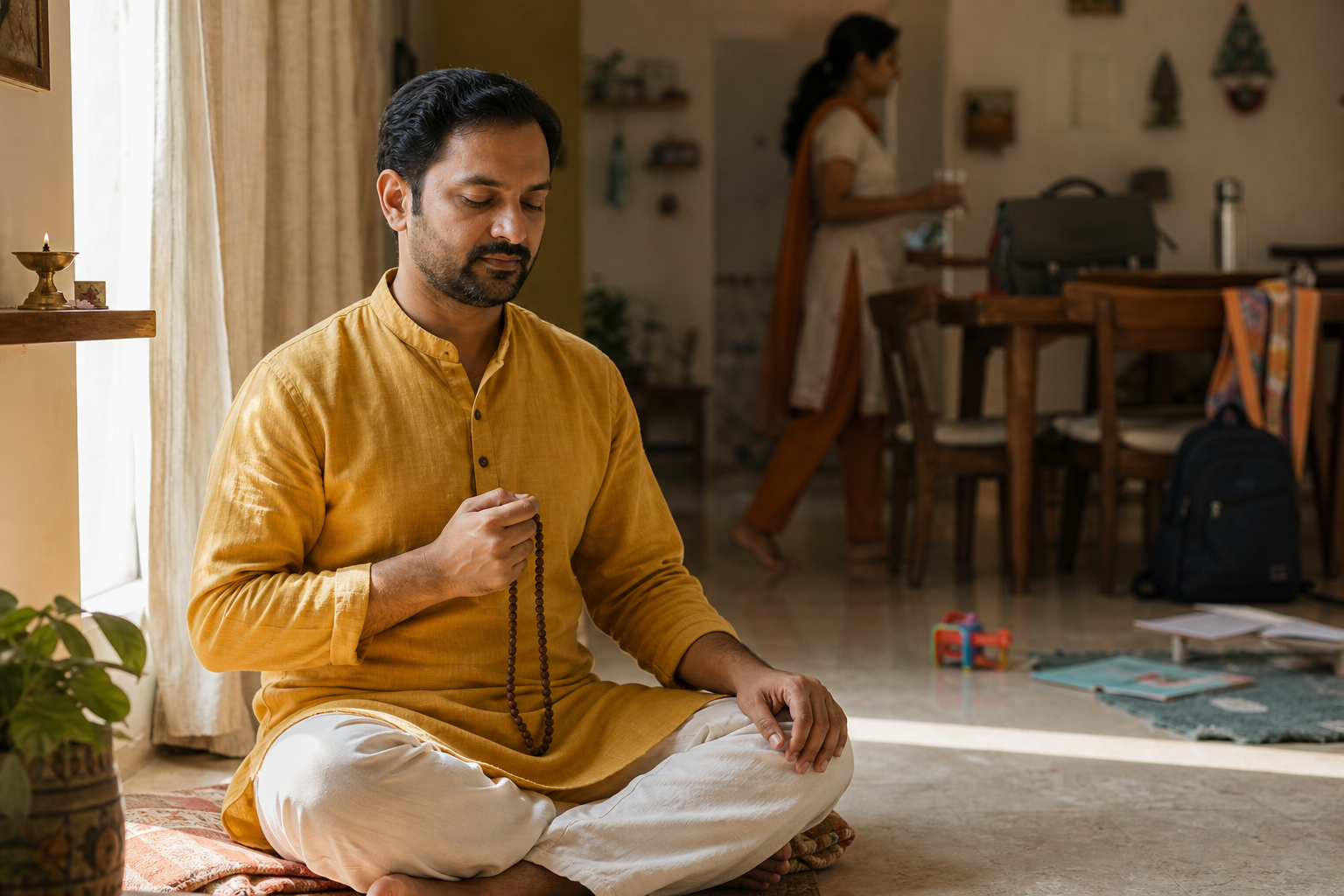
You sit for japa or meditation, and before the mala has settled your mind has reopened a message, an argument, a craving, and tomorrow’s unfinished work. This rapid movement from one attraction to another doesn’t prove that you are unfit for practice. It shows you where the practice has to begin.
For a householder, the answer cannot be permanent retreat from noise, people, or responsibility. Inner stillness must remain available in the middle of dharma: while you work, speak, care for family, make decisions, and meet obligations. The practical aim is not to become unreachable. It is to stop being ruled by every thought and impulse that passes through you.
Aim for freedom from compulsion, not an empty mind
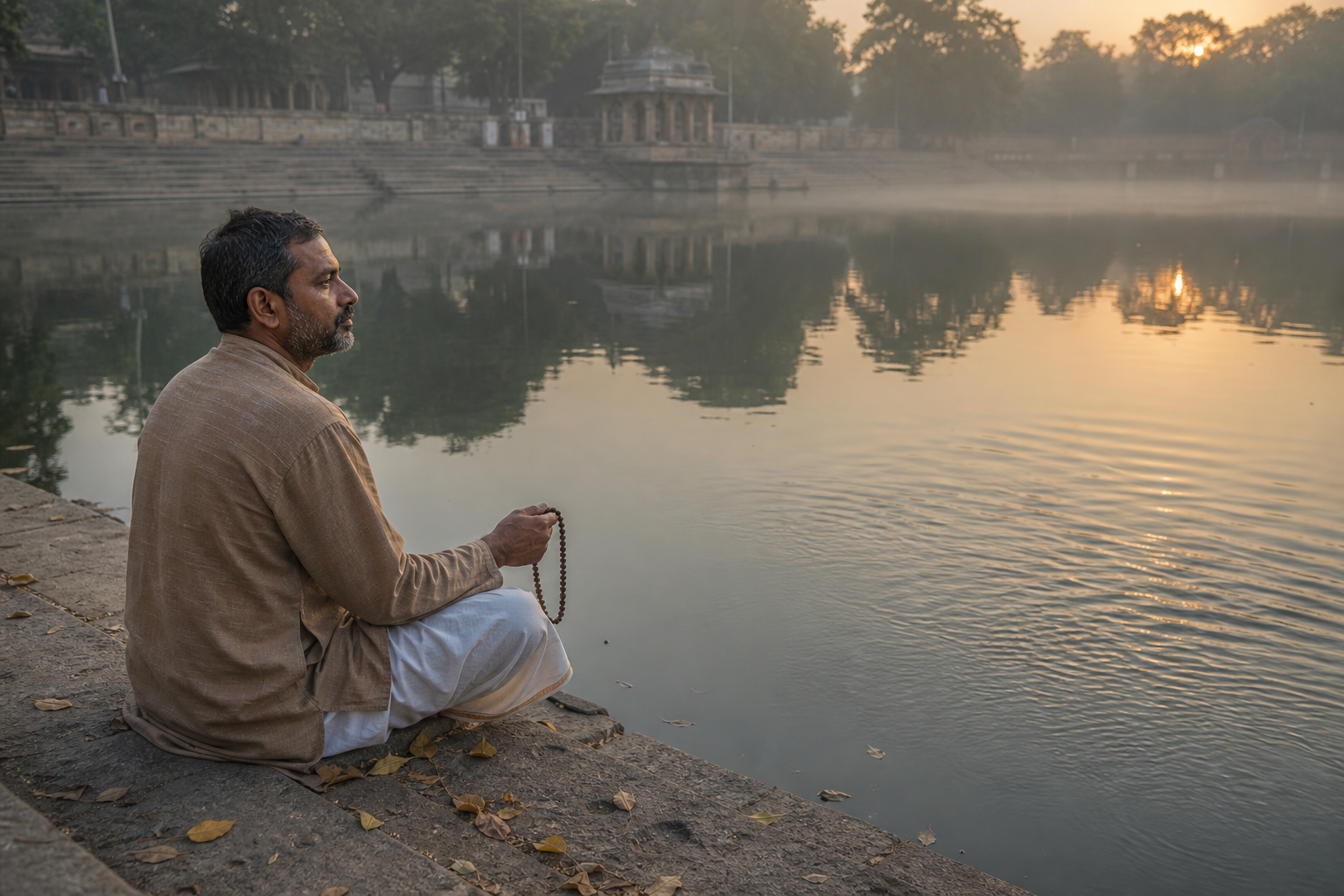
A quiet mind is pleasant, but inner stillness is deeper than a temporary absence of thought. You can sit in a silent room while conducting arguments in your imagination. You can also remain inwardly steady while a child calls for you, traffic moves outside, or an unpleasant conversation demands a careful response.
A useful definition is simple: you are still when a thought can appear without immediately becoming your command. Desire may arise, but you do not have to obey it. Anger may arise, but it does not have to choose your words. A memory may return, but you do not have to enter it and replay the entire scene.
This distinction changes how you judge a sitting. A meditation filled with noticed distractions may be more honest and fruitful than a peaceful sitting in which you merely drifted. The important movement is the return: you notice that attention has been captured, release the object, and return to the chosen anchor without scolding yourself.
Look for progress in ordinary conduct rather than dramatic experiences. You notice an impulse before acting on it. You recover from irritation sooner. You can leave a desire unsatisfied without spending the day arguing with it. You complete a necessary duty without waiting for the perfect mood. Your speech becomes less hurried and less defensive. These are practical signs that the mind has gained room around its habitual reactions.
Use one repeatable sequence when you sit
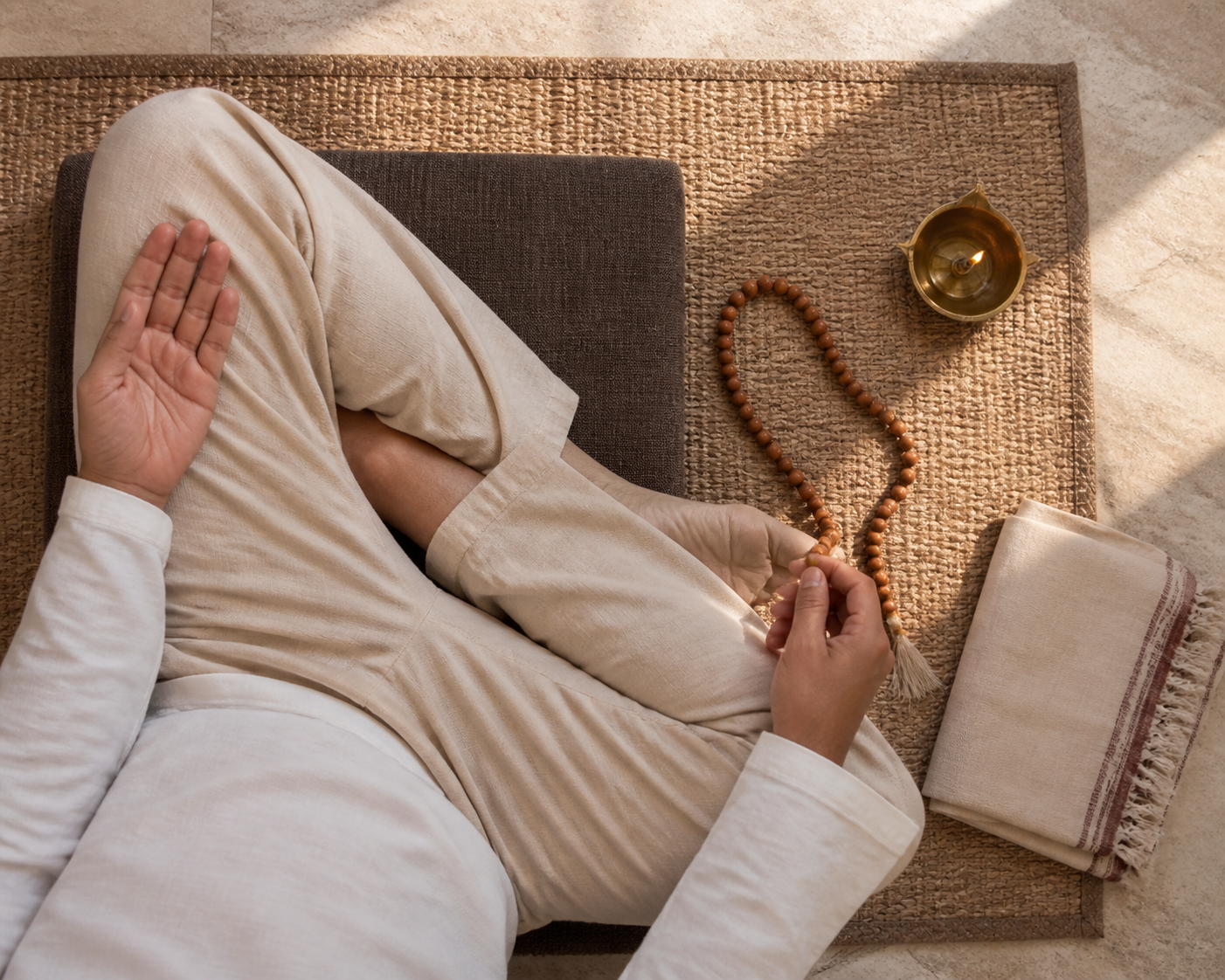
A complicated routine gives the restless mind more decisions to make. Use a small sequence that can survive an ordinary day. If you have received a practice from a guru or sampradaya, follow that discipline rather than replacing it with a collection of techniques. The sequence below is a framework for attention, not a substitute for initiated instruction.
- Protect the interval honestly. Put the phone beyond reach, silence avoidable notifications, and tell the people around you that you are sitting. If a real duty is active, attend to it or arrange for it first. Anxiety about neglecting someone is not a useful foundation for stillness.
- Let the body become steady without making posture an ordeal. Sit in a stable, dignified position you can maintain. Release unnecessary tension in the face, shoulders, hands, and abdomen. Allow the breath to remain natural unless your tradition has given you a specific pranayama discipline.
- Set one intention. Resolve that, for this sitting, you will not follow every mental invitation. You are not demanding that thoughts disappear. You are declining to travel with each one.
- Choose one anchor. Use the mantra you have been given, a divine name, the form of your Ishta Devata, or the natural movement of breath. Do not keep changing anchors because another method suddenly seems more powerful.
- Notice capture and return. When attention wanders, identify the movement plainly: planning, remembering, wanting, resisting, rehearsing. Name it once if that helps, then return. Do not begin an inner debate about why the thought appeared.
- Close with a dharmic action. Before standing, identify the next responsibility you will meet with steadiness. This carries the practice out of the protected interval and into conduct.
The return is the central act. Irritation at distraction creates another distraction, now decorated as spiritual seriousness. Treat each return as abhyasa, repeated practice. The mind wandered; you saw it; you came back. That is work completed, not evidence of failure.
Reduce the vasanas that keep reclaiming attention
Vasanas are latent tendencies that incline the mind toward familiar patterns of desire, avoidance, interpretation, and action. They are why attention often travels along the same routes: checking for approval, replaying an insult, anticipating pleasure, defending an identity, or postponing a duty. The object changes, but the inner movement repeats.
Trying to crush a vasana through self-disgust usually adds agitation. Obeying it automatically strengthens the familiar route. The workable middle is to see the tendency clearly, stop feeding it where you can, and tolerate the discomfort of not giving it its usual reward. In this sense, reducing vasanas strengthens the mind: attention becomes less available for capture by every recurring pull.
After practice, examine one pattern rather than producing a catalogue of personal defects. Use four questions:
- Trigger: What happened just before the pull became strong?
- Promise: What relief, pleasure, recognition, or escape did the mind expect?
- Cost: What duty, relationship, clarity, or peace was lost when the pattern was followed?
- Counter-practice: What is the smallest concrete refusal that weakens the pattern next time?
Suppose the recurring pull is compulsive phone checking. The counter-practice is not a grand vow against technology. It may be leaving the device outside the practice space and refusing the first urge to retrieve it. If the pattern is replaying an argument, the counter-practice may be returning to japa whenever the imaginary prosecution begins. If it is avoidance, the counter-practice may be completing the next visible part of the neglected duty before seeking another distraction.
Work on the environment as well as the will. An object kept in sight repeatedly invites attention. An unresolved obligation repeatedly asks to be remembered. A conversation you know you must have will continue appearing in silence. Remove needless cues, record tasks somewhere dependable, and complete small duties that are creating avoidable mental noise. This is not separate from spiritual practice. It prevents disorder from borrowing the language of contemplation.
Do not turn a lapse into an identity. The statement that you followed a particular tendency is useful because it describes an action. The statement that you are simply a restless or undisciplined person is less useful because it makes the pattern sound permanent. See the movement precisely, make the next refusal smaller if necessary, and continue the practice.
Keep silence from becoming withdrawal
Outward silence can support inward observation, but it is not automatically sacred. For a renunciate, solitude and mauna may form part of a sustained discipline. Within family and social life, however, silence can be either solace or suffocation. The difference often lies in intention, communication, and consequence.
If another person speaks and you withhold a response to punish, frighten, or control them, that is not inner stillness. If you disappear into silence whenever accountability becomes uncomfortable, silence has become avoidance. If family members must guess whether you are practising, angry, or emotionally unavailable, your private quiet is creating agitation for someone else.
Before taking a period of silence in a shared home, make the boundary clear. Say that you are going to sit or observe mauna, explain how someone can reach you for a genuine need, and state when normal conversation will resume. During conflict, ask for a pause instead of imposing unexplained withdrawal. A pause has a return point; the silent treatment leaves the other person carrying uncertainty.
Four tests can reveal whether silence is serving dharma:
- Did you communicate the silence, or impose it without explanation?
- Can necessary duties and urgent needs still reach you?
- Are you using quiet to observe reactivity, or to avoid a truthful conversation?
- Do you return to others more patient and available, or colder and more self-absorbed?
The householder’s practice is not inferior because it is interrupted. An interruption may be the moment when stillness becomes real. You can answer what needs answering, perform the duty, and return without resentment. That movement protects both contemplation and relationship.
Silence also should not be forced through severe psychological distress. If sitting repeatedly intensifies panic, traumatic memories, dissociation, or a sense of being unsafe, stop treating endurance as spiritual achievement. Reorient to your surroundings, seek appropriate support from a qualified mental-health professional, and consult a trustworthy teacher about adapting the practice. Meditation is not a replacement for psychological or medical care.
Key takeaways for the next time you sit
- Judge stillness by reduced compulsion, not by the total disappearance of thought.
- Choose one anchor and practise returning to it without arguing with the distraction.
- Study one recurring vasana through its trigger, promise, cost, and smallest counter-practice.
- Reduce avoidable cues and unfinished duties that repeatedly reclaim attention.
- Do not use mauna as punishment, evasion, or a claim of spiritual superiority.
- Carry the sitting into one immediate duty, decision, or conversation.
At your next sitting, do not demand a transformed mind. Protect the interval, choose the anchor, and observe which invitation is hardest to refuse. Then make one small refusal when that same vasana appears during the day. Inner stillness becomes dependable when the return practised in silence begins to govern speech and action.
References
- Hindu Blog – Hindu Teachings: The Mind Gains Strength by Reducing Vasanas
- Hindu Blog – Silence Can Be Both Solace And Suffocation – Hinduism Insights
