

If someone has told you that your kundli contains an inauspicious yoga, pause before you accept a frightening prediction or purchase an expensive remedy. Your first task is to identify exactly what has been interpreted, what conduct or difficulty it is supposed to indicate, and whether the proposed remedy bears any sensible relationship to that concern.
You can take Jyotisha seriously without treating one planetary combination as an unchangeable verdict. A grounded approach to shanti joins careful chart interpretation with self-examination, corrective conduct, steady spiritual practice, and practical action in the part of life that concerns you.
Get the yoga named precisely before seeking a remedy
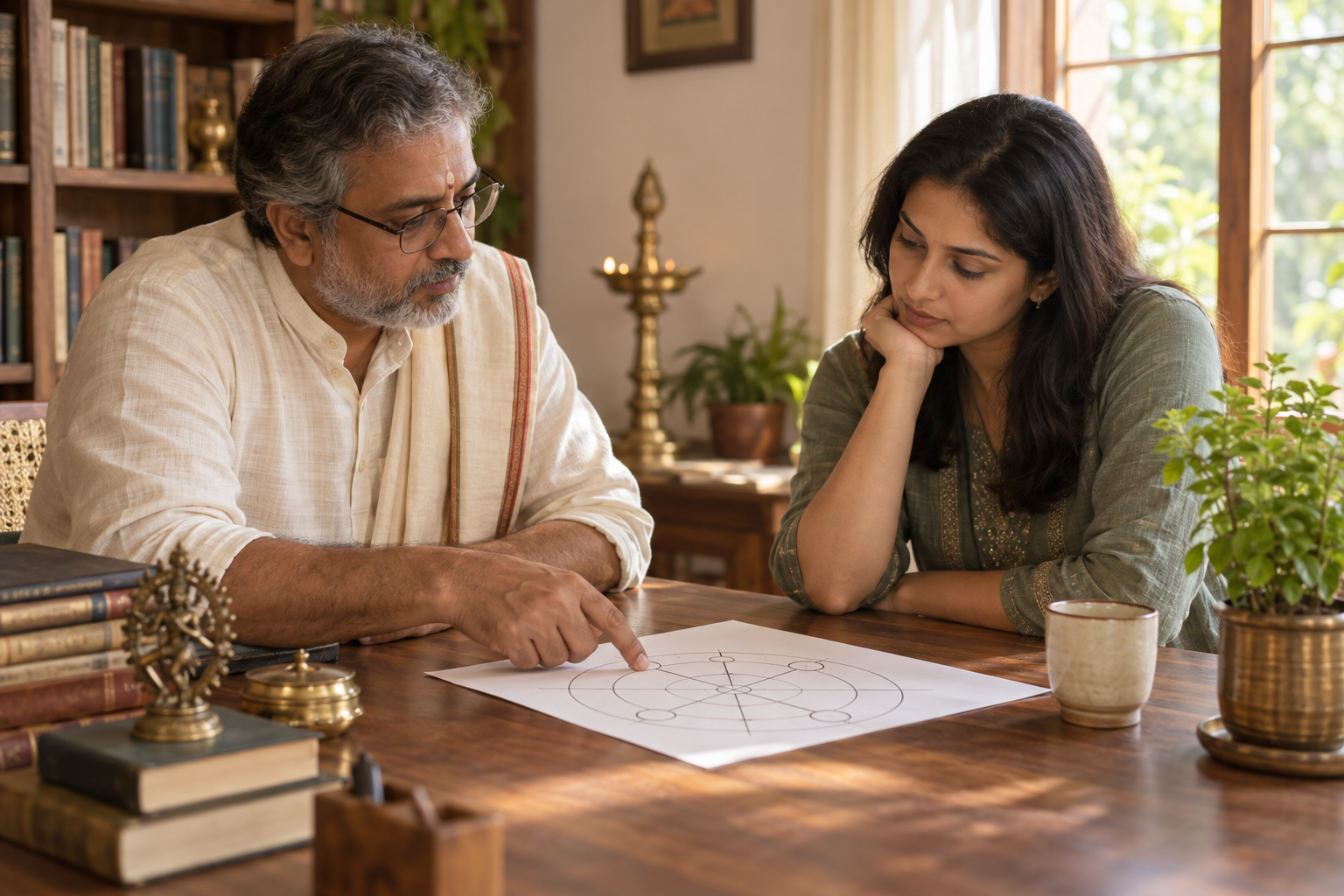
Vague warnings about bad planets give you nothing useful to examine. Ask the astrologer to name the yoga and show you the combination in the chart. You should be able to leave the consultation with a short explanation that another competent practitioner could inspect.
- What exact birth date, time, and place were used?
- What is the name of the yoga, and which placements are said to form it?
- Which area of life is being interpreted, and why?
- What factors elsewhere in the kundli strengthen, weaken, or redirect that interpretation?
- Is the astrologer describing a disposition, a difficult period, or a certain event? These are not interchangeable claims.
- What is each recommended remedy intended to cultivate or correct?
Birth-time uncertainty should be stated openly. Do not let anyone quietly adjust your time merely to make a dramatic narrative fit. If the recorded time is doubtful, ask how much confidence the practitioner places in the relevant houses and timing. A responsible answer may contain uncertainty.
Seek a second interpretation when the first consultation relies on fear, predicts unavoidable catastrophe, demands secrecy, or immediately ties relief to a costly object or ceremony. Compare the reasoning, not the confidence with which it is delivered. Two forceful voices can still be wrong, while a careful practitioner may properly give a qualified answer.
Separate the planetary symbol from your actual conduct

A yoga is a configuration in a kundli. Its meaning is an interpretation of potential, not a record of what you have already done and not a guarantee of what you must become. It should lead to observation rather than fatalism.
For example, Jupiter joined with Rahu or Ketu is identified as Chandal Yoga and traditionally associated with disrespect toward elders or teachers and with improper or harsh speech. That is a traditional astrological characterization. It is not proof that everyone with the combination behaves this way, nor does it justify branding a person as immoral.
If this yoga appears in your chart, turn the symbolism into specific questions. Review your real interactions rather than searching for incidents that merely confirm what you were told:
- Do you dismiss a teacher before understanding the teaching?
- Do you use bluntness as permission to humiliate another person?
- Do you reject sound counsel because accepting it would require humility?
- Do you confuse independent thought with contempt for all authority?
- Do you speak respectfully in public but become abusive with family members or subordinates?
- Can you identify occasions when you listened well, honored wisdom, or corrected your speech? Counter-evidence matters too.
This examination must retain moral discrimination. Respect for elders and gurus does not require obedience to manipulation, exploitation, or abuse. Dharma does not ask you to silence legitimate questions. The corrective movement is from contempt to discernment, not from discernment to submission.
The same method applies to another supposedly inauspicious yoga: write down the tendency being claimed, translate it into observable behavior, and test it honestly against your life. If the interpretation cannot be made concrete enough to examine, it is too vague to govern an important decision.
Let the remedy answer the tendency it is meant to pacify
A remedy is more coherent when its outer observance and inner purpose point in the same direction. A puja for peace followed by unchanged cruelty, dishonesty, or recklessness leaves the central work untouched. Begin with conduct because it is the part of the remedy you can verify in daily life.
Make achara part of graha shanti
Choose the opposite virtue of the tendency you are concerned about. For a reading centered on disrespect and harmful speech, a practical discipline might include:
- Pause before sending a message written in anger, and remove contempt without concealing the truth.
- Let another person finish speaking before you challenge the point.
- Prepare properly for lessons, keep commitments made to teachers, and acknowledge the people from whom you have learned.
- Correct a specific injury with an apology and changed behavior rather than a general declaration of regret.
- Refuse gossip and casual insults, especially when the absent person cannot respond.
- Study one teaching with discipline instead of collecting disconnected predictions and remedies.
Do not make the discipline so elaborate that it collapses after enthusiasm fades. Select one behavior you can notice at the moment of choice. Record lapses without dramatizing them, make the repair that is possible, and resume the practice.
Use seva and dana without turning them into a transaction
Seva can train the quality that a difficult interpretation says is weak. Service connected with education, care for elders, preservation of learning, or support for a legitimate spiritual institution may cultivate gratitude and humility when those are the qualities at issue. Choose a form of service whose beneficiaries and use of resources you can understand.
Dana is not a fee paid to make a planet overlook your conduct. Give within your means, without borrowing and without expecting a guaranteed worldly return. If someone insists that only a large payment can prevent disaster, step away before spending anything. Fear and urgency are poor conditions for financial consent.
Keep japa, puja, and formal rites within a trusted tradition
If you already have an ishta-devata practice, family observance, or daily prayer, consistency is usually a better starting point than accumulating unfamiliar rituals from several lineages. Ask a trusted family priest, acharya, or established Jyotisha practitioner whether a particular japa, vrata, puja, or graha-shanti rite is appropriate to your tradition and complete chart.
Before commissioning a formal rite, ask for the sankalpa or purpose in plain language, what will be performed, who will perform it, what materials are required, and the full expected cost. You need not accept a universal mantra copied from an anonymous list. Mantra practice can involve lineage, pronunciation, eligibility, and method, so specific instructions should come from a teacher who is willing to explain the practice and its boundaries.
Treat gemstones with similar care. They cost money and are not a harmless default response to a single isolated yoga. Do not buy one under a deadline, take on debt, or accept a recommendation that ignores the rest of the chart. No astrological object should be represented as a substitute for medical care, legal advice, financial planning, or the ordinary work needed to address a real problem.
Build a shanti plan you can actually follow

You do not need a shelf full of remedies. You need a clear chain connecting the interpretation to a disciplined response. Put the plan on one page:
- Record the claim. Write the yoga, the placements said to create it, the life area involved, and the predicted tendency in plain language.
- Check the foundation. Confirm the birth information and ask what else in the chart modifies the reading. Note any uncertainty rather than hiding it.
- Compare it with life. List actual examples that support the interpretation and examples that contradict it. Do not manufacture evidence for a prediction.
- Name the counter-quality. Convert anger into restraint, contempt into respectful inquiry, confusion into disciplined study, or negligence into reliable action. Choose the quality that answers the stated problem.
- Adopt one behavioral and one spiritual practice. Make the behavioral practice observable. Keep the spiritual practice consistent with your sampradaya, family tradition, or guidance from a trusted teacher.
- Set a review point. Look for changes in the relevant behavior, relationships, commitments, and decisions. If nothing changes, reconsider the practice and the original interpretation before escalating the expense.
If the concern involves marriage, employment, debt, health, education, or litigation, add the appropriate worldly action to the same page. Speak with the qualified professional relevant to the problem. Shanti should support clear action; it should not become a reason to postpone it.
This approach does not pretend that spiritual life can be reduced to a checklist. It gives your observance an ethical center. The test is not whether you can perform the most complicated rite, but whether the response makes you more truthful, disciplined, charitable, and capable of meeting your duties.
Questions to ask before accepting any remedy

Can an inauspicious yoga be completely removed?
Be cautious with literal guarantees of removal. The natal chart being interpreted does not disappear. Shanti is better approached as pacification, disciplined response, and the cultivation of a wiser expression of the tendencies attributed to the yoga. A practitioner can recommend an observance, but should not need to promise immunity from every difficulty.
Is a formal puja always necessary?
No single answer fits every kundli or sampradaya. A formal rite may have a proper place when recommended by a trusted practitioner who can explain it. Ethical correction, responsible action, and a steady existing sadhana remain sound foundations while you seek that guidance. Do not mistake complexity or price for spiritual depth.
What should you do when astrologers disagree?
Do not average their predictions or perform every remedy. Ask each practitioner to show the configuration, explain the modifying factors, distinguish possibility from certainty, and connect the remedy to the interpretation. Prefer transparent reasoning and proportionate advice. If neither explanation survives basic questions, you are free to seek better counsel rather than choosing the more alarming prediction.
Start now with one page containing your verified birth information, the exact yoga, the claimed tendency, evidence for and against it, one corrective behavior, one appropriate spiritual observance, and a review point. If the advice cannot yet be stated that clearly, do not spend money on it. Let shanti begin with disciplined attention rather than fear.
References

Leave a Reply
You must be logged in to post a comment.