

If you found an afflicted Sun, Saturn in the 9th house, or a difficult dasha and now fear for your father, stop before converting that symbol into a verdict. In Vedic astrology, no single placement responsibly establishes a father’s death.
The useful question is narrower: do the natal chart, the derived houses for the father, the Dwadashamsha, and the active timing all repeat the same vulnerability? Even when they do, the result is a period for closer attention, not a guaranteed event. Jyotisha is not a medical diagnostic method, so an actual health concern belongs with a qualified clinician regardless of whether the chart looks reassuring or difficult.
Key takeaways
- Use the 9th house as the primary father-lagna and the Sun as the fixed significator of the father. Some lineages also examine the 10th house for a night birth, but that is normally a secondary lens.
- The 8th house from the father-lagna is the native’s 4th house. The 2nd and 7th from the father-lagna, traditionally treated as paternal maraka houses, are the native’s 10th and 3rd houses.
- Separate natal vulnerability from timing. A difficult natal factor is not an event date; it must be activated by a relevant dasha and reinforced by transits.
- Require convergence across the rashi chart, D12, and dasha-transit timing before expressing serious concern. This is a safeguard against over-reading, not proof that a death will occur.
- Use a concerning period for appropriate health care, family presence, practical readiness, and spiritual discipline. Do not use it to announce an exact death date.
Read the father’s derived houses before judging any planet
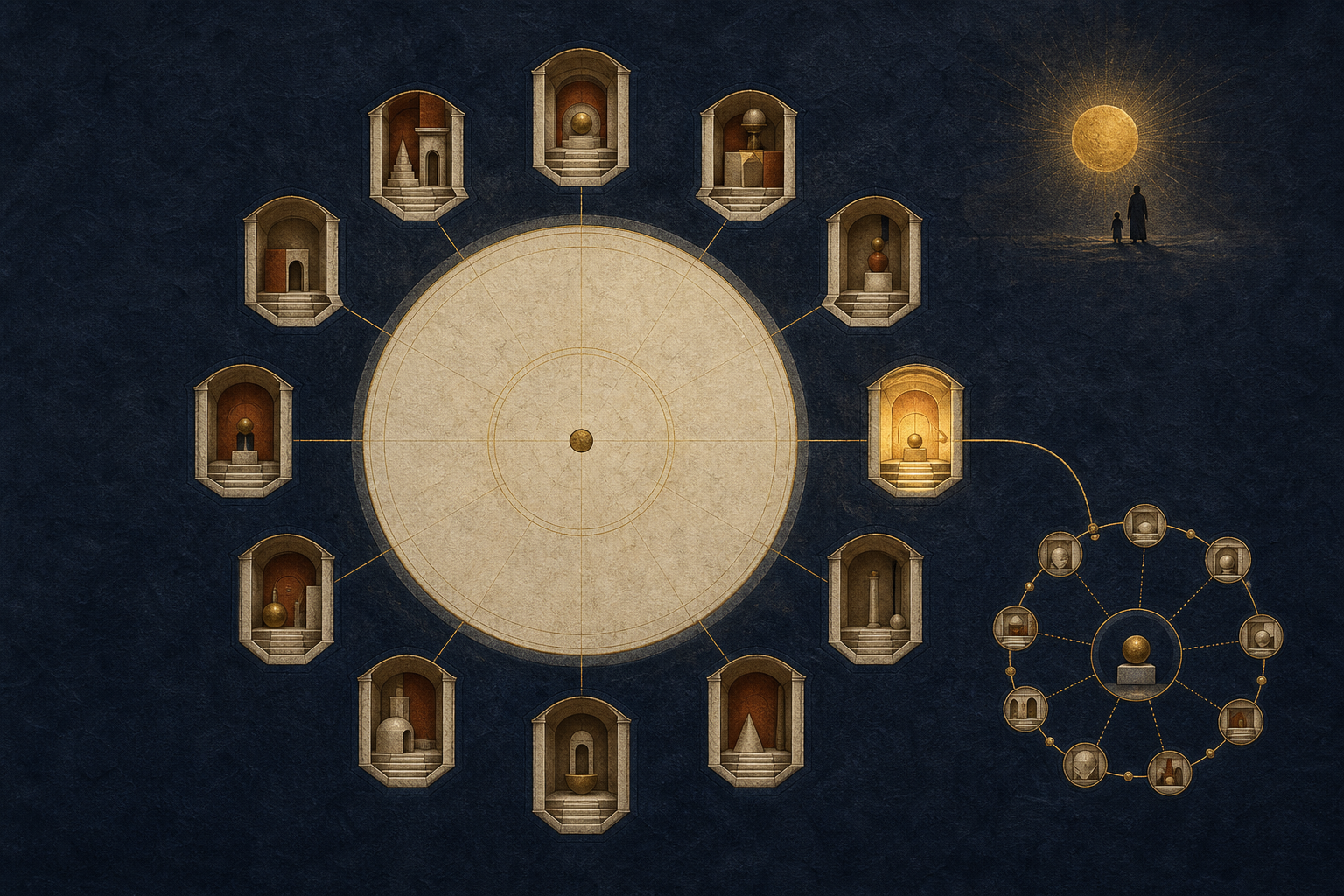
The central calculation is Bhavat Bhavam applied from the 9th house. You temporarily treat the 9th as the father’s first house, then count longevity and maraka houses from that point. This prevents a common mistake: seeing a supposedly harsh planet in the native’s chart and assigning it a paternal meaning without first establishing the correct house relationship.
| House in the native’s chart | House counted from the father-lagna | Traditional paternal role | What to examine |
|---|---|---|---|
| 9th | 1st | Father-lagna | The sign, occupants, aspects, dignity of the 9th lord, and connections with the Sun |
| 4th | 8th from the 9th | Paternal longevity and vulnerability | The 4th house, its lord, occupants, aspects, and links to the father-lagna or Sun |
| 10th | 2nd from the 9th | One paternal maraka house | Its lord and occupants, especially when connected with other paternal factors and activated by dasha |
| 3rd | 7th from the 9th | The other paternal maraka house | Its lord and occupants, judged by condition, relationship, and timing rather than house ownership alone |
Maraka does not mean that every planet associated with the 3rd or 10th will kill the father. It means that these houses and their lords can participate in a death-inflicting or severe health period under the traditional derived-house rules. Their involvement becomes weightier only when they connect with the 9th house, its lord, the Sun, or the 4th house and are activated at the same time.
The Sun must be overlaid on this entire map. A strong Sun can indicate resilience in the paternal line even when one derived house is under strain. A seriously afflicted Sun becomes more concerning when the 9th lord and the father’s longevity house repeat the same weakness. The operative word is repeat.
For a nocturnal birth, some lineages also assess the native’s 10th house as a father reference. Do not switch between the 9th and 10th merely because one produces a more dramatic prediction. Keep the 9th as the primary frame unless you consistently follow a lineage that teaches otherwise, and record the 10th-house reading as secondary. In that method, the 10th may have two distinct roles: an additional father reference and the 2nd, or maraka, house from the primary 9th-house father-lagna.
Build the natal case before looking for a date
A transit cannot create a sound interpretation from an unexamined natal chart. Begin with a written evidence sheet. Divide it into support and strain, and enter each factor only once. This simple discipline makes it harder to count the same conjunction repeatedly under different labels.
Establish the rashi baseline
- Assess the 9th house and its lord. Record sign dignity, placement, conjunctions, aspects, combustion, retrogression, avastha, and relevant strength measures.
- Assess the Sun independently. Note its dignity, house, associations, combustion-related relationships, aspects, and connection with the 9th lord.
- Assess the native’s 4th house and lord as the 8th from the father-lagna. Look for repeated links with the Sun, 9th lord, or derived maraka lords.
- Assess the 10th and 3rd houses, their lords, and their occupants. Do not label them dangerous merely because they are derived maraka houses; determine whether they actually join the paternal network.
- Record protection. Jupiter, Venus, a strong Mercury, and a waxing Moon are traditionally protective when well placed and functionally supportive. Protection matters most when it directly reaches the 9th house, Sun, 4th house, or their lords.
- Record concentrated strain. Saturn, Mars, Rahu, and Ketu can add pressure when they afflict sensitive paternal factors, especially through conjunctions or their relevant special aspects. Their sign dignity, functional role, and supporting influences still matter.
Shadbala, sign dignity, combustion, retrogression, planetary avasthas, Ashtakavarga, and classical aspects answer related but distinct questions. Do not flatten them into a crude score in which every difficult indication receives one point. Ask instead whether several techniques identify the same planet or house as weak. A debilitated 9th lord that is strongly supported is not equivalent to a debilitated, combust, harshly aspected 9th lord whose dispositor is also compromised.
At the end of the rashi assessment, you should be able to answer four concrete questions: Is the vulnerability isolated or repeated? Does one planet connect the father-lagna with the longevity or maraka axis? Is the Sun independently under strain? Is there direct benefic protection? If you cannot answer these from the chart, you are not ready to time an event.
Use Dwadashamsha as an independent confirmation
The Dwadashamsha, or D12, refines parental indications. Examine its Ascendant, the 9th house and 9th lord, the Sun, and the relationships among them. A stressed rashi chart with a strong, well-supported paternal pattern in D12 reduces confidence in an extreme interpretation and may point to greater resilience. When the rashi and D12 repeat the same damaged houses, lords, and karaka, the concern deserves closer attention, but it still does not justify certainty about death.
Verify the recorded birth time before giving D12 heavy interpretive weight. A divisional Ascendant is sensitive to birth data, and a doubtful time can produce a misleading parental framework. Do not choose whichever D12 version confirms an existing fear.
Add Jaimini factors only within a consistent method
If you are trained in Jaimini astrology, assess the Pitru Karaka according to the chara-karaka scheme used by your lineage. Examine its dignity, support, and relationship with the Sun and 9th house. Chara Dasha periods involving the Pitru Karaka or relevant paternal signs can provide corroboration when they coincide with Parashari timing.
Do not combine a Pitru Karaka selected under one lineage’s ranking rules with a Chara Dasha method borrowed selectively from another. Jaimini should sharpen a coherent reading, not supply an extra alarming factor after the Parashari case fails to converge.
Time a period only when dasha and transit reinforce the chart
The most common timing error is to notice Saturn, Rahu, or Ketu crossing a sensitive place and then search backward for reasons to call the transit fatal. Start with natal capacity, proceed to dasha activation, and use transits last. The order matters because a transit is a trigger, not the whole mechanism.
- Confirm natal vulnerability. The 9th house or lord, Sun, father’s longevity house, and derived maraka network should show a meaningful pattern rather than one isolated blemish.
- Identify dasha activation. Mahadashas and antardashas of the 9th lord, Sun, or lords of the native’s 10th and 3rd become relevant when those planets are afflicted, functionally difficult, or directly tied to paternal houses.
- Look for transit reinforcement. Saturn or Rahu-Ketu crossing the 9th house, the natal Sun, or the native’s 4th house can concentrate the symbolism. None of these transits alone establishes death.
- Cross-check the D12 and, if consistently used, Jaimini Chara Dasha. A serious interpretation requires the parental divisional chart or the complementary timing system to echo the natal and Parashari timing pattern.
This creates three main domains of confirmation: the rashi chart with its derived houses, the D12, and synchronized dasha-transit timing. Requiring all three is a rule of interpretive restraint. It is not a statistical formula and does not convert astrology into certainty.
Language matters at this stage. The responsible statement is: “This period concentrates difficult paternal health indications, so closer care and practical readiness are appropriate.” The irresponsible statement is: “Your father will die in this period.” The first tells you what to do while preserving uncertainty. The second creates fear that the method cannot honestly resolve.
An Aries Ascendant example
For an Aries Ascendant, the 9th house is Sagittarius, so Sagittarius becomes the temporary father-lagna. The 8th from Sagittarius is Cancer, which is the native’s 4th house. The 2nd from Sagittarius is Capricorn, the native’s 10th, and the 7th is Gemini, the native’s 3rd.
Capricorn and Gemini are not dangerous merely because they occupy these coordinates. First judge their lords, occupants, aspects, and connections with Sagittarius, its lord, Cancer, and the Sun. If the derived maraka lords are seriously afflicted, an activating dasha begins, the Sun is independently stressed, and Saturn or the nodes reinforce the sensitive houses by transit while D12 repeats the pattern, you have a reason to flag a period for vigilance. Without that chain, you only have a house calculation.
You can apply the same procedure to any Ascendant: mark the 9th, count its 8th, 2nd, and 7th, then translate those positions back into the native’s chart. The resulting native houses will always be the 4th, 10th, and 3rd respectively. What changes from chart to chart is the sign, planetary lordship, occupation, dignity, and timing.
Turn a concerning window into care, not fear

If an astrologer gives you a grave prediction, ask for the complete chain. Which condition affects the 9th house or lord? What independently affects the Sun? How is the 4th involved as the 8th from the father-lagna? Which dasha activates the pattern? What transit reinforces it? Where is the D12 confirmation? A claim resting on one placement or one transit should not govern a medical, family, financial, or legal decision.
- Begin with real-world health information. If your father has symptoms, a diagnosed condition, or a clinician’s monitoring plan, follow qualified medical guidance. Do not delay care because a dasha looks favorable, and do not demand unnecessary procedures solely because a dasha looks difficult.
- Use the period to support appropriate preventive care. Encourage the medical screenings and follow-up already recommended for your father’s age, history, and condition rather than trying to derive a diagnosis from the horoscope.
- Update practical information. Confirm emergency contacts, make essential records accessible to the right family members, and discuss important legal or financial documents respectfully. Medical, legal, and financial professionals should guide decisions in their own fields.
- Make time for direct presence. A phone call, visit, accompanied appointment, or unresolved family conversation often has more dharmic value than repeatedly recalculating the same transit.
- Choose a spiritual discipline that steadies attention. Surya arghya at sunrise, recitation of the Aditya Hridayam, the Mahamrityunjaya Mantra, and acts of seva are traditional options. Feeding people in need, planting trees, or supporting education and health care turns concern into service. None of these practices replaces treatment or guarantees a change in lifespan.
If your father has already died
Do not use the chart to assign blame or to claim that a missed remedy caused the death. Retrospective pattern-matching can make almost any configuration appear decisive once the outcome is known. If you revisit the horoscope, do it to understand the traditional technique, not to prosecute yourself or another family member.
Remembrance can follow the discipline of your own tradition and family. Hindu families may observe Shraddha or Tarpana; Buddhists may practise dana and dedicate merit; Jains may emphasize ahimsa, self-discipline, and charity; Sikhs may turn to remembrance, kirtan, and seva. These paths are not interchangeable rituals, but they share a movement from private grief toward gratitude and ethical action.
For your next reading, make a one-page worksheet with five natal entries – the 9th house and lord, Sun, 4th house and lord, 10th-house network, and 3rd-house network – followed by the D12 and current dashas and transits. If the three main domains do not converge, do not escalate the interpretation. If they do, translate the window into appropriate care, readiness, spiritual steadiness, and time with your father. That is a more responsible use of Jyotisha than trying to force uncertainty into an exact date.
References
