
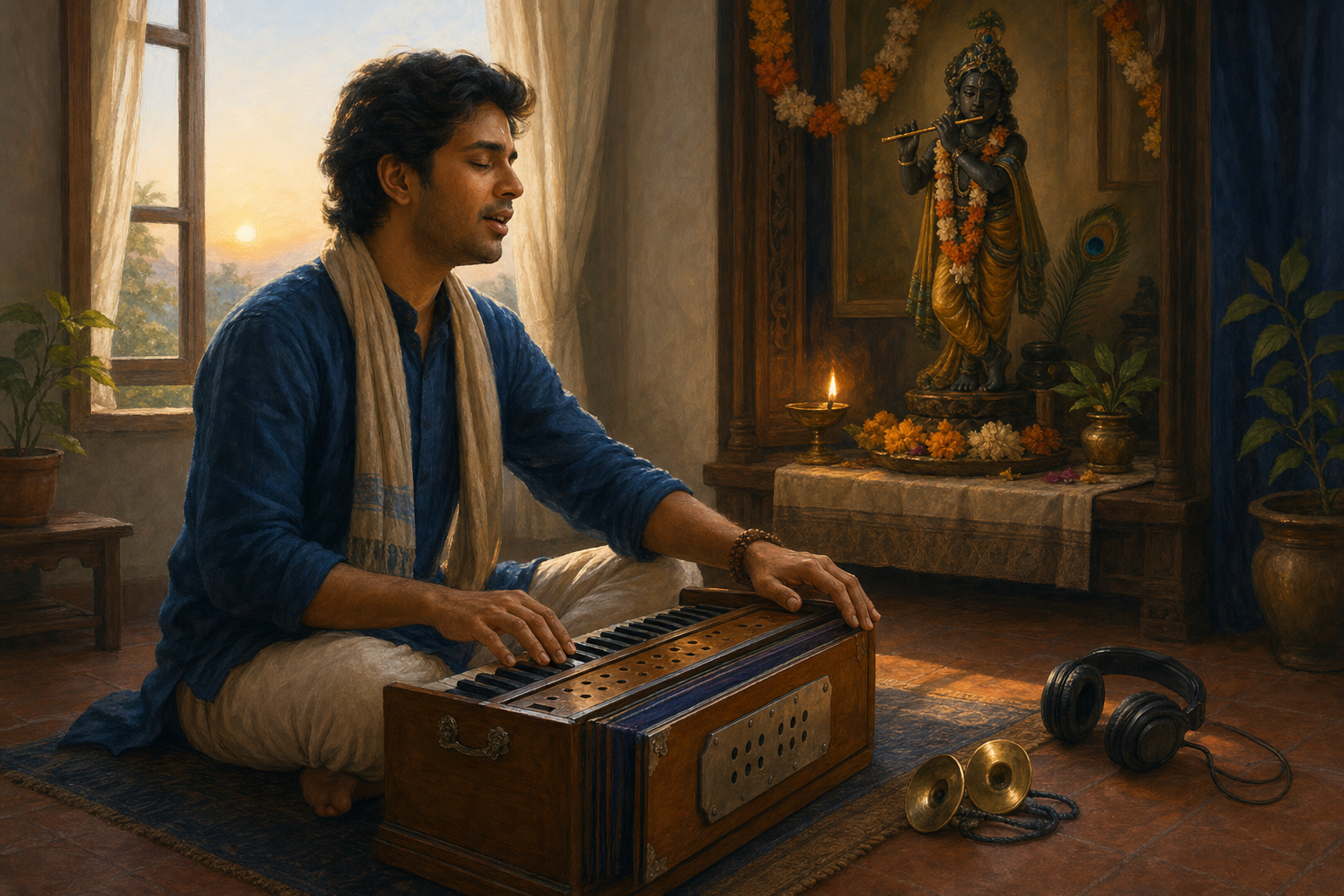
Maybe a song gave you Krishna’s name before a temple, teacher, or scripture did. You liked the melody, returned to the refrain, and now want to know whether that attraction can become something more than a playlist.
If that is where you are, don’t wait for a dramatic spiritual feeling. Treat the music as an invitation: learn what you are singing, give the words your own voice, follow the questions into the Bhagavad Gita, and notice whether remembrance of Krishna begins to shape your conduct.
The turn from beautiful sound to devotional attention

Music often reaches a person before philosophy does. You can be drawn to the meditative character of Ravi Shankar’s Indian classical music, notice a devotional current in George Harrison’s work, or hear the Hare Krishna mantra in public without knowing what tradition stands behind it. That beginning is not shallow. Beauty has already made you attentive.
The route can be remarkably ordinary. A name is heard imperfectly, curiosity prompts a search, and a correction opens an unexpected field of study. Even a misheard Crishne can become a search for Krishna, bhakti, and Hindu philosophy. You do not need perfect knowledge at the doorway. You need enough sincerity to keep asking what the sound means.
It helps to distinguish three layers. At the aesthetic layer, you enjoy the melody, voice, rhythm, or atmosphere. At the semantic layer, you learn which names are being sung and what the words are doing. At the devotional layer, you sing as an act of remembrance and address. The decisive movement toward bhakti occurs when Krishna is no longer merely the subject of the music but the focus of your attention.
Use three questions to locate yourself honestly:
- What word, name, or refrain keeps drawing me back?
- Do I know what I am singing, or am I responding only to the sound?
- When I sing Krishna’s name, am I willing to let that remembrance affect how I act afterward?
Write down your answers. If the second answer is no, your next step is translation and study. If the third answer is uncertain, continue without pretending. Bhakti deepens through honest attention, not manufactured emotion.
Build a practice that joins listening, chanting, and study
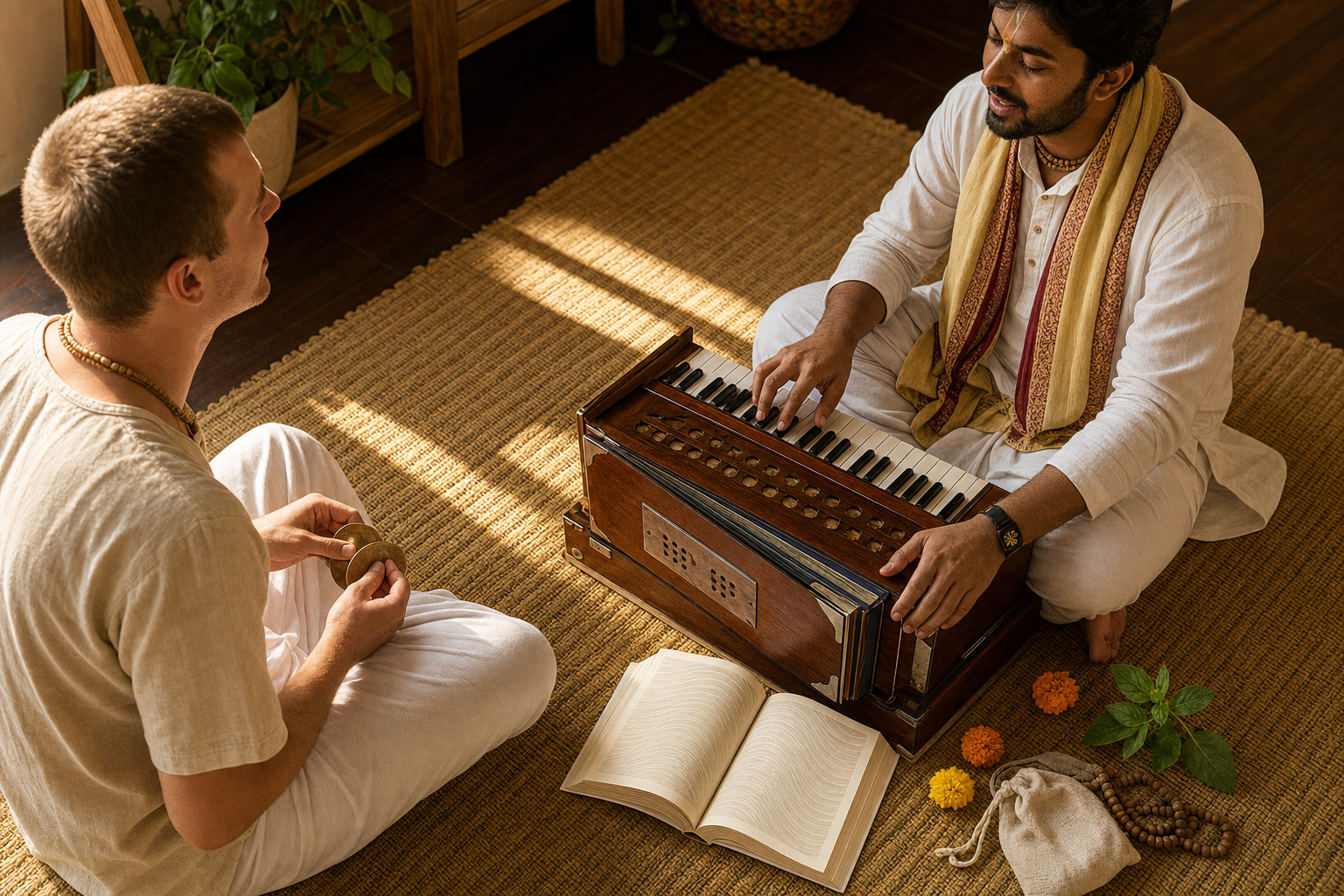
The easiest way to lose the opening is to keep collecting new devotional tracks. Novelty can produce a succession of moods without giving any name or teaching time to settle. Choose one musical doorway and stay with it until you can recognize its refrain, explain why it matters to you, and name the question it has raised.
- Choose an anchor recording. Select a Krishna-oriented chant or song whose words you can find. If Indian classical music first awakened your interest but the composition is not explicitly devotional, honor it as the bridge and then add a clearly Krishna-centered chant.
- Verify the words. Look for a dependable transliteration and meaning. Sanskrit and other Indian languages should not be reduced to decorative syllables. Pronunciation deserves care, but fear of an imperfect accent should not become a reason never to begin.
- Listen for the structure. Identify Krishna’s name, the recurring line, and any call-and-response pattern. This changes listening from exposure into recognition.
- Add your own voice. Sing softly if you are self-conscious. Musical skill is not the test. The useful question is whether you can give the name sustained attention without treating the recording as background noise.
- Attach the practice to a stable cue. You might chant after bathing, before beginning work, or as the final intentional act before sleep. Choose a point that already exists in your day so the practice does not depend on remembering a new schedule.
- Follow the music into the Bhagavad Gita. Read with a live question: What does devotion ask of action? How are self-knowledge and duty related to remembrance of Krishna? What would this teaching change in the situation directly in front of me?
- Return to the same music. Listen again after studying. A refrain that first carried only an attractive sound may now carry a name, a relationship, and an ethical demand.
Keep a small notebook beside the place where you listen. Use the headings words I learned, question I am carrying, teaching I examined, and action to practice. This prevents the familiar split in which music supplies emotion while scripture remains an unrelated intellectual exercise.
Choose the musical form that answers your real obstacle
Recorded music, bhajan, and kirtan can all help, but they solve different problems. Choose by the obstacle you face rather than by which form appears more advanced.
- Use a recording when you need privacy and close attention. You can pause, replay, compare the sound with the words, and learn without performing for anyone. The danger is passivity. Counter it by singing rather than letting the track run behind another activity.
- Use bhajan when lyrical reflection draws you inward. Follow the words and ask what image of Krishna, relationship, or devotional attitude the song expresses. If you cannot explain the basic meaning, pause interpretation and find a reliable translation.
- Use kirtan when isolation is the obstacle. Its participatory, often call-and-response form lets you learn by listening and answering. The danger is borrowing the energy of the group without developing personal attention. Afterward, repeat the refrain quietly and record the question that remains when the room is silent.
If you attend a Krishna-bhakti gathering, read the event description beforehand and note the mantra, language, and format if they are provided. During the singing, sit where you can hear the lead clearly. Ask about the meaning afterward. A healthy community should be able to connect music with teaching and practice, allow sincere questions, and avoid pressuring you to counterfeit certainty.
ISKCON may be one visible point of contact because the Hare Krishna movement has carried Krishna chanting into public life. Its visibility does not mean that a label can do your discernment for you. Look at the actual teaching, the quality of the community, and the effect of the practice on your attention and conduct.
You may also approach Krishna music while already formed by another Dharmic path. Hinduism, Buddhism, Jainism, and Sikhism have recognizable resonances in compassion, inner discipline, and truth-seeking, but respect does not require pretending that their teachings or devotional centers are identical. Let the music lead you toward accurate understanding. Unity becomes stronger when difference is neither weaponized nor erased.
Judge the practice by what survives after the music stops
Tears, calm, exhilaration, and a sense of belonging can accompany devotional music. None of them is a dependable scoreboard by itself. A powerful musical response may fade quickly, while a quiet practice may gradually reorganize your attention.
Look for changes you can actually observe:
- Attention: Krishna’s name is becoming something you remember deliberately, not merely a refrain that repeats involuntarily.
- Understanding: Your questions are becoming more precise. You are moving from wondering what the sound is to asking what devotion, action, self-knowledge, and relationship with Krishna require.
- Continuity: You return to the practice without needing a new recording, a large gathering, or a heightened mood every time.
- Conduct: Chanting is pressing on your habits. You notice where truthfulness, compassion, restraint, responsibility, or humility is absent and choose a concrete correction.
- Discernment: You can appreciate a musician without treating fame as spiritual authority, and you can value a community without surrendering your responsibility to ask questions.
After chanting, choose one ordinary action that will carry the remembrance forward: speak truthfully in a conversation you were tempted to manipulate, complete a neglected duty without resentment, restrain a contemptuous response, or give another person your undivided attention. The action need not look religious. Its purpose is to keep devotion from being confined to the duration of a song.
Be equally honest about stagnation. If you endlessly change playlists, never learn the words, avoid every text, and treat communal intensity as proof of realization, music is functioning as spiritual atmosphere rather than a gateway. The remedy is not to reject music. It is to reconnect sound with meaning, remembrance, inquiry, and conduct.
Key takeaways
- Musical attraction is a valid beginning, but Krishna bhakti starts to take shape when sound becomes attentive remembrance and address.
- Stay with one Krishna-centered chant long enough to learn its words, recognize its structure, and identify the question it raises.
- Join chanting to Bhagavad Gita study so emotion, understanding, and ethical action do not drift apart.
- Use recorded music for focused learning, bhajan for lyrical reflection, and kirtan for participatory practice and community.
- Measure progress by attention, understanding, continuity, conduct, and discernment rather than by emotional intensity.
At your next listening, place the words in front of you, sing the refrain with attention, write down the honest question it raises, and carry that question into the Bhagavad Gita. Music has opened the door. Your willing attention is what turns the doorway into a path.
References
