

You may be preparing a kirtan, opening a local study circle, welcoming someone to a temple, or speaking about Krishna online. The difficult question is not simply how to reach more people. It is how to welcome them without diluting bhakti, pressuring them, or confusing compassion with the absence of boundaries.
Gaudiya Vaishnava history offers a practical answer. Begin with mercy, give people an accessible encounter with devotional life, ask for freely chosen commitment, and support that commitment through practice, mentorship, and service. That pattern can cross cultures because it neither abandons the person nor hides the tradition.
Mercy sees the person and still names the harm

Compassion begins by refusing to reduce a human being to the worst thing he or she has done. It does not require pretending that harmful conduct is harmless. Gaudiya outreach loses moral credibility when it offers belonging without responsibility, just as it loses its devotional heart when it treats a struggling person as permanently impure or unwanted.
The Navadvipa account of Jagai and Madhai makes this distinction unusually clear. The brothers had become notorious for intoxication, violence, harassment, and theft. Their background did not excuse their conduct, but their conduct did not place them beyond grace. Acceptance became meaningful when it was joined to a sincere resolve to leave harmful behavior, accept disciplined guidance, and begin a different life.
This gives you a sequence for difficult outreach situations:
- Protect people first. Stop ongoing intimidation, violence, or abuse. A welcoming space must also be safe for the quiet person who may never complain publicly.
- Address the person without turning the behavior into an identity. Say what must stop in plain language, but do not tell someone that a past failure defines what he or she can become.
- Ask for a concrete commitment. A vague desire to be spiritual is not the same as a decision to abandon a harmful pattern. The needed commitment should match the actual problem.
- Connect commitment to guidance. Introduce regular devotional practice and a qualified mentor who can explain expectations, notice difficulties, and correct without humiliation.
- Let trust grow through conduct. A powerful conversion moment may open the door, but responsibility should follow sustained honesty, restraint, and service.
If someone is actively violent, severely intoxicated, or in a crisis, do not treat a spiritual conversation as the only intervention required. Protect those at risk and involve appropriate emergency, addiction, or mental-health support. Devotional companionship can accompany professional care; it should not be presented as a substitute for it.
Mercy and accountability therefore perform different tasks. Mercy tells the person, “You are not beyond return.” Accountability tells the person, “Returning will change how you live.” Compassionate outreach needs both sentences.
Give newcomers a doorway they can actually enter

A newcomer should not have to understand an entire theology before encountering devotional life. At the same time, an enjoyable event with no intelligible next step rarely becomes a spiritual path. The first meeting must be simple enough to enter and substantial enough to lead somewhere.
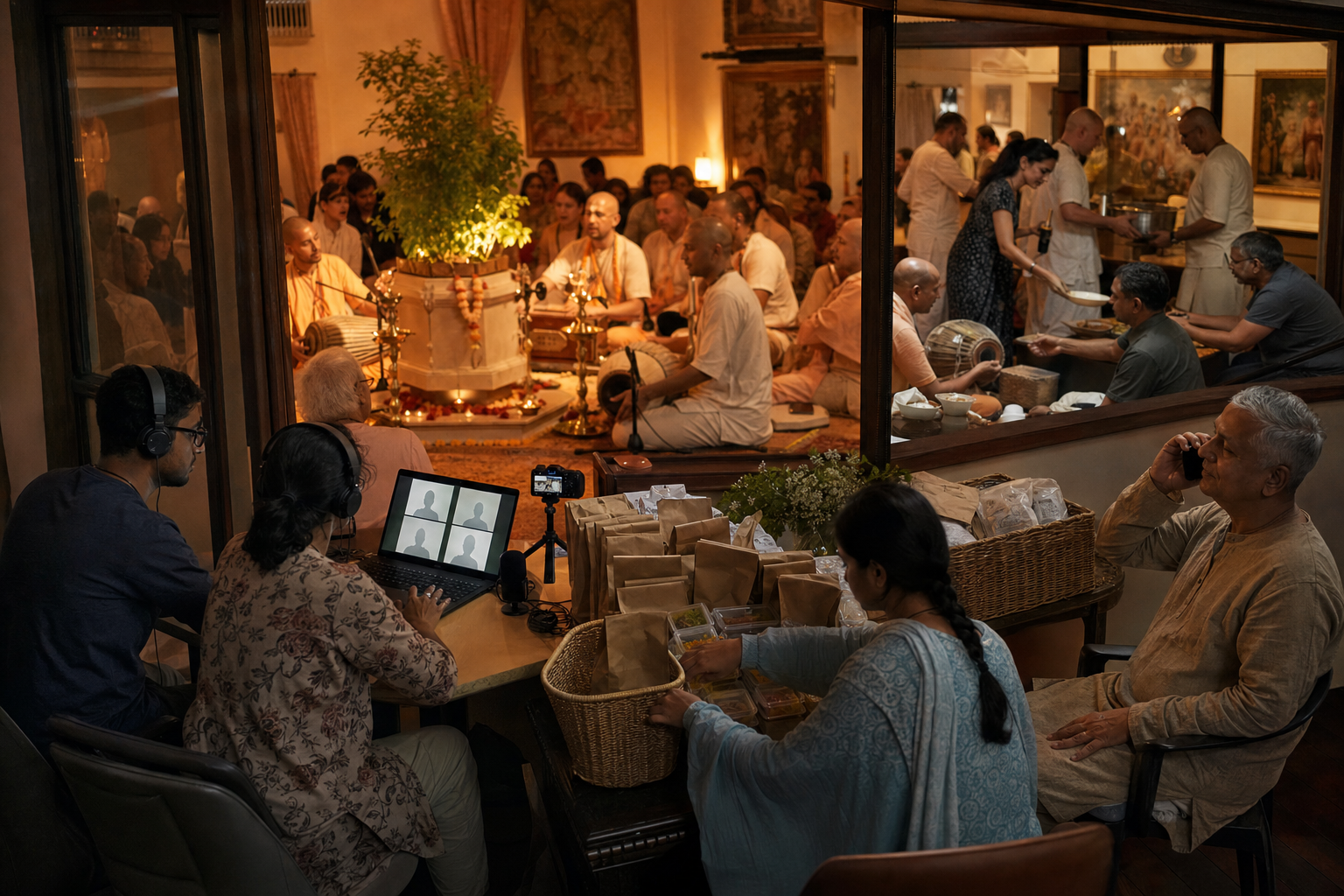
Srila Prabhupada made three public-facing practices especially effective in plural, urban settings: kirtan, prasadam, and scriptural study. Each meets a different part of the newcomer’s situation.
- Kirtan permits participation before mastery. A person can hear and respond without first passing a test of vocabulary, caste, ethnicity, or prior religious education. Explain that the chanting is devotional remembrance of Krishna; do not leave people guessing whether it is entertainment, meditation, or worship.
- Prasadam makes hospitality tangible. Food offered to Krishna and shared with care communicates that the guest is not merely an audience member. Give a brief explanation, make ingredients clear where needed, and never use the meal to pressure someone into assent.
- Scriptural study respects intelligence. People need a place to ask what the practice means, what it asks of them, and why Gaudiya Vaishnavas understand Krishna as they do. A study circle should welcome sincere questions without concealing the tradition’s convictions.
Together, these practices engage experience, relationship, and understanding. If your outreach uses only one of them, notice what is missing. Kirtan without explanation can be mistaken for a performance. A meal without devotional context can become ordinary hospitality. Study without shared practice can remain an intellectual club.
Build the first encounter in this order:
- Make the invitation legible. State what will happen, whether participation is optional, and whether someone may simply observe.
- Let the practice be visible. Do not bury kirtan or prayer beneath a long institutional presentation.
- Explain one thing well. A clear account of the maha-mantra, prasadam, or bhakti is more useful than a rapid tour of every doctrine.
- Create room for questions. Give people a way to ask privately as well as publicly; not everyone will voice uncertainty before a group.
- Offer one real next step. Name the next kirtan, study meeting, service opportunity, or mentor contact. Do not hand newcomers a maze of unrelated options.
- Follow up without pressure. Invite, answer, and remain available. A freely chosen commitment is spiritually different from compliance produced by social force.
The aim is not to make the first contact impressive. It is to make the path understandable.
Translate the doorway without moving the spiritual centre

Global outreach requires translation, but not everything is equally open to adaptation. Language, venue, media, and organizational form are means. Krishna-centred devotion, ethical discipline, accurate teaching, and voluntary participation belong to the substance of the mission.
| Outreach decision | What may adapt | What must remain clear |
|---|---|---|
| Language | Local vocabulary, examples, and level of explanation | The Krishna-centred meaning of the practice |
| Setting | Temple, home, street, campus, community venue, or digital space | Respectful conduct, safety, and the devotional purpose |
| Media | Print, audio, video, livestream, or short-form communication | Accuracy, sufficient context, and responsible representation |
| Participation | Different entry points for observers, guests, and practitioners | Free assent rather than coercion or social manipulation |
| Leadership | Locally appropriate roles and methods of coordination | Qualified guidance, ethical accountability, and fidelity to teaching |
This distinction protects outreach from two opposite errors. One is treating every inherited social habit as if it were an indispensable part of Gaudiya theology. That can make local culture an unnecessary barrier to Krishna bhakti. The other is removing every distinctive claim until bhakti becomes generic inspiration. That may make a program easier to market, but it leaves the seeker unable to know what path is actually being offered.
Shared dharmic values can help you communicate without flattening real differences. Hindu bhakti, Buddhist karuna, Jain ahimsa and self-restraint, and Sikh seva and moral courage provide recognizable ethical bridges. Use those bridges to establish respect and cooperation. Then state the Gaudiya position honestly rather than claiming that every tradition teaches the same doctrine.
In practice, this means you can say, “We share a concern for compassion, disciplined life, and service,” before explaining the specific place of Krishna, nama-kirtan, guru, and devotional surrender. The shared value opens conversation; it does not erase identity.
Before adapting any program for a new audience, ask two questions. First, what is merely unfamiliar and therefore needs explanation? Second, what would become inaccurate if changed? The first calls for patient translation. The second calls for a clear boundary.
Turn welcome into service, and service into responsible leadership
Global movements are not built by one teacher doing every task. They grow when newcomers become practitioners, practitioners learn to serve, and trustworthy servants receive responsibility with guidance.
Srila Prabhupada crossed into an unfamiliar society at the age of seventy, without financial backing, established contacts, or prior familiarity with the West. His work expanded through public devotional practice, temples, farm communities, publishing, and disciples entrusted with genuine duties. The important organizational lesson is not merely that he delegated. He paired a clear spiritual centre with the willingness to let others act.
You can apply that principle through a simple progression:
- Begin with an observable service. Let a newcomer assist alongside someone experienced rather than assigning a vague role with hidden expectations.
- Move to a repeatable responsibility. A person who returns should know what dependable completion looks like and whom to ask when uncertain.
- Offer bounded ownership. Give a developing volunteer a real project, but define its purpose, limits, resources, and review point.
- Add mentorship before authority becomes isolating. Responsibility without access to correction can turn confidence into improvisation and mistakes into defensiveness.
- Reserve teaching and pastoral roles for qualified people. Enthusiasm, popularity, and technical skill do not by themselves establish theological understanding or the judgment needed to guide vulnerable people.
Delegation is not abandonment. Every important role should have a named mentor, a clear remit, a point at which decisions are reviewed, and a safe route for raising ethical concerns. This protects both the volunteer and the community.
Evaluate outreach by its fruit, not only by its visibility. Notice whether guests return without being chased, whether kirtan and study continue after a major event, whether volunteers become more dependable, whether food and resources are handled responsibly, and whether honesty, non-harm, restraint, and service become more visible in community life. Attendance can show reach; it cannot by itself show transformation.
This is also where compassion becomes durable. A person is no longer merely welcomed into a room. He or she is helped to practice, contribute, accept correction, and care for someone else.
Let technology extend seva rather than define success
Tradition does not require fear of useful tools. Srila Prabhupada’s confident use of a Dictaphone without needing the offered instruction manual captures a larger attitude: learn what serves the mission, use it with purpose, and do not confuse unfamiliarity with spiritual depth.
The lesson is not that every new platform deserves adoption. A recorder can preserve teaching; a livestream can reach someone far from a temple; digital publishing can carry study material across borders. The same tools can also reward haste, remove statements from context, expose people who did not consent to be recorded, and make public attention look like spiritual progress.
Use this filter before adding a tool or platform:
- Name the seva. What devotional or educational need will this tool meet?
- Name the audience. Who will be able to hear, participate, study, or receive care who cannot do so now?
- Protect fidelity. Can the teaching retain enough context to remain accurate in this format?
- Protect people. Establish consent for recording and photography, moderation standards, and care for personal information before publishing.
- Assign stewardship. Decide who answers questions, corrects errors, maintains archives, and deals with misuse.
- Check continuity. If a platform changes or disappears, can the community retain its recordings, contacts, and educational material?
A tool has earned its place when it helps a real person move from first contact toward sound understanding, devotional practice, trustworthy relationship, or service. If it mainly increases output while weakening attention to people, it is consuming the mission rather than supporting it.
Key takeaways for your next outreach
- Welcome the person, stop harmful behavior, and make reform concrete.
- Use kirtan, prasadam, and study as connected doorways rather than isolated attractions.
- Adapt language, setting, and media while keeping Krishna-centred meaning explicit.
- Use shared dharmic values to build respect without claiming that distinct traditions are identical.
- Give real responsibility gradually, with a defined role, qualified mentorship, and ethical review.
- Choose technology by the seva it enables, not by the attention it promises.
At your next planning meeting, begin with one person rather than a reach target. Ask what that person will experience, understand, be free to choose, and be invited to do next. Then build the event, community role, or digital channel around that path. Global outreach becomes credible one dignified, truthful, well-supported encounter at a time.
References
- Dandavats – Lord Caitanya’s Radical Compassion: Redeeming Jagai-Madhai and Uniting Dharmic Hearts
- Dandavats – Srila Prabhupada’s Daring Voyage and Enduring Legacy: How One Sage Ignited Global Bhakti
- Dandavats – When Srila Prabhupada Mastered a Dictaphone: Shattering Assumptions About Tradition and Tech
