
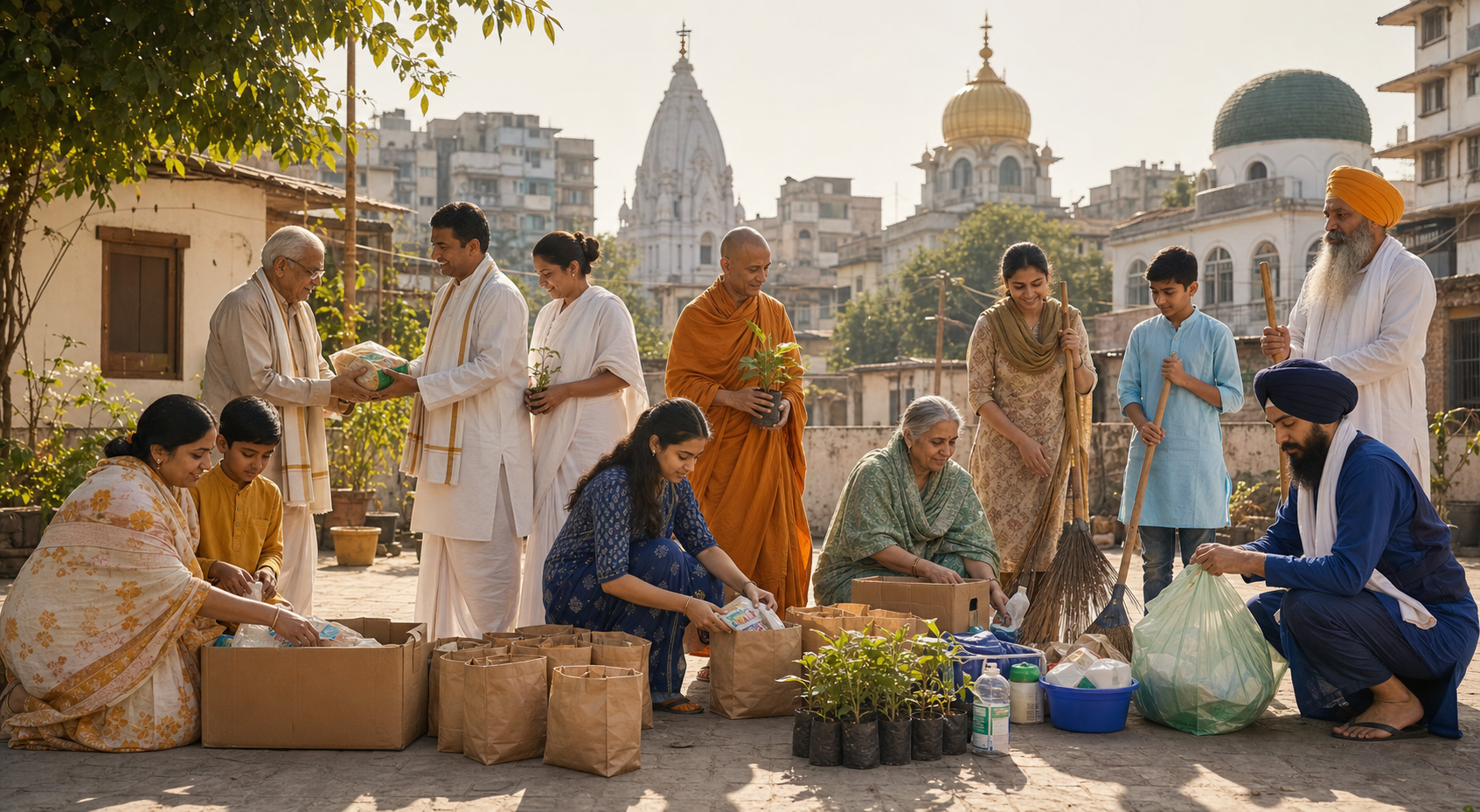
You are helping to plan a temple celebration, an inter-Dharmic forum, a neighbourhood service project, or a civic campaign. Everyone supports unity in principle. Then the first dispute arrives: whose symbols appear, who speaks, which language is used, whether politicians are invited, or what the gathering is supposed to achieve.
Your goal is not to manufacture agreement on theology. It is to protect distinct convictions while building enough trust for people to serve the same neighbourhood and uphold the same civic order. That requires pluralism with a spine: difference is protected, common duties are enforced, and cooperation produces something more substantial than a photograph.
Pluralism needs a civic floor, not a common creed

Dharmic pluralism does not mean that Hinduism, Buddhism, Jainism, and Sikhism are interchangeable. Each has its own teachings, disciplines, communities, sacred language, and understanding of liberation. Even within each tradition, different schools may disagree strongly. Unity becomes credible when it makes room for those differences instead of translating them into a vague spirituality acceptable to everyone and meaningful to no one.
The traditions nevertheless offer resources for living with difference: the Hindu recognition that seekers may approach truth through different chosen forms and disciplines; Buddhist compassion and skillful means; Jain anekantavada, or attention to the many-sidedness of truth; and the Sikh emphasis on humility and seva. These are not identical doctrines. They are distinct paths that can support a shared discipline of fair judgment.
That shared discipline needs a minimum civic floor. Truthfulness, non-violence, responsibility, justice, compassion, service, and accountability can guide public cooperation without becoming a new creed. In this sense, Dharma functions as an ethical compass for public life, not as a demand that every participant adopt the same worship or metaphysics.
- Conviction: You may state and practise your own tradition without pretending that all teachings are the same.
- Conscience: No participant should be required to perform another tradition’s observance or deny a sincere belief as the price of civic cooperation.
- Conduct: Disagreement does not justify intimidation, humiliation, collective blame, or violence.
- Reciprocity: A public rule should remain acceptable when another community administers it.
- Accountability: Leaders, organisers, donors, and public representatives must answer for their decisions under standards visible to everyone.
- Service: A unity initiative should create a benefit beyond the participating organisations themselves.
Use three questions when a proposed rule or event feels unfair. Would you accept the same rule if another community applied it? Does participation require anyone to conceal or renounce an identity? Can a dissenter see how the decision was made and how to challenge it? A proposal that fails any of these tests needs revision before it is presented as unity.
The civic floor must also protect neighbours outside the Dharmic family. If fairness ends at the boundary of a favoured identity, you have built a coalition, not a civic ethic. Dharmic confidence is strongest when it can defend its own inheritance and extend consistent justice to others.
Judge people by their ideals, then examine their conduct
One of the most useful disciplines for plural life comes from Swami Vivekananda’s counsel against measuring every person by our preferred path:
“Everyone must be judged according to his own ideal, and not by that of anyone else.”
Swami Vivekananda, The Complete Works of Swami Vivekananda, 2.104-06
This does not mean that every belief or action is equally sound. It means that fair judgment begins by understanding the standard a person claims to follow. Only then can you ask whether the person’s conduct is faithful to that standard and compatible with shared civic duties.
A Jain organiser may frame a decision through ahimsa. A Sikh volunteer may emphasise seva. A Buddhist facilitator may begin with compassion and skillful means. A Hindu association may act through the teachings of a particular sampradaya or ishta. You do not have to adopt any of those commitments to understand the reasoning. Understanding the standard improves the accuracy of your judgment; it does not predetermine the verdict.
- Ask for the governing ideal. Let the person or group explain what principle it believes should guide the matter.
- Restate it without caricature. Before responding, describe the position in language its holder recognises as fair.
- Translate it into observable commitments. Ask what the ideal requires in this decision, not merely what it means in the abstract.
- Compare conduct with commitment. Look for consistency between the declared value, the proposed action, and the treatment of people who disagree.
- Apply the common civic floor. Sincerity cannot excuse coercion, dishonesty, violence, or exemption from a rule applied to others.
- Make the criticism precise. Name the broken promise, unequal rule, or harmful action rather than assigning a hostile motive to an entire community.
Take stated ideals seriously, but not naively. A repeated gap between a leader’s declared principle and actual conduct is relevant evidence. The disciplined response is to document that gap, ask for correction, and judge the behaviour. Speculating about an entire tradition’s hidden motives usually produces heat while weakening accountability.
Change the language of conflict accordingly. Replace “your people do not care about unity” with “we agreed that every group would receive the agenda before the meeting, and that did not happen.” The second statement identifies a repairable failure. It also leaves room for an apology, a procedural correction, or a clear finding that trust has been breached.
Turn shared values into a working civic method

The first real test of unity often comes when participants must allocate voice, money, credit, stage time, or ritual visibility. A declaration of harmony will not settle those questions. A written process might.
Before sending invitations, prepare a short civic compact for the project. It should be plain enough for every participant to explain and specific enough for an organiser to enforce.
- State the public outcome in one sentence. Name the neighbourhood problem, educational purpose, cultural observance, or service result that justifies the gathering.
- Separate non-negotiable principles from flexible methods. A community may be unable to join a ritual while remaining willing to provide volunteers, food, transport, teaching, or medical logistics.
- Publish the decision process. Identify who proposes, who advises, who decides, and how objections enter the record.
- Require an accurate restatement of disagreement. A proposal should not move forward until each side can describe the other’s concern without mockery or distortion.
- Run the reciprocity test. Apply the proposed rule to every participating group, especially the group with the most influence.
- Assign responsibility. Give each commitment an owner, a deliverable, and a point at which the group will review what happened.
When discussion stalls, identify what kind of dispute you are facing. Different conflicts require different remedies.
| Type of dispute | Useful response |
|---|---|
| Doctrine or principle | State the boundary clearly and design coexistence without demanding theological agreement. |
| Symbol or representation | Use agreed criteria, rotation, or separate spaces rather than an improvised contest for visibility. |
| Money or material resources | Publish the budget, approval path, donor conditions, and conflicts of interest. |
| Facts or allegations | Verify the claim before debate and correct the common record when evidence changes. |
| Personal distrust | Use direct conversation or a mutually accepted mediator; another public speech will rarely solve it. |
Language matters here. Keep separate what a tradition asks of its adherents and what a civic institution imposes on everyone. A community can teach a demanding discipline internally while supporting a public arrangement that protects the conscience of people who do not follow it.
Do not force every decision into a false consensus. Record one of three outcomes: agreement, accommodation, or principled dissent. Agreement means the parties endorse the decision. Accommodation means they can cooperate without endorsing every premise. Principled dissent means they cannot participate in that part of the project but will continue to observe the civic floor. This vocabulary keeps cooperation from being misrepresented as theological assent.
Make service and public conduct prove the claim

Use seva to produce a real public benefit
Joint seva works as a bridge only when the work is independently worth doing. People in need must not become props for an image of harmony. Begin with a need recognised by the affected community, then build the partnership around competent delivery.
- Define the need before assigning ceremonial roles or organisational credit.
- Let each group contribute according to its capacity and conscience.
- Do not make religious conformity a condition for giving or receiving help.
- Keep funds, donated goods, responsibilities, and decision rights visible to all partners.
- Share public credit and obtain consent before using beneficiaries in publicity.
- After the work, review both the service result and the quality of cooperation.
Service does not eliminate doctrinal or political disagreement. It does something more useful: it shows whether people who disagree can keep commitments, distribute burdens fairly, and place a public need ahead of organisational prestige.
Keep cultural gatherings open without surrendering their character
Cultural expression can create civic space across political divisions. In Kittur, Belagavi district, Congress and BJP leaders shared the Hindu Samajotsava platform on 9 February 2026. The moment offered a useful but limited illustration: a cultural setting can open room for shared presence even when political competition continues. One gathering, however, cannot establish durable cooperation on its own.
If you invite political leaders to a cultural event, decide the guardrails before deciding the names. Will every speaker accept the same limits on adversarial rhetoric? Will the organisers retain control of the programme? Is the civic or service purpose clear? Can different parties attend without claiming ownership of the community’s sacred identity? If those questions have no firm answer, the event is vulnerable to partisan capture.
Inclusiveness does not require stripping a Hindu, Buddhist, Jain, or Sikh gathering of its own character. It requires clarity about the character of the event, voluntary participation, respectful treatment of guests, and conduct consistent with law and non-violence. Cultural confidence and civic courtesy can reinforce each other when neither is used as camouflage for domination.
Translate Ramrajya into questions of governance
When Ramrajya is invoked in public life, its most constructive civic use is as a test of governance, not a demand for theological uniformity. The ideal can be translated into justice, compassion, transparent institutions, responsible leadership, and the rule of law.
- Was the decision made through a process people could understand?
- Was the same rule applied to allies, opponents, majorities, and minorities?
- Did leaders disclose interests that could distort their judgment?
- Could a person harmed by the decision seek review or correction?
- Did compassion shape implementation without cancelling accountability?
- Did the result protect cultural inheritance while maintaining public trust?
If an invocation of Ramrajya cannot survive these questions, it is functioning as a slogan rather than an ethical standard. If it can survive them, it gives citizens a demanding way to assess power without requiring them to share every theological premise.
Stop and reset a unity project when difference is treated as disloyalty, one group is asked to hide its identity, consensus is staged after decisions have already been made, service recipients are used for publicity, party branding overwhelms the civic purpose, or prominent leaders exempt themselves from rules imposed on volunteers. These are not minor presentation problems. They show that the project’s public language and actual incentives have separated.
Key takeaways
- Dharmic pluralism protects distinct traditions; it does not blend them into a common theology.
- Civic unity needs a shared floor of truthfulness, non-violence, reciprocity, service, justice, and accountability.
- Judge a person first through the ideal that person claims, then test conduct against that ideal and the common civic floor.
- Write decision rules before disputes over representation, resources, ritual, or political participation arise.
- Use agreement, accommodation, and principled dissent as separate outcomes; cooperation does not require theological endorsement.
- Test every claim of unity through actual service, consistent public rules, transparent leadership, and a fair path for correction.
At your next meeting, do not begin with another speech about unity. Put five entries on one page for every participating group: our guiding ideal, our duty to everyone present, our non-negotiable boundary, our practical contribution, and the standard by which others may hold us accountable.
Turn those answers into a public plan, use them through the first disagreement, and review them after the first shared act of service. That is where civic unity becomes more than sentiment: not when differences disappear, but when people can carry them honestly while keeping common duties.
References
- Hindu Jagruti Samiti – Awaken Dharma Shakti for National Renewal: Ramesh Shinde urges an inclusive Ramrajya
- Struggle for Hindu Existence – Congress and BJP Unite at Kittur Hindu Samajotsava: A Rare Boost for Belagavi, Hindu Unity
- Hindu Blog – Judge by Their Ideals: Swami Vivekananda’s Transformative Call to Empathy and Dharmic Unity
