
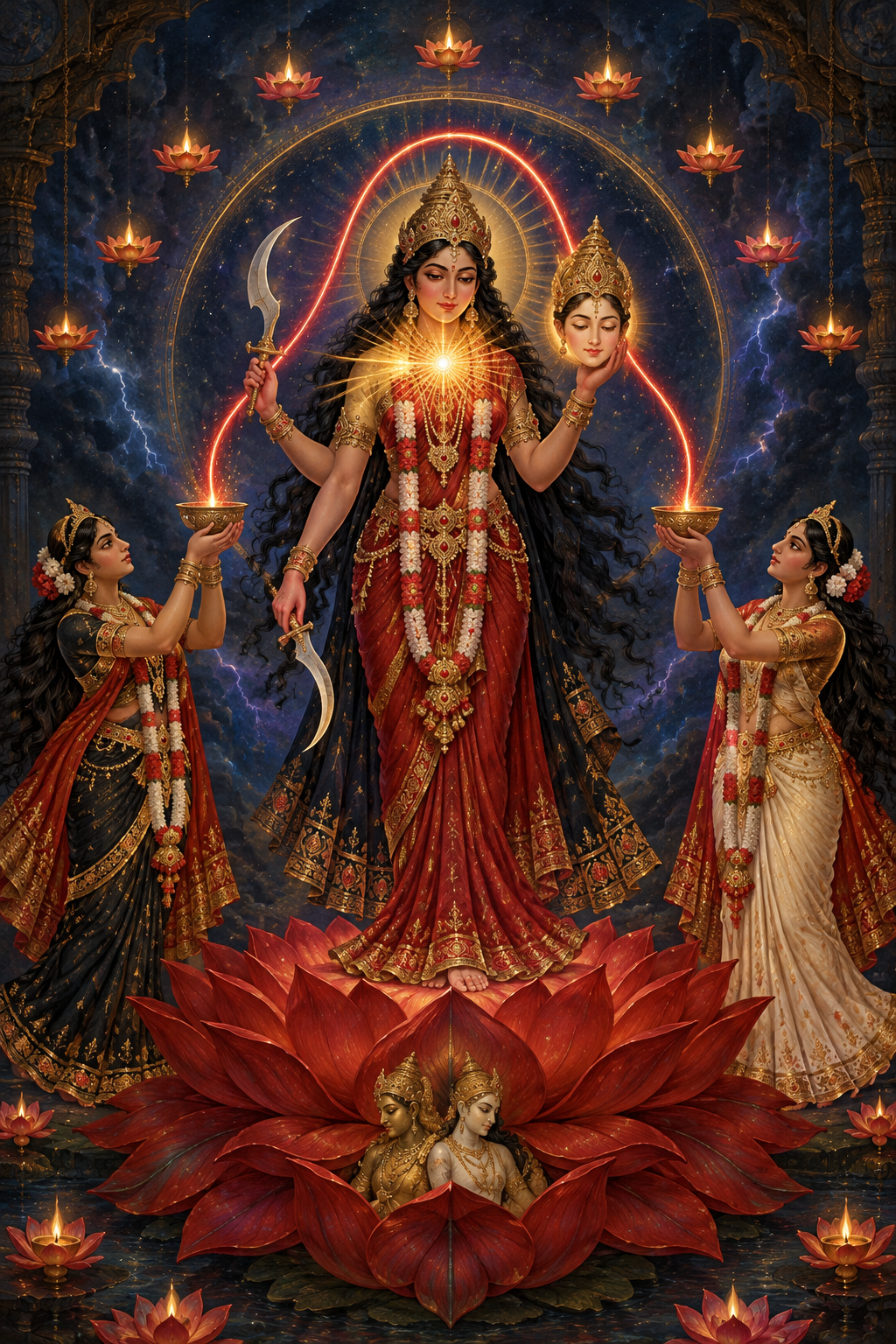
If Chinnamasta’s severed head unsettles you, don’t rush to dismiss the image as grotesque or force it into a simple contest between good and evil. Her form is meant to interrupt ordinary habits of seeing. The better question is: what can such a fierce form of Devi reveal that a gentler image cannot?
You can explore that question without trivialising Chinnamasta, treating Tantra as spectacle, or pretending to possess an initiation you haven’t received. The right starting point is her place within the Dasha Mahavidyas, followed by a disciplined distinction between contemplation and formal sadhana.
Begin with who Chinnamasta is, not how shocking she looks
Chinnamasta is one of the Mahavidyas and a fierce form of Parvati Devi. That identity matters. She is not an alien power standing outside the sacred order, and her fearsome appearance does not make her an embodiment of evil. She belongs to the reality of the Divine Mother.
Her familiar iconography presents a self-decapitated goddess. Read only as a literal scene, it appears to glorify violence. Read as sacred iconography, it confronts you with the limits of bodily identity, habitual desire, fear of death, and the ego’s demand to remain in control. These are possible contemplative openings, not a claim that every lineage gives every feature exactly the same interpretation.
Three disciplines keep the encounter grounded:
- Do not literalise the image. A sacred depiction of self-decapitation is not an instruction to injure yourself or anyone else.
- Do not sanitise the image. Replacing its fierceness with vague language about positivity removes the very challenge Chinnamasta places before the seeker.
- Do not reduce Devi to psychology. Self-reflection can help you receive the image, but for a devotee Chinnamasta is a form of the Divine Mother, not merely a symbol invented by the individual mind.
Hold those three points together. They let you acknowledge the icon’s force while remaining within a Dharmic understanding of sacred form.
The Dasha Mahavidya framework changes what you see
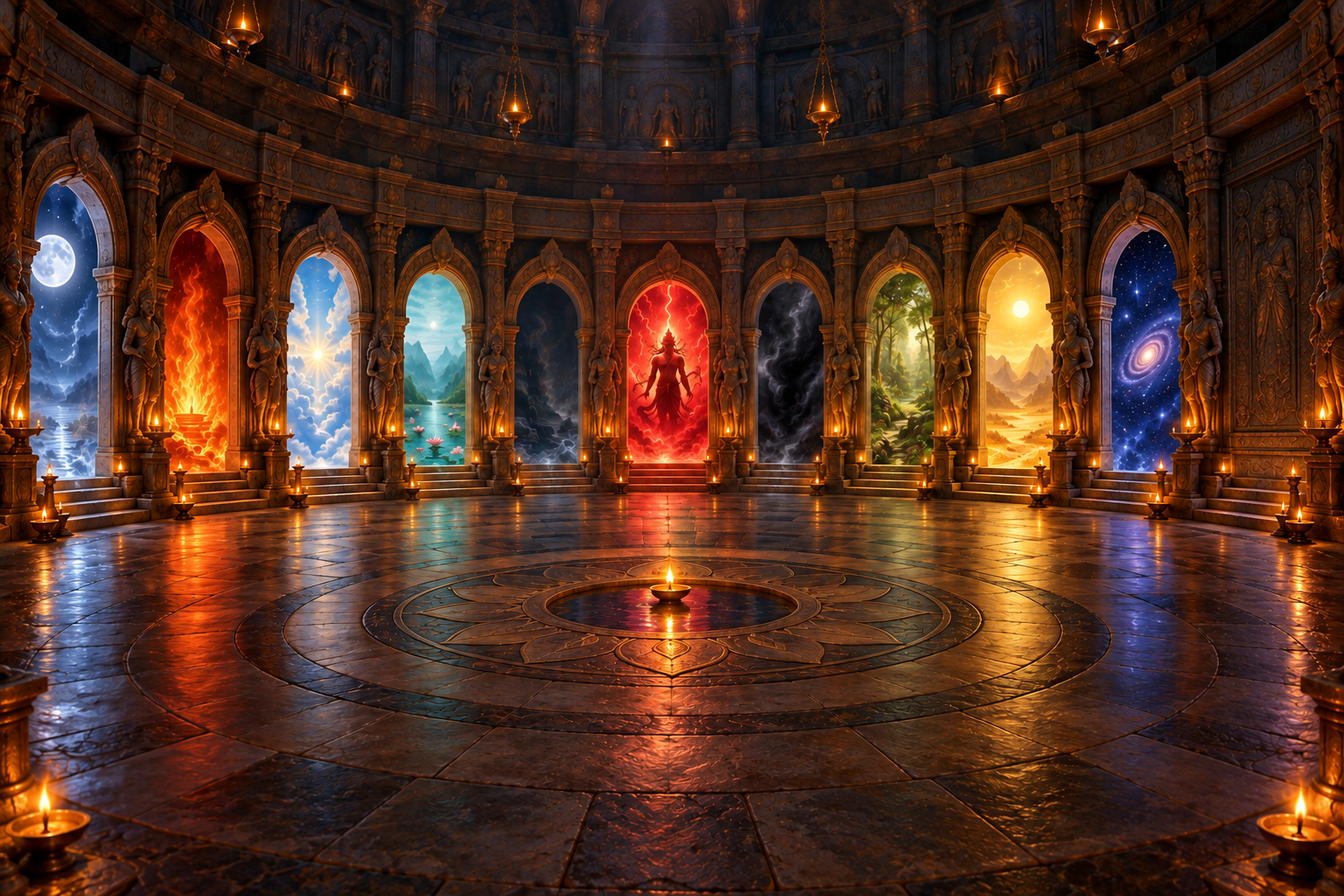
The Dasha Mahavidyas are understood as ten cosmic personalities of the Divine Mother, and they are worshipped during Navratri. The number ten gives you a map, but the word vidya supplies the purpose: these forms concern transformative knowledge, not curiosity about unusual deities.
That context prevents two common mistakes. The first is isolating Chinnamasta from Devi and interpreting her through categories foreign to her tradition. The second is treating the Mahavidyas like a personality test in which you select whichever goddess matches your temperament. A Mahavidya may confront precisely what your temperament avoids.
Intellectual study remains valuable, but it does not exhaust this kind of knowledge. What you can organise through concepts is limited; silence opens another mode of understanding. This does not mean abandoning reason. It means allowing reason to recognise its boundary.
When you next look at an image of Chinnamasta, separate observation from interpretation. First name only what the icon shows. Then notice what arose in you: fear, fascination, disgust, reverence, resistance, or confusion. Sit quietly before deciding what the reaction means. That pause is more honest than grabbing the first dramatic explanation you find online.
Chinnamasta holds restraint and vitality together
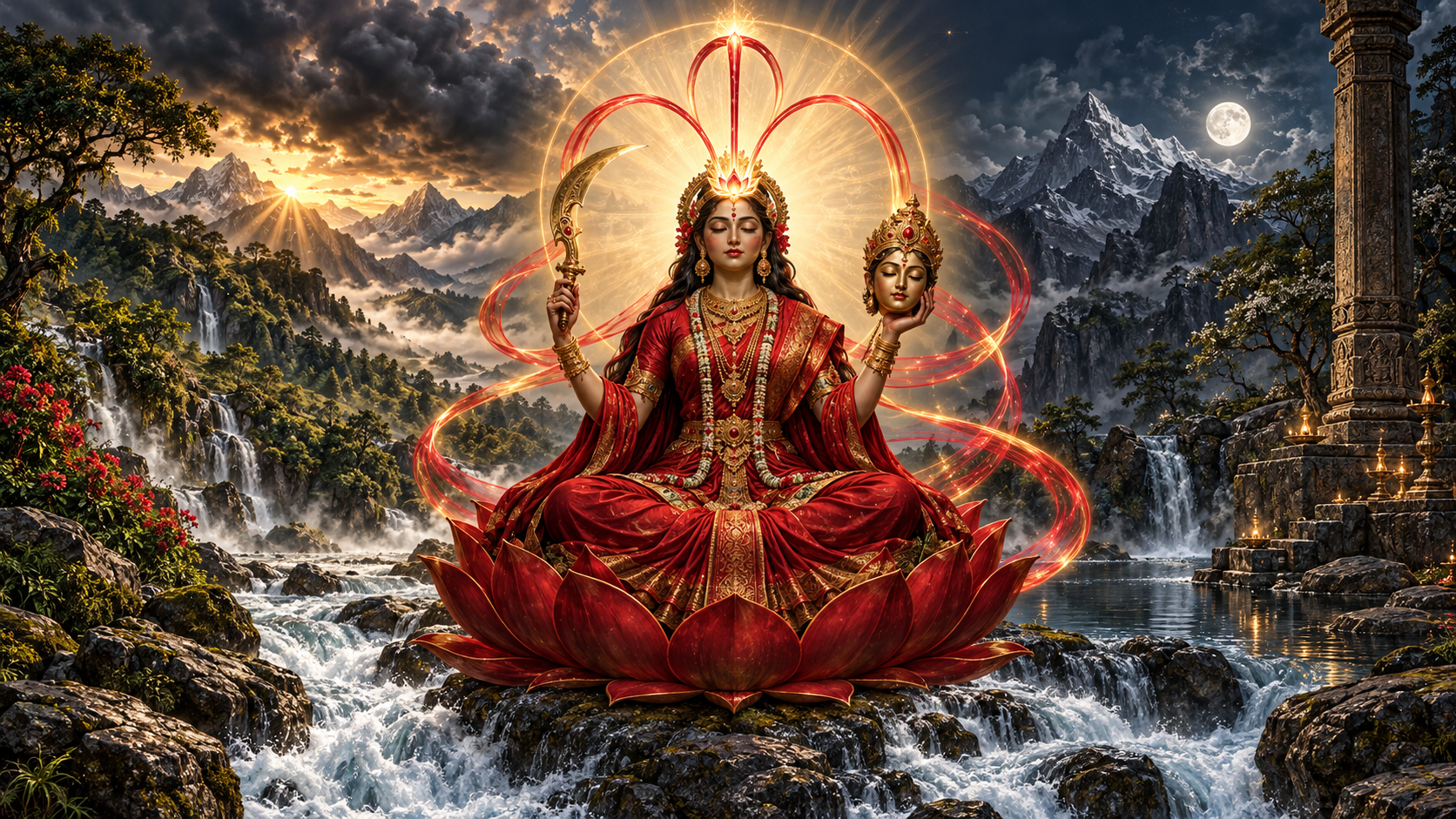
Chinnamasta becomes easier to misunderstand when purity, sexuality, marriage, and liberation are treated as mutually hostile subjects. Her devotional significance places them in a more demanding relationship.
Purity is not disgust toward embodied life
Chinnamasta is associated with purity and sexual self-control. Self-control is not the same as shame, fear of the body, or hostility toward marriage. It means that desire does not automatically command action. You notice the force of an impulse and take responsibility for where it goes.
For a householder, this distinction is practical. Restraint need not mean rejecting married life. It can mean fidelity, freedom from compulsive consumption, refusal to manipulate another person, and the ability to place affection above appetite. The test is not whether desire exists. The test is whether it serves dharma or rules you.
Vitality is directed, not denied
Devotional understanding also associates Chinnamasta with greater energy in married life and blessings for good children. These are blessings affirmed within faith, not outcomes that anyone can guarantee through a technique.
The pairing is significant: self-control on one side, vitality and family life on the other. The lesson is not simple suppression. Power becomes fruitful when it is governed. Without restraint, energy scatters into compulsion. Without vitality, restraint can harden into fear or lifeless moralism. Chinnamasta holds both demands before the seeker at once.
Death is faced in the light of liberation
Chinnamasta is further connected with self-realisation and immortality beyond death. These are spiritual claims about liberation, not promises of physical invulnerability. Confusing the two would turn a teaching about transcendence into a dangerous fantasy.
Her severed head therefore need not be read as contempt for life. It can turn your attention toward a harder inquiry: if the roles, appetites, achievements, and stories by which you recognise yourself were cut away, what would you still call the Self? Do not force an instant answer. The question is more useful when it weakens certainty than when it produces a clever slogan.
A respectful way to approach Chinnamasta
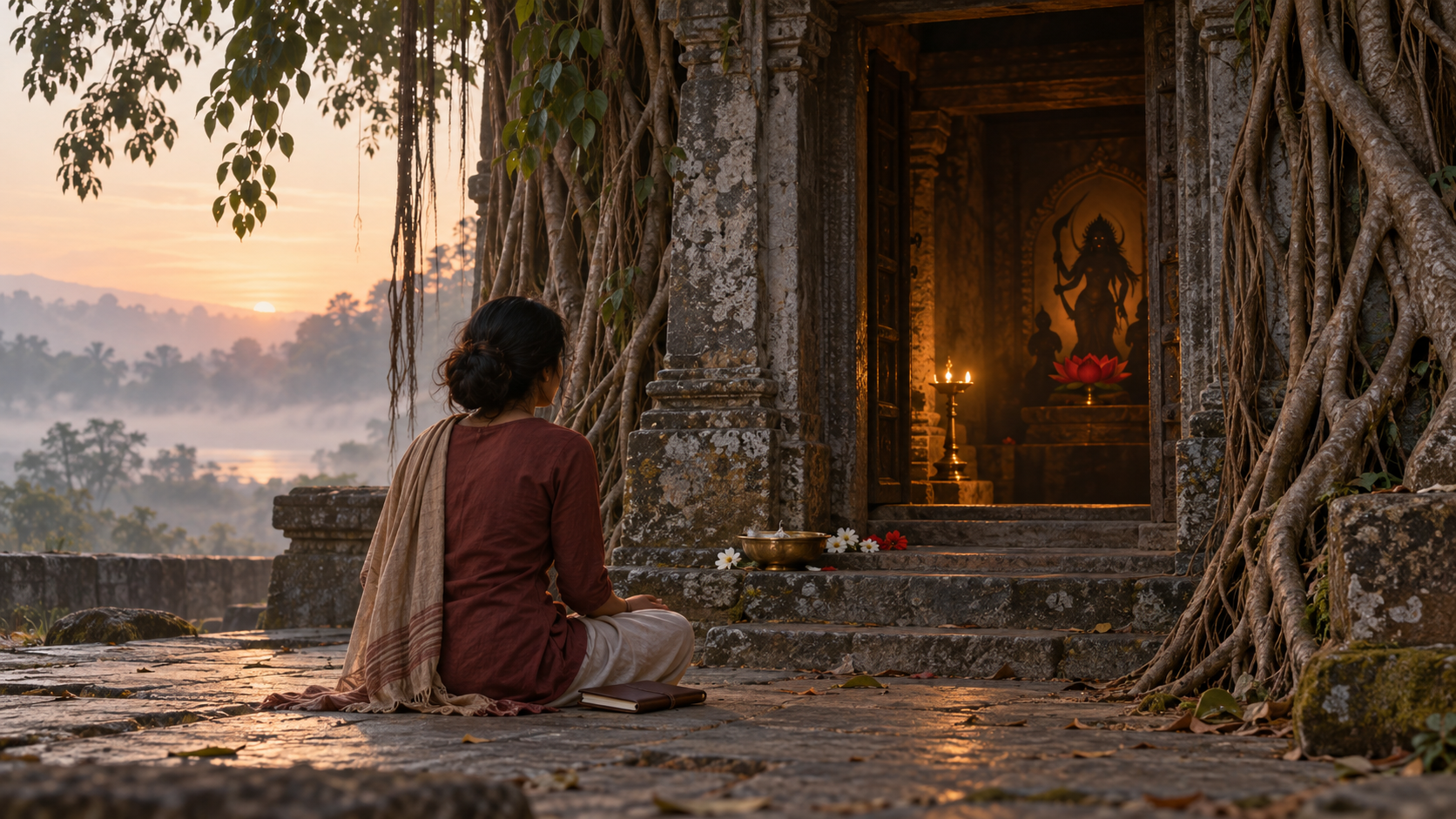
Study, darshan, personal reflection, and formal tantric sadhana are not interchangeable. A beginner can learn reverently without claiming the authority to improvise a specialised practice. Use the following sequence to keep those boundaries clear.
- Clarify your intention. Decide whether you are seeking cultural understanding, devotional connection, help interpreting the icon, or formal sadhana. If it is formal sadhana, recognise at once that reading alone is insufficient.
- Establish the theological context. Remember that you are approaching a Mahavidya and a fierce form of Parvati Devi. This protects you from sensationalist interpretations that detach the image from Shakti.
- Observe before explaining. Look carefully, name your immediate reaction, and distinguish what is visibly present from what you have projected onto it.
- Allow silence to follow study. Sit quietly with one honest question, such as: Which impulse currently rules me despite my better judgement? Do not manufacture an extraordinary experience.
- Apply the teaching to ordinary conduct. Choose one place where energy needs direction: speech, anger, sexual conduct, consumption, or the use of attention. Make a concrete Dharmic restraint there.
- Seek qualified guidance before adopting mantra, ritual, vows, visualisation, or other lineage-specific disciplines. A trustworthy teacher should be able to explain the practice’s lineage, purpose, prerequisites, commitments, and limits.
Do not imitate the icon’s violence, invent an extreme austerity, or assume that a mantra copied from an unverified page is automatically appropriate for you. Bodily harm, coercion, and sexual exploitation are not made sacred by tantric vocabulary. If anyone demands them as proof of devotion, leave and seek guidance elsewhere.
You can also judge an approach by its fruits. Sound engagement should make ethical responsibility harder to evade. If your interest produces only fantasies of secret power, superiority over other devotees, or contempt for ordinary duties, the attraction has drifted away from vidya and toward self-importance.
Questions readers often bring to Chinnamasta
Is Chinnamasta an evil or destructive goddess?
No. Her form is ferocious, but she is understood within Hindu Dharma as a Mahavidya and a form of Parvati Devi. Fierceness describes how she confronts limitation; it does not place her outside the Divine Mother.
Does sexual self-control mean a devotee must reject marriage?
Not as a general conclusion. Chinnamasta’s devotional significance joins sexual self-control with vitality in married life and blessings concerning children. A specific vow may depend on a seeker’s path and guidance, but restraint itself should not be confused with contempt for household life.
Can a beginner approach Chinnamasta without initiation?
You can study her place among the Mahavidyas, offer respectful pranam, examine your reaction to her iconography, and sit in silence. That is different from initiating yourself into a specialised mantra or tantric ritual. When a practice claims lineage-specific power or imposes vows, learn it from a qualified teacher rather than improvising.
Your next step can be modest and serious: return to Chinnamasta’s image, notice the first judgement your mind produces, and ask which uncontrolled force in your life needs direction. If you do not yet have trustworthy guidance, remain with study, reverence, silence, and ethical self-command. Restraint before a fierce form of Devi is not failure to advance; it is already part of learning how to approach her.
References
- Hindu Pad — Chinnamastha Mahatmya | Significance of Chinnamasta Mahavidya
- Hindu Pad — Significance of Dasha Mahavidyas in Daily Life

Leave a Reply
You must be logged in to post a comment.