

Bhakti is often translated as devotion or love of the Divine, but the source articles consistently present it as something more demanding: an organising purpose for attention, action, relationships and spiritual discipline. The guru gives that purpose direction, while daily practice tests whether devotion can move from aspiration into character.
Read together, the sources answer three connected questions: what bhakti is meant to accomplish, how spiritual guidance should be approached without abandoning discernment, and how mantra, meditation, study, worship and service can form a sustainable practice within ordinary life.
Bhakti gives spiritual practice a destination
A spiritual technique can calm the mind without necessarily changing what the mind serves. The sources therefore distinguish the immediate effects of practice from its ultimate purpose. Mantra may improve concentration, breathwork may settle agitation and ritual may create order, but bhakti directs each of them toward remembrance, surrender and a conscious relationship with the Divine.
This relational emphasis becomes clearer when placed beside Vedantic discussions of personal and impersonal reality. The article Personal and Impersonal God does not reduce the issue to a contest between reason and feeling. It reports that contemplation of the formless Absolute can challenge identification with body, role and ego, while devotion to the personal Divine gives love, gratitude, worship and service a definite orientation. Bhakti does not have to deny transcendence; it treats divine name, form and qualities as ways finite consciousness can approach the Infinite.
The question of destination also protects practice from becoming another form of self-improvement. The Supreme Goal of Life argues that changing achievements and possessions cannot bear the full weight of the desire for lasting fulfilment. Attaining Realisation Through Love adds that conceptual knowledge becomes spiritually significant only when it is embodied in humility, clarity, compassion and devotion. Taken together, these accounts place love at the centre without treating it as sentiment: knowledge clarifies the path, practice trains the person and bhakti supplies the governing intention.
This yields a practical test. The relevant question is not only whether a practice produces a moving experience, but whether it gradually weakens pride, possessiveness and harmful reactivity while strengthening remembrance, responsibility and service.
The guru connects teaching, correction and lived example
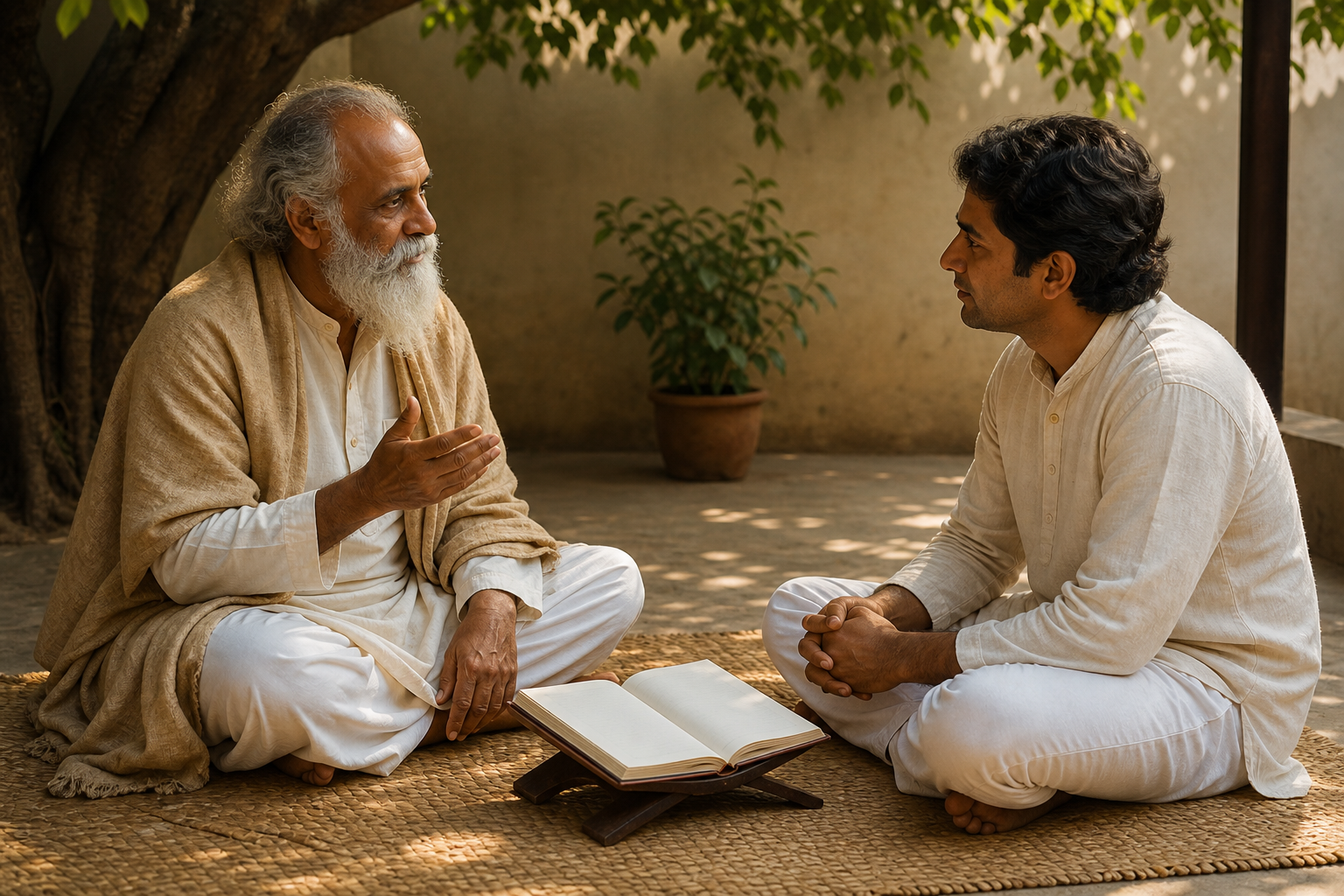
Across the sources, the guru is neither a religious celebrity nor a substitute for God. The guru is presented as a guide who helps expose self-deception, interpret teachings and turn spiritual information into disciplined life. That role explains why the guru-shishya relationship involves more than listening to lectures: the disciple is expected to practise, inquire, observe and become corrigible.
Recognising Paramahamsa Vishwananda emphasizes recognition in the heart, but it also carefully distinguishes settled spiritual recognition from impulsive attraction to charisma. Its account of Paramahamsa Vishwananda as a satguru belongs to the devotional self-understanding of Bhakti Marga. The article itself frames responsible recognition through discernment, ethical clarity and attention to the fruits of the teaching, rather than through emotion alone.
That balance is reinforced by Becoming a Devotee, which describes trust as something developed through consistency, practice and observation. The Supreme Goal of Life highlights humility, sincere inquiry and service as complementary elements of learning from a realised teacher. Humility makes instruction possible, inquiry guards against unthinking imitation, and service moves knowledge beyond self-centred acquisition.
Lineage-based practice adds another dimension. The articles on Atma Kriya Yoga and Mahavatar Babaji and Kriya Yoga present transmission and initiation as integral to their tradition’s understanding of practice. Those are lineage claims and should be recognised as such. Their broader lesson is that some methods are not meant to be assembled casually from disconnected instructions; guidance can preserve context, intention and accountability.
Discernment consequently applies in two directions. A seeker examines whether a teacher encourages truthfulness, compassion, responsibility and genuine God-centred practice. The seeker also examines whether resistance to guidance arises from legitimate ethical concern or from an ego that wants inspiration without correction. Neither automatic suspicion nor automatic obedience is sufficient.
A daily rhythm can engage the whole person

The sources describe a devotional ecology rather than one isolated exercise. Japa disciplines attention and speech; meditation steadies awareness; puja gathers the senses around offering; scriptural study brings intellectual clarity; kirtan makes remembrance communal; and seva carries devotion into action. The practices are distinct, but they reinforce one another when directed toward the same spiritual aim.
The following framework synthesises recurring elements from The Lifestyle of a Hari Bhakta, Powerful Daily Mantra Practice, the articles on Atma Kriya Yoga and meditation, and Becoming a Devotee. It is a practical pattern, not a replacement for the prescribed sequence of any lineage.
- Begin with deliberate remembrance. A fixed daily anchor can be mantra japa, prayer or another practice appropriate to the practitioner’s tradition. The mantra article stresses regularity over occasional intensity and recommends choosing sacred sound with respect rather than treating mantras as interchangeable wellness products.
- Engage body and attention together. Meditation, conscious breathing, posture and ritual can help gather a scattered mind. The Atma Kriya Yoga sources interpret breath, mantra and movement devotionally: technique is meant to support awareness of the soul and orientation toward the Divine, not the pursuit of display or personal power.
- Add hearing and reflection. A short period of scriptural reading or listening gives practice a philosophical frame. The sources repeatedly warn, in different ways, against both devotion without discernment and knowledge without transformation.
- Carry remembrance into one ordinary duty. Work, caregiving, preparing food or helping another person can become seva when performed responsibly and offered without a demand for recognition. This is where devotion begins to outgrow the prayer space.
- Review conduct, not spiritual drama. At the end of the day, the useful questions concern truthfulness, patience, restraint, service and remembrance. Unusual experiences are a poor substitute for visible ethical change.
This rhythm can remain simple. A shorter practice performed faithfully is more likely to shape attention than an elaborate programme repeatedly postponed. Depth comes from returning to the same sacred centre through changing moods and circumstances.
Daily life reveals whether practice is becoming devotion

Formal sadhana prepares the practitioner, but interruption reveals the current state of the heart. Powerful Spiritual Lessons From Flying uses air travel to illustrate several aspects of spiritual life: a journey requires a destination, unsuitable baggage must be screened, and delays expose the limits of personal control. Applied to daily practice, the metaphor suggests that attention must be protected from repeated inputs that inflame comparison, anger or restless desire. It also suggests that surrender is not passivity. A person can prepare carefully and act responsibly while accepting that outcomes are never completely controllable.
The sources consistently pair effort with grace. The seeker chants, studies, serves and restrains harmful tendencies; grace is not presented as permission to wait passively for transformation. At the same time, Recognising Paramahamsa Vishwananda, Attaining Realisation Through Love and Mahavatar Babaji and Kriya Yoga all resist the idea that spiritual realisation can be manufactured through egoic technique alone. Practice creates receptivity; grace names the help and transformation that exceed personal control.
This makes household life a genuine field of sadhana rather than an obstacle to it. The Kriya Yoga source highlights a tradition of making disciplined practice available within family and professional responsibilities, while the Hari Bhakta and devotee articles extend devotion into food, speech, relationships, work and community. The measure of integration is not how religious a schedule appears, but whether remembrance informs conduct when patience is difficult, service is unnoticed or plans fail.
Ethical safeguards remain essential. The source on the supreme goal states that authentic guidance should deepen compassion, steadiness and responsibility rather than fear, manipulation or hostility toward other paths. The mantra article also cautions that contemplative practice is not a substitute for medical care, therapy or social support. Bhakti can give suffering a spiritual context, but responsible devotion does not require neglect of appropriate forms of help.
Key takeaways
- Bhakti is the governing orientation of practice: it turns attention, knowledge, ritual and work toward loving remembrance of the Divine.
- A guru can provide teaching, correction, lineage and example, but trust should develop alongside inquiry, ethical discernment and observation.
- A sustainable daily practice combines a stable devotional anchor with reflection, embodied discipline and service in ordinary responsibilities.
- Effort and grace are complementary: disciplined practice prepares receptivity without pretending that realisation is a personal achievement.
- Progress is best judged through character, including reduced egoic reactivity and increased truthfulness, compassion, steadiness and willingness to serve.
A durable beginning does not require collecting many techniques. It requires choosing a sound practice, understanding its purpose and returning to it faithfully enough that devotion can enter the unscripted parts of the day. As that foundation matures, qualified guidance can help deepen the practice without losing its ethical centre.
References
- Dandavats – Powerful Spiritual Lessons From Flying: Faith, Focus, and the Journey to Krishna
- Bhakti Marga Blog – Personal and Impersonal God: A Powerful Vedantic Guide to Divine Reality
- Bhakti Marga Blog – Recognising Paramahamsa Vishwananda: True Guru, Bhakti, and Divine Love
- Bhakti Marga Blog – Hari Bhakta Lifestyle Explained: Powerful Daily Bhakti, Seva, Dharma and Grace
- Bhakti Marga Blog – Eternal Happiness and the Supreme Goal of Life: A Transformative Dharmic Guide
- Bhakti Marga Blog – Becoming a Devotee: The Transformative Power of Bhakti, Guru, and Inner Awakening
- Bhakti Marga Blog – Powerful Daily Mantra Practice: A Sacred Path to Inner Peace and Steady Focus
- Bhakti Marga Blog – Atma Kriya Yoga Explained: The Powerful Practice of Bhakti, Breath and Inner Realisation
- Bhakti Marga Blog – Powerful Realisation Through Love: How Bhakti Transforms Knowledge into Living Truth
- Bhakti Marga Blog – Meditation, Bhakti, and the Heart: A Powerful Path to Lasting Inner Peace
- Bhakti Marga Blog – Mahavatar Babaji and Kriya Yoga: Transformative Grace for Self-Realization