
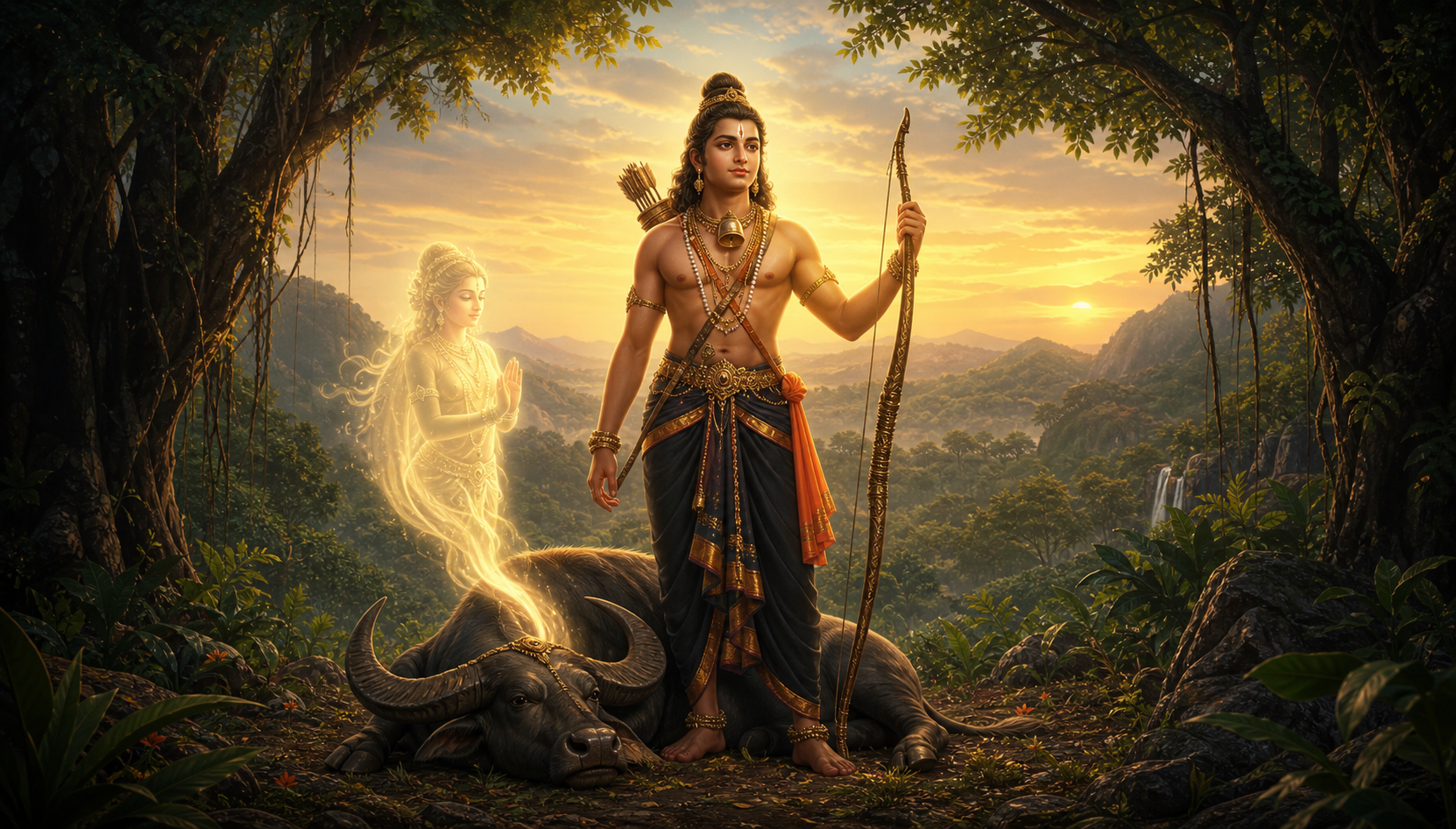
If you have heard Ayyappa invoked as Mahishi Samhara Moorthy, perhaps during a bhajan, a vrata, or a conversation about Sabarimala, you may wonder whether the title simply commemorates a divine battle. It does more. It tells you which disorder Ayyappa confronts, why his identity as Hariharaputra is indispensable, and what his victory asks of a devotee.
Understanding those connections changes how you hear the name. The Mahishi Samhara tradition becomes neither a spectacle of violence nor an abstract metaphor, but a complete movement from suffering to divine response, from divine response to restored dharma, and from sacred memory to disciplined conduct.
What the title Mahishi Samhara Moorthy actually says
Begin with an important distinction: Mahishi is not another name for Mahishasura. The Ayyappa katha identifies her as a buffalo-headed asura and the sister of Mahishasura. Endowed with formidable boons, she brings suffering to the Devas and to beings on earth. Her defeat belongs to Ayyappa’s narrative and should not be silently replaced with the better-known account of Mahishasura’s destruction.
In this title, samhara refers first to the decisive slaying of Mahishi. Moorthy identifies Ayyappa through the particular form and divine function manifested in that act. Mahishi Samhara Moorthy therefore means more than “Ayyappa the warrior.” It venerates Ayyappa as the one who ends Mahishi’s oppressive power and restores the order she has violated.
This distinction matters because the tradition does not celebrate destruction for its own sake. The moral centre is the restoration of dharma. Suffering has spread, ordinary remedies cannot end it, and divine action becomes necessary to protect those subjected to the disorder. A retelling that dwells only on combat misses the reason the combat occurs.
When you hear or retell the katha, follow three questions. What form has adharma taken? Why are the usual powers unable to overcome it? What order is restored when Ayyappa intervenes? Those questions keep the meaning of samhara attached to responsibility rather than aggression.
Why Ayyappa must be Hariharaputra
Mahishi’s boon establishes the central condition of the narrative: she is invulnerable to every being except one born of Shiva and Vishnu. Ayyappa can confront her because he manifests as Hariharaputra, born of Shiva and Vishnu in the form of Mohini. His divine parentage is not decorative genealogy added around the battle. It is the precise answer to the protection that has made Mahishi otherwise unconquerable.
Within the katha’s logic, the boon and the birth explain one another. Mahishi’s power reaches a point that no conventional opponent can penetrate. The response arises through a manifestation joining Hari and Hara, Vishnu and Shiva. Only then can the apparent invincibility of adharma be broken.
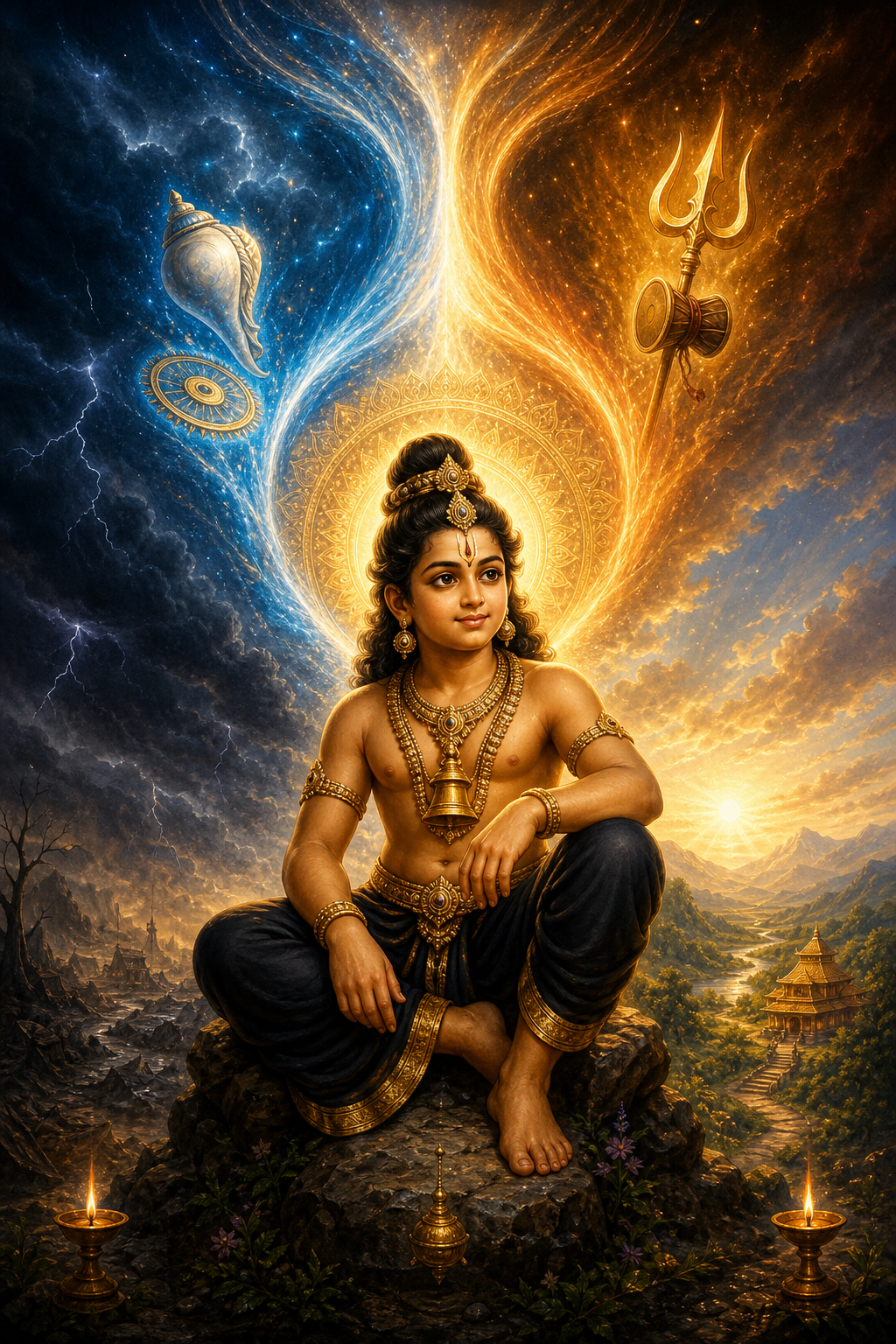
This also gives the tradition a powerful account of divine complementarity. Shaiva and Vaishnava forms are not forced into rivalry, nor must their differences be erased. Their conjunction has a specific dharmic purpose: the protection of the world through the manifestation of Ayyappa. Unity here is active. It answers a need that neither side of a sectarian division should try to possess exclusively.
If you are explaining the story to a child, a class, or a family gathering, use this order:
- Describe the suffering caused by Mahishi.
- Explain the condition created by her boon.
- Introduce Ayyappa as Hariharaputra, born of Shiva and Vishnu as Mohini.
- Then narrate the confrontation and the restoration of dharma.
That sequence prevents Ayyappa’s birth from sounding like disconnected mythic information. The listener can see why this manifestation appears and what it is uniquely able to accomplish.
Erumely and Petta Thullal turn victory into living memory
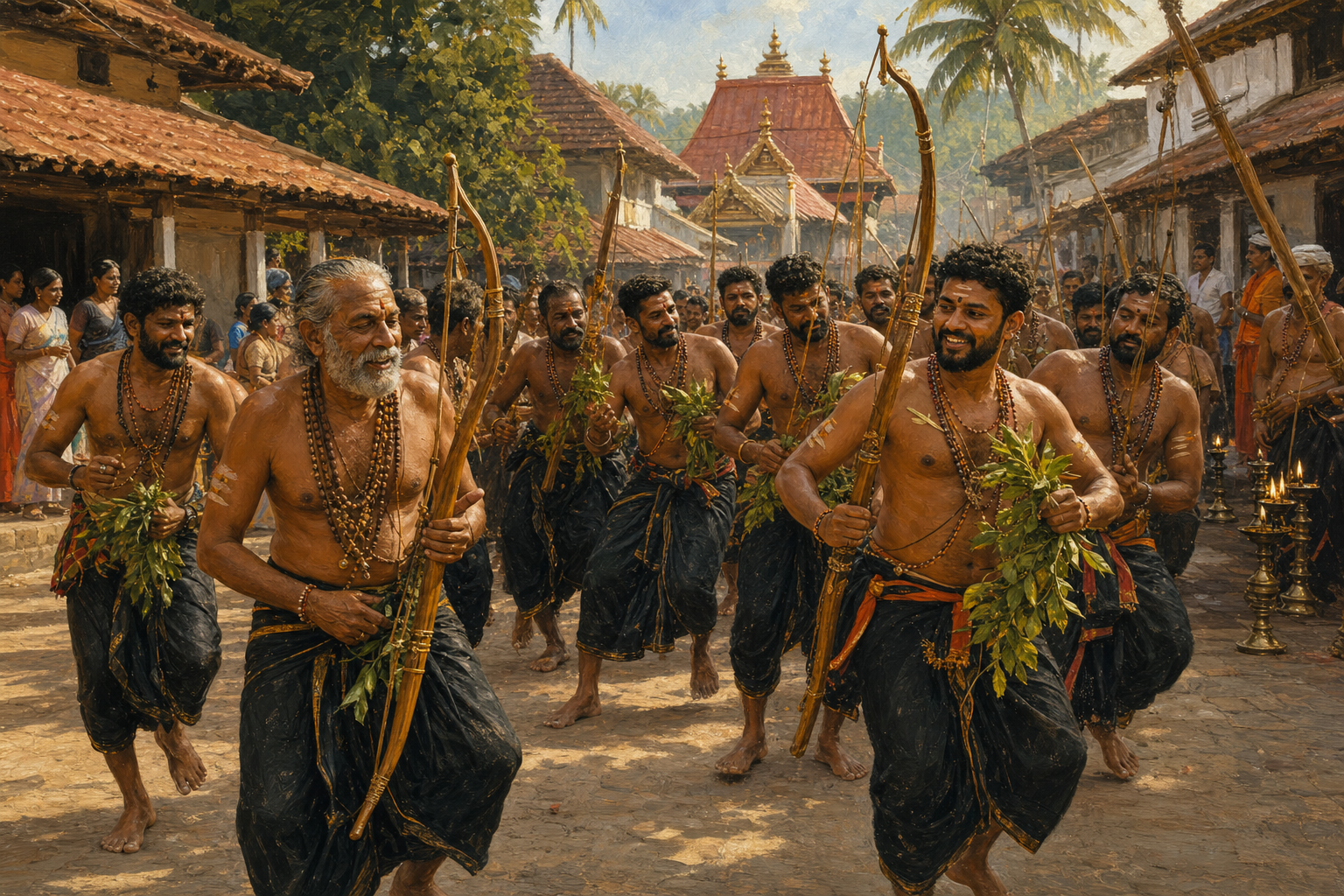
The defeat of Mahishi is often localized at Erumely in Kerala. Along the Sabarimala pilgrimage route, Petta Thullal symbolically reenacts the vanquishing of adharma. Sacred geography and embodied observance therefore carry the victory beyond verbal narration.
Localization does something important for a pilgrim. A cosmic struggle is remembered at a place through which people actually move. Petta Thullal, in turn, makes that memory physical and communal. The participant does not encounter Mahishi Samhara only as an idea about the distant past; the overcoming of disorder becomes part of the pilgrimage’s living rhythm.
If you visit Erumely or encounter Petta Thullal, keep three layers in view:
- The katha supplies the sacred event: Ayyappa overcomes Mahishi.
- Erumely supplies the remembered place associated with the decisive encounter.
- Petta Thullal supplies the communal act through which the defeat of adharma is recalled.
Seeing all three layers guards against two common mistakes. One is treating the observance as entertainment detached from worship. The other is treating symbolism as though it makes the katha unnecessary. In the tradition, story, place, and enactment reinforce one another.
A visitor should therefore learn the local devotional meaning before reducing the event to photographs or spectacle. If you participate, follow the instructions and customs of the community carrying the observance. Respect begins by allowing a living tradition to explain its own actions.
Turn Mahishi Samhara inward without shrinking the katha
The Mahishi narrative also supports an inner reading. Her buffalo-headed form is understood as an image of tamas expressed through lethargy, arrogance, and untamed impulses. Ayyappa’s victory then becomes a model for bringing those tendencies under dharmic discipline and transforming confusion into clarity and right action.
This interpretation should be used carefully. Mahishi is not a label to attach to someone you dislike. Doing that lets ahankara disguise itself as moral judgement. The useful question is not, “Who around me represents tamas?” It is, “Where do inertia, pride, or impulse prevent me from doing what I already know is right?”
Nor should the metaphor replace the sacred narrative. Ayyappa is worshipped as Mahishi Samhara Moorthy because he defeats Mahishi and restores dharma. The inward interpretation brings that victory into your conduct; it does not explain the deity away as a psychological symbol.
You can turn the teaching into a small daily discipline:
- Name one observable pattern under your control. It might be postponing a promised duty, rejecting a justified correction because of pride, or allowing an impulse to govern your speech.
- Choose an opposite action that can be completed today. Fulfil the delayed duty, acknowledge and correct the error, or pause before giving the response that impulse demands.
- Review the result at the end of the day. Ask whether your action restored order, protected another person from harm, or merely made you feel morally superior.
This is particularly fitting when the title is invoked during the Mandala and Makaravilakku season through bhajans and vrata observances. Devotees seek protection, moral clarity, and inner strength. The practical test of that devotion is whether discipline changes conduct after the invocation has ended.
A shared dharmic concern does not make every tradition identical
The inward conquest represented by Mahishi Samhara has recognisable parallels across Dharmic traditions. The comparison is useful when it remains precise:
- In this Ayyappa-centred interpretation, tamasic inertia, arrogance, and unruly impulse are answered by disciplined dharmic action.
- In Buddhism, the overcoming of kleshas concerns afflictions that disturb clarity and conduct.
- In Jain thought, discipline is directed against kasayas, the passions that bind and distort the self’s action.
- In Sikh thought, the ethical emphasis falls on bringing conduct into alignment with hukam.
The resemblance lies in a shared demand for inner conquest that bears fruit in ethical life. It does not mean that tamas, kleshas, kasayas, and misalignment with hukam are interchangeable doctrines. When discussing these traditions together, call them parallel ethical concerns rather than different names for an identical theology. That language honours both kinship and real difference.
Key takeaways
- Mahishi Samhara Moorthy identifies Ayyappa through his defeat of Mahishi and his restoration of dharma.
- Mahishi is the sister of Mahishasura, not an alternate name for him or a substitute for his better-known narrative.
- Ayyappa’s identity as Hariharaputra answers the exact condition of Mahishi’s boon and is essential to the katha.
- Erumely and Petta Thullal preserve the victory through sacred place, pilgrimage, and communal reenactment.
- The inner reading is sound when it corrects your own inertia, arrogance, or impulse; it becomes distorted when used to judge other people or erase the sacred narrative.
The next time you invoke or hear the name Mahishi Samhara Moorthy, carry it into one decision. Identify the duty that delay, pride, or impulse has obstructed, and take one corrective action before the day ends. That is how remembrance of Ayyappa’s victory becomes abhyasa rather than ornament.


References
