
Thursday, April 16, 2026, in the Hindu calendar (Panchang) spans a pivotal lunar transition: Krishna Paksha Chaturdashi (the fourteenth lunar day of the waning phase) continues until 6:54 PM (IST) in most Indian almanacs, after which Amavasya (no-moon day) begins and extends into the following civil date. This overview consolidates what the Tithi change implies for observances, the role of Nakshatra and Rashi, and how to identify shubh periods (Good Time) with technical clarity and practical guidance.
In Panchang terms, the day is best read as a sequence of two Tithis: Krishna Paksha Chaturdashi up to sunset and early evening, then Amavasya afterward. Because Tithi is defined astronomically and not by clock hours, a single civil day can legitimately host two Tithis. Devotional planning on this date thus hinges on recognizing the switch at 6:54 PM (IST), with many families moving Amavasya-specific rites to the window that follows or to the following morning if local tradition so advises.
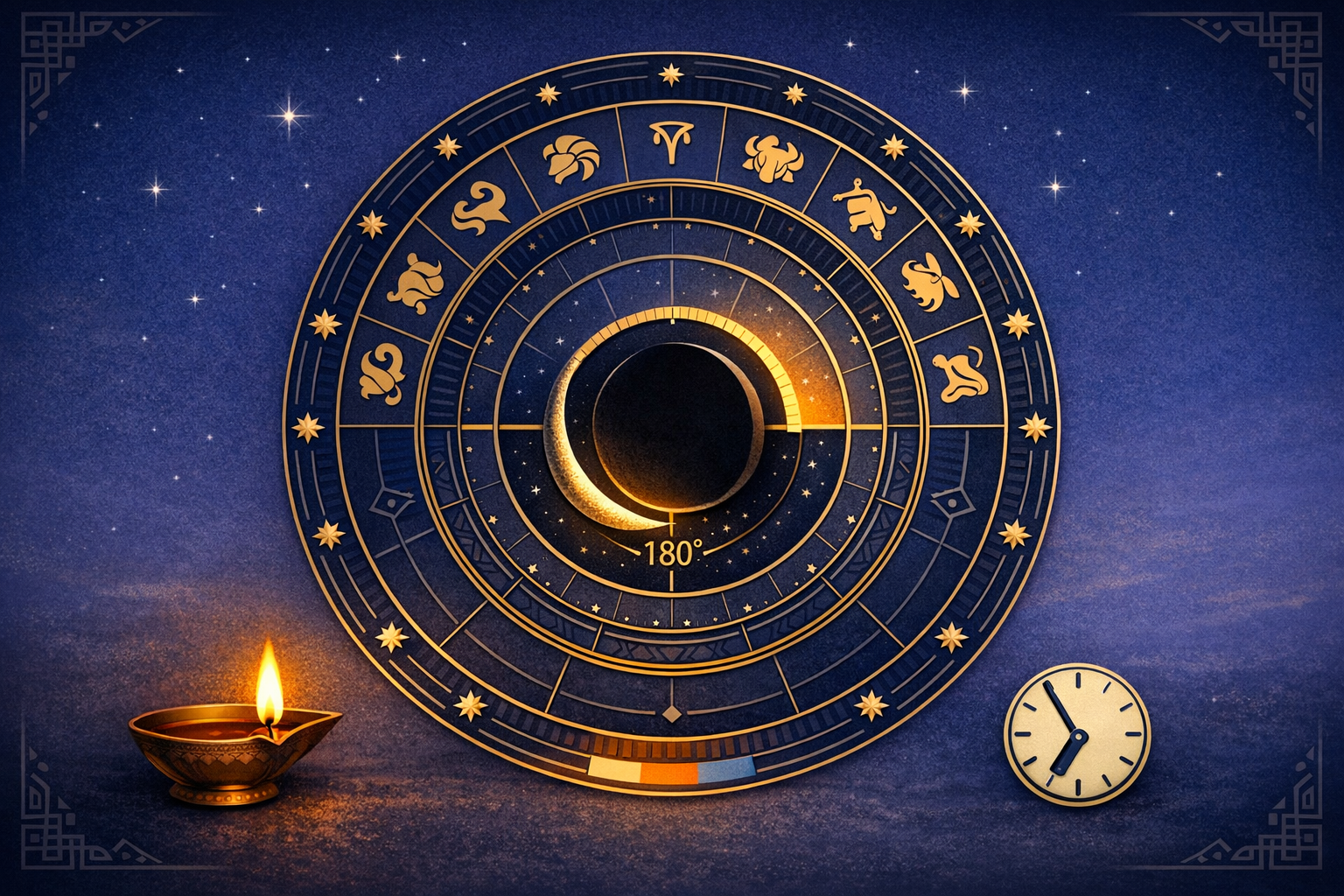
Tithi, the core timing unit in the Hindu calendar, is determined by the angular separation between the Moon and the Sun. Each Tithi spans a 12-degree increase in lunar elongation relative to the Sun. Krishna Paksha Chaturdashi occurs when the Moon–Sun elongation lies between 168° and 180°, while Amavasya begins as that difference crosses 180° and resets toward the new lunar cycle. Due to variable lunar speed, Tithis rarely map cleanly onto 24-hour civil days and can start or end at seemingly irregular times.
Within the Panchang framework, five elements guide daily auspiciousness: Vara (weekday), Tithi (lunar day), Nakshatra (lunar mansion), Yoga (sum of solar and lunar longitudes), and Karana (half-Tithi subdivision). Each influences distinct domainsritual suitability, travel, study, household ceremonies, and spiritual practice. While Vara and Tithi are prominently referenced in daily decisions, Nakshatra and Rashi (the Moon’s zodiac sign) often refine the timing for vows, donations (dāna), and meditative disciplines.
Krishna Paksha Chaturdashi carries a contemplative tenor aligned with release, restraint, and inward focus. In many Shaiva traditions, the Krishna Paksha Chaturdashi of each lunar month is observed as Māsa Shivaratri (monthly Shivaratri), emphasizing japa, upavāsa (fasting per capacity), and abhishekam where locally prescribed. The day favors sādhanā that stills the senses and minds the ethics of quiet speech, measured action, and self-study (svādhyāya).
Amavasya, beginning post 6:54 PM (IST) on April 16, 2026, is traditionally set apart for Pitṛ-tarpaṇa (oblations for ancestors), charitable giving, and reflective practices. When Amavasya starts in the evening, many householdsfollowing community injunctionsperform Pitṛ rites the next morning while Amavasya continues. Others emphasize silent contemplation, lamp offering, and simple meals, aligning conduct with the Amavasya ideal of inward renewal and ethical clarity.
Nakshatra and Rashi on a given date can change within the day and vary slightly with location. For precise April 16, 2026 values (e.g., the operative Nakshatra at sunrise and any subsequent shift, and the Moon’s Rashi transitions), consultation of a location-specific Panchang or ephemeris is recommended. These parameters fine-tune decisions for saṅkalpa wording, mantra selection, and the alignment of new undertakings with individual horoscopic contexts.
Good Time (Shubh Muhurat) on this date is determined by synthesizing Vara, Tithi, Nakshatra, Yoga, and Karana, then excluding inauspicious daily intervals such as Rahu Kaal and Yamaganda. A practical heuristic is to identify Abhijit Muhurat (the midpoint segment of daylight around solar noon), which is generally considered auspicious in many traditions, while recognizing that exact boundaries vary by sunrise and location. For Thursdays specifically, Rahu Kaal falls during the sixth division of daylight; to compute it accurately, divide the local daylight duration (sunrise to sunset) into eight equal parts and select the sixth segment as Rahu Kaal to be avoided for new ventures. Local Panchangs additionally mark Gulika Kaal and Durmuhurtas; excluding these sharpen the window for undertakings aligned with dharma and long-term stability.
Month naming can differ by regional calendar conventions. In Amānta systems (common in peninsular India), this Amavasya typically concludes the Chaitra month; in Pūrṇimānta systems (prevalent in parts of North India), month labels shift at full moons, producing different month names for the same Tithi. Accordingly, one may encounter the date referenced as Chaitra Amavasya 2026 or Amavasya (April 2026) in varied almanacs; both reflect legitimate, regionally rooted computations.
These lunar observances sit within a broader Dharmic continuum. In Buddhism, new-moon Uposatha emphasizes ethical purification and mindfulness; in Jainism, Amavasya and fortnightly Pratikraman support vows, ahiṁsā, and inner discipline; in Sikh practice, while the Nanakshahi calendar is primarily solar, many families honor shared subcontinental customs of communal service (seva), reflection, and charity around significant calendrical junctures. Read in this spirit, Panchang-guided days such as April 16–17, 2026 invite unity of purposeself-restraint, compassion, and serviceacross Hindu, Buddhist, Jain, and Sikh traditions.
A practical plan for householders might include: completing Krishna Paksha Chaturdashi prayers and any Shaiva sādhanā before the evening Tithi change; shifting to quiet, simple observances once Amavasya begins; scheduling Pitṛ-tarpaṇa, dāna, or extended meditation for the morning that follows when Amavasya continues; and avoiding the computed Rahu Kaal segment for first-time ventures. Such sequencing respects both the astronomical pivot at 6:54 PM (IST) and customary guidance about conducting Amavasya rites during strong, calm morning hours when available.
Technical note on accuracy: the 6:54 PM (IST) end of Krishna Paksha Chaturdashi on April 16, 2026 reflects the Panchang statement for most Indian regions; Amavasya begins immediately thereafter and runs into April 17, with its exact end time varying by location. Because Tithi start/end times depend on longitude, latitude, and local sunrise, practitioners should confirm details with a regional Panchang, temple notice, or trusted ephemeris for precise ritual scheduling.
In summary, April 16, 2026 is a thoughtfully composed Panchang day that transitions from the austerity of Krishna Paksha Chaturdashi to the reflective quietude of Amavasya. Reading Tithi in conversation with Nakshatra, Rashi, and daily inauspicious segments refines practice, aligns intention with time, and fosters a shared Dharmic ethic of restraint, remembrance, and generosity. Anchored in the Hindu calendar yet resonant across Dharmic paths, the date invites stillness, study, and service as a unified offering.
Inspired by this post on Hindu Blog.
