

If you have wondered why Rama did not simply seek Vali’s help, your question is practical. Sita was missing, time mattered, and Vali appeared to possess far greater immediate power. Why ally with an exiled Sugriva and undertake the dangerous work of restoring him?
That question becomes clearer once you stop treating the episode as a contest between two military suppliers. The Ramayana presents a stricter test: a righteous end does not make every effective means righteous. Rama must consider whether power is justly held, whether an ally’s conduct contradicts the mission, and whether assistance can be joined to reciprocal duty.
The choice was moral before it was military
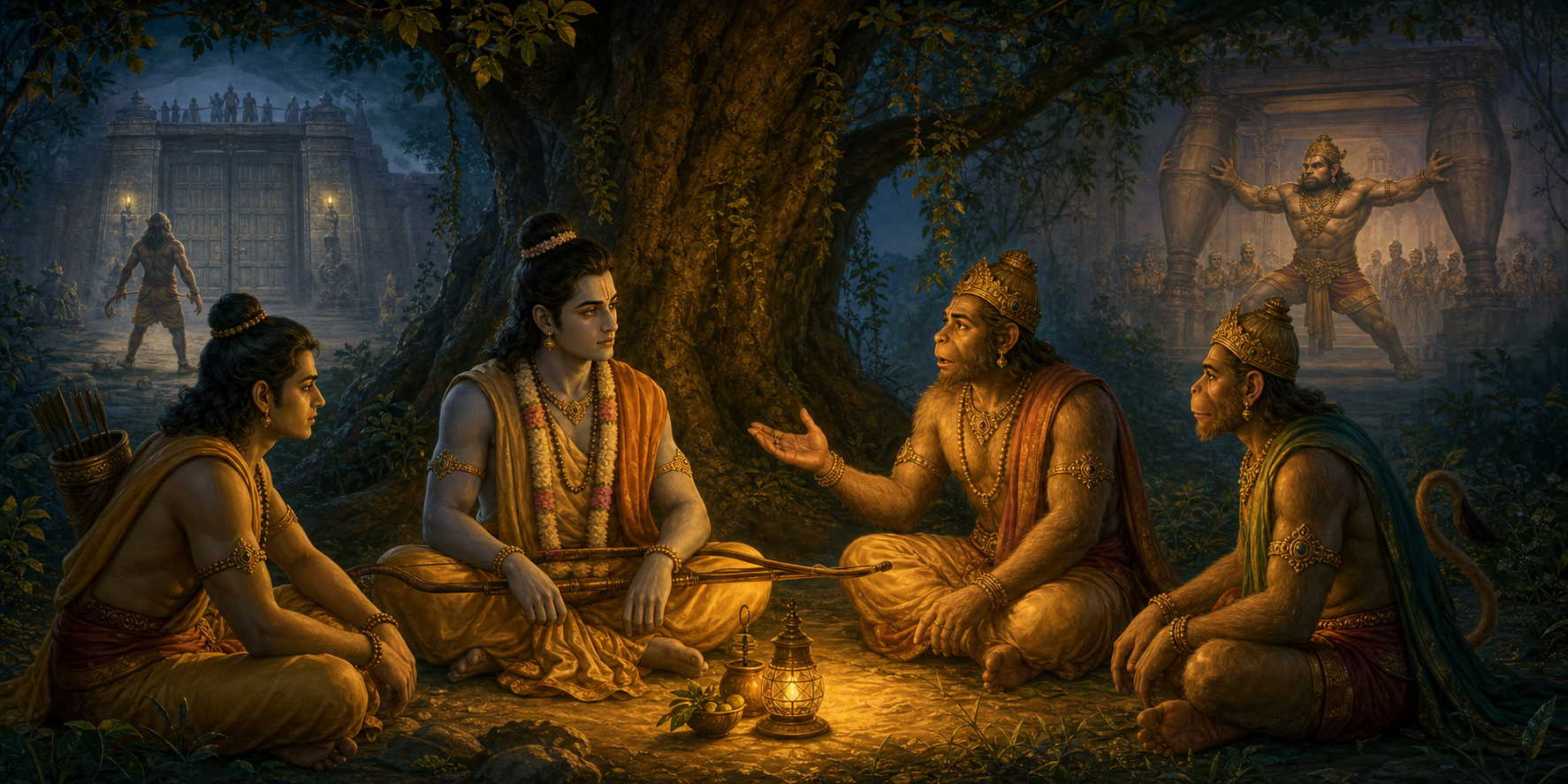
First, the narrative does not show Rama interviewing Vali and Sugriva as rival candidates. Rama encounters Hanuman and is brought into Sugriva’s confidence. The idea that Rama might have met Vali first is therefore a counterfactual question: would a different order of introductions have changed his allegiance?
Within the dharmic logic of the episode, it would not. Rama does not accept assistance merely because it is useful. His need is urgent, but urgency does not suspend the standards by which he decides whose power he may support.
This is the first distinction to notice. Rama needs an army, but he is not merely acquiring one. By accepting a ruler’s aid, he would also recognize that ruler’s authority. An alliance with Vali would therefore carry a moral meaning beyond its battlefield value.
Dharma is not an ornament added after success. It governs the route to success. If Rama rescued Sita by endorsing conduct that violated the same familial and moral order he was defending, the means would hollow out the purpose of the mission.
Vali’s strength could not make his rule legitimate
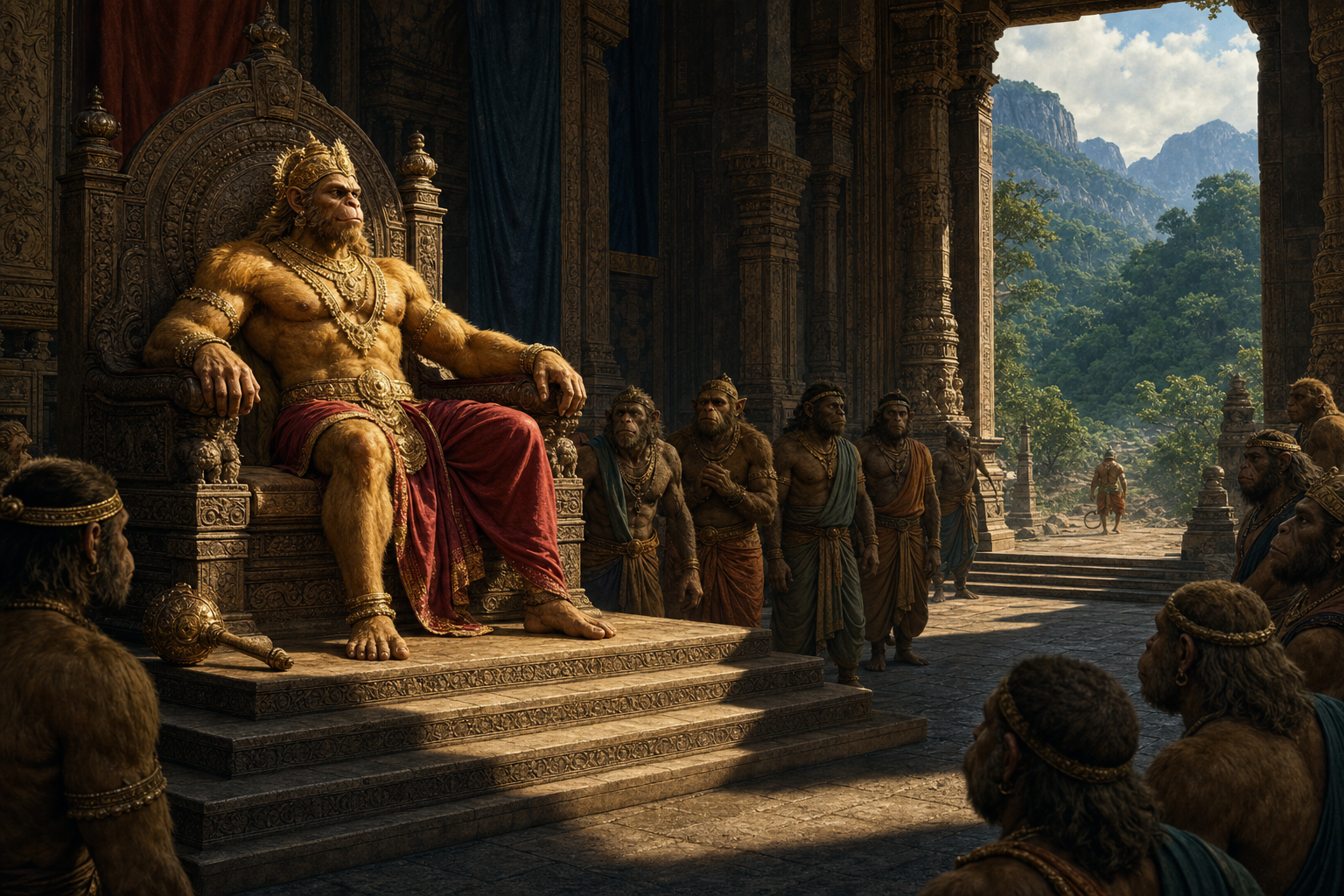
Vali’s advantage seems obvious. He possesses the throne, commands obedience, and has the physical strength to overwhelm Sugriva. A purely short-term calculation would say: approach the ruler already in control and avoid inheriting the weaker brother’s quarrel.
The Ramayana does not equate control with rightful authority. Vali’s kingship had come to rest on physical dominance rather than dharmic restraint. In the traditional account, the brothers’ conflict begins amid misunderstanding, but Vali’s response goes far beyond resolving that dispute. He drives Sugriva away, keeps the kingdom, and takes Sugriva’s wife into his own possession.
That last act is decisive for understanding Rama’s refusal. Rama is searching for Sita after she has been taken from him. He cannot coherently seek the help of a ruler who has used superior force to violate his own brother’s marital and familial rights. Vali might help recover one separated wife, but his rule perpetuates the kind of disorder that makes such violations possible.
This is not a matter of appearances or political messaging. It is a matter of moral coherence. The wrong defining Rama’s mission must also shape the alliances he refuses.
Vali’s strength is not itself condemned. Strength is necessary throughout the Ramayana. The problem is strength detached from rightful limits. Dharma asks who may exercise power, toward whom, for what purpose, and under what restraint. When a ruler treats superiority as sufficient permission, greater power magnifies the wrong instead of curing it.
Sugriva offered a covenant, not merely a grievance
Sugriva is not chosen simply because he is weaker or because he has suffered. Suffering alone does not make a person a suitable ally. What distinguishes Sugriva is that his claim can be placed within a reciprocal covenant.
Rama and Sugriva each disclose a deprivation. Rama has been separated from Sita and dispossessed of the life he should have been living. Sugriva has been separated from his wife, expelled from his home, and deprived of his royal position. Their circumstances are not identical, but each can recognize the other’s need without turning that need into submission.
Their alliance assigns a duty to each side. Rama will end Vali’s unjust domination and restore Sugriva. Sugriva will mobilize the Vanaras to search for Sita. Each promise answers a concrete wrong; neither party is asked to serve without obligation from the other.
Hanuman’s role helps you see why this can become more than an agreement between two aggrieved men. His discernment, disciplined speech, and capacity for service turn an encounter into organized cooperation. Sugriva’s side possesses not only a claim to redress but also a minister capable of converting restored authority into action.
Nor does the alliance require pretending that Sugriva is flawless. After regaining the kingdom, he delays fulfilling his commitment and must be recalled to it, with Lakshmana’s anger making the failure impossible to ignore. Sugriva then returns to the obligation and directs the search.
That lapse sharpens the lesson. A dharmic ally is not necessarily someone who will never fail. It is someone whose authority remains answerable to a promise, who can be confronted when duty is neglected, and who can return to the work. Sugriva can be called back to the covenant. Vali’s order, by contrast, rests on the claim that superior force settles the matter.
Vali’s death raises a separate and harder question

A careful reading should not evade the most uncomfortable part of the episode. Rama kills Vali from concealment while Vali is fighting Sugriva. Vali himself challenges Rama’s action. Readers have therefore asked whether the method of punishment was consistent with the dharma invoked to justify opposing him.
Rama’s answer is framed in terms of Vali’s wrongdoing and the authority to punish it, rather than the conventions of a formal duel between equals. Whether that defence resolves every ethical difficulty remains a matter of interpretation. You do not need to suppress the objection in order to understand why Rama could not accept Vali as an ally.
Two judgments must be kept distinct. The first concerns the justice of refusing Vali’s rule and supporting Sugriva’s claim. The second concerns the justice of the particular method used against Vali. Questioning the second does not automatically reverse the first. Defending the second also does not permit us to reduce dharma to the proposition that whatever the victor does must be right.
This distinction gives you a better way to read difficult scriptural episodes. Examine the cause, the authority, and the method separately. Ask what wrong is being corrected, why a particular person may correct it, and whether the chosen action remains within the limits it claims to defend. Reverence does not require imprecise reading; it requires enough seriousness to hear both the moral judgement and the challenge made against it.
Key takeaways
- Rama did not choose between Vali and Sugriva by asking which one possessed more force. He asked which alliance could stand within dharma.
- Vali’s treatment of Sugriva made his assistance morally incompatible with a mission centred on restoring a wrongfully separated wife.
- Sugriva qualified as an ally because he could enter a reciprocal covenant, not because weakness or victimhood made him automatically righteous.
- Sugriva’s later delay shows that a dharmic alliance includes accountability, correction, and a return to promised duty.
- The justice of opposing Vali and the manner of Vali’s death are related but distinct questions; each deserves its own examination.
When you apply this episode to leadership, public life, or your own difficult choices, do not begin with the person who can deliver the fastest victory. First name the wrong you are trying to correct. Then rule out any partnership whose power depends on reproducing that same wrong. Among the remaining choices, look for reciprocal duties, enforceable limits, and a willingness to be recalled when promises are neglected.
Rama’s choice is not an instruction to prefer weakness. It is an instruction to prefer strength that can be governed by dharma. Before accepting powerful help, ask what accepting it would require you to recognize, excuse, or become.