

You may be preparing a havan, explaining a ritual to your children, or simply wondering whether your daily acts of service can count as yajna. The question beneath all three is the same: what makes an offering sacred—correct performance, compassionate intention, devotion, or some union of them?
You don’t have to choose between outer form and inner meaning. A prescribed rite deserves discipline and competence. Yet a ceremony that ignores suffering contradicts yajna’s world-sustaining purpose, while a kindly impulse with no relinquishment, dedication, or responsibility should not automatically be given a sacred label. Compassion and devotion deepen yajna when they govern what you offer, how you offer it, and what your offering does in the world.
Yajna is more than a pious name for a good deed
Yajna has a precise ritual sense and a wider spiritual one. In its formal Vedic setting, it involves consecrated offerings, mantras, fire, qualified roles, and an ordered procedure. In its broader Dharmic sense, it expresses sacrifice, gratitude, duty, and reciprocity: we receive life from a larger order, offer something back, and resist the illusion that everything exists for private consumption.
The broader meaning does not erase the formal one. Calling volunteer work yajna does not make it a shrauta sacrifice, just as lighting a lamp at home does not reproduce every element of a prescribed homa. Clear language protects both practices. It lets you recognize sacred offering in ordinary life without pretending that inherited ritual knowledge is unnecessary.
When the word is used responsibly, three movements should be visible:
- Relinquishment: you surrender food, wealth, time, comfort, attention, status, or the claim to possess the result.
- Dedication: the act is directed toward Bhagavan, dharma, a sacred responsibility, or the welfare of beings—not merely toward self-image.
- Return: what you received is converted into nourishment, protection, gratitude, service, or restored relationship.
If nothing is actually given up, the language of sacrifice may be decorative. If the recipient is mainly your public identity, the act may be philanthropy mixed with self-promotion. If a beautiful ceremony leaves waste, exhaustion, humiliation, or avoidable injury behind it, its visible grandeur cannot settle the ethical question.
Hindu schools do not locate ritual efficacy in precisely the same place. Mīmāṃsā gives decisive weight to Vedic injunction and correct performance. Vedantic and bhakti traditions often draw greater attention to knowledge, freedom from attachment, devotional intention, and the identity of the ultimate recipient. These emphases should not be collapsed into a claim that technique never matters or that feeling alone is sufficient. Bhāva is not a shortcut around competence. It is the disposition that prevents competence from becoming empty display.
Sita’s mercy shows when a sacred procedure must pause

A regional tradition about child Sita and an Ashvamedha horse gives this principle a memorable form. In Maithili and North Indian oral tellings, the young Sita encounters King Dasharatha’s weary horse in Mithila. She gives the animal refuge, water, shade, and protection rather than treating its ceremonial status as a reason to overlook its condition.
The textual qualification matters. This episode is not present in the critical edition of the Valmiki Ramayana. If you teach or retell it, identify it as regional Ramayana lore rather than placing words or events into Valmiki’s text. That accuracy does not weaken the episode’s value. India’s Ramayana traditions include oral and regional narratives whose purpose is often to illuminate dharma through a concentrated moral scene.
The Ashvamedha was historically a demanding sovereignty rite. A consecrated horse wandered for a year under armed protection. A ruler who stopped it challenged the yajamāna’s claim and risked battle; one who permitted its passage tacitly accepted that sovereignty. The rite ultimately involved complex offerings, recitation, gifts, and an attempt to align royal authority with cosmic order.
That background makes Sita’s intervention sharper. She is not merely helping a stray animal. An apparently powerless child pauses an emblem of imperial reach and asks, through her action, whether sovereignty can claim alignment with dharma while ignoring the vulnerable being that carries its symbol. Her answer is neither a revolt against sacred life nor a sentimental dismissal of duty. She honors the higher purpose of order by refusing indifference to suffering.
You can use Sita’s pause as a practical sequence whenever a religious or social duty begins to produce an ethically troubling result. First, notice the actual being in front of you rather than seeing only the institution, schedule, or symbol. Second, interrupt the avoidable harm. Third, provide immediate care. Fourth, ask which element serves the rite’s purpose and which merely preserves momentum or prestige. Then resume in a corrected form, or seek qualified guidance about an appropriate alternative.
This is discernment, not a general license to discard whatever feels uncomfortable. Discomfort may arise from discipline, and discipline can be valuable. The relevant sign is not personal inconvenience but a conflict between the declared Dharmic purpose and preventable harm to another being. Compassion supplies moral attention; viveka distinguishes genuine protection from impulsive preference.
Indic practice has long shown a capacity to distinguish the purpose of offering from one literal method. Grain or dough representations known as piṣṭapaśu, together with expanded dāna and food distribution, became non-harming substitutes in many communities. The historical existence of such adaptations does not prove that every ritual rule is optional. It does show that compassion-driven reinterpretation is not foreign to Dharma. It can arise from within the tradition’s own concern for ahiṃsā, responsibility, and the preservation of life.
In Vraja, the recipient of yajna sits down to share food
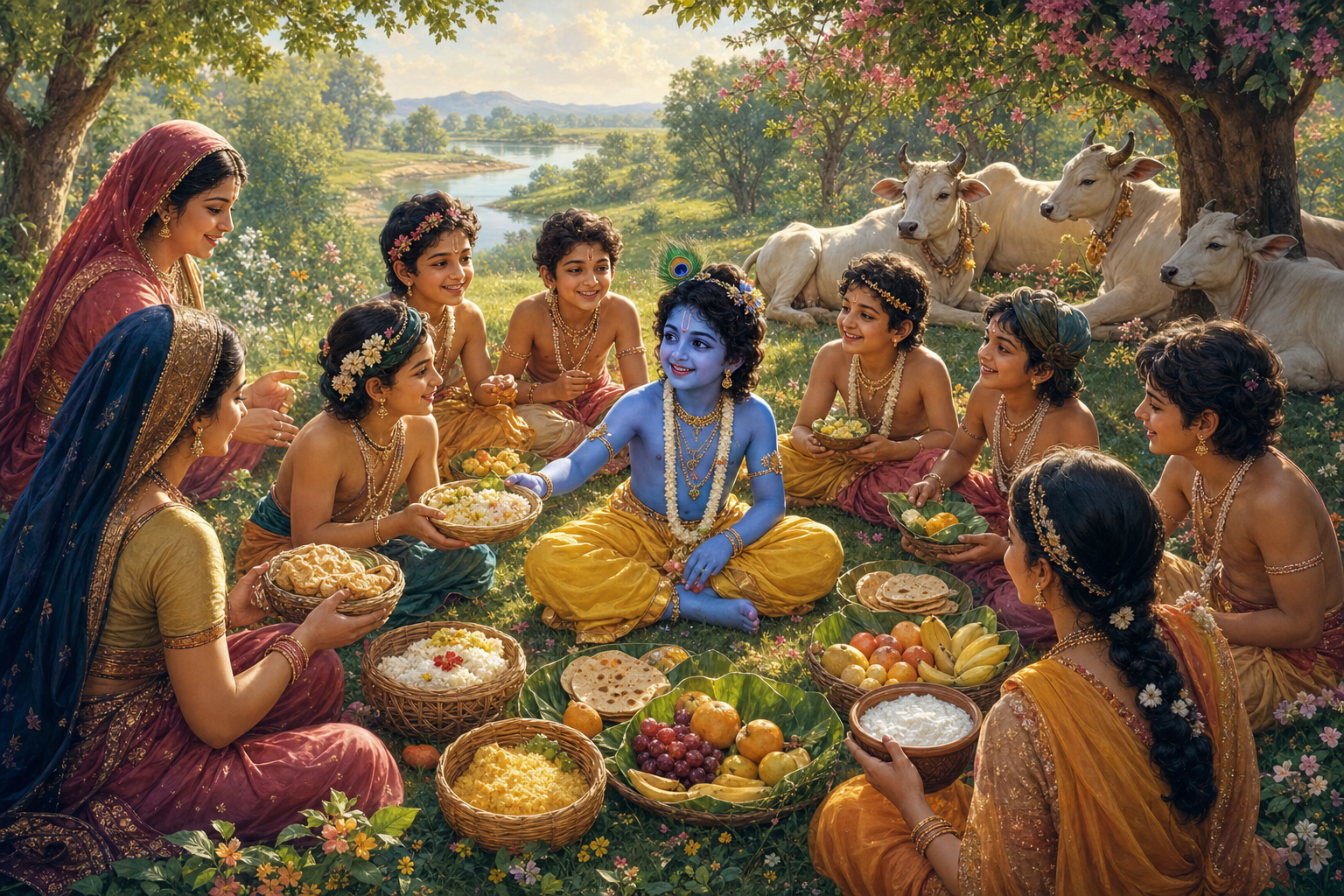
The bhakti transformation of yajna becomes especially intimate in Srimad Bhagavatam 10.13.4–11. Kṛṣṇa, the yajña-bhuk or enjoyer of sacrificial offerings, sits among His cowherd companions during a meal. His flute is tucked to one side; His horn and herding staff remain close. The cosmic recipient of formal offerings allows Himself to be approached, fed, teased, and loved as a friend.
The setting changes how you understand sacred exchange. The food is simple, the assembly informal, and the relationship immediate. Yet none of this makes the moment spiritually trivial. Majesty is present without creating distance, and affection is free without denying divinity. In Gaudiya theological language, this simultaneous intimacy and transcendence is consistent with acintya-bhedābheda: Kṛṣṇa is both the sovereign enjoyer and the distinct, near companion who reciprocates with His devotees.
Bhakti therefore does not merely shrink a large sacrifice into a small domestic ceremony. It clarifies the recipient. Food prepared for private enjoyment becomes bhoga when it is offered, and it is received as prasāda when it returns through grace. The physical food may look unchanged, but the relationship to it has changed. Possession gives way to reception; appetite is placed inside gratitude; nourishment is connected to service.
A daily meal practice that preserves this logic
You can bring this understanding into an ordinary meal without pretending to perform a Vedic fire sacrifice:
- Prepare with attention. Choose food consistent with your sampradāya, responsibilities, and commitment to non-harm. Cleanliness and care are part of the offering, not preliminary chores beneath it.
- Set apart what will be offered. Do not begin eating absent-mindedly and remember gratitude afterward. Place the offering first, in the manner taught in your household or lineage.
- Name the dedication. Address Kṛṣṇa, your iṣṭa-devatā, or the Divine according to your practice. Let the intention be concrete: may this nourishment support service, steadiness, and the welfare of beings rather than indulgence alone.
- Receive rather than seize. Eat as one receiving prasāda. This means attention, moderation, and respect for the labor and life involved in bringing food to the plate.
- Extend the circle. Share suitable food, support annadāna, welcome another person to the table, or direct part of your resources toward nourishment for someone beyond your household.
- Account for what remains. Store usable food properly, avoid needless waste, and clean the place of preparation. Gratitude that produces preventable waste has not yet reached practical completion.
If your lineage prescribes a mantra or procedure, follow it rather than improvising from a generic template. If you have not received such instruction, a sincere pause and a plain dedication are more honest than claiming technical authority you do not possess. The aim is to cultivate relationship and responsibility, not to perform expertise.
Use five questions to test whether an action is yajna
The word yajna can dignify service, but it can also conceal vanity, waste, or coercion. Ask these questions before a ceremony or charitable action, then ask them again after it. The second examination matters because noble intentions do not guarantee a Dharmic result.
Key takeaways
- What am I actually offering? Identify the food, wealth, time, comfort, control, or attachment being relinquished. If the answer is nothing, call the act appreciation or reflection rather than sacrifice.
- To whom is it dedicated? Name the recipient and purpose. An offering to Bhagavan should not quietly become an offering to your reputation.
- What avoidable harm can be removed? Check the treatment of people, animals, materials, and the place itself. Compassion should alter the method where the method burdens the vulnerable.
- Who is nourished or protected afterward? Look for a real return: prasāda shared, a person fed, a worker treated with dignity, an animal cared for, a community supported, or resources used more responsibly.
- Can the action accept correction? A living practice can pause when harm becomes visible, consult legitimate guidance, and improve without treating every question as hostility to tradition.
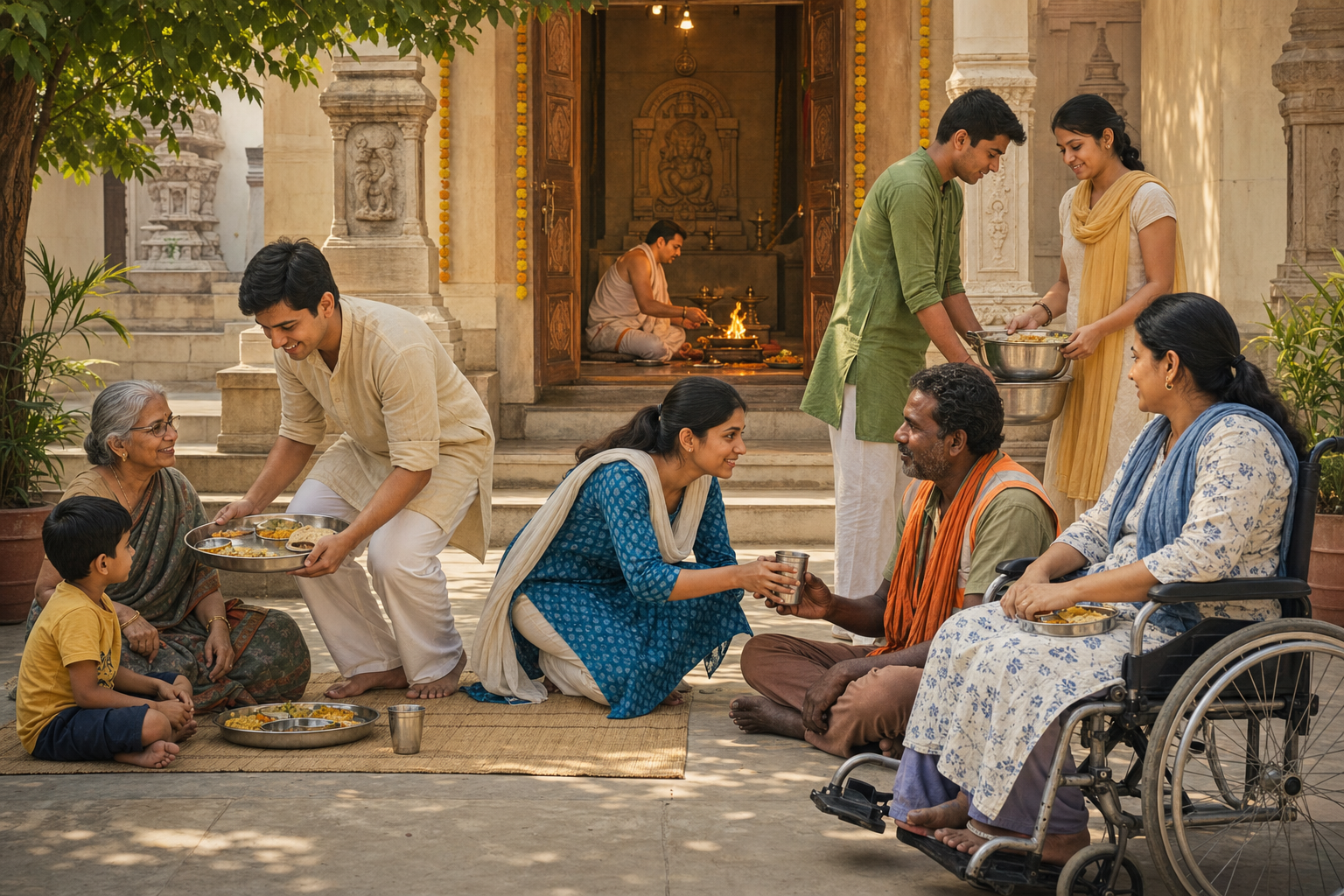
These questions change practical decisions. If a festival schedule exhausts the people serving it, build in water, food, shade, rest, and rotation rather than praising overwork as devotion. If a household puja generates more offered food than anyone can use, reduce the quantity or arrange distribution before the ceremony. If dāna requires humiliating photographs of recipients, protect their dignity and document the expense without turning need into a stage.
The same test applies to ritual materials. Plan acquisition and disposal as parts of the observance, not as unrelated tasks left for later. A clean altar followed by a burdened public space is a divided practice. The world-sustaining claim of yajna should remain visible after the final mantra.
Keep compassion rooted in tradition and devotion in service
Formal rites require qualified guidance
Compassion does not authorize you to replace prescribed mantras, ingredients, officiants, or procedures and then present the result as the identical inherited rite. Before changing a formal homa or shrauta observance, ask an ācārya or competent ritual specialist rooted in the relevant tradition which elements are fixed, which are customary, and which admit symbolic alternatives. If you are performing a devotional food offering or organizing seva, describe it accurately. Honesty about the form is itself part of dharma.
Nor should ahiṃsā become a weapon for casually condemning ancestors, texts, or communities whose ritual reasoning you have not studied. Ethical interpretation requires historical care as well as moral clarity. You can reject avoidable harm, support non-harming practice, and still resist caricaturing the complex ritual inheritance of Bharat.
Dharmic traditions share an ethical concern without becoming identical
Hindu, Jain, Buddhist, and Sikh paths approach sacrifice through distinct scriptures, disciplines, and theologies. Their similarities should not be used to erase those differences. Yet a recognizable ethical family resemblance remains. Jain traditions bring ahiṃsā and aparigraha to the critique of harming and possessiveness. Buddhist narratives often place compassionate action above royal prestige. Sikh teachings join dayā with sarbat da bhala, while langar makes shared nourishment and dignity concrete. Hindu bhakti turns offered food into prasāda and expands sacred generosity through annadāna.
The shared ground is not a single theory of ritual. It is the demand that spiritual action loosen selfish possession, protect life, discipline appetite, and serve more than the performer’s status. This gives you a way to recognize kinship across Dharmic traditions without forcing them into sameness.
For your next meal, puja, or act of seva, make a one-sentence saṅkalpa. Choose one thing you will genuinely relinquish, one preventable harm you will remove, and one recipient beyond yourself who will be nourished or protected. Complete the act without spectacle, then examine its consequences. When devotion directs the offering and compassion governs its method, yajna becomes more than something you observe. It becomes the way you return what you have received.
References
- DharmaRenaissance Blog — Child Sita’s Mercy Stops Dasharatha’s Ashvamedha Horse: A Timeless Lesson in Dharma
- Dandavats — Srimad Bhagavatam 10.13.4–11: Kṛṣṇa as yajña-bhuk in a Dazzling Vraja-Līlā of Love and Wisdom
