

When you face a difficult choice, the loudest option can look like the courageous one: strike back, prove your loyalty, use every power available, or refuse to yield. Dharmic heroism asks a harder question. What does your power serve, and what will it permit you to become?
You do not need control over the whole outcome to exercise moral agency. You need enough freedom to govern your intention, choose your method, accept accountability, and stop when action begins to reproduce the wrong it was meant to correct. Hanuman, Parikshit, Kashyapa, and Astika illuminate different parts of that discipline. Read together, their choices offer a practical way to distinguish service from self-display, acceptance from fatalism, and justice from revenge.
The first heroic act is mastery over impulse
Heroism is often associated with the decisive act at the height of a crisis. Dharmic narratives frequently begin the moral test much earlier, in an apparently small moment when someone still has time to govern the mind.
During a hunt, King Parikshit was overcome by fatigue and displeasure. He placed a dead snake on the meditating sage Samika, turning an agitated impulse into an abuse of royal power. Samika’s youthful son, Sringin, responded with a curse: within seven days, Takshaka would kill the king. The fatal bite came later, but the moral crisis began when a powerful man allowed his passing condition to determine how he treated someone who had not answered him.
That sequence gives you a concrete rule: when anger, exhaustion, humiliation, or injured status is driving the decision, delay any act that cannot easily be reversed. Do not ask only whether your grievance is legitimate. Ask whether you would choose the same method after your body has rested and your pride is no longer demanding an audience.
This matters more, not less, when you hold authority. A private irritation expressed through institutional, political, professional, or familial power does not remain private. Your role enlarges the consequences of your mood. Before acting, name the role you occupy and the duty attached to it: parent, teacher, manager, public representative, elder, volunteer, or friend. Then ask what that role requires from you that your emotion would prefer to ignore.
Parikshit did not simply dismiss the consequences. He turned toward atonement, counsel, ascetic discipline, ritual precautions, guards, and the company of sages. His later seriousness matters, but it does not erase the initiating act or guarantee immunity from its result. That distinction is essential in ordinary life. An apology acknowledges a wrong. Restitution attempts to repair what can be repaired. Precaution limits further damage. None of them entitles you to escape every consequence.
A shallow idea of agency says, “I chose, so I am free.” A Dharmic understanding is more demanding: because you can choose, you are answerable for the state of mind, use of power, and chain of consequences your choice sets in motion. The first mark of the hero is therefore not spectacular strength. It is the ability to prevent a transient impulse from commandeering a lasting duty.
Hanuman makes power answerable to service
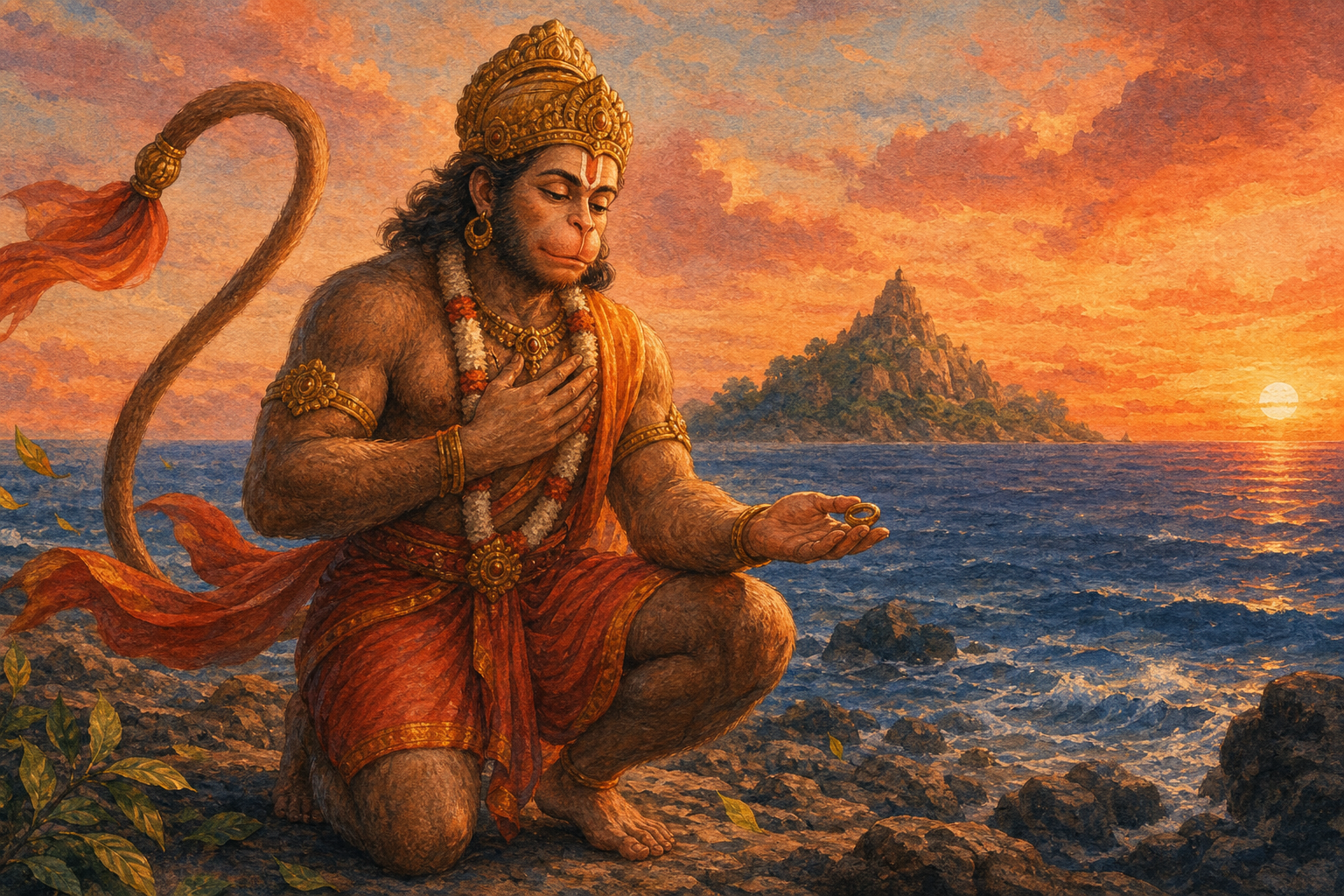
Self-control by itself is incomplete. A person can be disciplined and still serve vanity, domination, or fear. Moral agency becomes heroic when disciplined capacity is placed at the service of a rightful purpose.
Hanuman’s feats are immense: he crosses the ocean to Lanka, enters hostile territory, carries vital intelligence, burns Lanka, and bears the mountain associated with life-saving aid. Yet magnitude is not what makes these acts heroic. His strength belongs to a mission larger than his reputation. Courage works with intelligence, loyalty, humility, and seva. Power is impressive; power that accepts moral direction is trustworthy.
The Sundara Kanda makes that direction especially clear. Hanuman has a defined task, encounters obstacles that demand different responses, finds Sita, communicates hope, and returns with knowledge needed by the wider fellowship. He does not treat every obstacle as an invitation to display maximum force. He observes, adapts, speaks, reassures, fights, and withdraws according to what the mission requires.
You can apply the same discipline before using authority or skill. First state the mission in one sentence without mentioning your own status. Then name the person or community meant to benefit. Finally, define the point at which the intervention should end. If you cannot identify a beneficiary beyond yourself or your faction, the act may be self-assertion wearing the language of duty. If you cannot define an end, a legitimate mission can expand into domination.
Hanuman’s relationship to the vanara sena adds another corrective. His individual gifts do not make the fellowship dispensable. He contributes what others cannot, but his achievement remains part of a shared undertaking. Even his temporarily forgotten strength is renewed through remembrance, companions, and mentorship. Moral agency is personal, but it need not be solitary.
When your own judgement is clouded, ask a trusted person to identify the duty, affected party, or foreseeable consequence you may be omitting. This is not surrendering agency. It is protecting agency from the blind spots created by pride and urgency. A companion who recalls your capacity can strengthen you; one who recalls your limits can save you from misusing it.
Hanuman’s combination of devotion, disciplined strength, and service also resonates beyond one Hindu setting. Seva and the saint-soldier ideal give Sikh reflection a way to unite devotion with duty. Buddhist attention to right intention and right effort emphasizes the moral quality of the mind directing action. Jain ethical discipline keeps restraint and responsibility before the actor. These traditions should not be collapsed into a single doctrine, but their points of resonance reveal a shared warning: ability does not validate itself.
Destiny limits control, not accountability

The language of karma and destiny can deepen responsibility, but it can also be misused to avoid it. “It was meant to happen” is sometimes wisdom spoken after sincere effort. It can also be an excuse offered before duty has been attempted. The difference lies in what the speaker did while action was still possible.
Kashyapa sets out to save Parikshit because he possesses knowledge capable of countering poison. On the road, Takshaka demonstrates his venom by reducing a tree to ashes, and Kashyapa restores the tree, proving the efficacy of his knowledge. Human skill therefore remains a real force in the episode. Destiny does not enter an empty world in which effort is meaningless.
The moral difficulty arrives when Takshaka insists that the king’s death has already been sealed by a Brahmin’s curse and aligned with a deeper order. Kashyapa accepts gifts and turns back. His withdrawal admits more than one reading. It may be recognition that intervention would oppose an unavoidable karmic consequence. It may be prudential submission to an order beyond his authority. Yet the accepted gifts and resulting retreat also prevent an easy verdict that every refusal to intervene is spiritually elevated.
That ambiguity is useful because your own claims about inevitability also require scrutiny. Ask who is declaring the outcome fixed. Is that limit observable, or is it being asserted by someone who benefits from your withdrawal? Have you exhausted the action proper to your role? Would you make the same decision without personal reward, safety, prestige, or convenience attached to it? A conflict of interest does not automatically prove a choice wrong, but it does remove your right to present the choice as morally obvious.
Agency is not sovereignty. You can govern preparation, intention, honesty, method, and willingness to repair. You may influence other people and surrounding conditions. You cannot command every outcome. Confusing agency with total control produces arrogance; confusing limited control with helplessness produces passivity. Dharmic responsibility occupies the demanding ground between them.
In ordinary decisions, do not imitate the metaphysics of an epic by casually declaring an event fated. Imitate the ethical discipline: make the effort that belongs to your duty, disclose any interest that might distort your judgement, and accept that a righteous method does not purchase a guaranteed result. Respecting a genuine limit and abandoning a difficult responsibility are not the same act.
This distinction is especially important when you possess rare expertise. Your ability creates a reason to consider helping, but not an unlimited mandate to intervene everywhere. Examine competence, role, foreseeable harm, consent where relevant, and conflicts of interest. If you step back, be able to explain which duty or limit requires restraint. If the only explanation is that action is inconvenient, destiny is being used as camouflage.
Astika shows why stopping vengeance is heroic

Some of the hardest moral choices occur after a real wrong, when grief has already secured public sympathy for retaliation. At that point, anger rarely presents itself as anger. It calls itself justice, loyalty, or defence of the injured.
After Takshaka kills Parikshit, the king’s son Janamejaya begins the Sarpa Satra, a sacrifice directed toward the destruction of serpents. Astika intervenes and halts the retaliatory rite, ending the movement from one death toward collective annihilation. Heroism here does not appear as superior force defeating an enemy. It appears as the courage to interrupt vengeance after vengeance has acquired ceremonial, political, and emotional momentum.
The episode gives you a clear way to detect when a response is leaving the ground of dharma. The target widens from the responsible actor to an entire category. Protection of the living gives way to humiliation or eradication of the blamed. No stopping point can be named. Counsel for restraint is treated as betrayal. When these signs appear, the grievance may remain real while the response becomes adharmic.
Stopping escalation does not require pretending that the initiating wrong never occurred. Astika’s intervention does not make Parikshit’s death unreal. Restraint preserves the distinction between accountability and indiscriminate punishment. It allows you to condemn an act without assigning collective guilt, protect people without making harm an independent objective, and preserve memory without turning memory into a licence for endless retaliation.
This is where ahimsa becomes a practical diagnostic rather than a decorative word. Ask whether the harm under consideration is tightly constrained by a protective duty or whether inflicting harm has become the emotional reward. Ask whether innocent or peripheral people have been absorbed into the target. Ask what fact, remedy, or safeguard would be sufficient to end the action. If no answer could ever be sufficient, you are no longer describing a bounded response.
Astika also corrects a common misunderstanding of courage. It can take more moral strength to stop your own side than to oppose an acknowledged enemy. The person calling for limits may risk being misunderstood by everyone whose grief has fused with the desire for revenge. Dharmic loyalty is not agreement with every act committed in the group’s name. At its best, loyalty prevents a community’s legitimate pain from being recruited into adharma.
Key takeaways: a seven-question Dharmic decision test

Before a consequential act, write down brief answers to these questions. The exercise is deliberately concrete. Moral language becomes unreliable when it remains vague enough to bless whatever you already wanted to do.
- What is governing my mind? Name anger, fatigue, fear, humiliation, attachment, compassion, or clarity. If an agitated state is demanding an irreversible act, pause.
- What duty belongs to my actual role? Separate what is yours to do from what your power merely allows you to do.
- Whom does this action serve? Identify a person, community, truth, or protective purpose beyond your reputation and factional pride.
- Is the method fitted to the mission? Choose the effective method that keeps force, exposure, punishment, and self-display within the narrowest responsible bounds.
- Am I disguising convenience as destiny? Test every claim of inevitability, especially when withdrawal brings you money, safety, approval, or relief from a difficult obligation.
- What is the stopping condition? State the result that will end the intervention. If nothing could ever be enough, the mission is vulnerable to becoming domination or revenge.
- What will I do if I am wrong? Decide in advance how you will acknowledge the mistake, repair what can be repaired, and protect others from further consequences.
The test does not ask whether you are certain to win. That is intentional. Moral agency concerns the quality of the choice available to you, not possession of the future. Hanuman shows how capacity can serve a disciplined mission. Parikshit shows how a momentary failure of self-rule can enlarge through power. Kashyapa exposes the uncertainty between accepting a limit and abandoning responsibility. Astika shows why an intervention may become most heroic at the moment it stops further harm.
If your proposed action fails the first three questions, you are not ready to act. If it passes them but has no stopping condition, narrow it before proceeding. If you cannot explain the choice to a wise person who is permitted to disagree with you, examine what secrecy is protecting.
The next time courage seems to demand an immediate answer, take one sheet of paper and write four sentences: my duty is; the person or truth served is; the limit I will not cross is; I will stop when. That small pause will not settle every conflict. It will reveal whether you are preparing to serve dharma or asking the language of dharma to serve your impulse.
References
- DharmaRenaissance Blog – Kashyapa and Takshaka: Destiny, Dharma, and the Unfolding Tragedy of King Parikshit
- DharmaRenaissance Blog – Hanuman’s Timeless Blueprint: How a Dharmic Hero Shaped the Modern Superhero Archetype
