

If you are deciding whether a ruler’s demand for order is dharmic, or whether resistance to that order is justified, the encounter between Vritrasura and Indra gives you a demanding test. Ask what is being obstructed, which duties have been abandoned, and whether the proposed remedy will restore accountable order or merely transfer arbitrary power to a new hand.
This matters because domination often presents itself as stability, while chaos presents itself as liberation. A dharmic reading accepts neither claim at face value. It looks beyond slogans to the conditions under which truth, duty, restraint, and life can move again.
Vritra is the pattern of enclosure

The Vritra motif first appears in the Rig Veda and is developed through later Itihasa and Purana traditions. That long transmission matters. It tells you that this is not merely an account of one combatant defeating another. It is a durable way of thinking about obstruction, order, power, and release.
The name Vritra carries meanings such as enveloper, covering, obstacle, darkness, and the absence of natural light. The related name Ahi evokes a dangerous serpent and is also associated with Rahu, whose eclipse imagery suggests the obscuring of light. The common thread is not ordinary disagreement. It is enclosure: something necessary has been covered, captured, or prevented from moving as it should.
That distinction keeps the symbolism precise. A rival is not automatically Vritra. A critic is not Vritra merely because criticism is uncomfortable. The Vritra-pattern appears when an obstacle begins to imprison the conditions of common life: knowledge cannot circulate, duties are demanded but not reciprocated, legitimate grievances cannot be heard, or power cannot be corrected by any accepted means.
In this discussion, anarchy means the collapse of norm-bound authority and shared duty. It is not a blanket judgement on every modern political philosophy that uses the name anarchism. Anarchy in the relevant sense can appear as visible disorder, but it can also hide inside an institution that still has offices, procedures, uniforms, and seals. If decisions depend on favour, fear, or faction rather than intelligible duties, formal structure may conceal moral lawlessness.
When you encounter a claim that society is being obstructed, ask three questions before choosing a side:
- What exactly has been enclosed? Name the blocked good: truthful speech, worship, livelihood, education, justice, public safety, or a fair hearing. If no one can name it without resorting to an enemy label, the diagnosis is probably too vague.
- How does the obstruction reproduce itself? Look for inaccessible appeals, selective enforcement, intimidation, concealed information, or duties imposed in only one direction.
- Who bears the cost? A genuine public concern should be visible in its effect on people and institutions, not merely in the wounded prestige of a leader or faction.
Dharma is more demanding than quiet streets
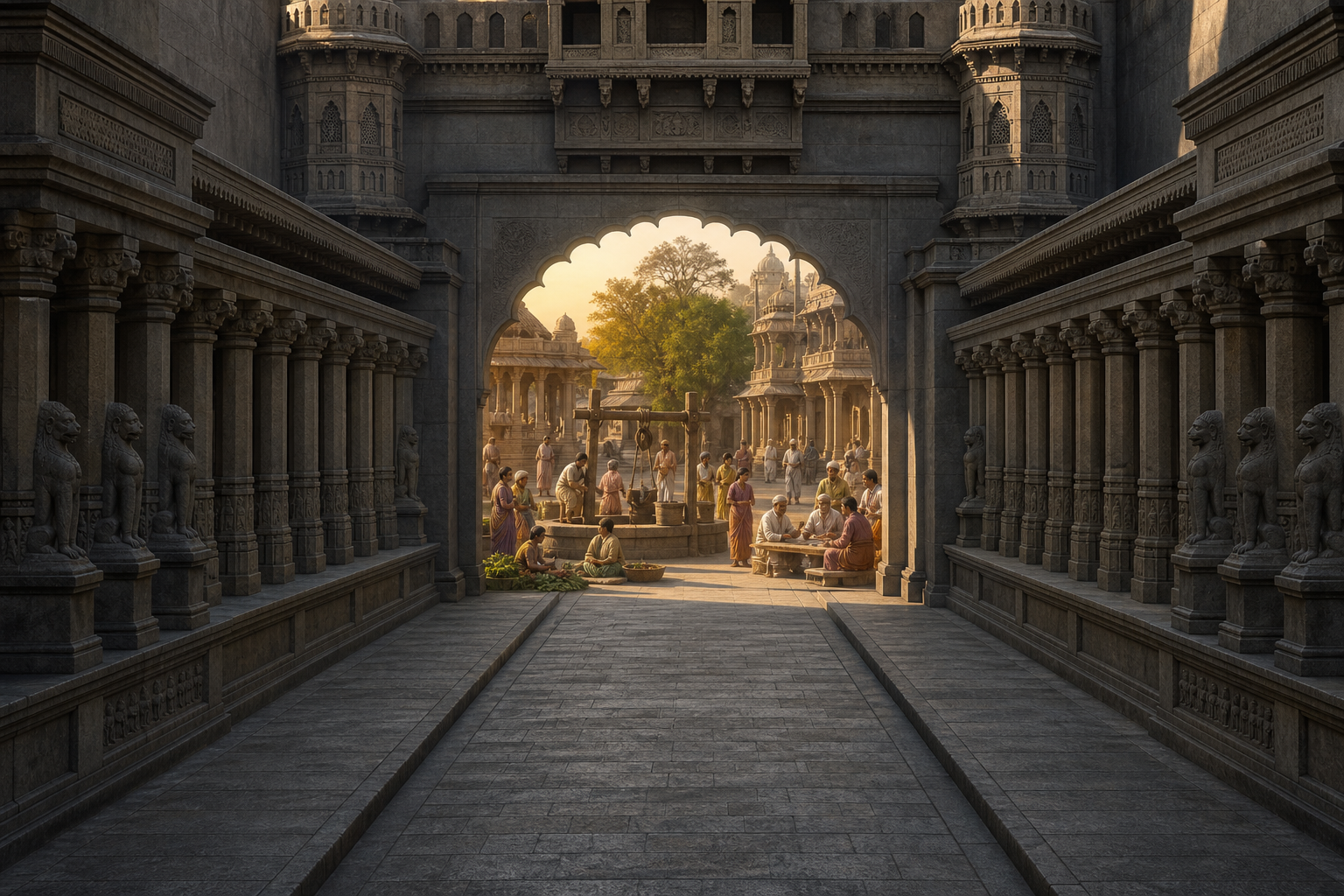
Dharma is sometimes reduced to order, and order is then reduced to obedience. That shortcut is dangerous. A society can be quiet because people trust its norms, or because they are afraid to speak. The outward stillness looks similar. Its moral structure is entirely different.
For this purpose, think of dharma as the order that sustains rightful relationships. It binds authority to duty, action to consequence, freedom to responsibility, and correction to restraint. It does not sanctify whatever arrangement already exists. A stable injustice remains unjust, while a disruptive correction may serve dharma if it is truthful, proportionate, and directed toward restoration.
You can test an institution, movement, or decision through four marks:
- Continuity: Does it preserve the conditions under which families, communities, sacred institutions, and legitimate public functions can endure?
- Reciprocity: Do those who claim rights also acknowledge duties, and do those who command others accept obligations of their own?
- Restraint: Are there limits on what may be done, even to a genuine wrongdoer? Dharma is not demonstrated by cruelty toward a person who has been declared adharmic.
- Repair: Can an error be acknowledged and corrected without destroying the entire community or treating every dissenter as an enemy?
These marks expose false order quickly. A family authority who demands obedience while neglecting personal duties has preserved hierarchy but weakened dharma. A state that applies law selectively retains legal form but introduces arbitrariness. A protest that exposes wrongdoing yet deliberately harms uninvolved people may oppose one injustice while creating another.
Do not ask only who disturbed the peace. Ask what obligations existed before the disturbance, who violated them, whether a credible path of correction remained open, and whether the response protects those who were not responsible. That sequence prevents peace from becoming a polite name for submission.
Indra represents capacity disciplined by purpose
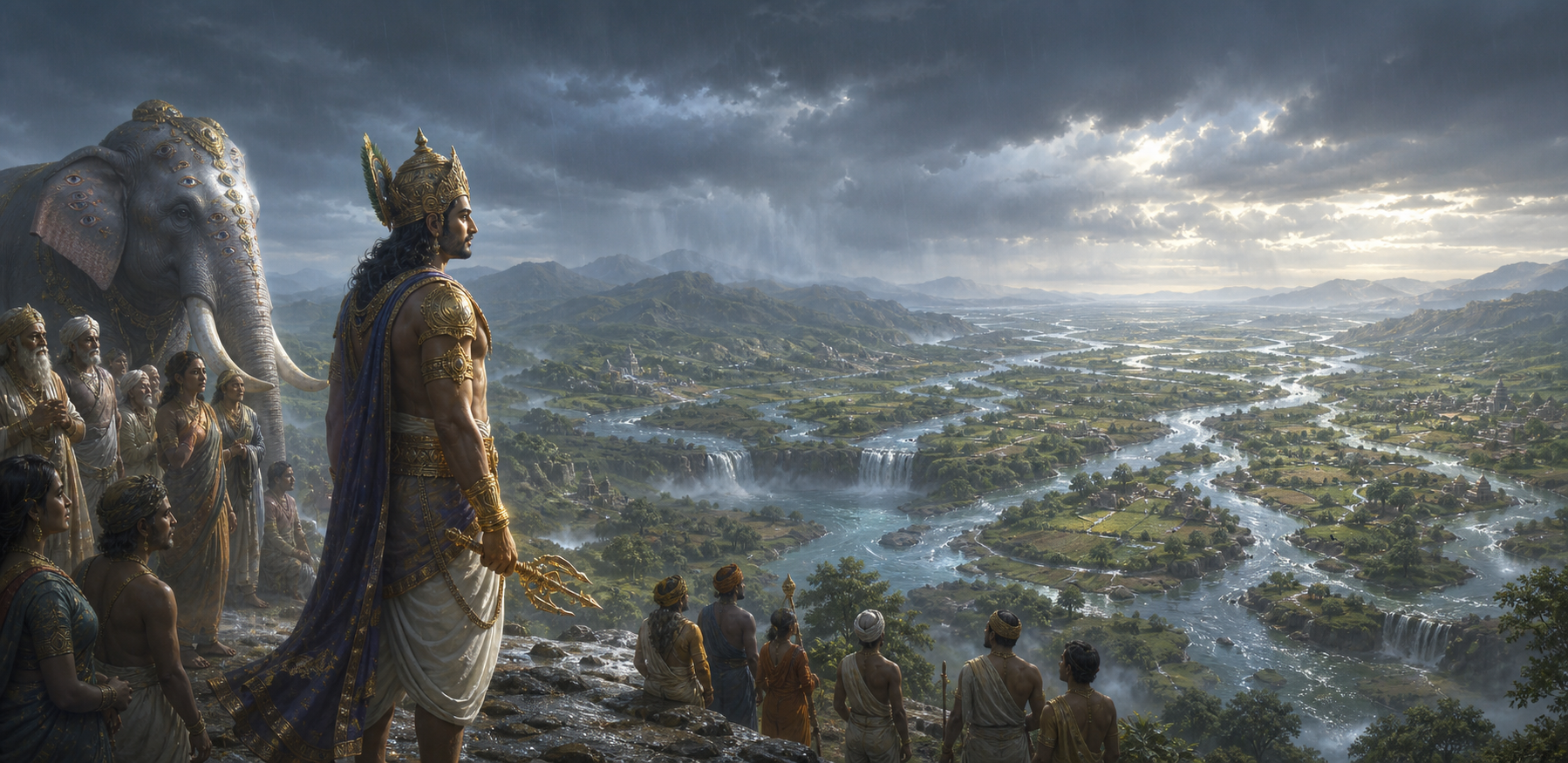
Indra matters in this encounter because obstruction cannot always be dissolved by naming it. Dharma needs intelligence, courage, and the capacity to act. A principle that cannot protect the conditions of life remains vulnerable to whoever is willing to use power without principle.
Yet strength is not self-validating. Victory does not retroactively make every method righteous. If power is dharmic only because it wins, then Vritra and Indra become interchangeable names for competing force. The decisive issue is whether power removes a defined obstruction and re-establishes a sustainable order under limits.
That requires five disciplines:
- A clear object: Act against the obstruction, not against an indefinitely expanding category of people.
- A limited mandate: State what authority is needed, for what purpose, and where it ends.
- Proportionate means: Use no more coercion than the protection or restoration of the threatened good requires.
- An after-state: Define what normal, accountable order should look like once the immediate obstruction has been removed.
- Answerability: Keep the actor subject to truth, review, and consequence. A restorer of order who cannot be questioned is already moving toward arbitrary rule.
The after-state is especially important. A leader who can describe the enemy in great detail but cannot describe the restored order is asking for allegiance to conflict, not dharma. An emergency that has no stopping condition becomes a method of government. An institution that defeats one form of capture only to reserve the same unreviewable powers for itself has changed occupants without ending enclosure.
This is why anarchy and despotism are not always opposites. Both allow consequential decisions to become arbitrary. In open disorder, many actors ignore common rules. Under despotism, one actor places itself above them. Dharma rejects both because it requires power to be capable enough to protect order and restrained enough to remain within it.
Use the encounter as a diagnostic, not a partisan slogan
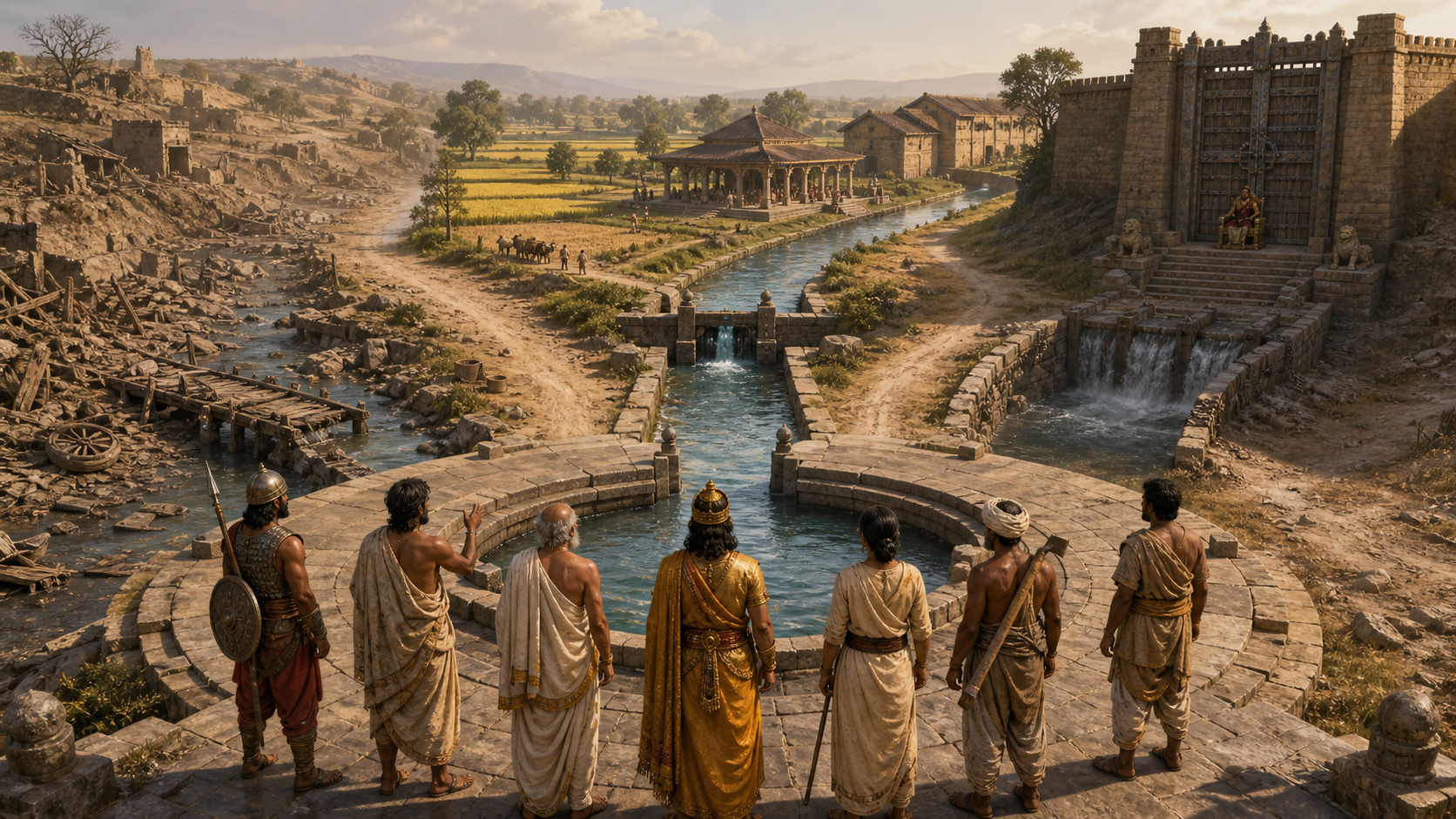
Sacred symbolism becomes politically dangerous when it is converted into a label-maker: our side is Indra, their side is Vritra, and every escalation is therefore sacred. That approach avoids self-examination, dehumanizes opponents, and treats a desired outcome as proof of righteousness.
A more disciplined application begins without mythic labels. Work through the facts first, then use the symbolism to examine the moral pattern.
- Name the blocked good in ordinary language. Write down what people can no longer do, receive, protect, or contest. Replace phrases such as “they are destroying everything” with a concrete description of the injury.
- Identify the relevant duty-holder. Ask who had the responsibility to prevent or correct the injury: a parent, trustee, teacher, religious authority, elected government, court, community body, or citizen. A grievance without a corresponding account of duty is incomplete.
- Separate the obstruction from the human being. Challenge conduct, policy, capture, intimidation, or dereliction. Do not treat birth, community, or disagreement as sufficient evidence of evil.
- Test the proposed remedy. Ask whether it is truthful, proportionate, protective of uninvolved people, open to correction, and consistent with the standards its advocates want others to obey.
- Describe restoration and its stopping rule. State what will become possible after success, which extraordinary powers will end, and how the restored authority will be held accountable.
This process corrects four common misreadings. First, not every conflict is a Vritra crisis; some are disputes among legitimate interests. Second, the existing order is not dharmic merely because it is old or peaceful. Third, the victorious party does not become Indra simply by prevailing. Fourth, a sacred narrative is not a mechanical prediction of modern events.
The narrative’s development across Vedic, Itihasa, and Purana settings also calls for interpretive care. Before invoking it in a public argument, say which aspect you are using: the symbolism of enclosure, the duty to confront obstruction, the morality of force, or the restoration of order. This prevents details from different layers of tradition from being flattened into a single political allegory.
For a private citizen, symbolic identification is never a personal licence to attack another person. The proper sequence is evidence, truthful speech, legitimate remedy, collective deliberation where appropriate, and proportionate action. If your chosen method depends on rumour, collective blame, or freedom from accountability, the method has already failed the dharmic test.
Key takeaways
- Vritra is best recognized as a pattern of enclosure: the obstruction of light, movement, duty, truth, or the conditions that sustain common life.
- Dharma is not identical to obedience, institutional continuity, or outward calm. It joins authority to duty and power to limits.
- Indra’s strength matters because dharma must be capable of confronting obstruction, but victory alone cannot prove that force was righteous.
- Anarchy can appear as public chaos or as arbitrary rule concealed inside a formally ordered institution.
- Before supporting a ruler, movement, protest, or emergency measure, identify the blocked good, the failed duty, the limits on action, the intended restoration, and the stopping rule.
The next time someone asks you to choose between unquestioning order and unbounded resistance, refuse the false choice. Name what has been enclosed. Trace the broken duties. Then support only the remedy that can restore movement without making arbitrariness permanent.
That is the practical demand of a dharmic politics: enough courage to confront obstruction, enough discernment to recognize false saviours, and enough restraint to ensure that the destroyer of one enclosure does not build the next.
References
