
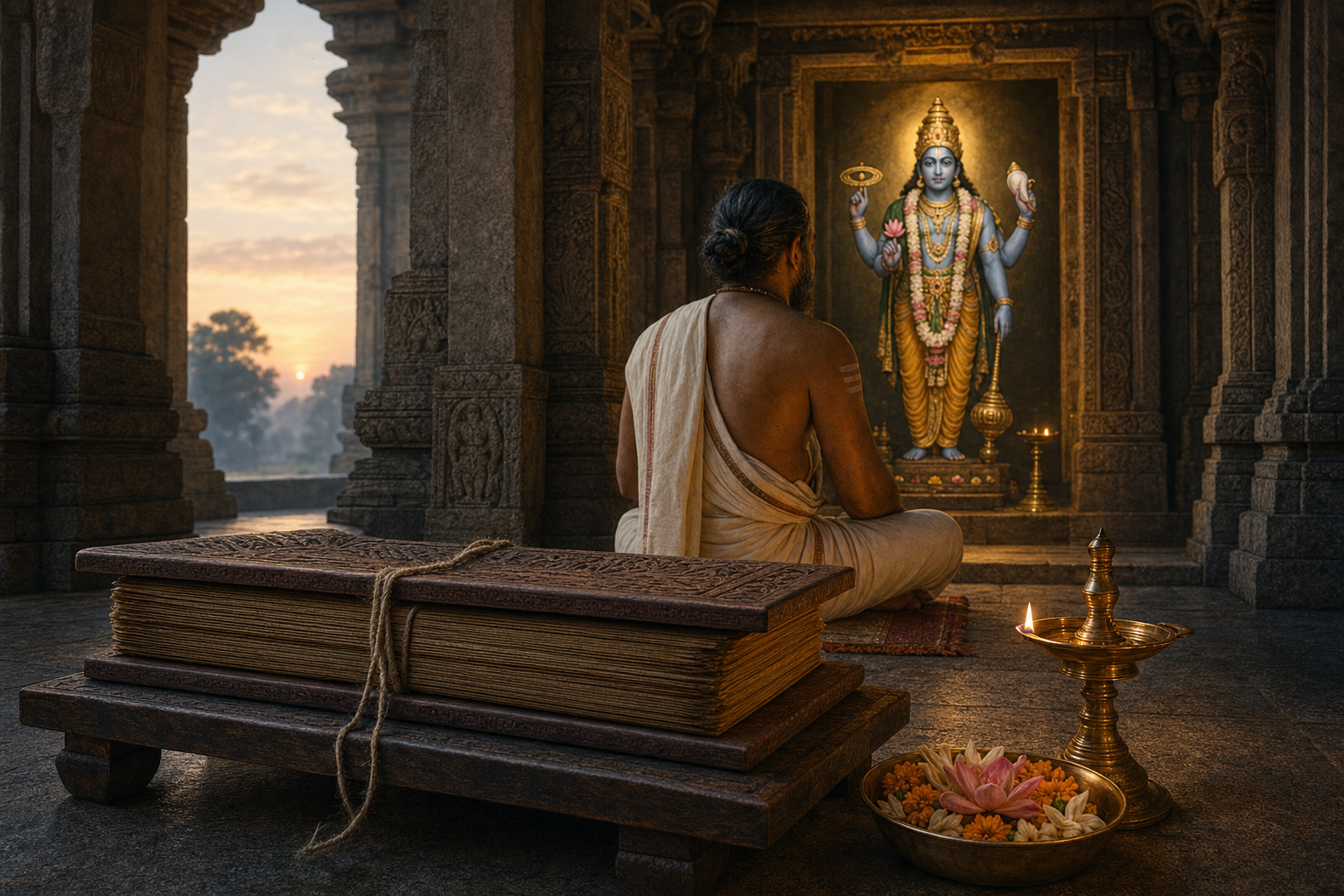
You may have encountered the Vishnu Samhita in a list of Agamas, a discussion of Vaishnava worship, or a temple bibliography and wondered what kind of work it is. Is it philosophy, a ritual manual, a devotional scripture, or something meant only for specialists?
The most useful answer is that these functions belong together. The Vishnu Samhita should be read as a Pancharatra scripture in which understanding Vishnu, worshipping Vishnu, and forming the worshipper are parts of one discipline. Once you see that structure, you can study it without reducing it either to abstract doctrine or to a collection of ritual instructions.
Place it correctly before you interpret it
Pancharatra is a Vaishnava scriptural and ritual tradition centred on the worship of Vishnu or Narayana. Its Samhitas belong to the broader Agamic world, where theology, liturgy, sacred images, disciplined conduct, and the ordering of worship are not treated as unrelated subjects.
The Vishnu Samhita is an important work within this Pancharatra corpus. Its significance lies especially in the way it joins devotional practice, philosophical reflection, and practical ritual order. That combination tells you how to approach it: a doctrinal passage may explain the vision behind worship, while a ritual passage may show how that vision is embodied.
Do not use “Pancharatra” as a synonym for every form of Vaishnavism. Vaishnava schools differ in their texts, commentarial authorities, temple customs, initiation systems, and accounts of how Agamic and Vedic authority relate. The Vishnu Samhita can illuminate a major current of Vaishnava tradition without becoming a universal manual for every devotee or temple.
This distinction matters whenever you meet an unfamiliar instruction. Before asking, “Should I do this?” ask, “Within what ritual community, for which participant, and under whose authority does this instruction operate?” That one change prevents many errors.
Key takeaways
- The Vishnu Samhita belongs within the Pancharatra stream of Vaishnava scripture and worship.
- Its philosophical and ritual dimensions should be interpreted together.
- It is not a handbook for all Hindu or even all Vaishnava practice.
- Study is open to a serious reader, but role-specific or initiation-dependent rites require guidance from the tradition that transmits them.
- Your first goal should be to understand the text’s structure and assumptions, not to collect isolated techniques.
Read ritual and philosophy as a single discipline
Modern readers often separate religion into beliefs and practices. Beliefs are placed in the mind; rituals are treated as external actions. That division is a poor reading tool for an Agamic scripture.
A ritual sequence can carry a theological argument. The identity invoked, the order of actions, the objects treated as sacred, the roles assigned to participants, and the purpose named for worship all reveal what the tradition believes about divine presence and human relationship with Bhagavan. Philosophy, in turn, gives ritual its direction. It explains why disciplined action should be more than habit or spectacle.
This does not mean that every procedural detail hides a secret metaphor. It means that procedure exists within a sacred vision. Your task is to identify that vision without making the text say more than it does.
Ask three questions of every passage
- What does this passage assume? Look for what it takes to be true about Vishnu, the worshipper, sacred presence, spiritual authority, or the purpose of worship.
- What does it require? Identify the action, sequence, participant, setting, and any stated conditions. Keep an instruction attached to its context.
- What is it trying to form? Notice whether the passage directs attention toward reverence, purity, order, remembrance, devotion, correct understanding, or another explicitly stated end.
Keep those answers separate in your notes. If the passage prescribes an action, do not silently turn it into a universal philosophical principle. If it teaches a theological truth, do not assume that you have thereby received authority to perform every related rite.
This method also makes ritual detail readable. Instead of seeing a sequence as a long list to memorise, you begin to notice relationships: preparation before invocation, qualification before action, attention before offering, and completion rather than abrupt abandonment. Follow the sequence actually present in the passage; do not fill gaps with procedures borrowed from another school.
Use a thirty-chapter method instead of reading at random
The Vishnu Samhita is organised across thirty chapters. That is manageable enough for a complete first pass, but substantial enough that random excerpts will give you a distorted picture. A striking passage can appear more universal than it is when detached from the chapters around it.
Use one chapter as the unit of study. One chapter per sitting gives you a thirty-session plan, but do not force a dense chapter into a single sitting. The aim of the first pass is orientation, not mastery.
- Record the chapter number and give it a provisional one-line title of your own. Mark that title as provisional so you do not mistake your summary for the text’s terminology.
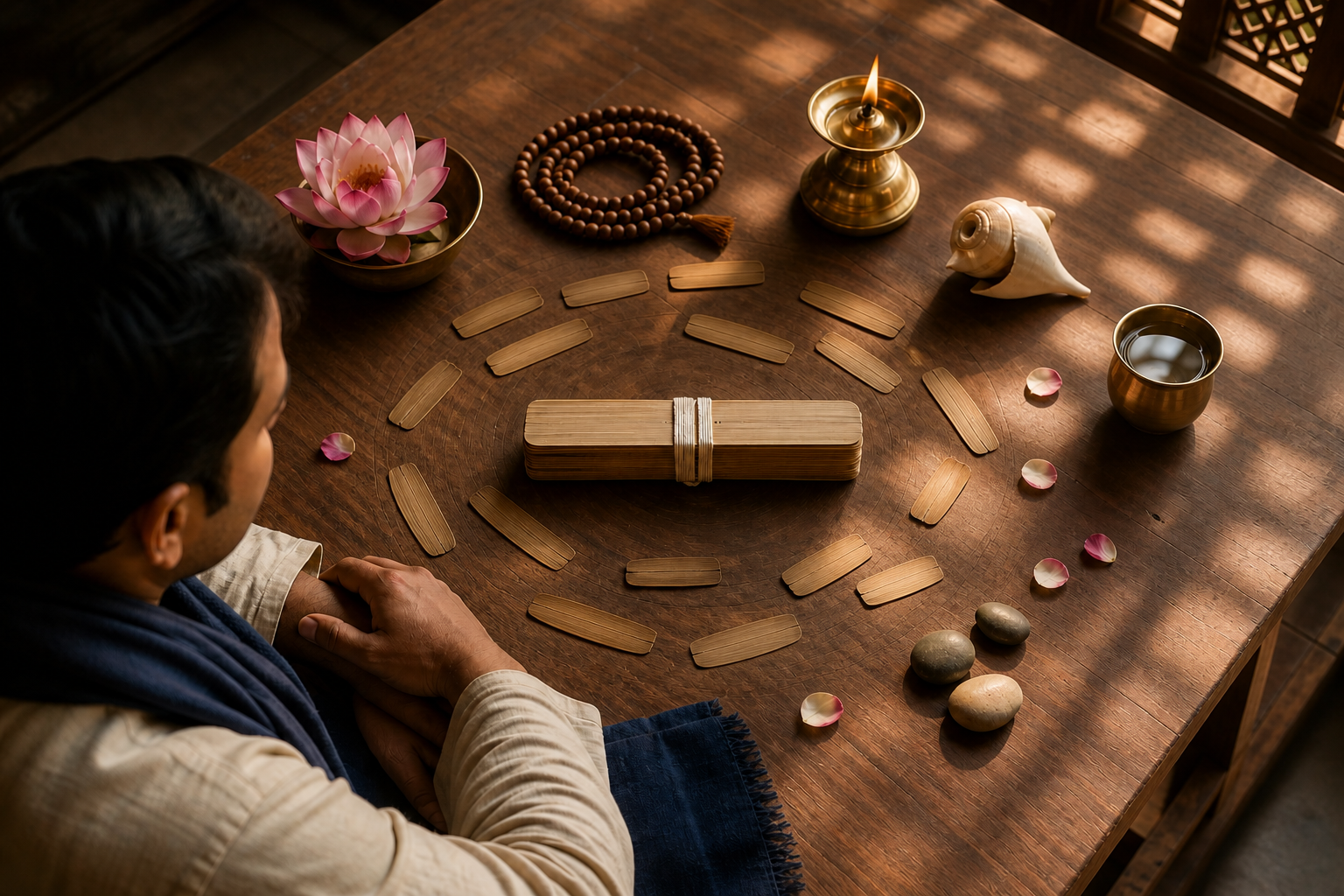
- Divide a page into three fields: vision, action, and aim. Under vision, note theological assumptions. Under action, note what is prescribed and who appears responsible. Under aim, copy or paraphrase only the purpose the passage actually states.
- Circle every technical term you cannot yet explain. Build a glossary from repeated usage rather than assigning a definition after its first appearance.
- Mark changes of audience. A general teaching, a personal discipline, and an instruction directed to a ritual specialist cannot automatically be applied in the same way.
- After all thirty chapters, create a one-page index with one entry per chapter. Only then group recurring subjects and identify the work’s larger pattern.
This two-pass approach solves a common problem. On the first pass, you preserve context. On the second, you can compare themes without pretending that every occurrence has the same function.
Your choice of edition also affects what you can notice. Prefer an edition or translation that clearly preserves chapter divisions, identifies technical Sanskrit terms, and distinguishes translation from explanation. If two editions number or render a passage differently, record the difference rather than harmonising it from memory. An elegant English paraphrase may be easy to read while concealing distinctions that matter in ritual interpretation.
Do not begin by hunting for the most esoteric-sounding passage. Begin with the text’s own order. A scripture that unites philosophy and practice must be allowed to establish its vocabulary before isolated statements are made to carry the weight of the whole tradition.
Avoid the five misreadings that cause the most confusion
- Treating it as a manual for all Hindu worship. The proper scope is Pancharatra and Vaishnava. Broader comparisons can come later, after you understand the work on its own terms.
- Extracting ritual steps for immediate use. A written instruction does not tell you by itself whether initiation, ritual office, temple authority, prior preparation, or oral transmission is required. If a passage assigns an act to a particular participant, retain that assignment.
- Keeping the philosophy and discarding the ritual. This removes the embodied discipline through which theological claims acquire practical form. Even when you do not perform a rite, its order can help you understand the tradition’s account of worship.
- Assuming every statement has the same level of application. Distinguish a general theological claim from a context-bound prescription. Also distinguish what the text presents as an ideal from what a particular temple or lineage presently practises.
- Replacing traditional terms with modern analogies too quickly. Psychology, symbolism, or comparative religion may offer secondary perspectives, but none should erase the categories through which the scripture understands itself.
There is a simple test for your interpretation: can you identify the chapter, the immediate context, the intended participant, and the words that support your conclusion? If not, you probably have an impression rather than an interpretation.
The same discipline should govern claims about the whole Pancharatra tradition. One Samhita may reveal a great deal without speaking for every Pancharatra text, historical community, or living temple. Let the Vishnu Samhita be specific before asking it to be representative.
Let study mature into received practice
You do not need to be a ritual specialist to study the Vishnu Samhita seriously. You do need to recognise the boundary between understanding a practice and authorising yourself to perform it.
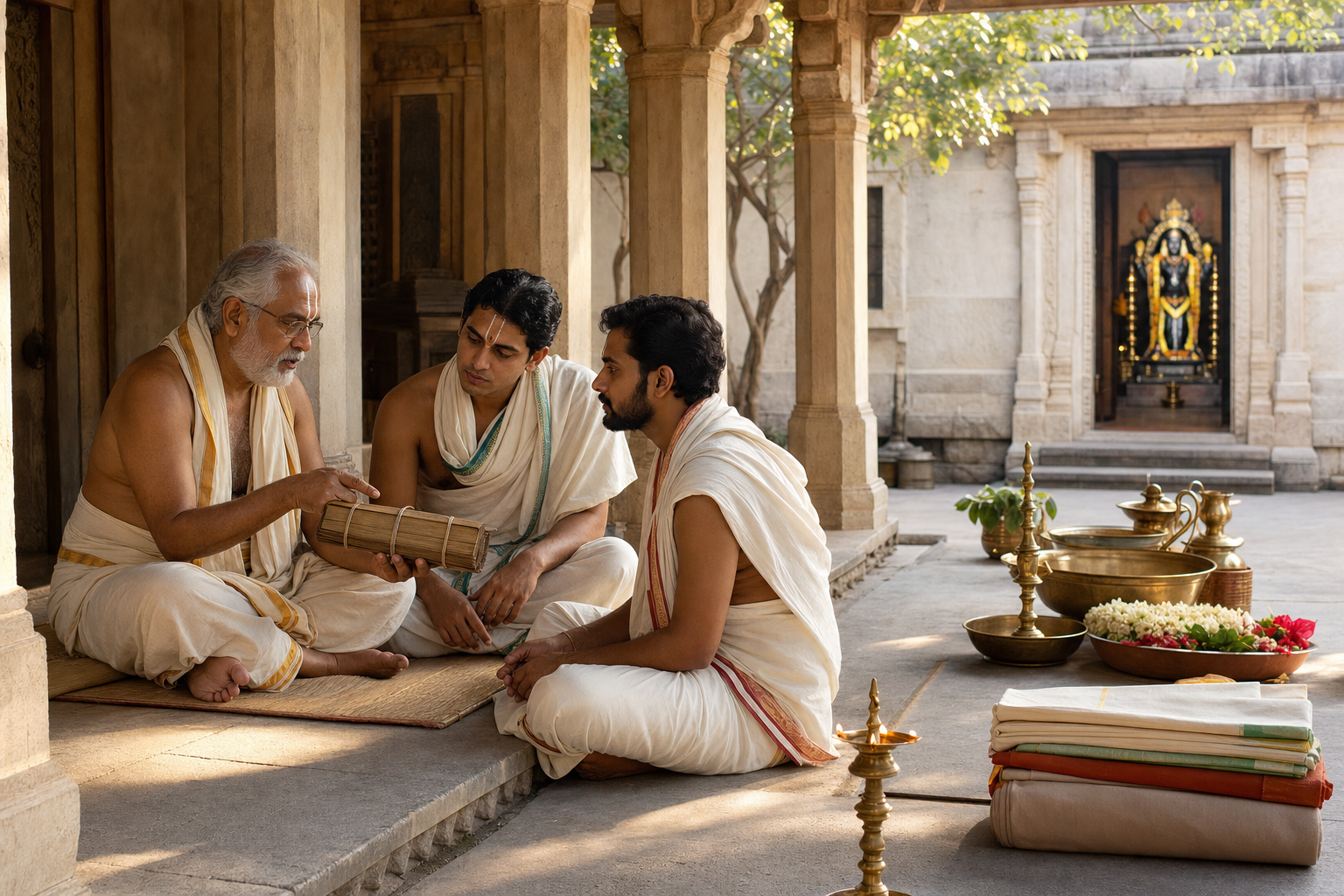
If you already belong to a Vaishnava lineage, compare your notes with the teaching and daily discipline you have received. Look for clarification rather than novelty. A text may deepen your understanding of a familiar act without requiring you to add a new one.
If you are an independent reader, concentrate first on structure, vocabulary, theology, and the roles named in ritual passages. When a technical instruction raises practical questions, take a focused question to someone who can identify the relevant lineage, temple setting, edition, and ritual authority. “Who is instructed to do this, and what qualification is assumed?” is much more useful than “Can I try this at home?”
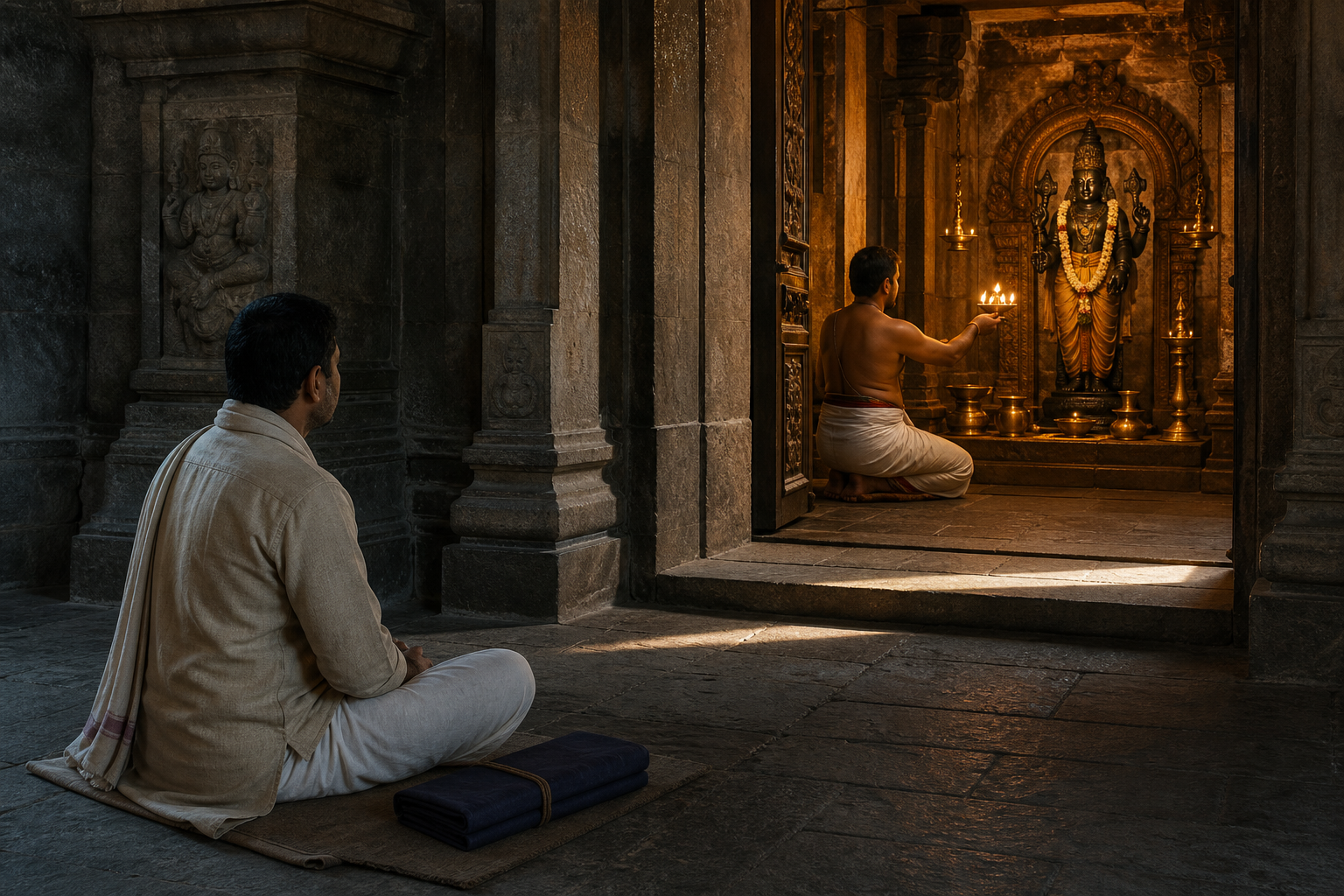
If you serve or volunteer in a temple, do not use a newly discovered passage to correct local procedure on your own. Ask how the temple’s established Agamic affiliation and received paddhati, or procedural tradition, relate to the passage. Textual learning should make service more attentive, not turn a sevak into a self-appointed ritual authority.
You can act immediately in one safe and fruitful way: bring greater attention to a devotional practice you have already received. Notice its sequence, the name of Bhagavan invoked, the disposition expected of you, and the way the act joins understanding with reverence. That is the central reading habit the Vishnu Samhita demands.
Start with the first chapter and a page divided into vision, action, and aim. Complete the thirty-chapter map before drawing large conclusions. By the end, you will not merely have collected information about Pancharatra; you will have learned to see how a Dharmic scripture turns theological understanding into disciplined worship.

References
