
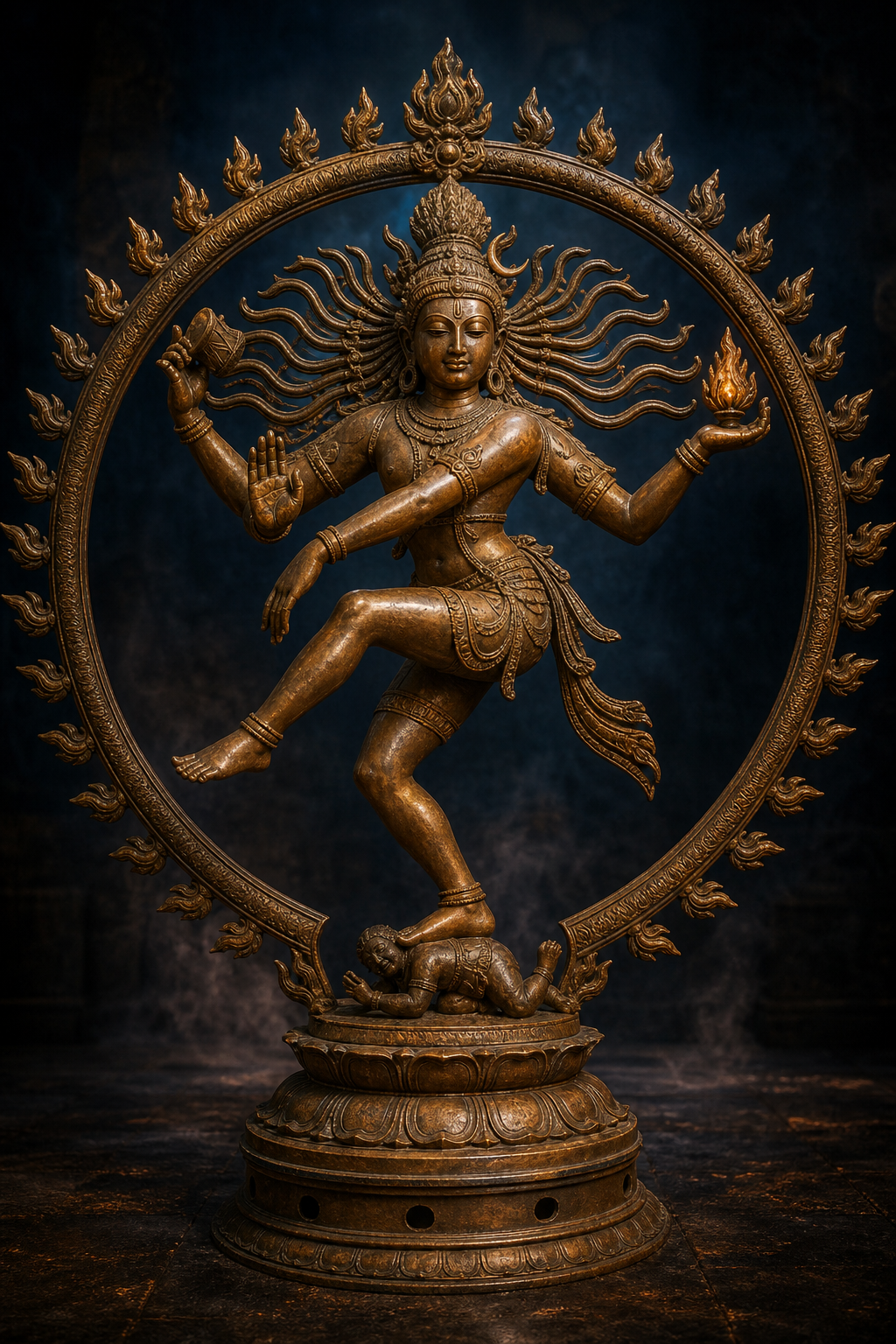
You may recognize Shiva immediately and still find the Nataraja image difficult to read. Four arms move in different directions, one foot presses a small figure, another rises, fire surrounds the body, and every detail seems to demand a separate explanation.
The image becomes clearer when you stop treating it as a collection of ornaments. Read it as a movement through five inseparable cosmic activities: creation, preservation, destruction, concealment and grace. The hands and feet provide the main path; the surrounding symbols deepen it.
Key takeaways
- Nataraja does not represent destruction alone. The dance holds creation, preservation, destruction, concealment and liberation within one rhythm.
- The drum marks creation through sound; the open right palm offers protection; the flame signifies destruction.
- The figure beneath Shiva’s right foot is Apasmara, the personification of forgetfulness or ignorance.
- The raised left foot represents grace, release and spiritual refuge; the lower left hand directs your attention toward it.
- The ring of flames is not merely a backdrop. It expresses the recurring movement of the cosmos.
- The modern comparison with moving atoms can be useful as a metaphor, but it should not be presented as proof that the sculpture encodes modern physics.
Begin with the five acts, not the individual ornaments

A common mistake is to reduce Tandava to a dance of annihilation. Destruction is present, but it is only one movement within the larger pattern. Shiva creates, sustains, destroys, conceals and releases. These are sometimes described together as pancha-kriya, the five activities.
| Cosmic activity | Visible sign | What to notice |
|---|---|---|
| Srishti, creation | Drum in the upper right hand | Form and differentiation arise through rhythm and sound. |
| Sthiti, preservation | Lower right hand in abhaya mudra | Existence is protected and steadied while change continues. |
| Samhara, destruction | Fire in the upper left hand | Forms must end; dissolution belongs to the cosmic process. |
| Tirobhava, concealment | Right foot pressing Apasmara | Ignorance and forgetfulness hide the true self. |
| Anugraha, grace or release | Raised left foot, indicated by the lower left hand | Liberation remains possible within the cycle, not outside it. |
Do not turn these five activities into a rigid timeline. The sculpture shows them happening together. The same Shiva who sounds the drum also carries the flame. The same body that subdues ignorance offers fearlessness and refuge.
This simultaneity is the central insight. Creation and destruction are not two gods pulling reality in opposite directions. They are coordinated movements within one divine dance. Preservation does not mean freezing the world as it is; it means sustaining order while forms continue to arise and pass away.
Read the hands and feet as one continuous teaching
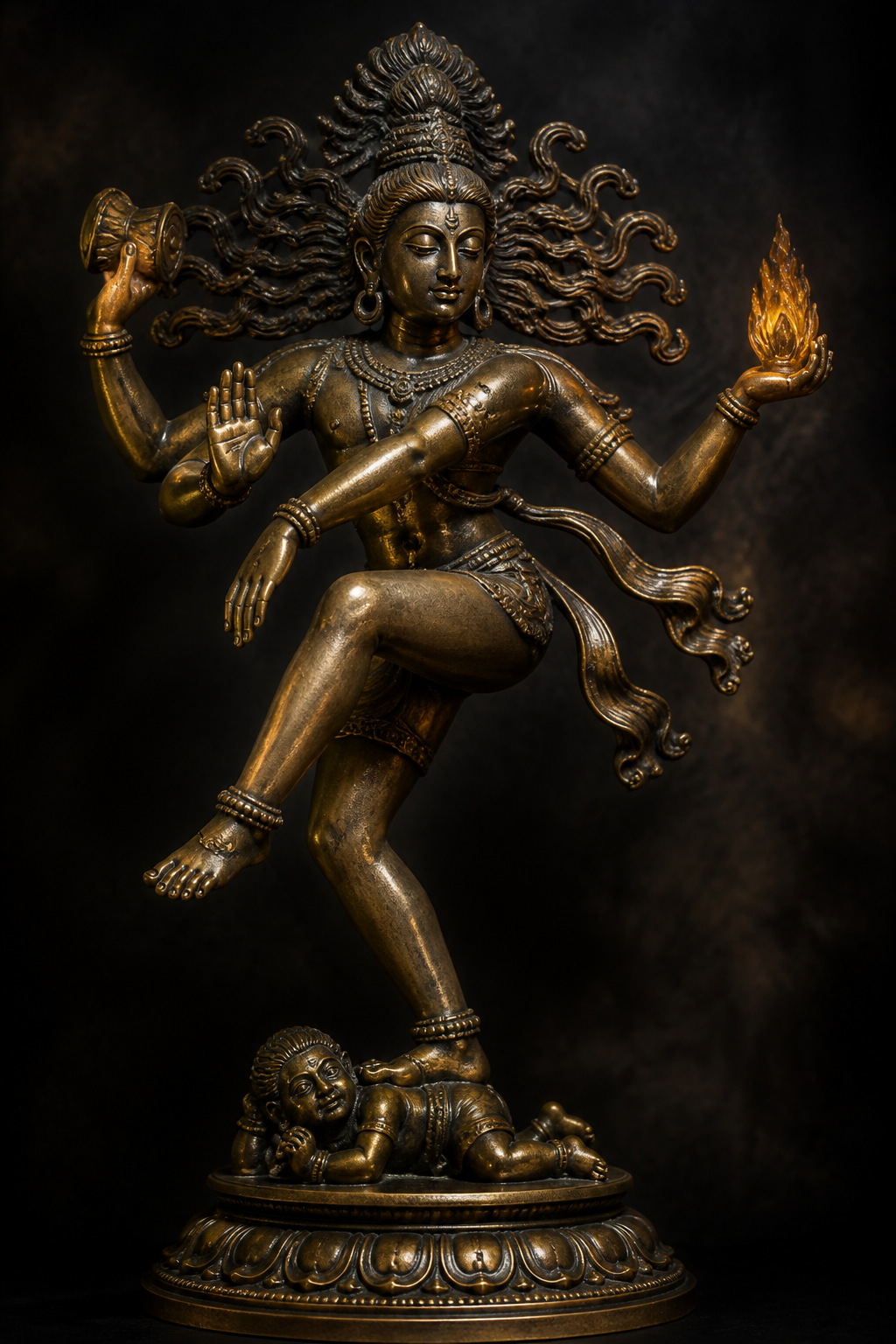
Descriptions of the right and left hands refer to Shiva’s own right and left, not yours as you face the image. Once that orientation is clear, trace the composition from the upper right hand, down to the lower right hand, across the left side and finally to the feet.
The right side joins creation to reassurance
The upper right hand holds the drum. Its repeated beat represents sound, rhythm and the emergence of creation. Within the philosophical framework behind the image, sound is associated with akasha, the subtle medium through which air, water, fire and earth become manifest.
That teaching is metaphysical, not a claim that ordinary sound waves manufacture physical matter. Its practical force lies elsewhere: beginnings require differentiation, sequence and rhythm. A beat divides silence into moments, just as creation distinguishes one form from another.
The lower right hand forms abhaya mudra, a gesture of protection and reassurance. Creation therefore does not open into abandonment. The image places a sign of safety immediately below the sign of arising. When you look at the open palm, notice that stability is included within change rather than promised only after change ends.
The left side joins destruction to refuge
The upper left hand carries fire, the sign of complete destruction. The flame answers the drum across Shiva’s body: whatever takes form will eventually lose that form. Neither hand defeats the other. Their balance prevents two opposite errors, the belief that everything can be preserved forever and the belief that destruction makes creation meaningless.
The lower left hand crosses the body in gaja-hasta mudra and directs attention toward the raised left foot. The visual line matters. The eye moves from the fire of dissolution toward the place of release. Destruction is not presented as the last word; the image directs the devotee through it toward sanctuary.
The two feet distinguish ignorance from liberation
Shiva’s right foot presses down Apasmara Purusha, the dwarf-like figure who personifies forgetfulness or ignorance. The elevated left foot signifies liberation and divine grace. The pointing hand ensures that you do not miss the contrast.
Apasmara should not be read merely as a small external enemy whom a stronger deity has defeated. He represents the obscuration that causes a person to forget the true self and mistake a partial identity for the whole. Shiva’s foot prevents that ignorance from directing the dance.
This gives you a sharper question than simply asking what Shiva is crushing. Ask what is being denied authority. Ignorance may remain visible within experience, but it need not govern awareness. Liberation appears when attention shifts from the figure beneath the foot to the foot that has been lifted.
Let the circle, hair and asymmetry deepen the meaning

Once the five activities are clear, move outward. The secondary details do not introduce a different message. They show the scale, energy and unity of the dance.
- The prabhamandala is a circular formation of flames rising from a lotus pedestal. It frames the dance as the cyclical movement of the cosmos. Because the ring returns to itself, the scene has no single visual moment that can be called the absolute beginning or final end.
- Shiva’s flying, matted locks make movement visible in a motionless sculpture. They tell you that the dance is not a polite pose but an outpouring of cosmic energy.
- Ganga appears as a small personified presence in the hair on Shiva’s right side, with folded hands in anjali mudra. The detail places the celestial river within Shiva’s dynamic form rather than outside his power.
- The crescent moon appears on the left side of the hair, while Shiva also bears the third eye. These signs broaden the figure beyond an ordinary dancing body.
- The serpent on the right arm signifies divine power. It belongs to the controlled energy of the composition, not to an accidental disturbance of it.
- The two earrings differ: the left is associated with femininity and the right with masculinity. Their pairing expresses Shiva’s union with Uma or Parvati and the reconciliation of what appears divided.
Use a hierarchy when examining a particular murti, bronze or photograph. First identify the drum, open palm, fire, pointing hand, Apasmara and raised foot. Then study the ring, hair, Ganga, moon, serpent and earrings. A small reproduction may omit fine details, so do not force an interpretation onto a feature that is not actually present.
The asymmetry is especially important. Different objects, gestures and earrings do not fragment Shiva. They are coordinated by the dance. The form does not erase dualities such as creation and destruction, masculine and feminine, motion and protection. It holds them without allowing them to break the whole.
Bring the symbolism into reflection without flattening it
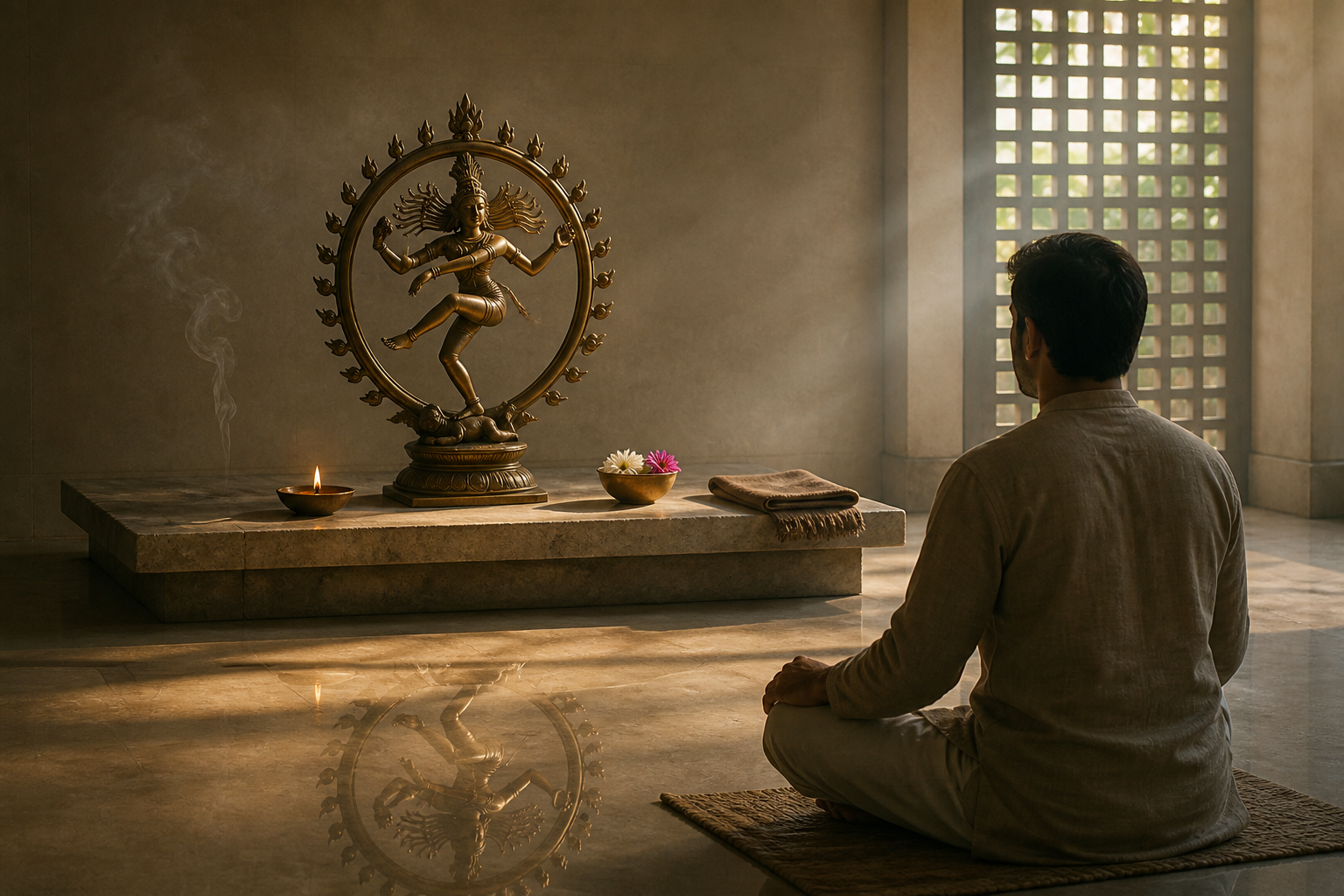
You do not need to memorize an iconographic catalogue before the image can shape your attention. The following five-pass exercise offers a disciplined way to study Nataraja. Treat it as a method of reflection, not as a claim that every Shaiva sampradaya prescribes the same ritual.
- Look at the drum. Name one thing that is genuinely beginning in your life. Be precise: a responsibility, relationship, discipline or stage, not merely “change.”
- Move to the abhaya hand. Decide what needs steady protection while that beginning develops. This may be a commitment, boundary, practice or duty.
- Look at the flame. Name what must be allowed to end. Distinguish a necessary ending from an impulsive rejection; the fire belongs to an ordered cycle, not to carelessness.
- Look at Apasmara. Identify the form of forgetfulness that could distort your judgment. Ask what you know in principle but repeatedly fail to remember in action.
- Follow the lower left hand to the raised foot. Choose one concrete act of release: relinquishing a false claim, loosening an attachment, correcting an assumption or seeking appropriate spiritual instruction.
Write one sentence after each pass. The discipline is useful because it prevents the symbols from dissolving into vague language. If you cannot distinguish what should be preserved from what should be released, remain with that tension rather than assigning everything uncomfortable to the flame.
Keep the physics comparison in its proper place
Nataraja is often described as a picture of the dance of atoms, the universe and all creation. The comparison can illuminate a cosmos understood as movement rather than inert substance. It also captures the inseparability of formation and dissolution.
Use that comparison as a philosophical metaphor, not an empirical equation. The symbolism does not by itself establish that ancient sculptors predicted modern particle theory or encoded contemporary formulas. Claims of that kind require scientific and historical evidence beyond a visual resemblance.
The restraint strengthens the Dharmic reading. Nataraja does not need to become a disguised physics diagram to be profound. The image already integrates cosmology, devotion, metaphysics and disciplined self-examination in a visual form.
Remember that Nataraja is a sacred form with a history
Nataraja is counted among Shiva’s twenty-five divine forms. Dancing representations of Shiva appeared in Tamil Nadu during the Pallava period, and the worship of Nataraja gained major momentum under the Cholas. The sculpture therefore belongs first to a living Shaiva and Tamil sacred world, not to a modern science illustration.
A.K. Coomaraswamy’s 1924 interpretation helped articulate cosmic activity as the central theme of the dance. That language remains useful, provided it does not displace the fivefold religious meaning carried by the drum, flame, gestures and feet.
The next time you stand before Nataraja, resist the urge to decode every ornament at once. Follow the image’s own direction: hear the drum, receive the open palm, face the flame, notice what lies beneath the right foot and follow the pointing hand toward the raised foot. Then decide which of the five movements your present situation requires you to recognize.
References
