
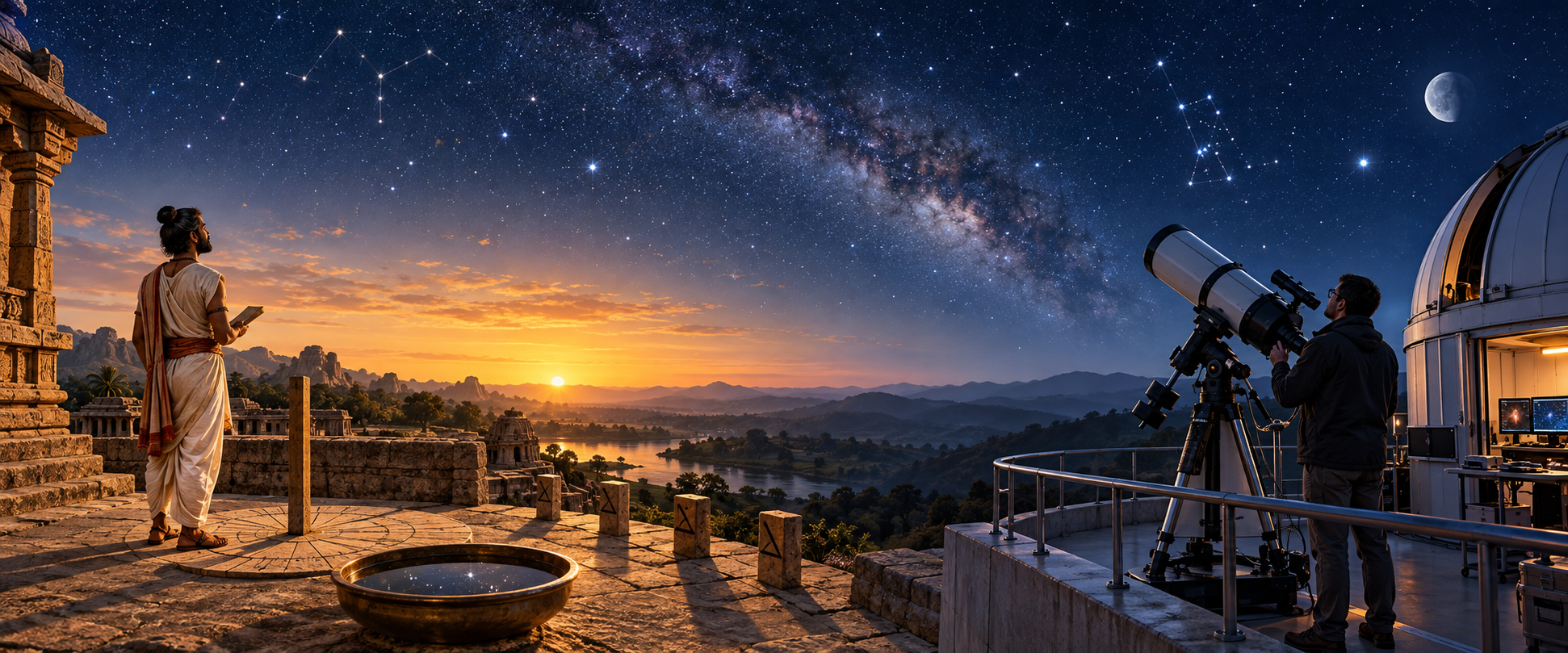
If you arrived because someone claimed that a Vedic verse anticipated modern astronomy, you need a better answer than immediate belief or dismissal. The comparison can be intellectually serious, but only when we identify exactly what is being compared.
There are genuine parallels in the questions asked, the attention given to celestial order, the use of recurring cycles, and the effort to place human life inside a much larger cosmos. That does not make a scriptural cosmology and a modern scientific model interchangeable. Learning to preserve both the resemblance and the difference is the most respectful way to read the tradition.
First decide what kind of parallel is being claimed

The word “parallel” can describe four very different relationships. Many weak arguments begin with the first kind and quietly end by claiming the fourth.
- A shared question: Both traditions ask about celestial order, cosmic structure, time, origins, or humanity’s place in the whole.
- A structural resemblance: Two accounts may use cycles, nested regions, differing scales, or descriptions tied to a particular standpoint.
- A quantitative correspondence: Terms, units, magnitudes, and relationships can be mapped without arbitrary adjustments.
- A predictive equivalence: The two models produce the same independently testable expectations about observations.
The first two can be philosophically and historically meaningful. The third requires careful textual and mathematical work. The fourth is a strong scientific claim and needs correspondingly strong evidence. A resemblance does not become a prediction merely because it sounds striking in modern vocabulary.
This distinction gives you a practical first question whenever you encounter a bold claim: is the speaker identifying a common theme, proposing a compatible interpretation, demonstrating a numerical match, or asserting that the same physical theory is present in both? If that level is never stated, the claim is not ready to evaluate.
Where the comparison is genuinely illuminating

The strongest parallels do not depend on pretending that ancient and modern thinkers used identical methods. They arise from recurring intellectual problems created by the sky itself.
Celestial regularity invites disciplined observation
The sky presents repetition: rising and setting, changing lunar appearances, seasonal movement, and longer recurring patterns. Any developed astronomical tradition must distinguish regularity from accident. Modern astronomy greatly extends that work through instruments, mathematics, and repeatable measurement, but the underlying recognition remains important: celestial events exhibit an order that can be noticed, recorded, and reasoned about.
When reading a Vedic astronomical claim, separate the observed pattern from the interpretation attached to it. An observation may concern recurrence or position; its surrounding explanation may concern ritual time, cosmic order, or spiritual meaning. Keeping those layers visible prevents you from dismissing a sound observation because you dispute an interpretation – or treating a meaningful interpretation as though it were a measured physical mechanism.
Human life is placed inside a larger order
Vedic cosmological thought and modern astronomy both challenge the instinct to treat the everyday human scale as the measure of everything. One does so through a sacred account of ordered reality; the other uses observations and physical models. The valuable parallel is the displacement of human self-importance, not an automatic identity between their maps.
You can preserve that insight without forcing numerical agreement. Ask what change of perspective a passage demands. Does it move attention from an individual lifespan to cosmic duration, from one inhabited setting to a wider order, or from visible appearance to an underlying arrangement? That interpretive work can remain worthwhile even when no modern scientific correspondence is established.
Cycles provide a common language, but not necessarily a common model
Recurring celestial motion naturally supports cyclical descriptions of time. Modern astronomy also calculates periods and repeated motions. This is a real point of contact, but “both contain cycles” is only a structural resemblance. A calendar cycle, an orbital period, and a sacred cosmic cycle do not become the same thing simply because each involves recurrence.
To test a stronger claim, identify what returns, how the interval is defined, whether the cycle is observable, and what would count as a failed prediction. If those questions have no clear answers, retain the comparison as philosophical or symbolic rather than presenting it as physical equivalence.
Standpoint matters in every description of the heavens
A description of how the sky appears from Earth is not automatically a claim that Earth occupies the physical centre of everything. Modern astronomers routinely use observer-centred coordinates when those coordinates suit the task. A useful coordinate system and a complete theory of the cosmos are different things.
The same care is needed when ancient language describes celestial movement from a human viewpoint. Ask whether the wording reports an appearance, supplies a practical framework, or makes a claim about physical structure. Do not promote an observational description into a total cosmology, but do not condemn it merely for using the observer’s position.
Where an attractive parallel stops being evidence
Modern astronomy is answerable to measured observations. Its models use defined quantities, specify relationships among them, and remain open to correction when observations disagree. A sacred cosmology may instead organize moral, ritual, theological, and metaphysical meaning. Those purposes can overlap, but they are not identical.
Three common moves should make you slow down.
- Replacing translation with a modern keyword: Calling any difference in time “relativity” does not demonstrate relativistic physics. A physical theory requires defined variables, mathematical relationships, and observational consequences.
- Matching after the fact: If a flexible ancient expression is adjusted only after the modern result is known, the fit may show interpretive ingenuity rather than prior scientific knowledge.
- Ignoring the remainder: A proposed match is weak when attention falls on one similar phrase while conflicting details, scale, context, or purpose disappear from view.
Compatibility is also weaker than derivation. A Vedic statement may be read in a way that does not conflict with a modern idea. That can matter to a religious reader, but it does not show that the modern model was derived from the statement. Use the modest label when the evidence supports only a modest conclusion.
This restraint is not anti-Dharmic. Inflated claims make the tradition depend on whichever scientific language is currently fashionable. A text does not gain dignity by being made to impersonate a technical paper, and spiritual meaning does not become false merely because it serves a different purpose from mathematical astronomy.
A seven-step test for any Vedic astronomy claim

You can evaluate a proposed parallel without being a specialist in every Sanskrit text or branch of physics. Work through the claim in this order:
- Locate the exact passage. Record the verse or statement, the translation being used, and enough surrounding material to see its immediate subject. A slogan detached from context is not evidence.
- Separate textual layers. Mark which ideas occur in the passage, which come from commentary, and which were supplied by a modern speaker. All three may be valuable, but they should not be attributed to one another.
- Define the modern proposition. Replace broad words such as “energy,” “dimension,” “universe,” or “relativity” with a plain statement of what the scientific concept actually claims.
- Map terms one by one. Write the Vedic term beside its proposed modern counterpart. State why the mapping is justified. If one term changes meaning whenever the comparison encounters difficulty, the fit is unstable.
- Check quantities and units. For a numerical claim, show every conversion and identify where each number comes from. Unexplained multipliers, selectively chosen units, and adjustable symbolic values weaken the result.
- Look for independent consequences. Ask what the interpretation would have led someone to expect before learning the modern result. A successful prediction is stronger than a resemblance noticed afterward.
- Record the mismatches. A trustworthy comparison states where the analogy fails. Classify the final result as thematic, structural, quantitative, predictive, or unsupported.
That last classification is especially useful. It lets you affirm a meaningful thematic parallel without accidentally advertising it as a scientific discovery. It also leaves room for a stronger conclusion when exact textual, numerical, and observational evidence really is available.
How to approach SB 3.15.7 without forcing the answer

If your question began with SB 3.15.7 and an Alachua discussion dated 1996, treat the verse reference as the beginning of the inquiry, not as proof of a modern theory. The verse, its setting, its translation, the interpretation offered in the discussion, and the proposed astronomical counterpart are distinct elements.
Make a four-column note headed “passage,” “interpretation,” “modern claim,” and “strength of connection.” Under the first heading, retain only what the cited wording actually communicates. Under the second, record the explanatory reading. Under the third, state the modern proposition precisely. Under the fourth, identify whether the link is thematic, structural, quantitative, or predictive.
This small exercise exposes the point at which an argument becomes stronger or weaker. If the modern concept appears only in the interpretation column, say so. If the passage supplies an exact relationship that can be checked independently, show it. If the connection works primarily as an analogy about cosmic scale, time, order, or standpoint, value it as an analogy.
Also ask what the teaching is trying to accomplish for its original audience. A passage concerned with spiritual orientation should first be understood on that level. Scientific comparison can then become a secondary question rather than a filter that erases the passage’s own purpose.
Key takeaways
- Real parallels exist at the level of celestial regularity, cycles, cosmic scale, standpoint, and the search for an ordered whole.
- A shared theme is not a shared equation, and compatibility is not the same as scientific derivation.
- Keep the passage, commentary, modern interpretation, and physical theory in separate columns until their relationship has been demonstrated.
- Demand definitions, units, complete mappings, and independent consequences before accepting a quantitative or predictive claim.
- Acknowledging differences protects both intellectual honesty and the spiritual purpose of the Vedic material.
The next time you meet a claim that Vedic thought “already knew” a modern astronomical idea, do not begin by choosing belief or disbelief. Begin by naming the level of comparison. Preserve what is genuinely illuminating, test what is presented as scientific, and leave unsupported equivalence behind. That approach gives both Dharma and astronomy enough room to speak in their own voices.
References

Leave a Reply
You must be logged in to post a comment.