
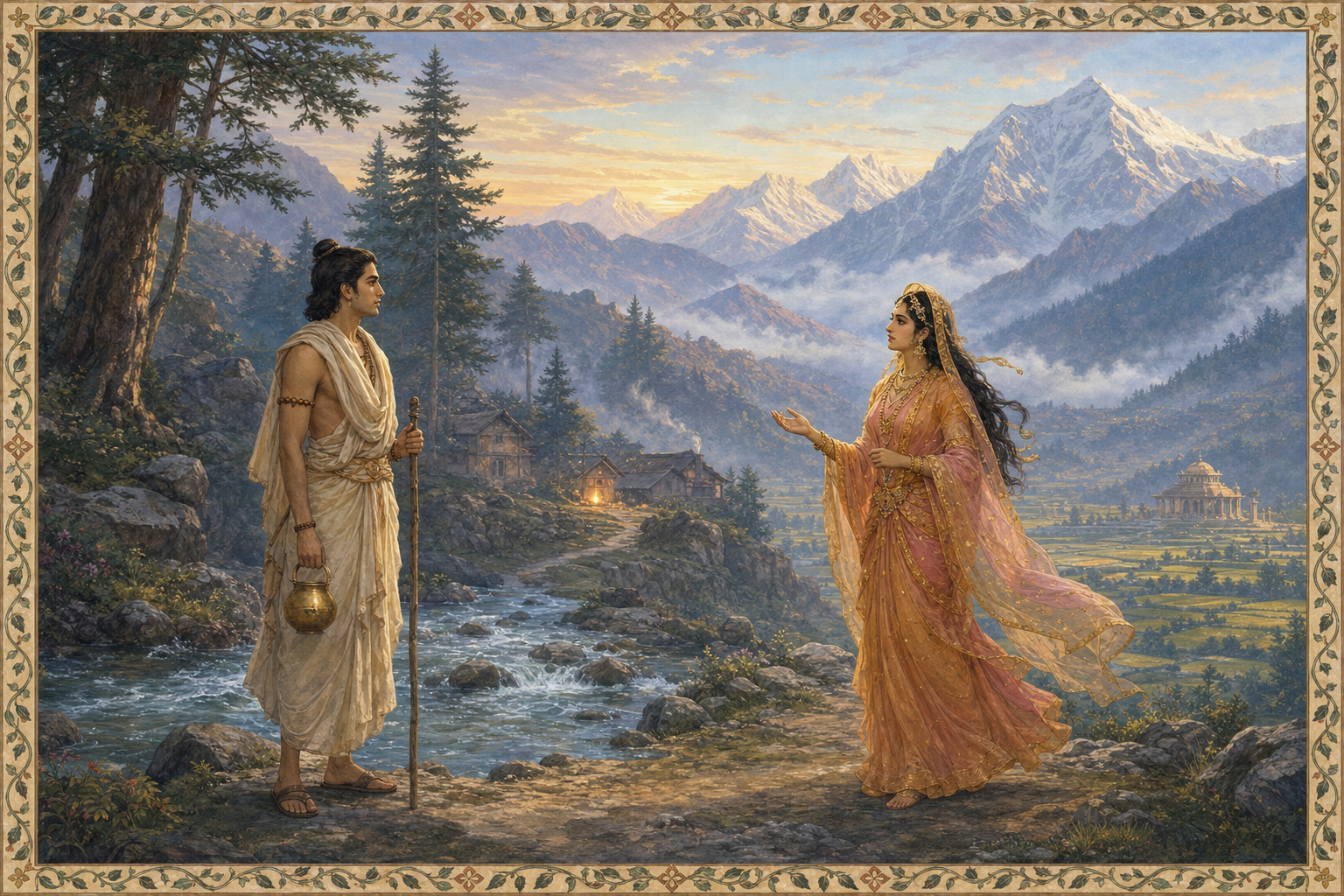
If you encountered Varudhini and Pravarakhya through a brief retelling, you may be wondering what kind of story it is. Is it a romance, a lesson about hospitality, a genealogy of rulers, or an account of karma unfolding across generations?
The most useful answer is that it holds all four together. You will understand it more clearly if you follow its moral sequence: disciplined life, human relationship, consequential action, and the emergence of leadership. That sequence also helps you distinguish what the tradition preserves from meanings a modern reteller may add.
Read the tradition in four movements, not as an isolated romance
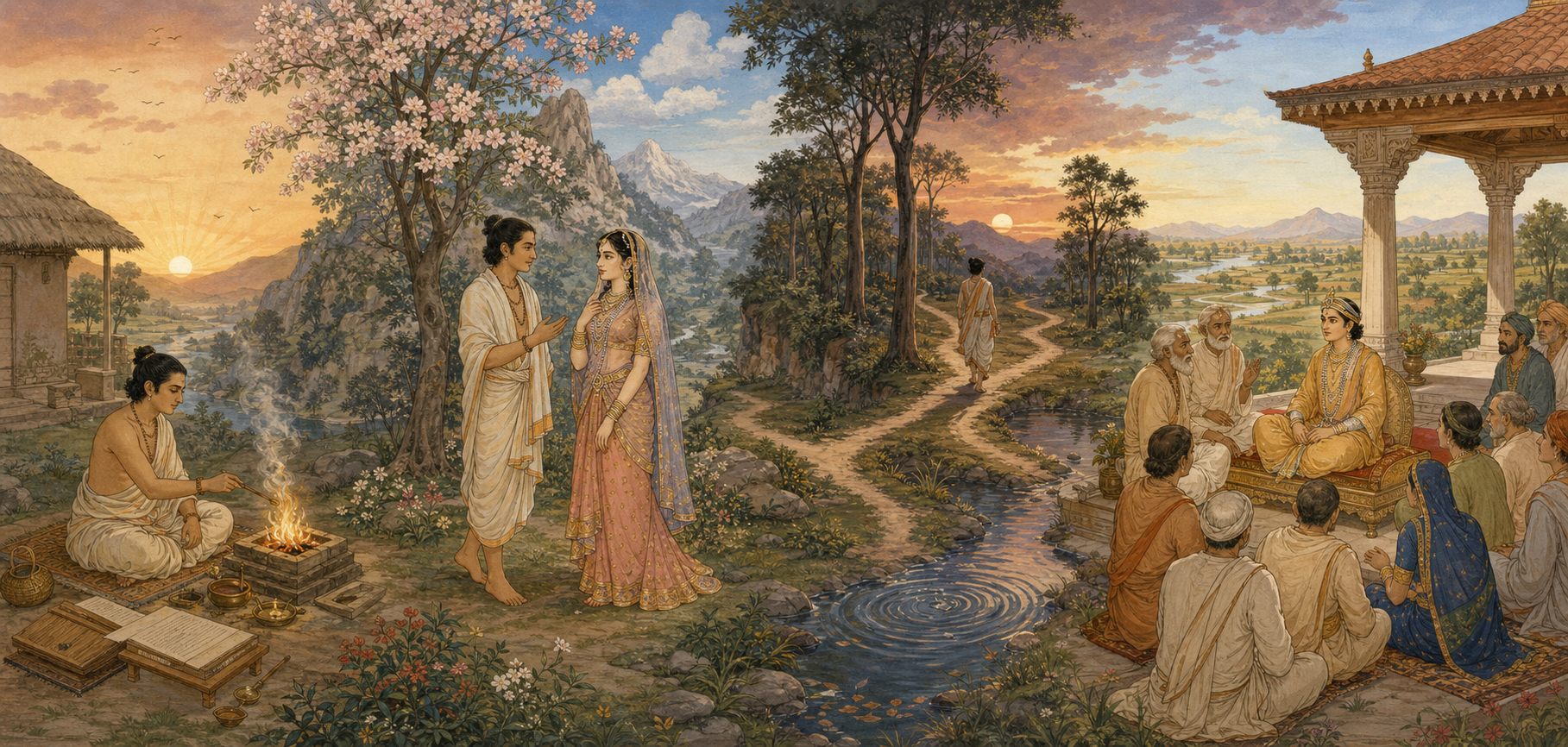
The remembered account first places Pravarakhya, a learned Brahmana youth, beside the River Varuna. He observes his required rites regularly and receives guests with reverence. His conduct establishes the ethical world into which Varudhini enters.
That order matters. If you begin and end with the attraction between two people, Pravarakhya’s observances look like decorative background. If you begin with his disciplined household life, the relationship becomes part of an existing field of dharma. Love is being considered alongside duty, hospitality, karma, and consequences beyond the couple.
- Place: The bank of the River Varuna situates the narrative within a sacred geography rather than an anonymous setting.
- Practice: Regular rites, vrata, sadhana, humility, and care for guests reveal character before any great destiny is announced.
- Relationship: Varudhini supplies the emotional and moral counterpart through whom the personal dimension of the tradition unfolds.
- Consequence: The relationship is linked with the auspicious emergence of King Swarochi and Manu Swarochisha, carrying the narrative from household conduct into the domain of righteous leadership.
Use these four movements whenever you hear or retell the tradition. They prevent its moral architecture from disappearing beneath the convenient label of a love story.
What makes the love dharmic is the life surrounding it
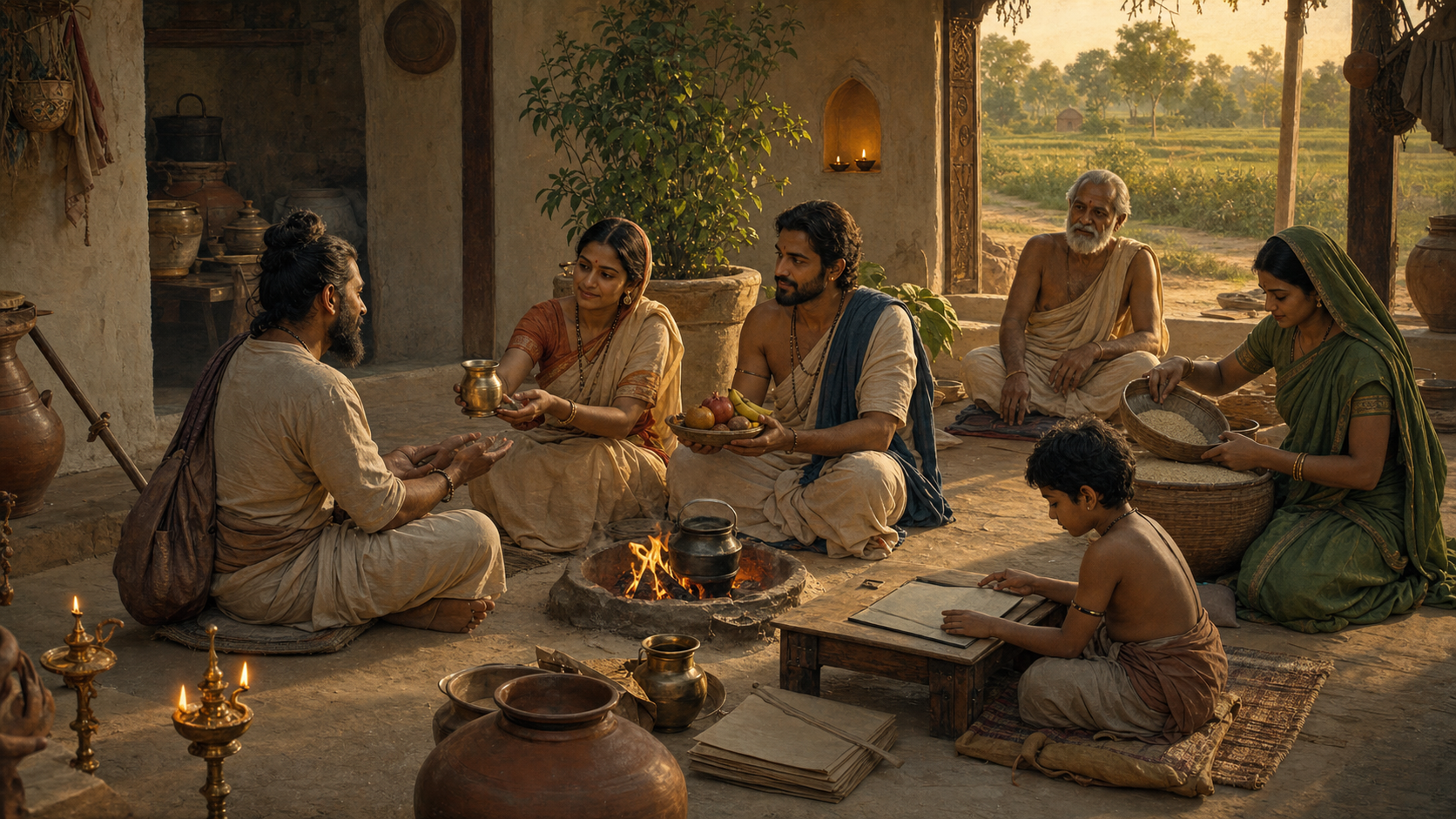
Calling a relationship dharmic should mean more than calling it ancient, sacred, or emotionally powerful. In this tradition, the decisive signs appear in the practices surrounding the relationship.
- Discipline comes before reward. Pravarakhya’s regular observances show a life ordered by commitments that do not depend on convenience or mood.
- The stranger matters. Atithi-devo-bhava places the arriving guest within the household’s moral responsibilities. Reverence is demonstrated through conduct, not merely affirmed as an ideal.
- Desire is not treated as a sealed private matter. Personal bonds participate in a wider network of duties and consequences.
- Leadership has a moral prehistory. The movement toward King Swarochi and Manu Swarochisha suggests that public order begins upstream, in the character and habits cultivated before anyone exercises authority.
This does not turn karma into a bargain in which ritual observance automatically purchases distinguished descendants. That would reduce dharma to a transaction. The more careful lesson is that repeated actions form dispositions, dispositions shape relationships, and relationships can influence a future larger than the individuals who began them.
Do not let Varudhini become only a genealogical bridge
A careless retelling can give Pravarakhya all the ethical substance and leave Varudhini as a name required to move the genealogy forward. Resist that distortion. The tradition presents her as the counterpart who completes its emotional and moral arc.
At the same time, do not compensate for a short account by inventing her speech, motives, choices, or inner conflicts. Give Varudhini her proper narrative weight while marking the boundary between preserved detail and imaginative elaboration. Respect for a traditional figure includes refusing to place unsupported words in her mouth.
Handle different tellings without manufacturing certainty
Regional and textual tellings can vary. Variation is not a reason to dismiss the tradition, but neither is devotion a reason to erase differences. When two versions do not align, your first task is to identify what each one actually preserves.
- Ask where the telling came from. Record the named text, edition, teacher, family tradition, temple discourse, or regional narration if that information is available.
- Keep the stable anchors visible. These include Pravarakhya’s disciplined life by the River Varuna, his reverence for guests, Varudhini’s central place, and the connection with Swarochi and Manu Swarochisha.
- Mark additional details as version-specific. A detail found in one telling should not silently be inserted into every other telling.
- Do not force several versions into one seamless narrative. If the sequence, relationship, or emphasis differs, present the difference plainly instead of inventing a reconciliation.
- Separate narrative identity from ethical resonance. Hindu, Buddhist, Jain, and Sikh communities can recognize the value of discipline, hospitality, compassion, and ethical action without the Varudhini-Pravarakhya narrative becoming a shared canonical account of all four traditions.
A simple teaching method is to make two columns in your notes: “What this telling preserves” and “What we learn from it.” The first column disciplines your factual claims. The second allows reflection without pretending that your interpretation is itself part of the inherited narrative.
Apply the same care to the riverside setting. You may notice that the River Varuna joins household discipline to sacred geography. You should not assign a more elaborate symbolism unless the particular telling or teacher establishes it. This habit of restraint makes traditional interpretation stronger, not thinner.
Turn the teaching into a seven-day household practice
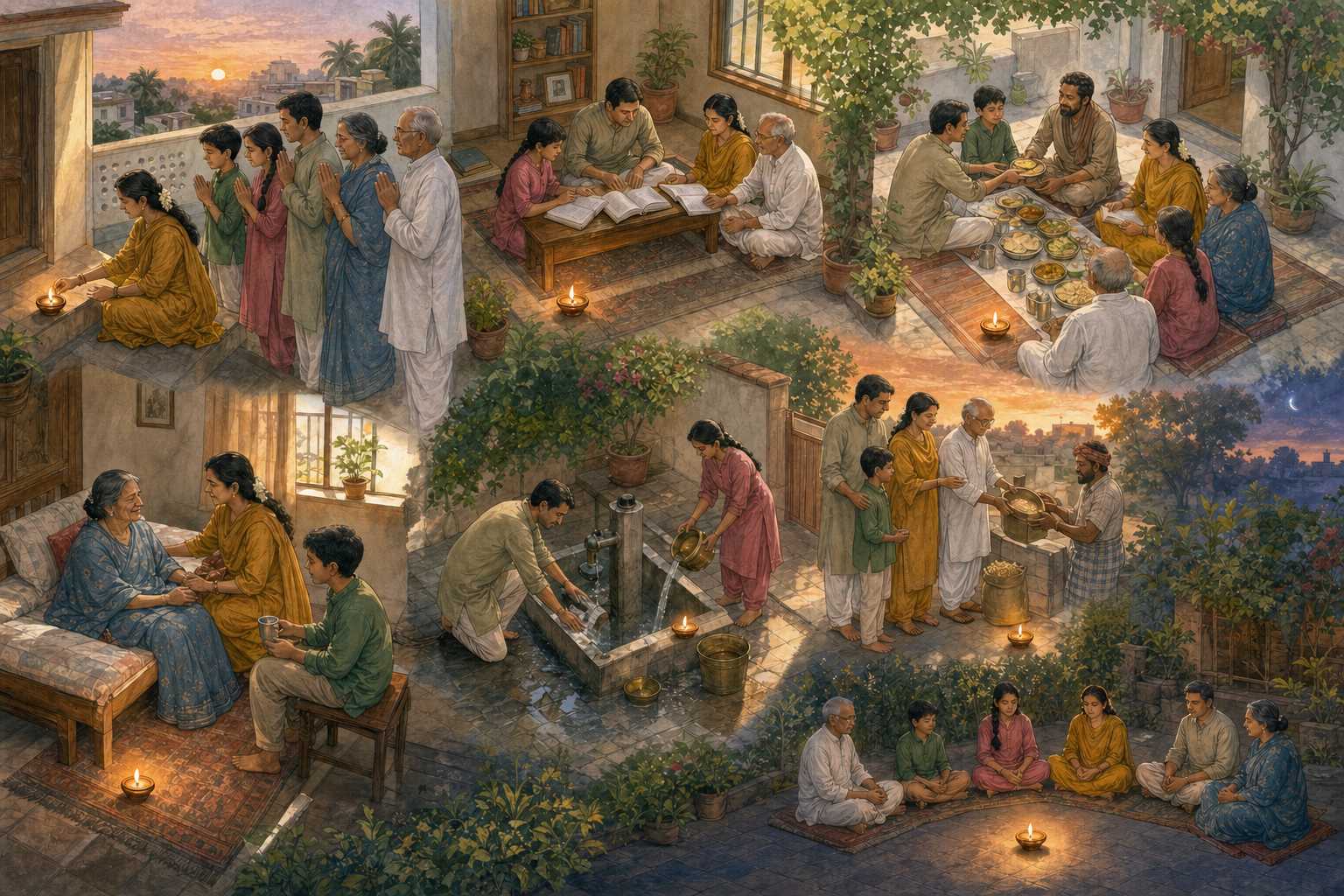
You do not need to imitate an unspecified ancient rite to act on the tradition. For seven days, work with practices already appropriate to your family, sampradaya, or teacher’s guidance. The aim is to observe how discipline and hospitality change ordinary conduct.
- Choose one fixed observance. Keep one existing prayer, reading, meditation, seva, or other established practice at the same time each day. Make it modest enough that you can keep it without display.
- Create a guest protocol. When someone enters your home, pause what can be paused, greet the person directly, offer a seat or water where appropriate, and give undivided attention before returning to your task.
- Watch the moment of inconvenience. Hospitality is easy when it costs nothing. Notice what happens when a guest, relative, or person seeking help interrupts your preferred schedule.
- Write two sentences each evening. Record one duty you kept and one effect your conduct had on another person. Do not record only how the practice made you feel.
- Retell the tradition on the seventh day. Use the four movements of place, practice, relationship, and consequence. State openly which details you know and which you do not.
This exercise keeps the lesson from becoming vague admiration for the past. It lets you test whether atithi-devo-bhava changes your attention, whether regular practice steadies your conduct, and whether you have begun to see apparently private choices as part of a larger moral inheritance.
When you next encounter Varudhini and Pravarakhya, begin with the household beside the river. Follow the conduct before the consequence, preserve uncertainty where versions differ, and choose one form of disciplined welcome that can become real in your home.
Key takeaways
- Read the tradition through four movements: sacred place, disciplined practice, human relationship, and consequences extending into leadership.
- Its love is dharmic because it remains connected to duty, hospitality, karma, and the welfare of a world beyond the couple.
- Preserve Varudhini’s moral importance without inventing biographical details that the telling does not provide.
- When versions differ, identify their origins, retain the stable anchors, and label additional details rather than forcing agreement.
- Put the teaching to work through a regular observance and a concrete household practice of welcoming guests.
References
