
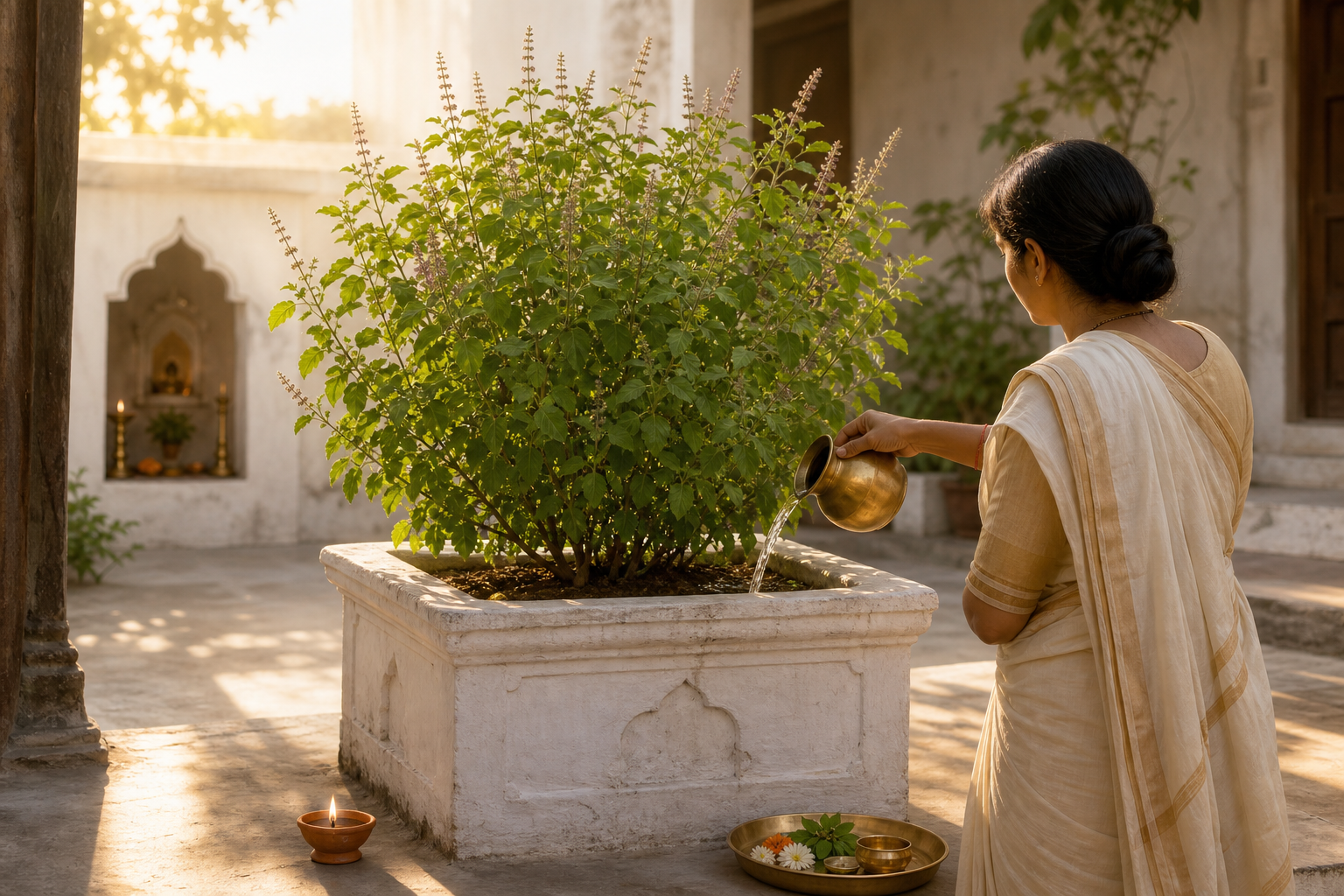
You may already have Tulasi in your courtyard, balcony, or prayer space and still wonder what Puranic worship actually requires. Is watering the plant enough? Must you light a lamp twice a day? How should you offer the leaves, and which rules are essential rather than local custom?
The clearest answer is simpler than an ever-growing ritual checklist. Care for Tulasi as a living sacred presence, connect that care to devotion to Vishnu, and let the daily repetition train your conduct. A short observance performed attentively is more coherent than an elaborate one that neglects the plant, burdens the household, or becomes mechanical.
Begin with Tulasi’s place in Puranic devotion
Tulasi is not merely a useful plant placed beside a shrine. In Puranic tradition she is Vishnu-priya, beloved of Vishnu, and is identified with Vrinda. The Padma, Skanda, Garuda, Narada, and Brahma Vaivarta Puranas connect planting, tending, worshipping, and offering Tulasi with Vishnu-centred bhakti.
That identity gives the practice its internal logic. You aren’t maintaining a plant first and performing an unrelated puja afterward. The care itself belongs to the worship. Watering without attention to the plant’s condition misses that relationship, just as offering leaves to Vishnu while damaging the plant contradicts it.
Puranic mahatmyam, or praise of a sacred practice’s greatness, often speaks in the language of punya and purification. It would be a mistake to reduce that language to a transaction in which a fixed action purchases a fixed reward. The repeated acts are meant to orient you toward shraddha, self-restraint, purity of intention, and steadier devotion. Punya is therefore inseparable from the quality of attention and conduct cultivated through the observance.
This also explains why Tulasi belongs so naturally in the home. A household does not need to wait for a pilgrimage or a major festival to establish a devotional rhythm. The plant, lamp, japa, and pradakshina give ordinary mornings and evenings a sacred centre.
Build a daily practice you can actually sustain
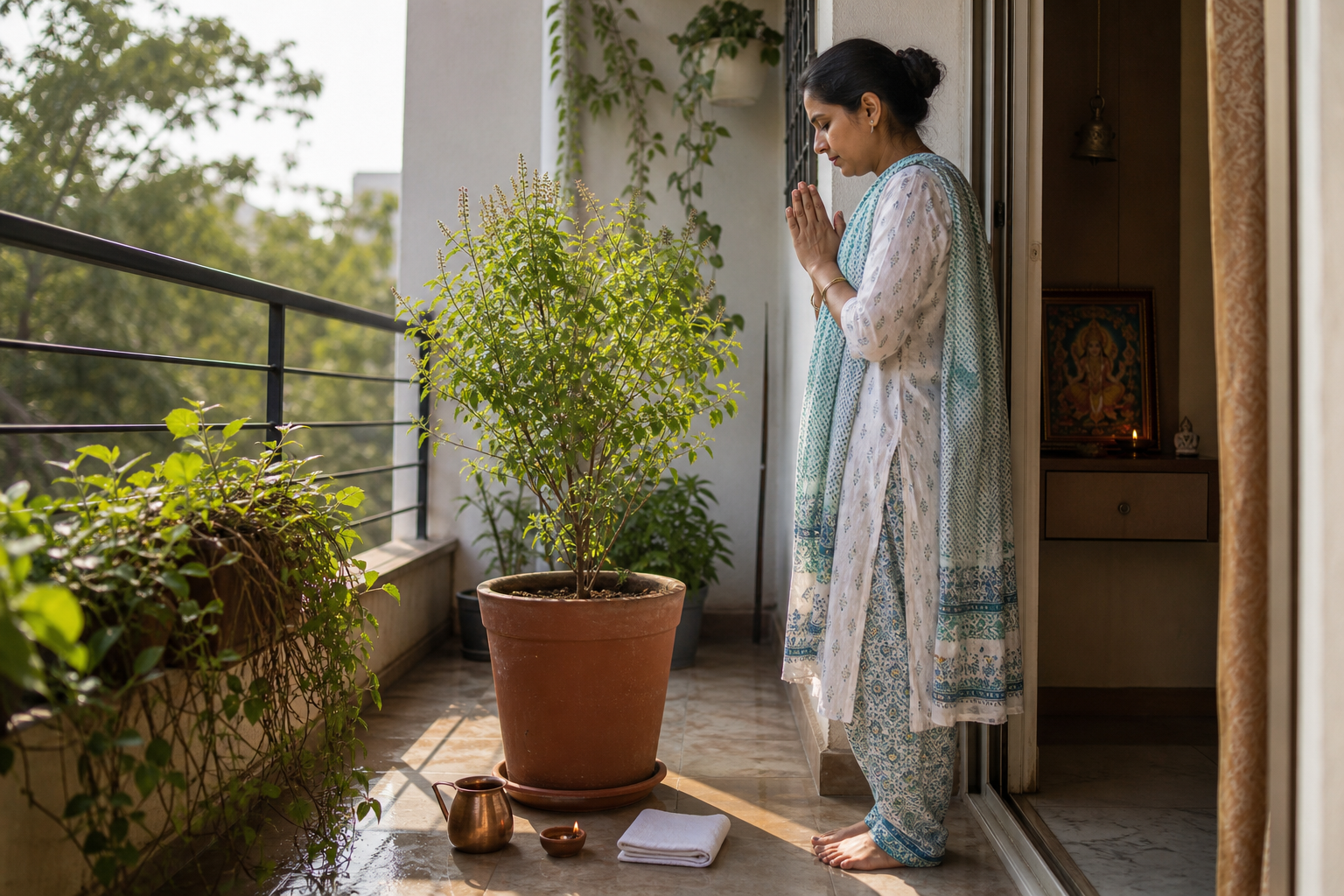
The traditional daily rhythm may include care of the plant, arghya, a lamp at dawn and dusk, japa, and pradakshina around the Tulasi vrindavan. If that entire pattern is unfamiliar, don’t rush to imitate every variation at once. Establish a dependable core, then learn the details preserved by your family, sampradaya, or temple.
- Begin by looking at the plant. Remove obvious litter and keep the pot or vrindavan clean. Notice whether Tulasi is receiving suitable sunlight and whether the soil already appears adequately watered. Ritual repetition should make you more observant, not less.
- Care for Tulasi without excess. Water with attention to the plant’s actual condition rather than assuming that more water means more devotion. If your parampara distinguishes ordinary watering from the offering of arghya, preserve that distinction.
- Offer a deepa safely. Dawn and dusk form the customary rhythm. If you are beginning, one consistent daily lamp is a sound starting discipline. Place it securely, protect the plant from heat, and don’t leave an open flame unattended.
- Give the mind one devotional task. Recite a stotra or perform a short period of japa near Tulasi. Use a Vishnu nama, mantra, or prayer received through your tradition rather than collecting formulas without context. A brief recitation with attention is enough to establish the habit.
- Perform pradakshina according to your custom. Walk without haste and keep your attention on the sacred presence before you. The number of circumambulations may vary by parampara, so don’t turn a local count into a universal rule.
- Carry one quality into the day. Before leaving, choose a concrete expression of the worship: speak without needless harshness, practise restraint, protect a living being, or complete an act of service. This is how an external observance begins to shape dharmic conduct.
You don’t need to perform all six parts at every sitting. On a demanding day, clean the space, attend to the plant, light the lamp if it is safe, and offer a short prayer. Consistency matters because Tulasi worship gains its formative power through return: the same place repeatedly calls you away from distraction and back toward reverence.
Family participation should strengthen that rhythm rather than turn it into one person’s compulsory labour. Hindu women have often carried this daily samskara across generations, but the practice need not be confined to women. Children can help maintain cleanliness, adults can share plant care, and the household can gather for the evening lamp. Participation becomes meaningful when each person learns why the act is performed.
Offer Tulasi leaves without separating bhakti from care
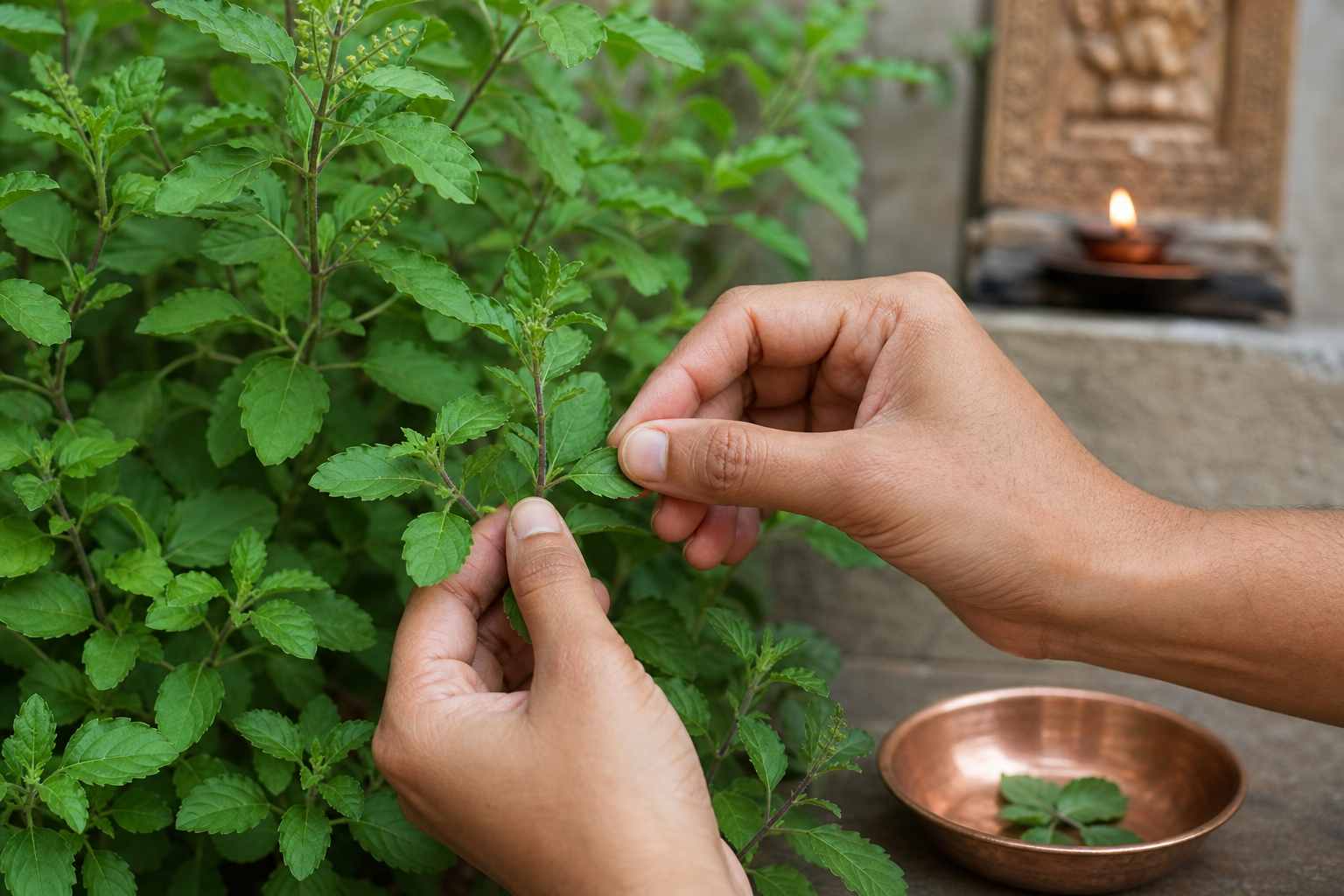
Tulasi leaves hold a particularly honoured place in Vaishnava worship. Their purpose is not decorative. Offering a leaf to Vishnu joins the life of the household plant to worship of the deity and makes a small, accessible act of devotion possible.
The rules for plucking can differ across regions, families, temples, and sampradayas. Some households preserve specific restrictions concerning time or festival days. Follow the parampara you have genuinely received. If you haven’t received one, ask a knowledgeable elder or the temple tradition you normally follow instead of assembling strict rules from unrelated lineages.
- Look at the plant before taking anything. If it is weak or recovering, protecting it is consistent with the ahimsa and restraint that the worship is meant to cultivate.
- Take only what is required for the puja. Stripping a plant to make a larger offering confuses quantity with devotion.
- Handle the leaves attentively and offer them with gratitude. The meaningful sequence is care, reception, and offering, not hurried collection.
- Keep the plant, vessel, altar, and vrindavan clean. Cleanliness here is both practical care and preparation of the mind.
- If no suitable leaf is available, continue with prayer, japa, deepa, or pradakshina. Don’t injure Tulasi merely to complete an outward form.
This approach protects you from two opposite errors. One is casualness, in which Tulasi becomes just another leaf within the puja tray. The other is anxious rule-collecting, in which fear of a minor mistake overwhelms bhakti. Reverence, plant care, and fidelity to a living parampara provide a steadier middle path.
Deepen the observance during Kartik and Shravan

Tulasi is worshipped throughout the year, but Kartik and Shravan invite heightened devotion. Kartik carries an especially developed domestic pattern: regular lamps, deepa-dana, vrata, simpler living, added japa, service, and Tulasi Vivah. The point of intensification is not to produce a few crowded ritual days. It is to make your devotional life more deliberate.
Choose one seasonal addition that you can keep for the month. You might make the evening lamp non-negotiable, add a fixed period of quiet japa, undertake a modest vrata from your tradition, or pair worship with a regular act of service. One completed discipline teaches more than several ambitious vows abandoned after a few days.
Tulasi Vivah gives families a particularly cherished way to gather worship, celebration, and gratitude around Tulasi. Observe its details through your regional or family parampara. If this is your first year, learn the essential sequence from the community with which you actually worship rather than assuming every household follows one uniform form.
During Shravan, use the same principle: deepen an existing practice before adding complexity. Maintain the vrindavan more carefully, extend your japa, or gather the family for the lamp. Seasonal devotion should leave the daily practice stronger after the month ends.
You can judge the discipline by its effects on conduct. Is the sacred space cleaner because you attend to it? Is the plant healthier because you notice its needs? Does the lamp create a shared pause rather than another source of conflict? Are japa and vrata making speech, consumption, and behaviour more restrained? These are practical signs that outer worship and inner formation are moving together.
Tulasi worship is specifically rooted in Hindu, and especially Vaishnava, devotion. It need not be blurred into a generic nature ritual to reveal its wider Dharmic significance. Ahimsa, mindful restraint, compassion, and responsible care for living things also resonate across Hindu, Buddhist, Jain, and Sikh ethical worlds. The connection lies in these shared dispositions, not in claiming that every Dharmic community performs the same worship.
Key takeaways for a grounded Tulasi practice
- Treat Tulasi as a living sacred presence associated with Vrinda and honoured as Vishnu-priya, not as shrine decoration.
- Join plant care and puja. Cleanliness, suitable sunlight, careful watering, and avoidance of excess belong to the discipline.
- Use deepa, arghya, japa, and pradakshina to establish a repeatable household rhythm rather than an occasional display.
- Offer Tulasi leaves to Vishnu with restraint and gratitude, and follow your own parampara for rules about plucking.
- Intensify worship in Kartik and Shravan through one sustainable addition, such as a regular lamp, added japa, vrata, or service.
- Measure the practice by what it cultivates: attention, bhakti, ahimsa, steadiness, service, and greater harmony in the home.
Start with the next dawn or dusk. Clean the space, attend to Tulasi’s condition, offer one lamp or prayer, and keep the observance small enough to repeat tomorrow. Once that rhythm is stable, let your parampara teach you how to deepen it.
References
