
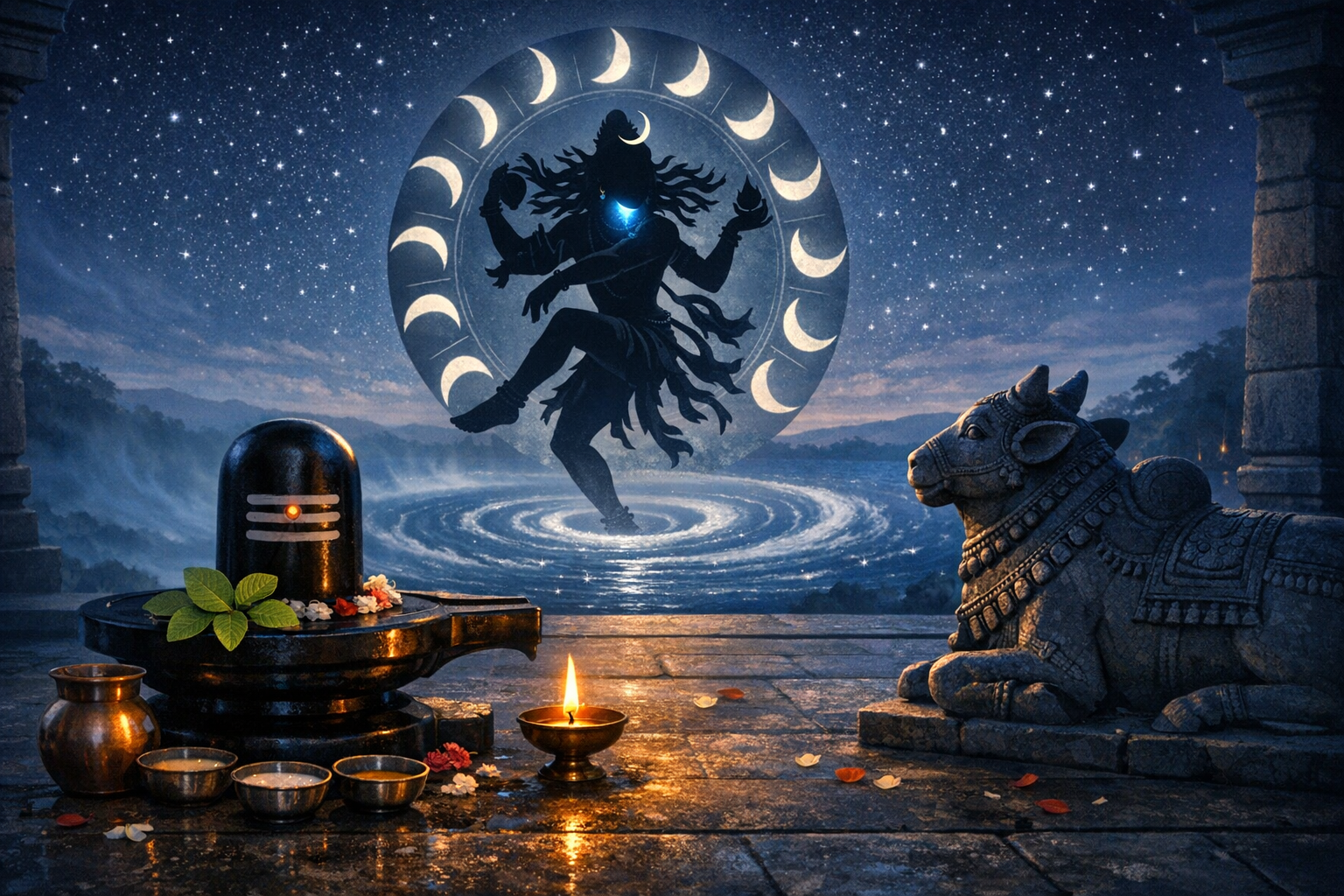
Trayodashithe thirteenth lunar dayoccupies a singular place in the Hindu calendar because it carries the sanctity of Pradosha, the twilight worship of Lord Shiva. Across Shaiva traditions and temple liturgies, this day is honored as a threshold in time when devotion, cosmic memory, and ethical resolve converge. Its prominence is not arbitrary; it is rooted in Puranic narratives, ritual sciences of muhurta, and the living practices of devotees who experience Pradosha as a moment of protection, grace, and inward transformation.
The Puranas describe the Samudra Manthanthe churning of the ocean of milkby Devas and Asuras seeking amrita. Before ambrosia arose, a devastating poison, Halahala (kālakūṭa), first emerged and threatened all life. In this existential crisis, Shiva accepted the world’s peril into his own throat, becoming Nīlakaṇṭha, the blue-throated Lord. This salvific act, celebrated in the Skanda Purāṇa and Śiva Purāṇa among other texts, established Shiva’s enduring role as Apattodharanathe One who rescues in calamityand forms the mythic foundation for Trayodashi’s protective aura.
Traditions connect that cosmic event with the sanctification of Pradosha on Trayodashi: the Devas, at the liminal hour between day and night, sought Shiva’s refuge and worshipped him with single-pointed devotion. From then, the Trayodashi that coincides with Pradosha-kāla became a canonical time to remember the Lord’s compassionate guardianship and to vow ethical living aligned with Dharma. This association lives on in countless temples where Pradosha Abhiṣeka is performed with solemnity and joy.
Technically, a tithi in the Hindu calendar is defined by the relative longitudinal separation between Sun and Moon. Each tithi marks a 12-degree increase in that separation. Trayodashi (trayo-daśī) thus denotes the 13th step of this cycle156° in the bright fortnight (Śukla) and 204° in the dark fortnight (Kṛṣṇa). Because tithis are angular rather than clock-based, their start and end times shift daily, making local astronomical calculation (panchāṅga) essential to determine observance.
Pradosha-kāla is the early evening sandhyā segment that follows sunset, often approximated to 1.5–2 hours depending on latitude and season. It is a transitional field in time, and Shaiva communities regard it as especially receptive to worship that harmonizes the restless currents of day with the introspective silence of night. When Trayodashi tithi prevails during this window, it is PradoshaShiva’s own.
Scriptural and liturgical traditionspreserved in sections such as the Pradoṣa-māhātmya of the Skanda Purāṇa and supported by passages of the Śiva Purāṇapraise the merits of fasting, bathing, and evening worship on Trayodashi. While textual recensions vary, a consistent thread affirms that Pradosha performed with sincerity yields inner purification, clarity of purpose, and the removal of obstacles, embodying Shiva’s protection in the wake of Halahala.
Devotional lore also remembers Pradosha as the time of Śiva’s sacred dance (Ananda Tāṇḍava) witnessed by the Devas gathered around Nandi. This imageryShiva dancing, Nandi attentive, and the Devas encirclinghas informed the spatial choreography of temple worship. Many temples carry out a circumambulation around Nandi and a special darśana of Nataraja during Pradosha, translating myth into ritual form.
The theological center of Trayodashi is clear: Shiva’s Nīlakaṇṭha vow. By holding, rather than expelling, the Halahala, Shiva demonstrates an ethic of containment and transmutationabsorbing toxicity (cosmic or psychological) so that life may continue. In this light, Pradosha invites a personal vow: to hold anger without acting in harm, to transform resentment into responsibility, and to turn fear into fearless compassion.
Common Pradosha observances include a day-long upavāsa or saatvik diet, evening snāna, and a saṅkalpa oriented toward well-being of family, community, and the wider world. In temples and homes, devotees perform Abhiṣeka to the Śivaliṅga with Pañcāmṛta (kṣīra, dadhi, ghṛta, madhu, śarkarā) followed by pure water (snāna), and apply vibhūti (sacred ash), invoking Shiva’s presence as Rudra, Paśupati, and Nīlakaṇṭha.
Offerings of Bilva (Aegle marmelos) leavespreferably in tri-foliate clustersare considered auspicious. Classical hermeneutics read these three leaflets as symbolic of the guṇas (sattva, rajas, tamas), or the triad of Śiva’s functions (saṃhāra, sṛṣṭi, sthiti) held in equilibrium. Alongside lamps (dīpa), incense (dhūpa), and fruits (naivedya), Bilva underscores a contemplative ecology: austerity, simplicity, and boundless reverence for life.
Mantric recitation typically centers on the Rudra Namakam and Chamakam (Taittirīya Saṃhitā of the Kṛṣṇa Yajurveda), the Mahāmṛtyuñjaya mantra, and stotras such as the Śiva Mahimna Stotra. In many communities, 108 Bilva offerings are paired with 108 recitations of the Mahāmṛtyuñjaya, weaving sound, gesture, and intention into one integrated sādhana.
A distinctive Pradosha custom is the whispering of prayers into Nandi’s ear before darśana of the Śivaliṅga. Nandi, the archetype of attentive mind and unwavering devotion, is understood as the conduit of intention. In practice, this gesture trains focus: framing the prayer clearly, offering it humbly, and then leaving it at the Lord’s feet without agitation.
Within the monthly cycle, certain Pradoshas are regionally celebratedSom Pradosh (falling on Monday) and Śani Pradosh (on Saturday) are widely observed. While popular belief associates them with lunar resonance (for Som) and karmic discipline (for Śani), the scriptural heart remains unchanged: Trayodashi-Pradosha is a vow of remembrance and renewal under Shiva’s compassionate gaze.
Trayodashi also stands near another Shaiva summit: Masik Shivaratri and the annual Maha Shivaratri occur on the Kṛṣṇa Pakṣa Chaturdaśī (14th tithi). In many households and temples, the Pradosha of Trayodashi flows seamlessly into Chaturdaśī’s night vigil, yoking twilight and midnight into one extended arc of meditation, japa, and abhiṣeka.
A different, yet related, TrayodashiKārttika Kṛṣṇa Trayodashiis renowned as Dhantrayodashi (Dhanteras), the day tradition associates with Dhanvantari’s emergence from the Samudra Manthan. The practice of Yam Dīp Dāna on this evening underscores the shared cosmology of the lunar calendar: whether one invokes Shiva’s protection or Dhanvantari’s healing, the underlying vow is care for life and responsibility for one another.
Trayodashi’s ethos resonates across the wider family of Dharmic traditions. Buddhism observes Uposatha on new/full moon and quarter phases as days of intensified ethics and meditation; Jain practice orients regular vrata and pratikraman to lunar markers as discipline of ahiṃsā and self-restraint; Sikh memory holds a luminous association with the number thirteen through Guru Nanak’s “tera” (Thine)a radical affirmation of surrender and service. These convergences do not collapse differences; they illuminate a shared grammar of sacred time, restraint, and compassion.
From the perspective of astronomy, determining Pradosha is straightforward in principle and precise in practice. One identifies: (i) the local time of sunset; (ii) the Pradosha-kāla window thereafter; and (iii) whether Trayodashi tithi is operative during that window. Panchāṅgas implement this via the solar–lunar elongation (12° per tithi) and local time conversion, yielding the day of observance for each locale.
When Trayodashi spans two civil days, the rule widely followed in Smārta and temple traditions is to observe Pradosha on the day when Trayodashi prevails during Pradosha-kāla. If it prevails during Pradosha on both days, regional ācāra may differ; one may consult the local temple or panchāṅga notes. The governing principle remains: align worship with the tithi’s presence in the sacred twilight.
Beyond ritual correctness lies Trayodashi’s practical wisdom. A day of gentle fasting and mindful evening practice can benefit attention, mood, and intentionespecially when paired with simple vegetarian foods, adequate hydration, and rest. While such benefits should not be medicalized, they are consistent with a broad integrative outlook that values moderation, rhythm, and contemplative time.
Halahala offers a perennial metaphor: life inevitably yields toxinsanger, envy, fear, misinformation, and collective harms. Shiva’s Nīlakaṇṭha stance models an inner technology of nirodha (containment) and parivartana (transmutation), not indulgence or suppression. In many lineages, breath regulation (prāṇāyāma), mantra, and steady attention are taught as practical means to “hold” disturbances without harm, until they are pacified and clarified.
Specific materials used in Pradosha worship are themselves pedagogic. Vibhūti recalls impermanence and purity; Pañcāmṛta combines nourishment and sweetness with sanctification; Bilva integrates ecology with reverence. Such choices reveal the ancient synthesis of ritual, ethics, and environment that characterizes Sanātana Dharma.
Nandi’s centrality at Pradosha is likewise didactic: when the mind (Nandi) steadies and listens, the Lord’s presence is evident. In many temples, devotees circumambulate Nandi, then view Nataraja and the Śivaliṅga. The sequence is intentionalstill the mind, behold the dance of consciousness, and then dissolve into formless worship.
Regionally, Pradosha (often “Pradoṣam” in Tamil) inspires elaborate abhiṣekas, āratī, and community participation in Shaiva kṣetras across South India, the Himalayan belt, and diaspora communities. Iconography of Nataraja, especially in Chidambaram’s living tradition, underscores the insight that time itself is Shiva’s rhythm; Trayodashi is when that rhythm is most readily heard.
In framing Trayodashi for contemporary life, a balanced approach emerges: attend to calendar precision; cultivate ethical intent; embrace simplicity in offerings; and allow the twilight practice to integrate the day’s work with the night’s contemplative silence. The essence is not opulence but presenceclarity of heart and steadiness of mind.
For those navigating interfaith or inter-tradition settings, Trayodashi can be presented as a universal pedagogy: a disciplined pause at day’s threshold; a remembrance of compassionate responsibility (embodied by Shiva during Halahala); and a commitment to non-harm and service. In that sense, Trayodashi aligns naturally with the broader dharmic ethos cherished across Hinduism, Buddhism, Jainism, and Sikhism.
Seen from scripture, ritual, and lived experience, Trayodashi is not merely a dateit is a doorway. Each Pradosha re-enacts the world-saving vow of Nīlakaṇṭha and invites renewed dedication to Dharma. In honoring the Sacred Thirteenth, communities remember that protection and transformation begin at the level of attention, speech, and action, and radiate outward to sustain the shared fabric of life.
Inspired by this post on Hindu Blog.
