

If you came to the Janasthana episode asking whether Surpanakha was a victim or an aggressor, the usual either-or answer will fail you. It excuses too much on one side and notices too little on the other.
The more defensible reading is act by act. Surpanakha can retain her dignity while bearing responsibility for her hostility toward Sita. Lakshmana can act from a protective purpose while leaving us a serious question about proportion. Khara can receive a real grievance and still answer it with vengeance. Rama can fight a justified defensive battle without that victory retroactively proving that every earlier choice was beyond criticism.
Do not turn a chain of choices into one moral verdict
The conflict does not begin as a war between two armies. It begins with desire, rejection, rivalry, danger and an injurious response. Only after those interpersonal choices does it become a military confrontation.
- Surpanakha approaches Rama out of desire. Rama remains committed to Sita, and Surpanakha’s attention eventually turns against Sita.
- Lakshmana intervenes and disfigures Surpanakha. Within the protective reading of the scene, the act prevents immediate harm to Sita; within South Indian folk and performance traditions, the injury also carries the weight of humiliation and punitive excess.
- Surpanakha goes to Khara seeking redress. Khara first sends fourteen rakshasas to kill Rama.
- After their defeat, Khara deploys a force traditionally numbered at fourteen thousand, led by Dushana and Trishira. Rama moves Sita away from the battlefield and confronts the force.
- Khara’s defeat then becomes part of the chain leading to Ravana’s abduction of Sita.
This sequence gives you a basic rule for reading ethically difficult episodes: causation is not the same as moral responsibility. An earlier act can create the occasion for a later crime without compelling anyone to commit that crime. Surpanakha’s injury helps explain her appeal to Khara, but it does not compel Khara to send killers. Khara’s defeat helps explain Ravana’s anger, but it does not compel Ravana to abduct Sita.
The same rule works in the other direction. Rama’s victory over an attacking army does not settle the proportionality of Lakshmana’s earlier action. Moral credit earned at one stage cannot simply be transferred backward to every act performed by the same side.
The first test is whether protection became punishment
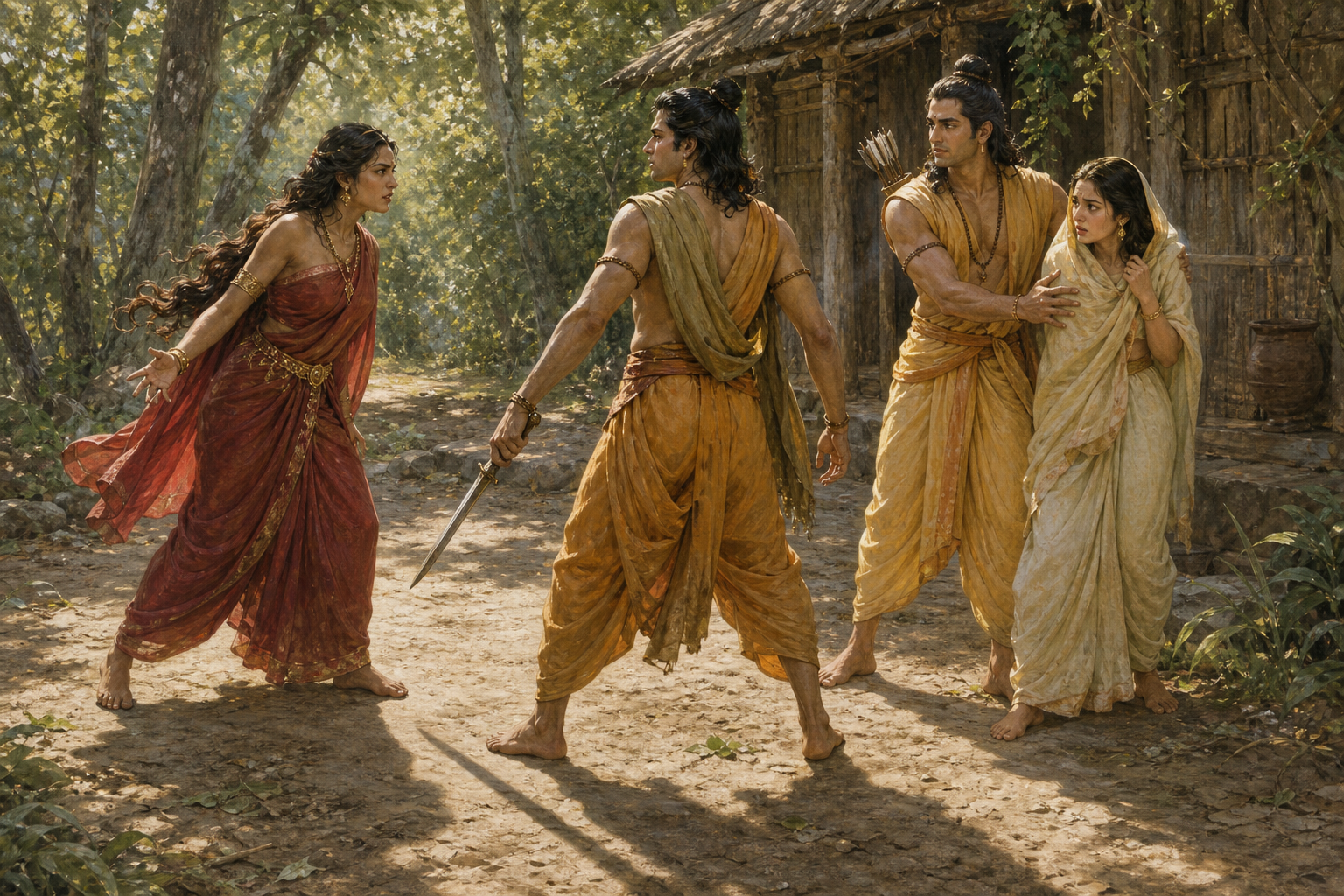
Surpanakha’s desire is not, by itself, the decisive wrong. She may approach; Rama may refuse. His fidelity to Sita does not require Surpanakha’s degradation, just as her disappointment gives her no claim over Rama and no license to attack Sita. Consent protects both the freedom to express desire and the freedom to reject it.
Her hostility toward Sita changes the ethical situation. Once Sita faces danger, Lakshmana has a duty to protect her. A reading that sees only a rejected woman and erases the threatened woman is not compassionate; it has merely made compassion selective.
Yet a valid duty does not automatically validate every means used in its name. Protection asks what is necessary to stop a threat. Punishment asks what suffering the wrongdoer deserves. Those are different questions, especially during an unfolding confrontation when no neutral adjudication has occurred.
- Rejection is not humiliation. Rama’s refusal protects his marriage. Ridicule or deliberate shaming would serve a different purpose and should be judged separately.
- Restraint is not punitive marking. Force may be necessary to interrupt an attack. Lasting disfigurement raises the further question of whether the response exceeded what protection required.
- Good intention is not the whole moral account. Lakshmana’s aim may be Sita’s safety, while the method still produces injury, humiliation and escalation that deserve scrutiny.
- Compassion does not cancel agency. Surpanakha’s pain should be taken seriously without pretending that her movement against Sita was harmless.
This is why Yakshagana, Kathakali, Kaliyattam and related folk tellings give Surpanakha more voice and pathos. Their unease need not be treated as hostility to Rama or as denial of Sita’s danger. It asks whether a person cast as an antagonist can still be wronged. Dharma becomes shallow when the label attached to a person decides in advance what may be done to that person.
The narrow verdict is therefore stronger than either pole of the argument: intervening to protect Sita fits the demands of duty, while the proportionality of disfiguring Surpanakha remains ethically contestable. You do not have to erase one woman to recognize the vulnerability of the other.
A grievance does not give Khara a license for war

Surpanakha’s appeal to Khara must also be separated from Khara’s response. Someone who has suffered an injury may seek protection, acknowledgment or redress. That entitlement does not establish that every part of the person’s account is complete, that the accused has no defence, or that any remedy demanded is proportionate.
Khara does not answer the grievance by containing an immediate danger to Surpanakha. She has already withdrawn from the encounter and reached him. He sends fourteen rakshasas to eliminate Rama and, after they fall, commits a much larger force. An assassination mission is not an inquiry. Escalating from fourteen failed attackers to an army traditionally counted at fourteen thousand is not restitution. It is organized lethal retaliation.
A dharmic response to grievance would have to keep several boundaries intact:
- Establish what danger remains now, rather than acting only from anger about what already happened.
- Distinguish the original advance against Sita from Lakshmana’s response to it.
- Identify a proportionate remedy instead of treating kinship as permission for revenge.
- Keep people who did not commit the alleged wrong outside the retaliation.
- Use force for immediate protection only when a lesser response cannot secure that protection.
Khara’s decision fails before the battlefield outcome is known. Rama’s superior strength is not what makes Khara’s campaign wrong. The purpose and form of the campaign already reveal the problem: Khara seeks elimination, not protection or measured redress.
Surpanakha still has agency in the escalation. She deliberately takes her injury to a powerful relative and seeks action against Rama. But commanders do not become instruments without responsibility merely because an aggrieved person appealed to them. Khara chooses the first lethal mission, chooses the second escalation and commands the force. Assigning that responsibility to him prevents a familiar ethical evasion in which leaders blame the person whose pain they converted into war.
The same reasoning applies later to Ravana. The fall of Khara and Dushana is a motive in the developing conflict, not a moral authorization to abduct Sita. Each new actor owns the new wrong he chooses.
Rama’s defence at Janasthana stands on its own merits
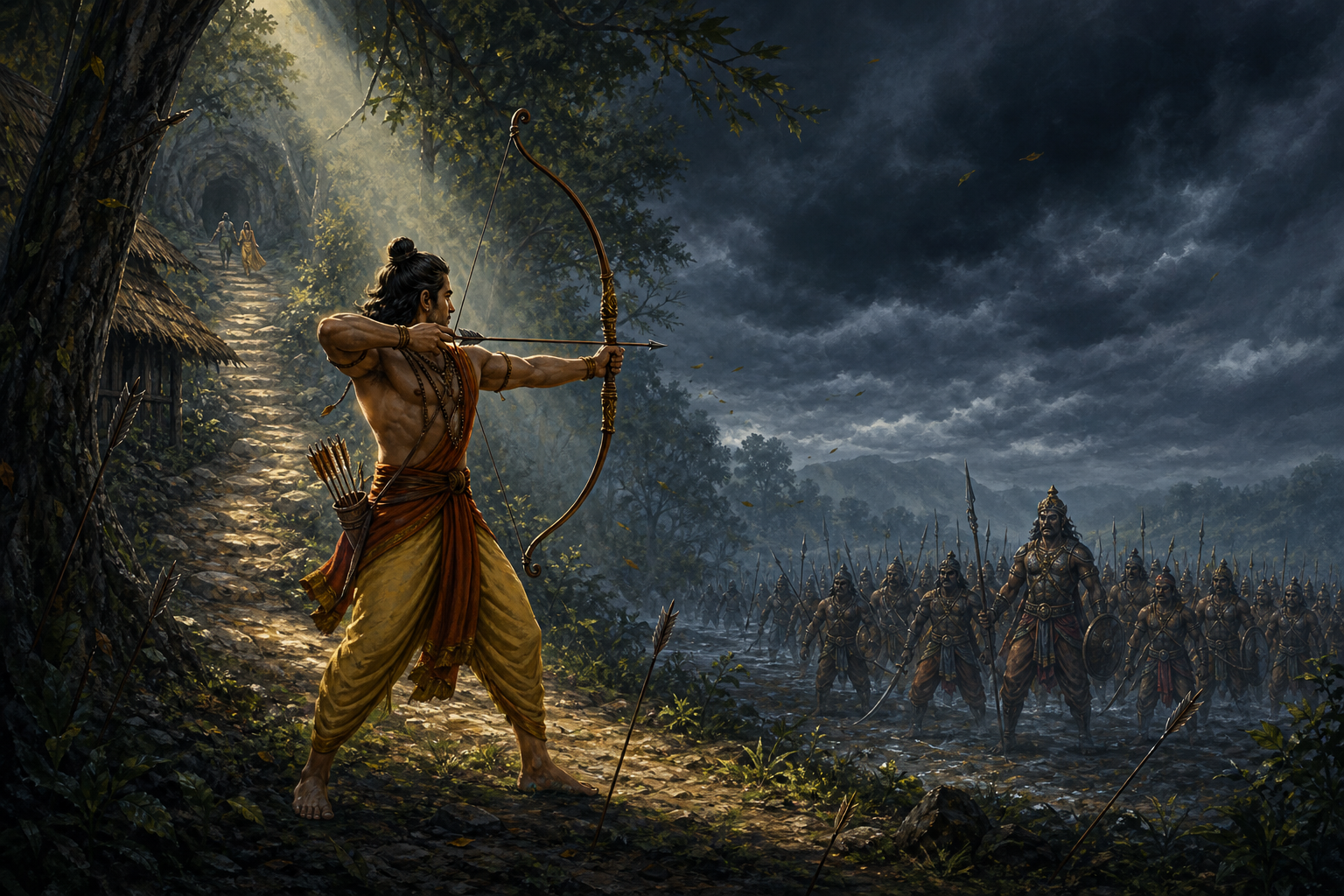
By the time Khara’s main force reaches Janasthana, the immediate issue is no longer an unwanted advance, an insult or even Surpanakha’s injury. An armed force has arrived to kill Rama. The ethics of the encounter have moved from interpersonal restraint to defence against organized violence.
Rama first instructs Lakshmana to take Sita to safety. He then faces the attacking force, defeats Dushana and Trishira, and finally kills Khara in the decisive duel. The movement of Sita away from combat, followed by Rama’s disciplined engagement with the attacking commanders, matters as much ethically as the victory itself.
- The cause is defensive. Khara’s forces come to eliminate Rama; Rama does not initiate the armed expedition against them.
- The vulnerable person is removed from danger. Sending Sita to a refuge separates her from the battlefield instead of using her presence to justify reckless action.
- Force is directed toward the armed threat. The battle is narrated through Rama’s engagements with combatants and their commanders, not as indiscriminate revenge against Surpanakha or Khara’s wider kin.
- The response ends with the attacking force’s defeat. Rama does not turn victory at Janasthana into a punitive campaign against Surpanakha.
These features support a dharma-yuddha reading: clarify the protective purpose, secure the noncombatant, meet the armed threat and exercise control over force. They also explain why Janasthana should not be reduced to a display of martial power. Skill matters ethically because uncontrolled power would expose Sita and others to greater danger.
None of this makes mass death morally weightless. A force traditionally numbered in the thousands is destroyed. Precision and courage can make defensive action more disciplined; they do not turn killing into a cause for delight. The right response is neither to deny Rama’s duty to defend nor to celebrate suffering as though the designation rakshasa removed all moral gravity from it.
This distinction is especially important when teaching the episode. Battlefield victory is evidence of capacity, not automatic proof of moral perfection in every preceding exchange. Rama’s conduct during the attack can model protection and composure even while Lakshmana’s earlier disfigurement remains open to a separate proportionality test.
Four Dharmic lenses reveal different parts of the conflict
Hindu, Jain, Buddhist and Sikh traditions share ethical languages of non-harm, compassion, dignity, service and protection, but they should not be blended into a manufactured single verdict. Each emphasis catches a failure that another approach might overlook.
| Dharmic lens | Question to ask | What it reveals at Janasthana |
|---|---|---|
| Hindu kshatra-dharma | Was power governed by duty, self-command and the protection of the vulnerable? | It highlights Lakshmana’s obligation to protect Sita and Rama’s disciplined defence, while still requiring proportion in the means used. |
| Jain ahimsa | Which injuries and deaths might have been prevented by restraint at an earlier decision point? | It keeps the entire chain of harm visible, from humiliation and mutilation to Khara’s catastrophic escalation. |
| Buddhist attention to intention and suffering | Which mental states drove each choice, and what suffering followed even an intended good? | It distinguishes desire, jealousy, fear, anger, protective resolve and vengeance rather than assigning one fixed moral essence to an actor. |
| Sikh dharam yudh and seva | Is force serving justice and the protection of life, or anger and domination? | It clarifies the difference between Rama’s defence against an attacking army and Khara’s use of force as retaliation. |
The Jain Paumacariya and Buddhist modes of examining intention, ignorance and unintended harm show why motives and moral weights need not remain identical across Ramayana traditions. That plurality is not a defect to be repaired. It trains discernment.
Jain ahimsa should not be made to rubber-stamp a war. Sikh dharam yudh should not be reduced to approval of martial action. Buddhist compassion does not erase accountability, and Hindu kshatra-dharma does not make every act performed by a righteous figure proportionate by definition. Used carefully, the four lenses press toward the same practical discipline: protect life, minimize avoidable harm, refuse vengeance and keep even an adversary within the field of moral concern.
Key takeaways: use a six-question dharma test
If you are reading, teaching or discussing this episode, pause at each decision instead of judging everything from the final victory. Ask the same six questions every time:
- What is the immediate threat? Do not use a past injury to invent a present emergency, and do not minimize a real danger because the threatening person is also vulnerable.
- Who needs protection now? At the first encounter, Sita needs protection. After the disfigurement, Surpanakha also has a claim to have her injury heard. Those claims are not mutually exclusive.
- What is the least harmful effective response? Test intervention by what was needed to stop the danger, not by how offensive or unlikeable the aggressor appeared.
- Did protection become punishment? Once the threat is contained, added injury, humiliation or retaliation requires a new justification.
- Who chose the next escalation? Keep separate ledgers for Surpanakha, Lakshmana, Khara, Rama and Ravana. Do not let an earlier wrong erase the agency of the next person.
- Did force remain bounded? Look for the protection of noncombatants, discrimination between threat and bystander, control during combat, and an end to violence when defence has been achieved.
Apply that test before you attach labels such as victim, villain, righteous or demonic. The labels may describe part of the narrative role, but they cannot do the work of ethical judgment for you.
On your next reading of Aranya Kanda, stop at four moments: Surpanakha’s movement against Sita, Lakshmana’s disfiguring response, Khara’s first order to kill and the arrival of his main force. At each pause, ask what protection required at that exact moment and what it did not require. That practice lets you honour Rama’s disciplined defence, defend Sita without reservation, hear Surpanakha’s anguish without romanticizing her aggression, and condemn Khara’s retaliation without denying the grievance that preceded it. This is how reverence becomes moral attention rather than moral exemption.
References
- DharmaRenaissance Blog – Surpanakha Reimagined: Folk Ramayana’s Haunting Lament and Dharma’s Grey Zones
- DharmaRenaissance Blog – Epic Clash at Janasthana: Rama’s Decisive Victory over Khara and Dushana in the Ramayana
