

You may understand the words of Srimad-Bhagavatam 4.9.8 and still wonder what the verse should change in your life. If you came to it through Dina-bandhu Prabhu’s discourse on SB 4.9.8, the useful next question is not merely how to explain the verse. It is how to remember it before your next conversation, decision, act of worship or moment of irritation.
Dhruva’s prayer gives you a compact discipline of consciousness: the Lord within awakens speech, enlivens the senses and limbs, and sustains life itself. Your abilities are therefore received before they are possessed. The practical response is neither helplessness nor self-denial. It is to turn ability into responsible seva.
Read the verse as a movement from dependence to offering
SB 4.9.8 addresses the Supreme Person as the One who enters within and brings dormant speech to life. The prayer then extends this dependence to the hands, feet, hearing, touch, other faculties and prana. Dhruva ends by offering obeisance to the Lord who bears all potencies.
The sequence matters. Divine presence makes enlivening possible; enlivening makes embodied action possible; recognition of that dependence becomes worship. If you take only the final gesture of reverence and overlook the faculties that precede it, the verse can remain confined to the altar. Dhruva brings the altar into speech, movement, perception and life.
- Entering within points to an intimate source of life, not merely a distant giver of occasional help.
- Enlivening dormant speech means that even the power used to pray cannot be treated as independently produced.
- Naming the senses and limbs carries remembrance into the whole embodied person.
- Offering obeisance converts recognition into a relationship of gratitude and service.
This is more demanding than the vague statement that God is everywhere. The verse asks you to notice dependence at the precise moment when you feel most capable. When speech is fluent, work is successful or judgement feels sharp, remembrance becomes especially necessary. Ability can conceal its source.
Dependence on the Lord does not cancel your responsibility
Two opposite mistakes can distort this prayer. The first is self-sufficiency: “These are my talents, produced by me, for my purposes.” The second is passivity: “If the Lord supplies the power, my choices no longer matter.” SB 4.9.8 supports neither conclusion.
The Lord’s sustaining power and your moral direction of a faculty are not the same thing. The ability to speak does not make every statement truthful. The ability to move a hand does not sanctify every act performed by it. The capacity is given; you remain accountable for its use. Dependence deepens responsibility because a received power should not be turned against dharma.
This distinction also prevents humility from becoming self-contempt. Dhruva does not deny that speech, hands, feet and senses operate. He sees them accurately as real capacities that function through divine support. You need not pretend that a skill does not exist. You need to stop treating it as an isolated possession.
When a faculty is strong, ask what it is serving. When it is weak, ask how it can still be offered. A gifted speaker can serve through careful truthfulness. A quiet person can serve through attentive hearing. Someone unable to perform a visible task can still direct attention, intention and prayer toward the Lord. Seva begins with what has actually been entrusted to you, not with an imagined version of someone else’s capacity.
Speech is the first test of whether remembrance is real
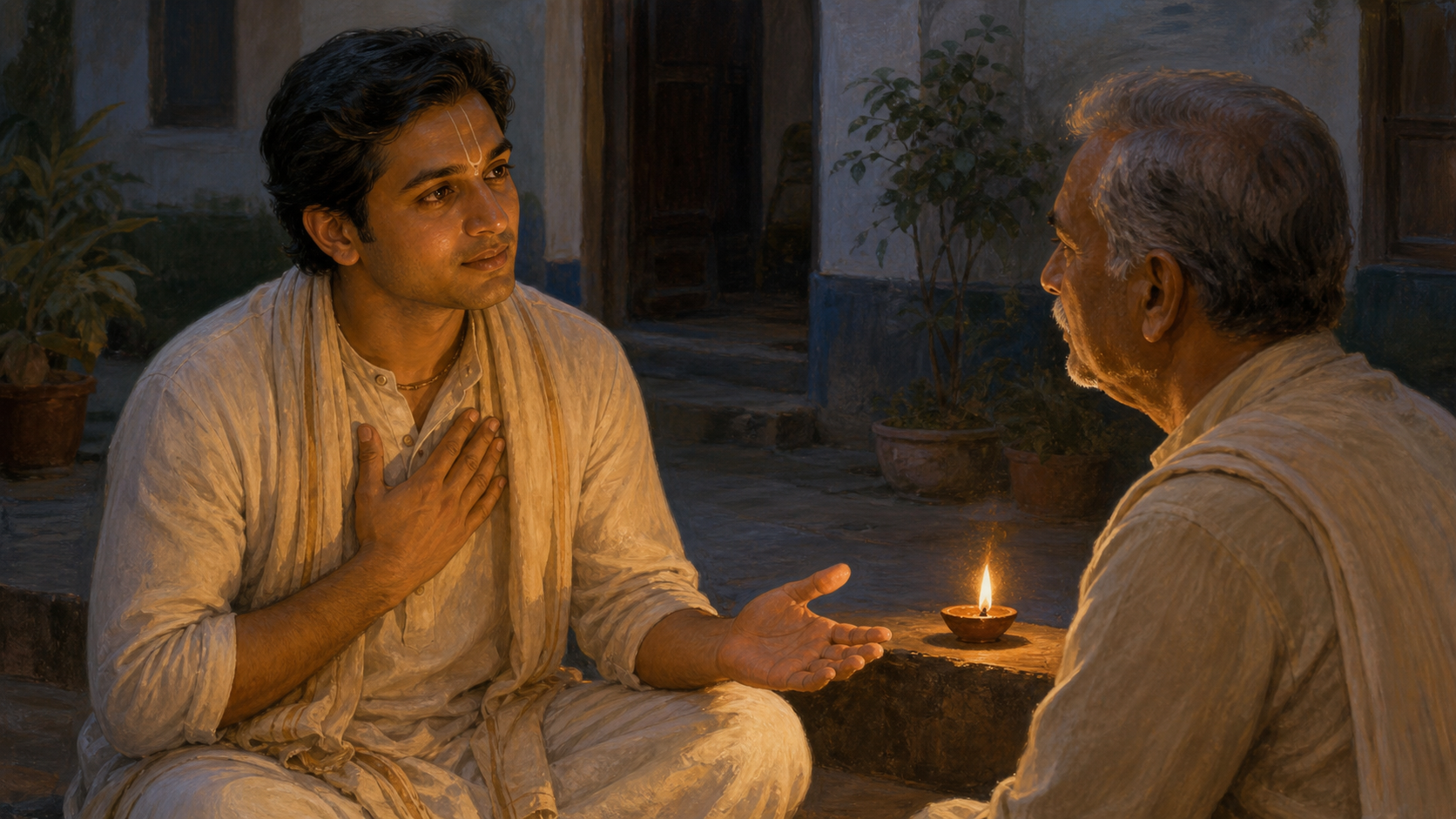
Dhruva wants to address the Lord, yet the power of address must first be awakened by that same Lord. The theological insight is precise: the Lord to whom prayer is offered is also the Lord by whom prayer becomes possible.
That insight should follow you beyond formal recitation. Speech is where spiritual remembrance is quickly tested because words move from intention into the lives of other people. Flattery, exaggeration, gossip and needless harshness all use an enlivened faculty while forgetting why it was given.
Before an important reply, pause for one unhurried breath and ask three questions: Is what you are about to say true? Is this the right way to say it? What will these words serve? The pause is not a ritual formula, and it need not be visible to anyone else. It simply creates enough space for remembrance to enter before reaction becomes speech.
This discipline does not require silence when dharma calls for a clear word. Avoiding a necessary truth can also misuse speech. The aim is not to make every sentence soft, ornamental or conventionally religious. It is to make speech answerable to truth, compassion and service rather than anger, vanity or the desire to dominate.
The same standard applies to public communication. Before sending a message, publishing an accusation or passing along a claim, read it once as an offering. If you would be ashamed to place the intention behind it before Bhagavan, revise it, verify it or do not send it. Remembering the source of speech should change both what you say and what you refuse to amplify.
Carry the prayer into your senses, limbs and daily choices

The verse does not stop with the voice. Its movement through hearing, touch, hands, feet and prana keeps devotion from becoming merely verbal. Each named faculty presents a different field of practice.
- Hearing: Notice not only whether something is pleasant but whether it deserves repeated entrance into your consciousness. Give sustained attention to shastra, nama and speech that strengthens discernment. Withdraw attention from gossip and agitation that you consume merely out of habit.
- Hands: Treat ordinary work, care for family, preparation for worship and help offered to another person as possible forms of service. The question is not whether the task looks sacred; it is whether the hand is being directed with integrity.
- Feet: Examine where your choices repeatedly carry you. Going to satsanga, a temple or a person in need can become a bodily expression of intention. Refusing to go where you know your resolve will be weakened can also be an offering.
- Touch: Let remembrance govern gentleness, restraint and respect for another person’s boundaries. A faculty belongs to devotional life precisely where its misuse could harm someone.
- Prana: Receive life as sustained rather than self-created. The verse’s point is larger than a breathing technique: the living person who performs every technique remains dependent on the Supreme Person.
You do not have to monitor every faculty at once. Choose the one most connected to your present difficulty. If conflict follows your words, begin with speech. If distraction is shaping your mind, begin with hearing. If devotion feels sincere but inactive, begin with the hands or feet. A focused application is more useful than admiring the verse in general terms.
Use a repeatable practice instead of waiting for a devotional mood

Remembrance becomes dependable when it is attached to ordinary actions. You can use the following practice without manufacturing an elevated feeling:
- Read or recite SB 4.9.8 before beginning your main duties. Attend to the meaning, especially the faculty you intend to watch.
- Name the capacity you are about to use. Silently recognise, “The power to speak,” “the power to hear” or “the power to act.” This interrupts the assumption of automatic ownership.
- Acknowledge dependence. If you do not remember the Sanskrit, use a plain working reminder: “This power is given; let it serve.” Do not mistake that sentence for a scriptural quotation.
- Direct the faculty deliberately. Make one concrete choice: withhold a cruel reply, listen fully, complete neglected service, go where duty requires or turn away from degrading content.
- Review the use, not the mood. At the close of the day, ask where remembrance changed an action and where forgetfulness took over. Make the next correction specific.
This practice also reveals a subtle obstacle: you may remember Bhagavan when you feel powerless but forget Him when things work well. SB 4.9.8 trains the opposite reflex. Success itself becomes a reminder because functioning speech, clear hearing and effective action are the very evidence of received power.
Key takeaways
- SB 4.9.8 presents the Lord within as the enlivener of speech, senses, limbs and life.
- The verse does not erase human agency; it makes the use of every received capacity accountable.
- Speech is an immediate field of practice because remembrance should alter truthfulness, tone, timing and intention.
- Hearing, touch, hands and feet belong to spiritual discipline as much as formal prayer does.
- The most practical application is to choose one faculty, remember its source before using it and direct it toward a concrete act of dharma or seva.
At the next moment when a word, movement or decision is about to leave you, do not wait for a grand spiritual experience. Remember the One who makes that ordinary power possible, then use it in a way you can honestly offer back.
References
