

If you are asking why Srila Prabhupada’s Vrindavan period matters, do not treat it as an empty interval before the more visible mission in the West. His years there are remembered especially for work on the first volumes of Srimad Bhagavatam and his determination to carry Krishna consciousness westward.
The useful question is not simply, “What happened in Vrindavan?” It is: how did life in a sacred center become preparation for serving people far beyond it? That question gives you a clearer way to read his life. It also offers a practical test for your own spiritual study: does contact with a holy place or sacred text end in admiration, or mature into responsible transmission?
Vrindavan was not the opposite of mission
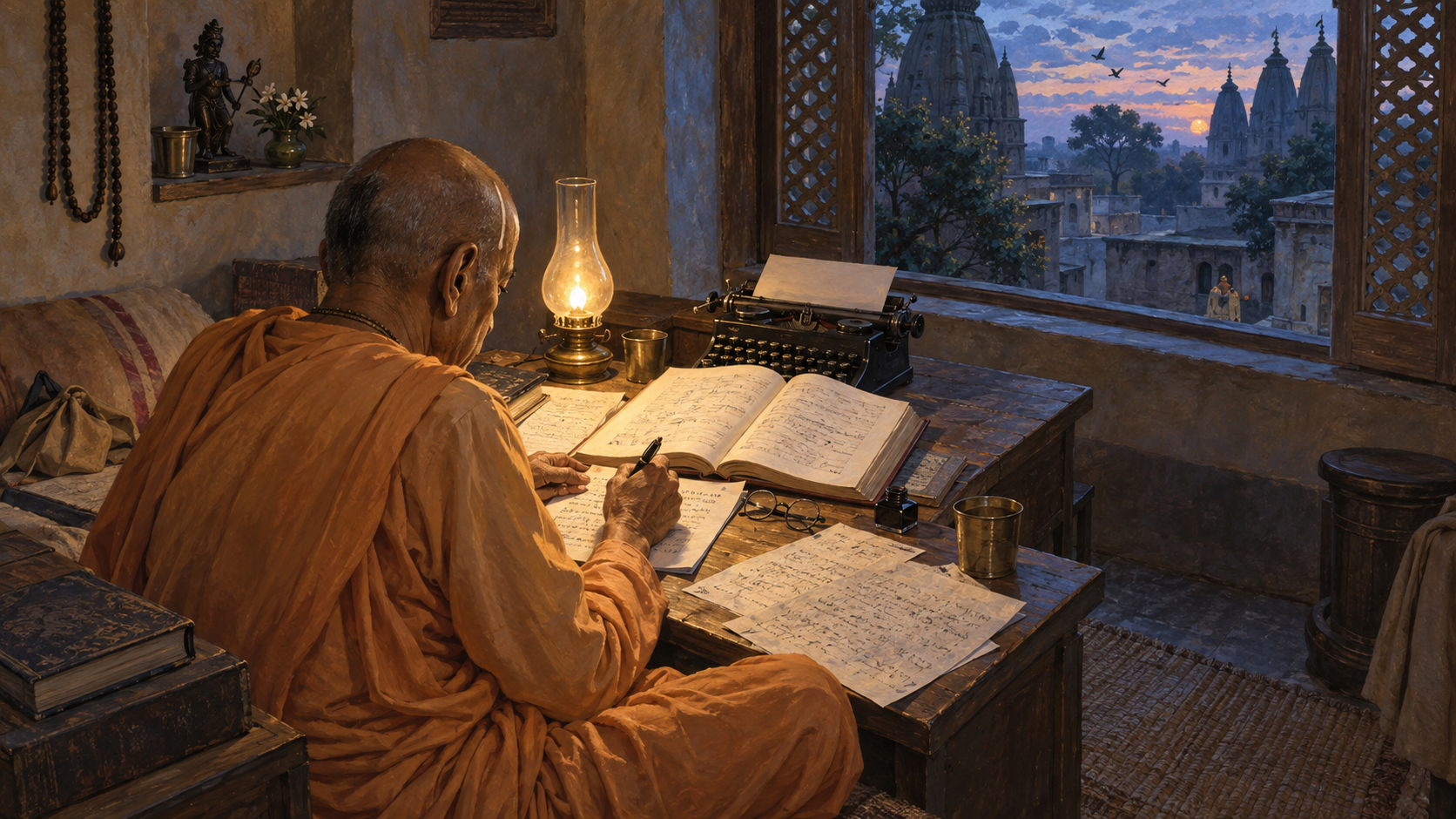
Vrindavan naturally draws the mind inward. Its importance in Krishna bhakti comes from remembrance, worship, pilgrimage, and the sacred geography associated with Krishna’s pastimes. It would therefore be easy to imagine Prabhupada’s time there primarily as withdrawal from the world.
The preparation of the Bhagavatam volumes points in another direction. Vrindavan was not only a destination for devotion; it was also a setting in which devotion was being made ready to travel. The inward and outward movements belonged together. Immersion in a sacred tradition supplied the substance, while preparing books gave that substance a form that could reach readers elsewhere.
This corrects two opposite misreadings. One romanticizes Vrindavan as though sacredness required disengagement from people outside it. The other celebrates the later Western mission while treating the years of preparation as a mere preface. Both miss the hinge of the story: what eventually became visible was preceded by quiet work with scripture.
When you read a biography of a spiritual teacher, pay attention to the preparatory verbs. Teaching publicly may be memorable, but preparing, studying, writing, revising, and persevering often explain how the public work became possible. Do not fill the quieter period with picturesque details that cannot be established. Notice the actual relationship between place, text, resolve, and service.
Why the Bhagavatam belonged at the center of the mission

Srimad Bhagavatam is not a collection of generic encouragement. It is a sacred text centered on Bhagavan, bhakti, and the formation of spiritual vision through sustained hearing and reflection. Making its opening volumes part of the preparation meant that the mission would be carried by a text, not merely by personal magnetism.
A teacher can address the people present in a room. A book can remain after the gathering ends, enter a reader’s home, and be revisited when memory becomes uncertain. It gives later teaching a stable point of reference. It also places a demand on the messenger: enthusiasm must remain answerable to the teaching being transmitted.
The fact that these were the first volumes matters. A first volume is not a finished lifetime of work. It is a beginning sturdy enough to carry intention into action. Prabhupada did not need every possible part of the mission to be complete before taking its central message outward. He needed a real foundation from which the work could continue.
That distinction is useful if you are trying to begin serious service yourself. “Start before everything is complete” does not mean “start without substance.” The Vrindavan pattern is more demanding: identify the teaching that must govern the work, prepare enough of it carefully to serve another person, and then carry it without pretending that the work is finished.
Read the Vrindavan years without flattening them
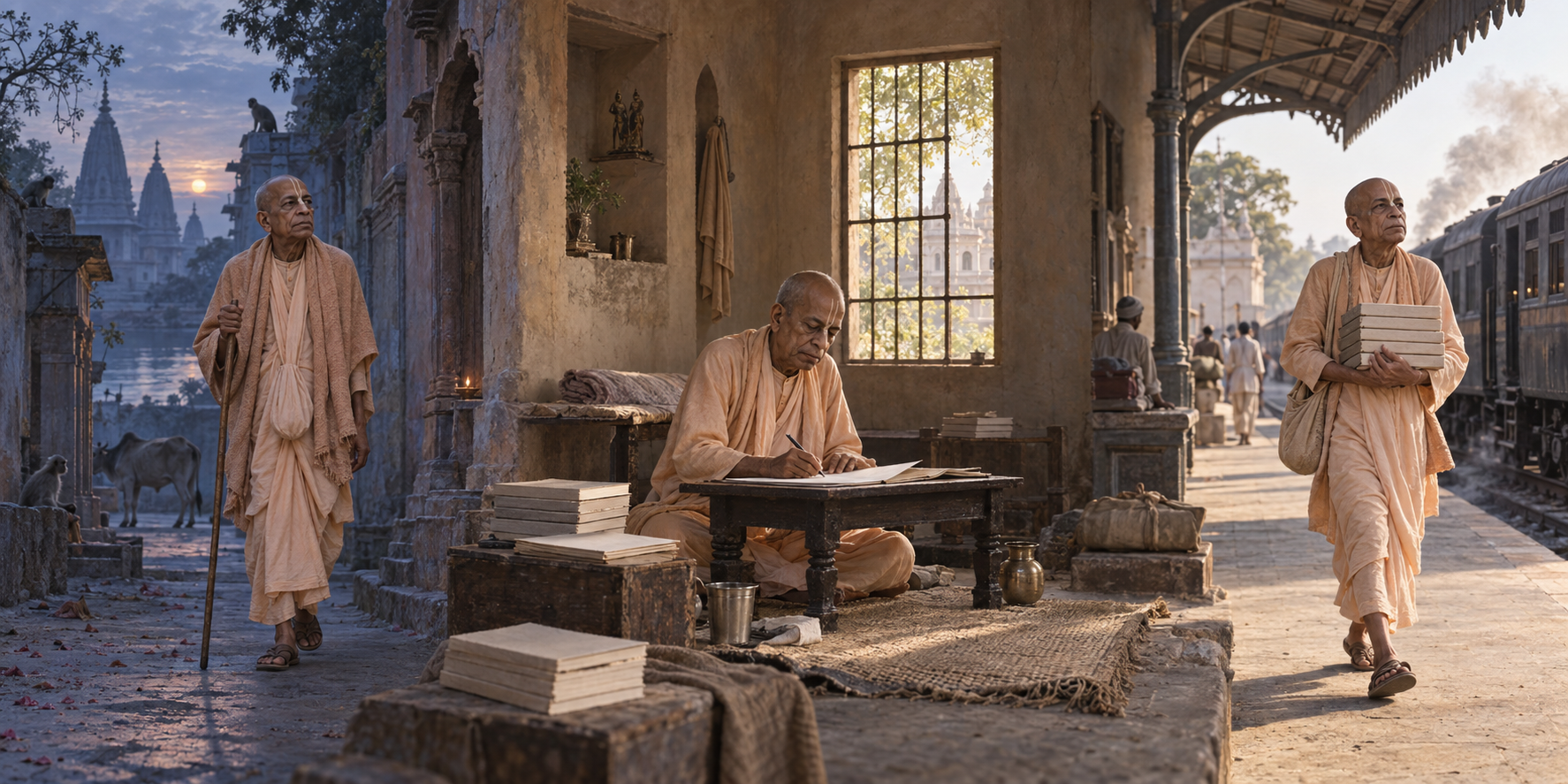
Devotional history often carries fact, interpretation, and spiritual meaning in the same narrative. All three can be valuable, but they do not perform the same job. Keeping them distinct lets you honor the tradition without turning every inference into a historical certainty.
- Begin with the factual core. In this case, keep the first Bhagavatam volumes, the Vrindavan setting, and the resolve to bring Krishna consciousness to the West in view.
- Name the interpretation as interpretation. Reading the period as a union of inward formation and outward service is a reasoned understanding of those facts. It should not be confused with a detailed diary of motives or daily events.
- Receive devotional meaning without using it as a substitute for evidence. A devotee may see Vrindavan as spiritually forming the service that followed. That meaning can guide practice even when it does not establish a chronology.
- Test remembered anecdotes by the claim you want them to support. Memory may illuminate character, mood, or conviction. It may be less suited to settling an exact sequence unless corroborating detail is available.
This method protects you from two failures. Skepticism can become so narrow that it refuses to hear what devotional memory communicates. Reverence can become so indiscriminate that it treats interpretation as documentation. A mature reader neither dismisses meaning nor relaxes the standard of truth.
Key takeaways
- Prabhupada’s Vrindavan years matter because scriptural preparation and westward resolve were present together.
- The Bhagavatam made the mission text-centered and gave teaching a form that could travel beyond the teacher’s immediate presence.
- Vrindavan should not be reduced either to private retreat or to background scenery for later achievements.
- A careful reader distinguishes established events, historical interpretation, and devotional meaning without discarding any of them.
- The practical pattern is preparation followed by transmission: understand what you are carrying before trying to carry it far.
Make the Bhagavatam mission concrete in your own study

You do not honor a scriptural mission merely by admiring the sacrifice behind it. You honor it by becoming a more careful receiver and transmitter. A simple study discipline can keep that intention from dissolving into sentiment.
- Choose one manageable textual unit. If your edition presents the verse, translation, and commentary together, read them as a unit rather than extracting a memorable line from its argument.
- State the central teaching in plain language. Write down what the passage says about Bhagavan, the living being, the world, or devotional practice. If you cannot state the point clearly, remain with the passage before trying to teach it.
- Separate the layers. Mark what comes directly from the verse, what the commentary explains, and what you are applying to your own circumstances. This prevents a personal reaction from being presented as scripture.
- Explain the passage to one real person. Use ordinary language, but do not remove the idea that makes the teaching distinctive. Accessibility is not the same as dilution.
- Return and correct yourself. After another reading, note what you overstated, omitted, or misunderstood. Transmission becomes trustworthy when correction is part of the practice.
This does not make your circumstances equivalent to Prabhupada’s. It applies the discipline visible in the Vrindavan period: absorb the teaching, give it a durable form, and carry it with fidelity. The next time you visit a temple, hear a discourse, or open the Bhagavatam, take one teaching far enough that you can explain it accurately to someone who was not there. That is a modest but real way to let sacred reception become service.
References

Leave a Reply
You must be logged in to post a comment.