
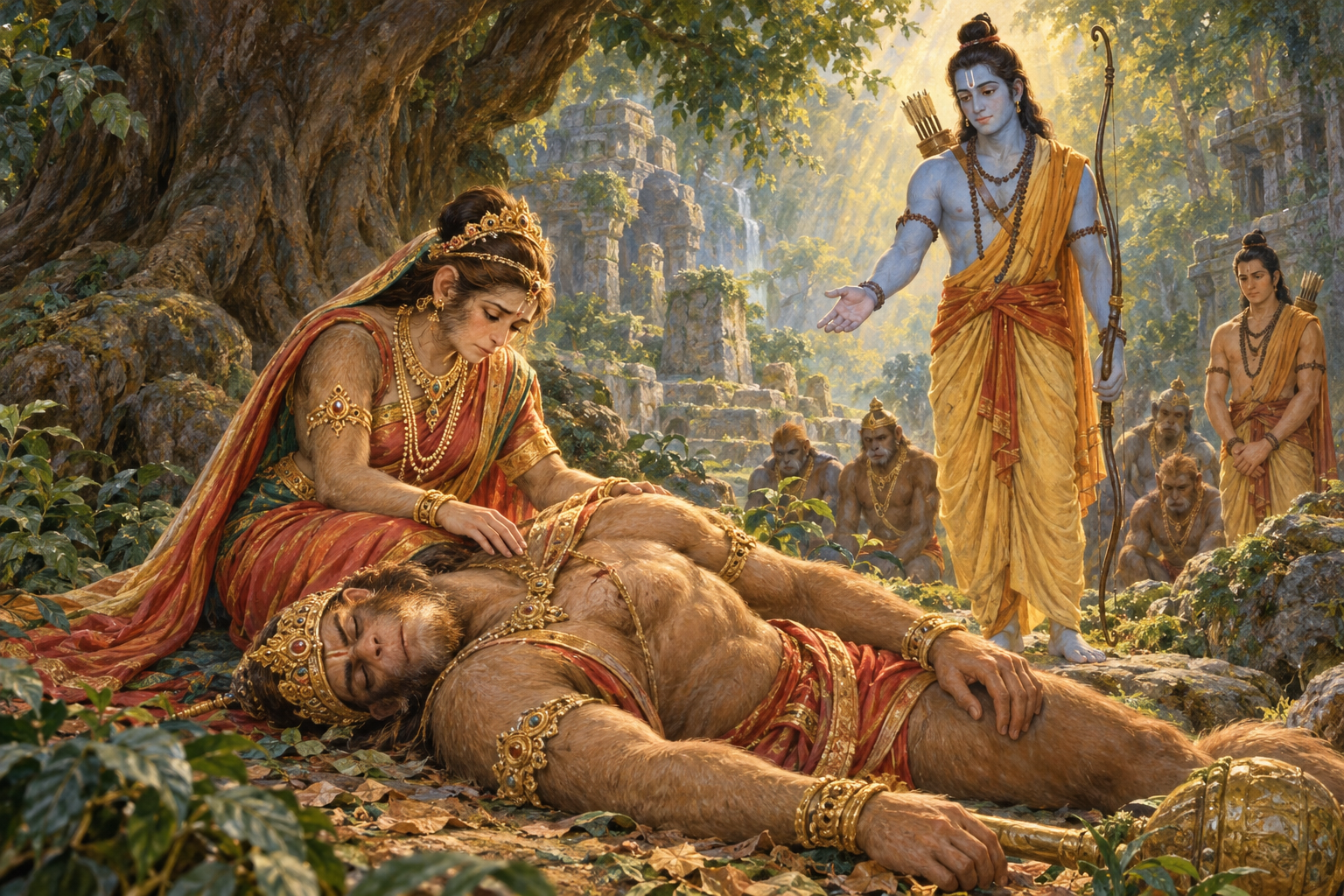
Perhaps you reached Tara’s encounter with Sri Rama because his counsel seems almost too austere for the moment. A woman is grieving beside her husband’s body. Why answer her with a teaching about the deathless Self?
The answer becomes clearer when you notice what Rama is trying to heal. He does not make love meaningless or pretend that Tara’s life has not changed. He separates the reality of her loss from the far more destructive conclusion that death has annihilated the beloved, emptied her own being, and left her with no ground on which to stand.
Rama asks Tara to distinguish what died from what cannot die
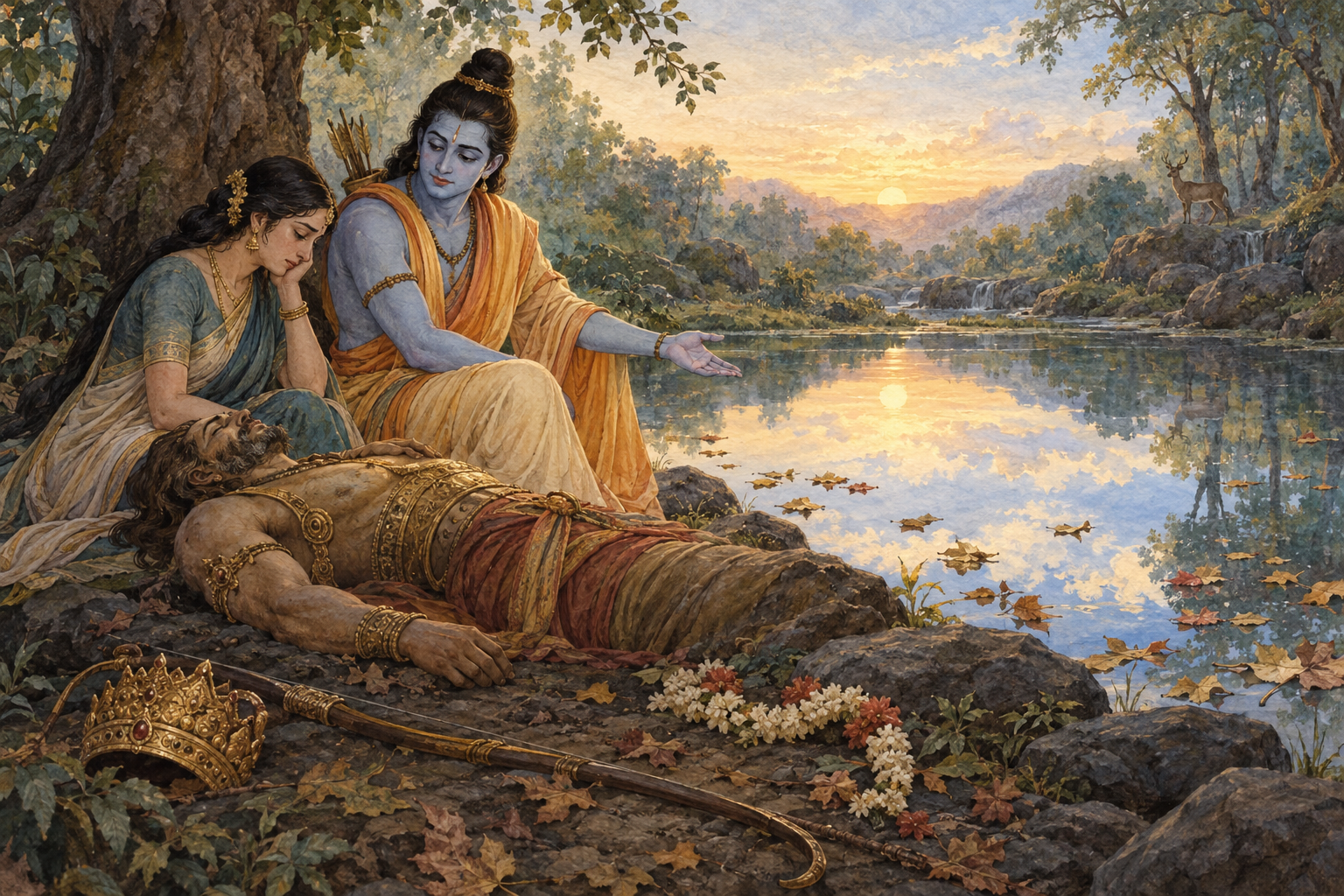
In Ezhuthachan’s Malayalam Adhyatma Ramayana, Vali falls in battle and Tara collapses beside him. Her sorrow is not an abstract philosophical problem. She has lost her husband, her familiar relationship and the identity through which much of her life had been organised.
Rama responds by introducing a precise distinction between the body and the Atman. The body associated with Vali is before Tara, but it no longer speaks, acts or recognises her. If Vali were nothing more than that body, the body’s continued presence ought to satisfy her. Yet it plainly does not. What she loved was not inert matter by itself.
If Vali is understood as the conscious Self, however, that Self is not a material object that death can cut apart or extinguish. The body undergoes change and destruction. The Atman, in the Vedantic vision informing the episode, is the unchanging consciousness because of which bodily life, thought, affection and grief are known.
This is not a verbal trick. Rama is disentangling three claims that grief can compress into one overwhelming experience:
- The physical fact: Vali’s embodied life has ended.
- The relational fact: Tara can no longer meet him through the shared life she knew.
- The metaphysical conclusion: the person has become absolute nothingness, and Tara’s own being has therefore been diminished or destroyed.
Rama does not ask Tara to deny the first two. His counsel challenges the third. That distinction matters whenever you apply the teaching to your own grief. The sentence I miss this person names a relational wound. Nothing remains makes a claim about reality. I am nothing without this person turns the loss into a claim about your own identity. Each sentence needs a different response.
Why a lost relationship can feel like the loss of the self

Tara’s grief reveals more than attachment to another person. Her place in the world has been bound to being Vali’s wife and queen. When the relationship is broken by death, the mind does not register only his absence. It also asks, often without words: Who am I now?
Vedanta does not treat roles as useless. A marriage, family responsibility or public office can carry serious dharmic obligations. The error begins when a role is mistaken for the whole Self. The mind says, I am this role; it then says, this person is mine; finally, it treats the survival of that relationship as the condition for the survival of the self.
You can notice the mechanism in a simple sequence:
<!– wp:list {
Leave a Reply
You must be logged in to post a comment.