
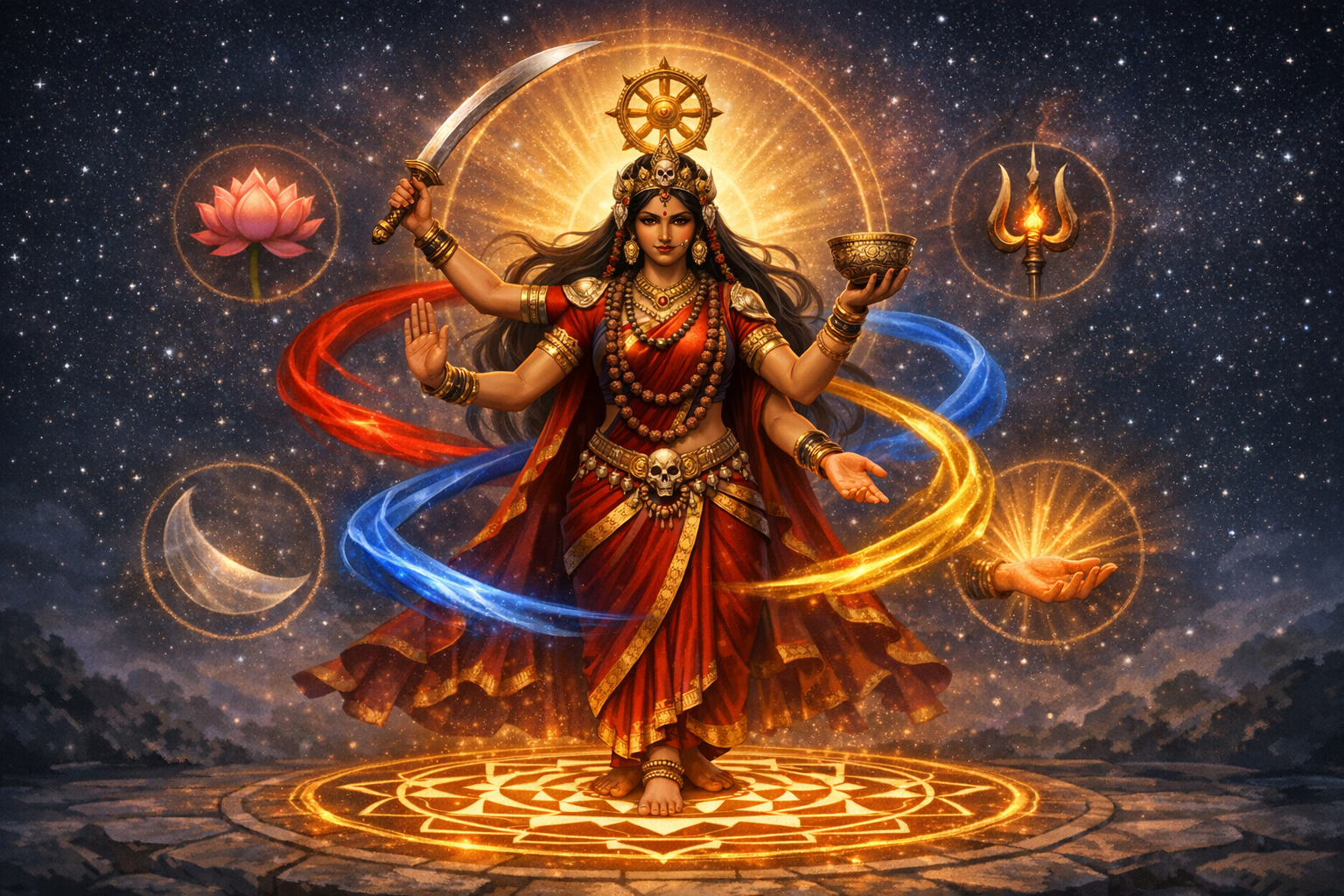
Shakta and Tantric philosophy place at the center of Hindu thought a striking yet rigorously reasoned principle: without Shakti, even the greatest cosmic deities remain inert. This assertion is not a polemical flourish but a metaphysical axiom tied to the nature of Brahman, manifestation, and the very logic of causality and action. In this view, Shakti is the primordial dynamism through which consciousness actively knows, wills, and does; Shakti is the power by which the universe moves from latent potential to living process.
The classical formulation of this truth is memorably expressed in Saundarya Lahari 1: “śivaḥ śaktyā yuktō yadi bhavati śaktaḥ prabhavitum na cedevaṁ devo na khalu kuśalaḥ spanditum api.” In precise terms, consciousness (Śiva) requires power (Śakti) to manifest any function; absent that conjunction, even the slightest vibration (spanda) does not occur. The statement is ontological, not sectarian. It affirms that divinity in repose and divinity in action are two aspects of a single ineffable reality, known in Advaita as Brahman and articulated in Tantra as the inseparable pair of Śiva and Śakti (śaktiḥ śaktimato’bhinnā).
Philosophically, one may distinguish Brahman as nirguṇa (beyond attributes) and Īśvara as saguna (with attributes). Shakti is the operative principle that bridges the unmanifest and manifest poles. In Vedānta, the language of Māyā and Prakṛti helps map how the Absolute appears as the ordered cosmos; in Tantra, Śakti is not a veiling impulse alone but the radiant potency of consciousness itself (cit-śakti). Thus, Shakti is neither an external tool nor a subordinate adjunct; Shakti is the very nature of Brahman-in-manifestation.
Tantric analysis further refines Shakti into three fundamental modalitiesicchā (will), jñāna (knowledge), and kriyā (action). Through these, the five cosmic acts (pañcakṛtya)sṛṣṭi (emanation), sthiti (maintenance), saṁhāra (reabsorption), tirobhāva (concealment), and anugraha (grace)unfold as the living grammar of reality. If Brahmā, Viṣṇu, and Rudra are poetic-personalized names for these functions, then Shakti is their capacity to be effective at all. Without Shakti, “creator,” “sustainer,” and “transformer” are only titles; with Shakti, they become operative principles of a breathing universe.
Within this larger frame, Śrī Cāmuṇḍā Stotra offers a consummate vision of Shakti in her fierce, protective, and liberating mode. The stotra, read alongside Devī Māhātmya (of the Mārkaṇḍeya Purāṇa) and regional Sthala-Māhātmyas echoed in the Skanda Purāṇa, venerates Cāmuṇḍā as the energy that dismembers fear, agitation, and inertia at their roots. In the Devī Māhātmya narrative, Cāmuṇḍā arises from Ambikā to subdue Caṇḍa and Muṇḍaarchetypes for unbridled aggression and dark cunning. The hymn thereby encodes a psychological lesson: when consciousness unites with its primordial power, destructive impulses are transmuted and mastered.
Iconographically, Cāmuṇḍā is depicted in cremation-ground settings, adorned with a garland of skulls, holding a khaḍga (sword) and kapāla (skull-cup), and accompanied at times by jackals. Far from mere terror imagery, this grammar is pedagogical. The cremation-ground points to impermanence and the stripping away of false identity; the skulls symbolize the transcendence of limited cognition; the jackals signal the fearless reclamation of liminal spaces in consciousness. Such symbolism aligns with the hymn’s soteriological thrust: confronting finitude without evasion awakens a deeper, undying presence.
From a textual-structural standpoint, Śrī Cāmuṇḍā Stotra typically progresses through salutations (maṅgalācaraṇa), a litany of epithets describing the Goddess’s functions and attributes, an interiorization of these powers within the practitioner, and a concise phala-śruti that frames practice outcomes ethically and spiritually. Rather than magical guarantees, the stotra sets an inward arc: devotion ripens into discernment; discernment matures into fearlessness; fearlessness issues as compassionate action. In short, the hymn maps the transformation of energy from diffuse emotion into lucid, purpose-filled resolve.
This inner transformation is intelligible within multiple philosophical registers. In Kashmir Śaivism, spanda theory understands reality as a pulsation of consciousness whose potencies (śaktis) contract into finite experience and re-expand into freedom. In Śrīvidyā, the Devī is contemplated as the totality of manifestation and the ground of liberation, diagrammed through the Śrīcakra and articulated via mantra and nyāsa. In both frames, Cāmuṇḍā is not “outside” the aspirant but manifests as the latent resourcefulness that faces terror and transmutes it into wisdom.
The refrain from Devī Māhātmya resonates as a cross-textual keynote: “yā devī sarvabhūteṣu śakti-rūpeṇa saṁsthitā namastasyai namastasyai namastasyai namo namaḥ.” The hymn’s insight is universalizable: the presence of Shakti as will, knowledge, and action abides in all beings. Śrī Cāmuṇḍā Stotra, when read through this lens, becomes less a plea to an external rescuer and more a disciplined invocation of the cosmic power already inhabiting the field of one’s life, relationships, and responsibilities.
Theological clarity helps avoid common misreadings. The assertion “without Shakti, even the gods are inert” does not diminish Brahmā, Viṣṇu, or Rudra; rather, it elevates understanding from competitive theism to integral metaphysics. Names like Brahmā, Viṣṇu, Rudra, Sadāśiva, and Īśvara poetically designate functions of the one Reality. Shakti names that Reality’s power of self-expression. In this sense, Śāktism converges with Advaita’s non-duality, not as abstraction but as the lived non-separateness of consciousness and its power.
Yogically, the hymn can be interiorized as a map of kuṇḍalinī-śakti ascending through the cakras. At mūlādhāra, Shakti is ground; at maṇipūra, she becomes disciplined energy; at anāhata, she refines emotion into compassion; at ājñā, she concentrates into insight. Śrī Cāmuṇḍā, as the remover of inimical tendencies, can be contemplated at each stage as the courage to face and release constrictions (granthis), enabling energy to move from compulsion to clarity.
Ritually, practice traditions align stotra recitation with dawn or twilight, cultivating sattva (clarity) and steadiness. A simple pañcopacāra (five-offering) pūjā with a clean lamp, water, flowers, scent, and food offering, performed with reverence and restraint, harmonizes the outer rite with inner contemplation. The point is not ostentation but alignment: voice, breath, and intention cohering in a quiet, stable presence anchored in dharmanon-harming, truthfulness, and self-discipline.
Viewed across dhārmic traditions, the primacy of enlivening power finds kindred expressions that invite shared respect and dialogue. In Vajrayāna Buddhism, the complementarity of prajñā (wisdom) and upāya (skillful means) parallels the Śiva–Śakti nexus as inseparable facets of awakening. Jain contemplative ethics, with its emphasis on vigilance and the transformation of harmful impulses, resonates with Cāmuṇḍā’s iconography of fearlessness and restraint. Sikh scripture and tradition acknowledge Divine Power (Bhagautī), and compositions such as “Chandi di Var” in the Dasam Granth poetically celebrate the victory of righteous courage over chaos. Such convergences underscore a civilizational ethos: many paths, one shared aspiration toward wisdom, compassion, and fearlessness.
Historically and regionally, devotion to Cāmuṇḍā has flourished in diverse centers, each interpreting the Devī’s fierceness as nurturing protection. While textual lineages recall her exploits from the Devī Māhātmya, temple and folk traditions expand her living presence through festivals, vows (vratas), and local narratives that translate the hymn’s metaphysics into everyday couragetending families with integrity, safeguarding communities with judicious strength, and meeting uncertainty with poise.
As an interpretive key, Śrī Cāmuṇḍā Stotra also clarifies the ethical use of power. Shakti, untethered from discernment (viveka) and compassion (karuṇā), devolves into aggression; when guided by clarity and care, it becomes benevolent leadership and service (seva). The hymn recurrently pairs valor with humility, reminding practitioners that real fearlessness springs from egolessness, not domination.
Scholarly cross-references help situate the hymn’s claims in a larger scriptural lattice: Devī Māhātmya (Mārkaṇḍeya Purāṇa) as the narrative fountainhead for Cāmuṇḍā; Saundarya Lahari as the concise metaphysical axiom of Śiva–Śakti nonduality; Śākta Upaniṣads (e.g., Devī Upaniṣad) for doctrinal consolidation; and Skanda Purāṇa’s regional Sthala-Māhātmyas for ritual-ecological context. Read together, these sources support the central teaching without demanding exclusivism, in keeping with Hinduism’s plural hermeneutics.
Practically, the hymn’s relevance endures because it addresses a human constant: the encounter with fear, loss, and change. By contemplating the Devī in cremation-ground imagery, practitioners symbolically rehearse meeting endings without denial. In doing so, they discover the unending: the resilient intelligence that neither clings nor collapses, but responds skillfully. In that discovered poise, the claim that “without Shakti, the gods are inert” is no longer abstract; it becomes evident as the difference between paralysis and purposeful action in daily life.
In sum, Śrī Cāmuṇḍā Stotra does not merely praise a fierce Goddess; it unveils a universal principle of sacred efficacy. Shakti is the primordial impetus by which consciousness knows, wills, and acts. Whether named Brahmā, Viṣṇu, Rudra, Sadāśiva, or Īśvara, divinity’s titles become living realities only in and through Shakti. To recognize this is to see that the same animating power courses through the body, mind, and worldguiding creation, sustaining order, transforming obstacles, veiling and unveiling truth, and, finally, gracing liberation. That recognition is both metaphysical clarity and practical courage, the very heart of the hymn’s promise.
Inspired by this post on Hindu Blog.
