
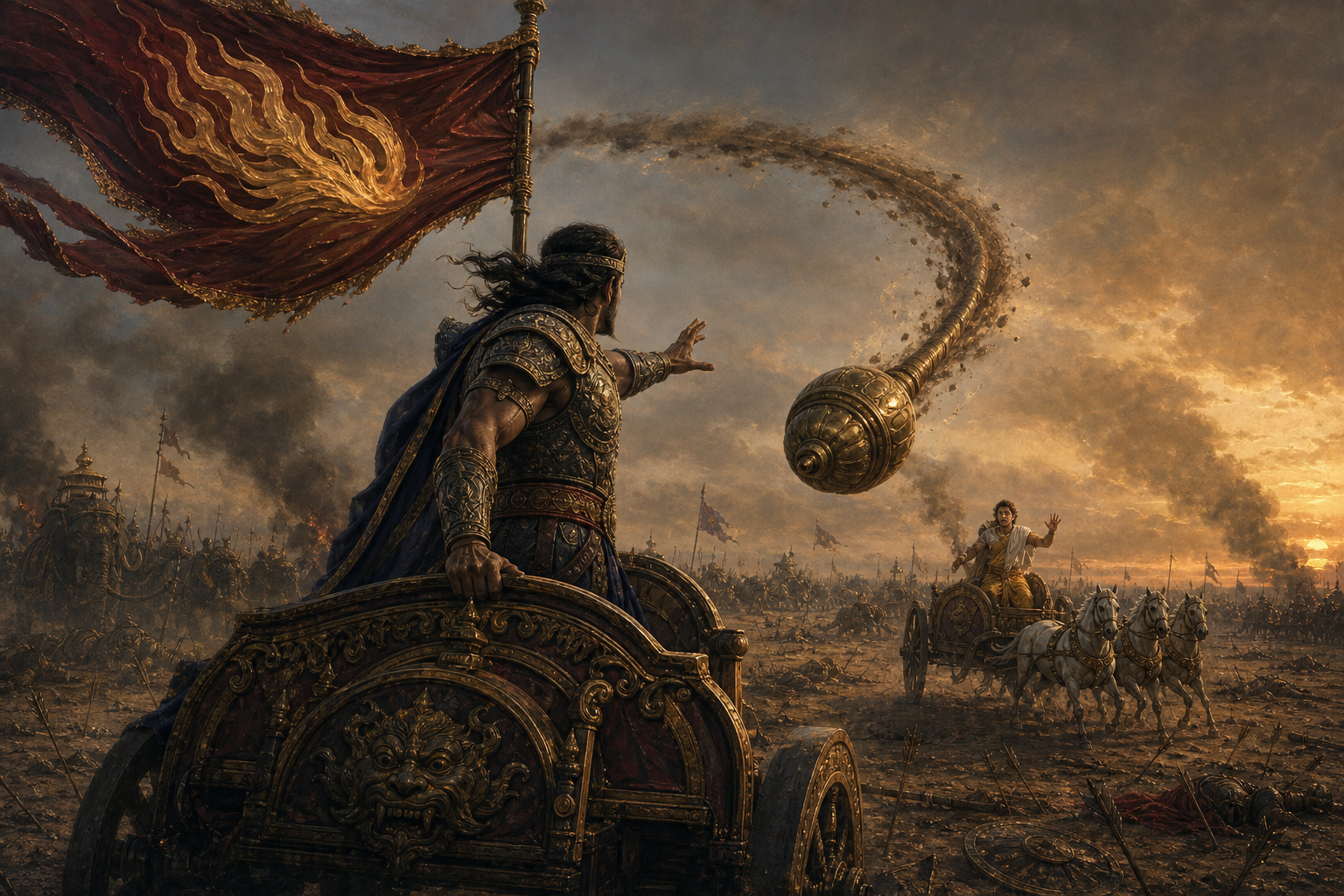
If you have wondered why Shrutayudha, a warrior associated with Varuna’s mace, carries Agni on his standard, the apparent contradiction is the wrong place to stop. The banner becomes intelligible only when you place it beside the weapon’s condition and the battlefield decision that kills its bearer.
Read in that sequence, Agni is not merely decorative fire. It illuminates one of the Mahabharata’s most practical teachings about power: a formidable capacity remains protective only while its wielder respects the limits built into it.
The episode turns on one forbidden target
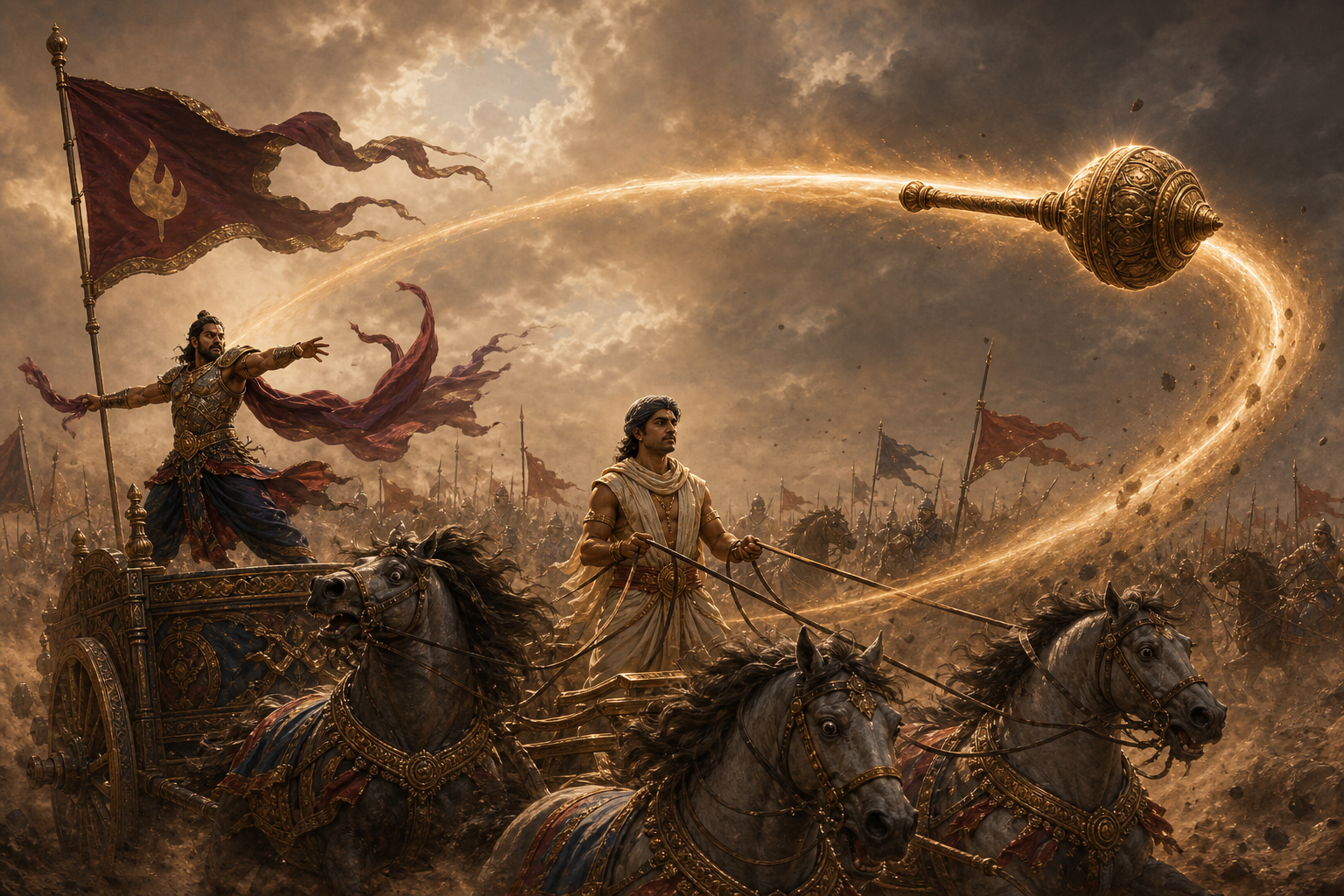
Shrutayudha’s name joins shruta, meaning heard or renowned, with ayudha, meaning weapon. His identity is therefore bound to the fame of his weapon. That matters because his end is not separate from this identity. The very power that distinguishes him becomes the means of his destruction.
His mace comes from Varuna, but the divine gift carries a rule. It must not be cast at someone who is not fighting as an armed opponent. The restriction is not an optional piece of moral advice added after the gift. It is part of how the power works.
During battle, Shrutayudha casts the mace at Krishna. Krishna is guiding Arjuna’s chariot, not confronting Shrutayudha as an armed combatant. The prohibited use activates the weapon’s consequence: the mace turns back upon Shrutayudha and kills him.
- A warrior receives extraordinary power.
- The power arrives with a precise boundary.
- The battlefield tests whether the bearer will remember that boundary.
- He chooses a target outside the weapon’s permitted use.
- The force meant for another returns to its wielder.
This sequence keeps the interpretation grounded. Shrutayudha is not killed because fire defeats water, nor because Krishna answers the mace with a more destructive weapon. His own act completes the condition attached to the gift. The moral centre of the episode is judgment under pressure.
Why Agni belongs on a Varuna-linked warrior’s flag
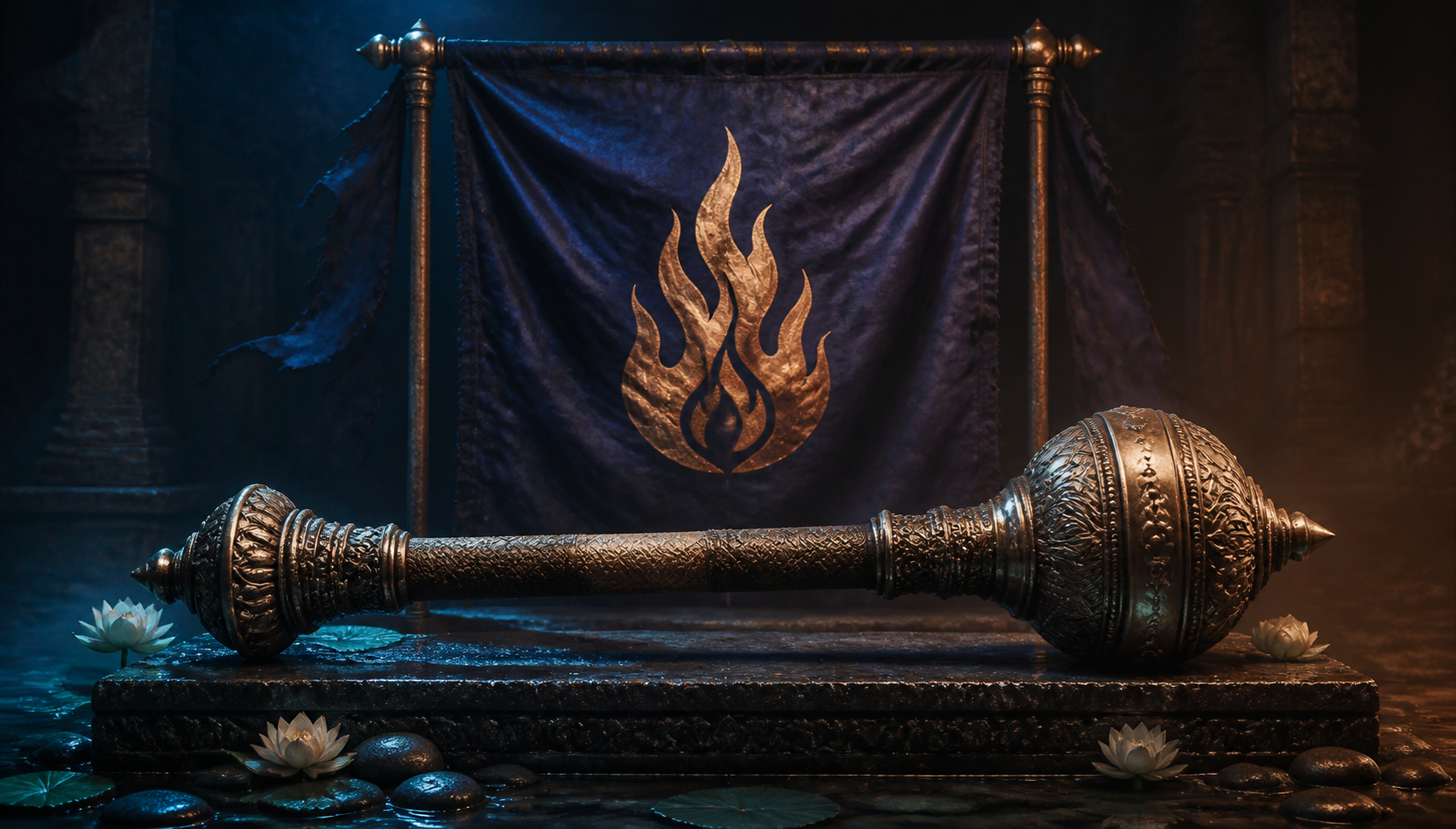
A one-to-one reading of divine symbols creates a false problem. Varuna’s connection to the mace does not require every sign surrounding Shrutayudha to be aquatic. A weapon’s provenance and a banner’s imagery can perform different narrative tasks.
Within Hindu thought, Agni is more than physical flame. Fire can signify radiance, martial energy, sacrifice, transformation and the power that consumes what is placed within it. These meanings should not be treated as a rigid code in which every appearance of fire carries every possible association. You have to test the image against the character’s actions and fate.
Before Shrutayudha’s fatal decision, the fiery standard suits a warrior of visible force and reputation. It projects heat, brilliance and danger. After the mace returns, the same emblem acquires a darker resonance: power has become self-consuming. The flame that announced the warrior’s strength now helps you recognise the pattern of his fall.
This is best stated as an interpretation, not as a mechanical translation of the emblem. Agni need not be the literal agent of Shrutayudha’s death for the banner to illuminate it. The narrative action supplies the cause; the symbol gives that action an additional layer of meaning.
Three distinctions prevent the common misreading
- Agni is the emblem, not the giver of the mace. The fiery standard expresses something about the warrior’s displayed energy and narrative trajectory. Varuna remains associated with the weapon and its condition.
- Divine origin does not erase ethical limits. A god-given weapon is not a licence for indiscriminate use. Its restriction reveals the order within which its power is legitimate.
- Krishna is the chosen target, not the direct counterattacker. The decisive event is Shrutayudha’s own misuse of the mace. That preserves his agency and prevents the episode from becoming a simple contest of divine strength.
Once these layers are separated, the passage no longer looks like a clash between incompatible elements. It becomes a study of disciplined and undisciplined force. Water and fire do not need to cancel each other; Varuna’s conditional gift and Agni’s consuming imagery converge on the same warning.
The weapon’s rule also changes how you should understand dharma in the episode. Dharma is not merely a verdict delivered after Shrutayudha dies. It is already present in the limit governing the mace. The warrior’s error is therefore practical as well as moral: he tries to separate capacity from the conditions that make its use rightful.
How to read Mahabharata battle symbols without overclaiming
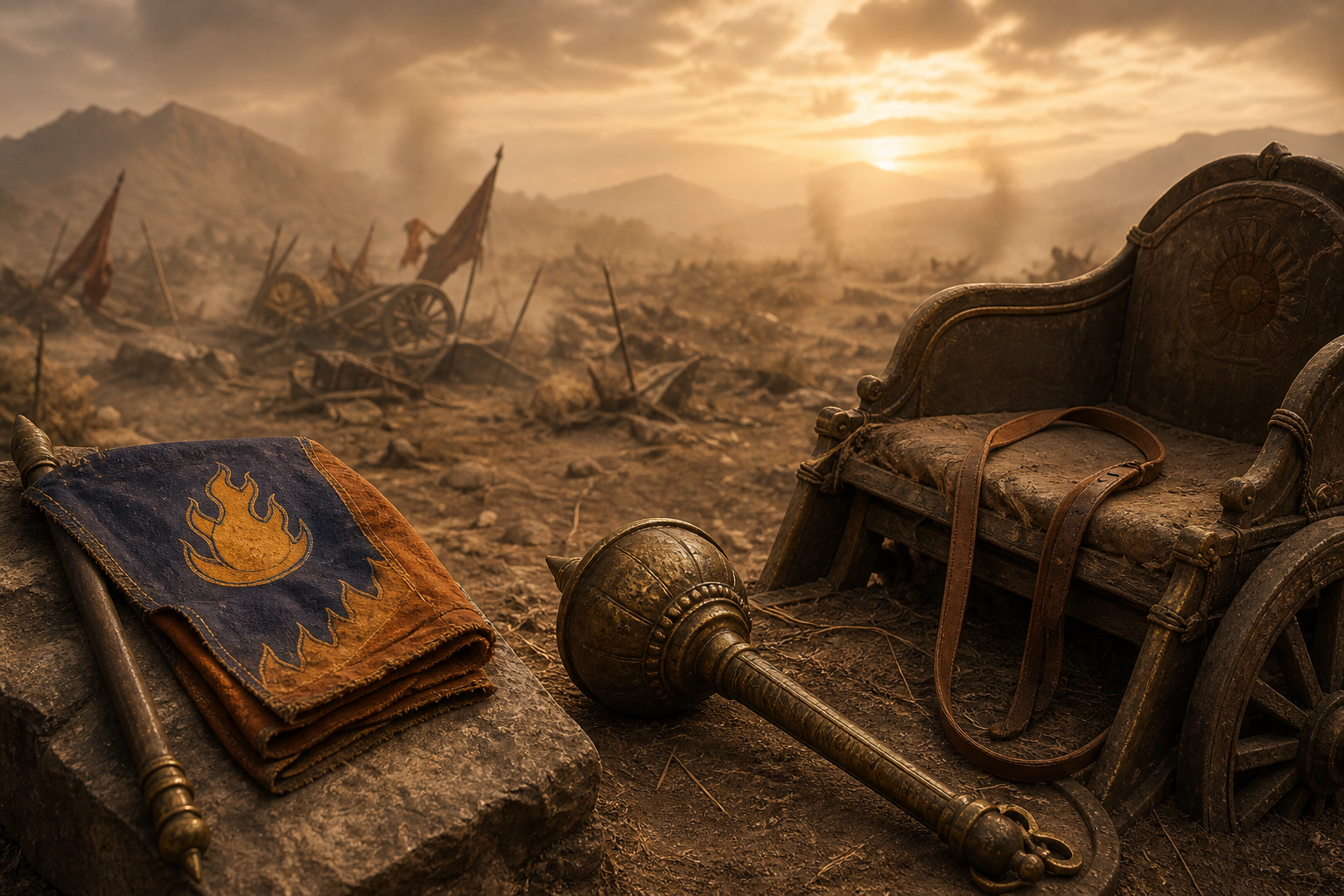
Shrutayudha’s banner offers a useful method for approaching other standards, weapons and divine associations in the Mahabharata. Begin with the event, then interpret the image. Reversing that order makes it easy to impose a favourite meaning on the text.
- Establish the narrative sequence. Identify who receives the power, what condition accompanies it, which choice violates that condition and what consequence follows.
- Keep objects in their proper roles. Do not assume that a flag, weapon, chariot and divine patron must all express the same element or idea.
- Pair every boon with its boundary. If you remember only the weapon’s strength, you miss the mechanism of the episode. Here, the restriction is as important as the mace itself.
- Test the emblem before and after the decisive act. Agni first suits Shrutayudha’s martial brilliance; after his mistake, it evokes force consuming its own bearer. A strong reading should illuminate both moments.
- Separate what happens from what it may mean. The mace returns and kills Shrutayudha within the narrative. The inward-turning flame is an interpretive connection. Keeping that distinction explicit makes the reading clearer, not weaker.
This method also prevents moral caricature. Shrutayudha’s death does not teach that martial power, reputation or divine weapons are inherently corrupt. It shows a narrower and more demanding principle: power becomes perilous when the bearer treats a condition as an inconvenience rather than as part of the gift.
Key takeaways
- Shrutayudha’s connection to Varuna and the presence of Agni on his banner serve different symbolic functions; they are not an elemental contradiction.
- The mace’s restriction makes dharma operational. Right use and continued protection cannot be separated.
- The fiery standard can be read first as martial radiance and then, in light of Shrutayudha’s death, as power turned against itself.
- The fatal cause is Shrutayudha’s choice of an impermissible target, not a direct battle between Agni and Varuna or between Krishna and the mace.
- A responsible symbolic reading begins with the narrative sequence and labels interpretation as interpretation.
When you next encounter a flag or divine weapon in the Mahabharata, ask more than what the object represents. Follow it into the bearer’s moment of decision. Shrutayudha’s standard becomes meaningful there: force shines while governed by dharma, but it can turn inward when its wielder mistakes possession for permission.
References
