
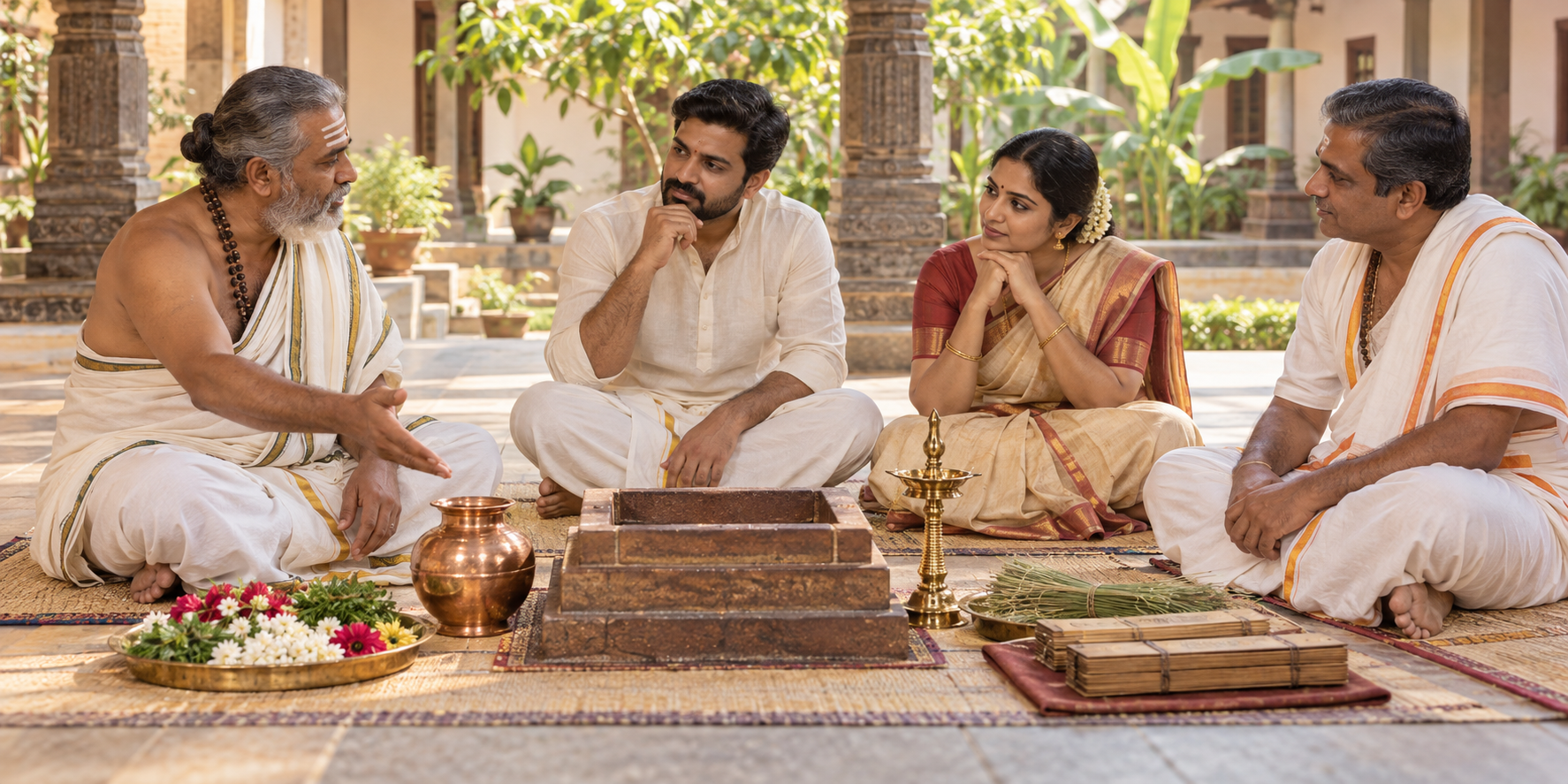
Someone tells you that a ritual is invalid because the wrong person performed it. Someone else replies that devotion is all that matters. If you are choosing a priest, planning a samskara, assessing a temple appointment, or trying to understand whether you may conduct a rite yourself, neither slogan gives you a dependable answer.
Adhikara gives you a more disciplined method. Instead of judging a person’s worth, it asks four narrower questions: Which act is being performed? In which role? Under which body of shastra? After which qualifications? Once you separate those questions, many arguments about ritual authority become easier to test.
Adhikara authorizes a defined act, not an entire person
In ritual discussion, adhikara means eligibility or authorization for a particular karma. It is not a declaration that one human being is spiritually superior to another. Nor is it a universal certificate allowing its holder to perform every Hindu rite.
This distinction matters because the same ritual setting contains several roles. A person may receive the benefit of a rite, undertake a vrata, study a text, teach it, perform a sacrifice for oneself, or officiate for someone else. Those roles are not interchangeable. Manusmriti 1.88 and Atri Smriti 13 distinguish study from teaching, sacrifice for oneself from officiation for others, and giving dana from accepting it. The division implies that permission for one activity does not automatically establish permission for another.
That gives you the first rule for any dispute: never ask only, Can this person perform Hindu rituals? Break the question into four parts:
- Name the karma: Is it upanayana, homa, a samskara, temple puja, mantra instruction, or another defined observance?
- Name the role: Is the person participating, receiving the rite, performing it for oneself, teaching, or officiating for others?
- Name the governing tradition: Is the claim based on Shruti, Smriti, an Agama, or the established discipline of a particular sampradaya?
- Name the prerequisite: Does the role require a samskara, initiation, a course of study, mastery of specified mantras, or a regulated form of conduct?
If any one of these remains unspecified, the conclusion is probably broader than the evidence. A restriction governing a Vedic officiant cannot simply be transferred to every devotional practice. Permission to conduct one form of worship cannot be stretched into authority to teach every mantra or preside over every samskara.
Ritual authority begins with shastra, not personal preference
Karmakanda is a regulated field because its acts are defined by injunctions, prohibitions, sequences, materials, mantras, and eligible agents. It includes nitya duties performed regularly, naimittika rites arising on a particular occasion, and kamya rites undertaken for a desired result. You cannot determine all of those conditions from the visible action alone.
Bhagavad Gita 16.23-24 places the determination of what should and should not be done under shastric authority. The practical consequence is sharp: sincerity can explain why you want to perform a rite, but it cannot by itself establish that the chosen form, mantra, or ritual office belongs to you. Svabhava, personal inclination, and shastric authorization answer different questions.
This does not make intention irrelevant. Intention affects the moral and devotional quality of an act. Adhikara addresses something else: whether a prescribed act is being undertaken by the qualified agent in the prescribed manner. Good intent cannot replace a missing initiation any more than technical skill alone can confer a teaching office that a tradition formally transmits.
The same discipline applies when people quote scripture at one another. Mahabharata, Anushasana Parva 162.4 warns that doubts about dharma are easy to raise but difficult to resolve because relevant testimony is extensive. Verse 162.25 further warns against treating valid proof as invalid, or invalid proof as authoritative. A verse is therefore the beginning of the inquiry, not always its conclusion.
When someone makes a claim about ritual eligibility, ask for the complete chain:
- Which text and passage establish the rule?
- What exact action, role, and class of ritual does that passage govern?
- Which prerequisite does the passage require?
- How does that prerequisite apply to the person under discussion?
- Does the governing sampradaya or Agama add a more specific rule for this rite?
This sequence prevents two common errors. The first is replacing shastra with modern preference. The second is collecting isolated verses from different ritual domains and treating them as though they regulate one identical office.
Upanayana shows why qualifications are cumulative
Upanayana is especially important in discussions of Vedic ritual authority because it is presented as an initiation into disciplined study, Savitri or Gayatri practice, and the ritual life associated with dvija status. It is not merely an ornament, family celebration, or retrospective badge.
Yajnavalkya Smriti 1.39 describes Brahmana, Kshatriya, and Vaishya as twice-born through upanayana, while Shankha Smriti 1.7 describes the acharya as father and Savitri as mother in that second birth. The language presents initiation as the opening of a new discipline under a teacher, not as proof that the initiate has already mastered it.
Atri Smriti 138 makes the progression more explicit: birth designation, samskara, learning, and the integrated standing of a shrotriya are treated as distinct stages. The useful point is not to turn those labels into casual honorifics. It is to notice that birth, initiation, education, and demonstrated formation are not synonyms.
Manusmriti 2.36 assigns traditional times for upanayana: the eighth year from conception for a Brahmana, the eleventh for a Kshatriya, and the twelfth for a Vaishya. Whether a contemporary community follows that schedule exactly is a separate question. Within this Smriti framework, however, the timing reveals that ritual competence was expected to grow through a structured period of formation. It was not meant to appear instantly when someone assumed a title.
The formation continues after initiation. Manusmriti 2.26-28 connects samskaras, svadhyaya, vows, homa, Vedic learning, yajna, and the mahayajnas with purification and fitness for higher realization. Ritual discipline is therefore both authorization and cultivation: the practitioner becomes capable by repeatedly living the discipline that the office requires.
Initiation alone is consequently insufficient. A prospective acharya or officiant should also be able to demonstrate relevant learning, truthful conduct, control of the senses, compassion, and knowledge appropriate to the rite. Traditional descriptions of the guru join character with mastery of Veda, Vedanga, and Agama. Neither reputation without learning nor learning without discipline satisfies that model.
If you are evaluating a practitioner, ask concrete questions rather than relying on dress, confidence, family name, or social-media popularity:
- What initiation or samskara stands behind this person’s role, and who conferred it?
- Which Veda, Vedanga, paddhati, or Agama did the person study for the rite you require?
- Can the person explain the rite’s vidhi, nishedha, sequence, and limits without evasion?
- Is the claimed authority restricted to one temple, lineage, deity, or class of rites?
- Does the person’s conduct support the responsibilities of teaching or officiating for others?
You do not need to conduct an interrogation. A qualified practitioner should nevertheless be able to name the tradition, training, and scope of the office. Inability to state those boundaries is itself useful information.
The question about women must be made ritual-specific
Can women be Hindu priests? As phrased, the question is too broad to receive a responsible shastric answer. The modern word priest can refer to a Vedic ritual officiant, a purohita conducting samskaras, an acharya teaching or initiating, an archaka performing temple service, or someone leading a household or devotional observance. Those offices do not necessarily derive their rules from an identical textual jurisdiction.
A Vedic rite dependent on specified mantras and Smriti-based qualifications must be assessed through that chain. Temple worship must also be examined under the relevant Agama and the established discipline of the temple’s tradition. Household and devotional practices require their own analysis. A conclusion about one cannot be universalized merely because English uses the same occupational label for all three.
The strict Smriti-based argument commonly begins with two propositions already discussed: dvija standing is connected with upanayana in Yajnavalkya Smriti 1.39, and the six duties involving study, teaching, yajna, officiation, dana, and receiving dana are assigned to the Brahmana in Manusmriti 1.88. Those propositions identify an eligibility chain. To apply that chain to a particular woman and a particular ritual, the remaining links still have to be shown rather than assumed.
- Show that the proposed rite belongs to the ritual domain governed by the cited rule.
- Show that the proposed role requires the initiation or status named in that rule.
- Show how the applicable text defines eligibility for that initiation or status.
- Check whether a more specific Agamic or sampradaya rule governs the actual office.
- State the conclusion only as broadly as those premises permit.
The same standard must govern arguments for permission. Personal capability, social fairness, inherited custom, institutional appointment, scriptural authorization, and spiritual attainment are different kinds of claims. One may be true without establishing all the others. A serious affirmative argument should identify its positive authority and ritual jurisdiction just as carefully as a restrictive argument should.
This approach neither erases traditional restrictions nor expands them beyond their demonstrated scope. It also keeps human dignity separate from ritual office. Within an adhikara framework, saying that a person lacks authorization for a defined act is not the same as denying that person’s devotion, moral worth, capacity for realization, or place within dharmic life. Conversely, spiritual sincerity does not automatically confer every formal office.
If a temple committee or household is making an appointment, it should record the exact office, governing tradition, required initiation, expected training, and permitted ritual scope. That written clarity is more useful than a general declaration either for or against women priests, because it produces a decision that can actually be examined.
Key takeaways for testing a claim of ritual authority
- Start with the act: Name the precise rite instead of speaking about Hindu ritual in general.
- Separate the roles: Receiving, participating, performing for oneself, teaching, and officiating for others may carry different qualifications.
- Identify the jurisdiction: Determine whether Shruti, Smriti, Agama, or a specific sampradaya governs the act.
- Verify the formation: Look for the relevant samskara or initiation, actual study, competent practice, and disciplined conduct.
- Demand the full pramana chain: A verse must be connected to the rite, role, prerequisite, and person before it proves the conclusion.
- Keep the conclusion narrow: A rule established for one ritual office should not become a claim about every form of worship or a verdict on anyone’s spiritual worth.
Your next step is not to choose a side in an abstract argument. Write the exact rite and exact role at the top of a page. Then require anyone making a claim to identify the governing shastra, the necessary qualification, and every link between them. If disagreement remains, consult an acharya or shrotriya formed within the same ritual tradition. That is how adhikara turns a heated question into one that dharmic reasoning can answer.
References
