
If the Atmarama verse has left you with a simple puzzle – why would someone already satisfied in the self worship anyone? – you are asking the right question. The verse is built around that apparent contradiction.
Read carefully, it changes where you place bhakti in spiritual life. Devotion is not merely a transaction used to obtain liberation. In the Gaudiya Vaishnava understanding, bhakti remains meaningful when bargaining, fear and material need have fallen away.
atmaramas ca munayo nirgrantha apy urukrame kurvanty ahaitukim bhaktim ittham-bhuta-guno harih
The Atmarama verse, cited in Chaitanya-caritamrita, Madhya-lila 6.148
The contradiction is the doorway into the verse

A plain paraphrase gives us the structure: contemplative sages who delight in the self, though free from binding knots, nevertheless offer unmotivated devotion to Urukrama because Hari possesses qualities of such a nature.
The surprising word is not bhakti. It is api: even, although or nevertheless. These sages are not described as spiritually empty people trying to become complete. They are atmaramas. Yet they engage in devotion. Their freedom does not make relationship with Hari irrelevant.
The contradiction arises only if you assume that every action must fill a deficiency. Human action can have several different structures:
- Compulsion: you act because pressure or bondage leaves you no real alternative.
- Exchange: you act to obtain a result that you lack.
- Expression: you act because knowledge, love or joy naturally seeks expression.
The Atmarama verse places pure bhakti in the third category. The sages do not serve Hari to repair a defective self or purchase a future reward. Their devotion expresses a freedom already present. Hari is not being used as the means to something supposedly higher.
This gives you a practical test for your own sadhana. When you pray, chant, study or perform seva, ask what would remain if the outcome you want were not granted. There is no need to deny your genuine needs. Simply distinguish a request made to Bhagavan from devotion made conditional upon Bhagavan satisfying that request.
Read the load-bearing words before choosing a philosophy

The verse is compact enough to invite slogans and rich enough to resist them. Before deciding what it proves, notice what each major term contributes.
- Atmarama: one who takes delight in the atman. This is deeper than being pleased with one’s personality, achievements or circumstances. It points to a person no longer dependent on ordinary material stimulation for inner completion.
- Munayah: reflective sages. The verse concerns people capable of sustained spiritual discernment, not people merely following an impulse.
- Nirgrantha: free from knots or binding ties. The term has a wider semantic range in Sanskrit interpretation, but its immediate force here is freedom from what binds. Do not quietly turn it into another word for ignorance.
- Api: even or nevertheless. This is the hinge. Freedom from bondage does not prevent devotion.
- Kurvanti: they perform or render. The verse describes what the sages do; it is not phrased as a command imposed upon them.
- Ahaitukim bhaktim: devotion without a selfish, external motive. This does not mean irrational action. The verse itself supplies an intelligible ground for devotion: the nature of Hari’s qualities.
- Urukrama: the Lord of great steps or mighty acts. The object of devotion is not an abstract placeholder but the Supreme known through divine action and potency.
- Ittham-bhuta-guno Harih: Hari’s qualities are of such a nature that even self-satisfied sages are drawn toward Him. Attraction here need not signal deprivation in the person who is attracted.
That last distinction is decisive. Ahaituki cannot mean that bhakti has no intelligible ground at all, because Hari’s qualities are explicitly given as the ground. It means that devotion is not produced by an external bargain: worship for wealth, status, relief, power or even liberation as a private acquisition.
You can therefore translate the verse’s logic into a precise statement: the absence of selfish motive does not entail the absence of loving responsiveness. A gift can be given without payment being its cause. Joy can be shared without loneliness being its cause. In the same way, devotion can arise from recognition of Bhagavan rather than from an attempt to extract something from Him.
Sarvabhauma’s exchange models disciplined interpretation

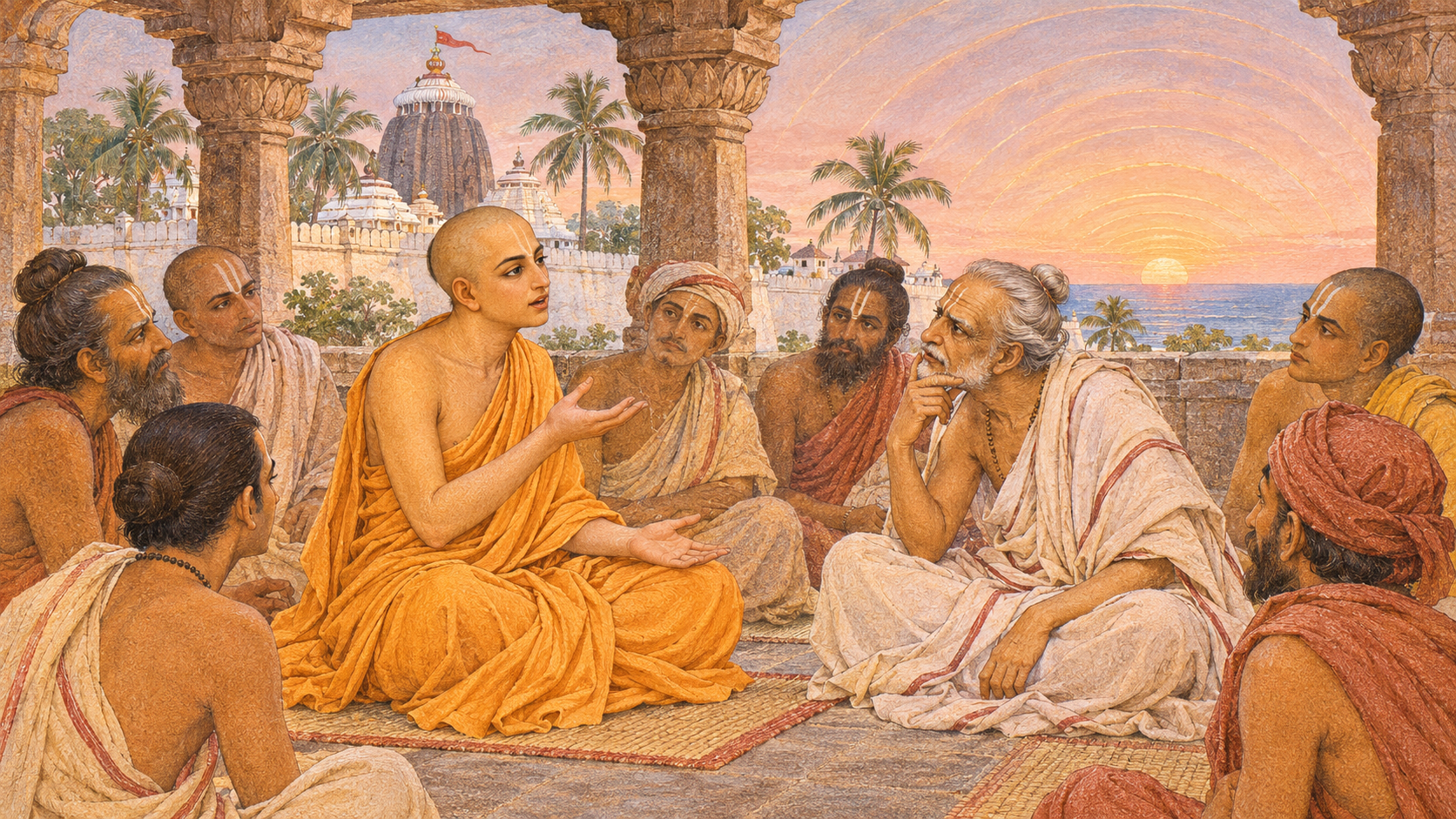
The setting matters because the verse is not delivered as an isolated maxim. In Madhya-lila 6.148-151, Sarvabhauma Bhattacharya wants to hear Sri Chaitanya Mahaprabhu’s explanation, while Mahaprabhu first calls upon the learned scholar to explain the verse.
That exchange offers a sound reading discipline. You should not approach a teacher with the conceit that your first explanation must be final. But neither should you outsource the work of understanding before you have looked closely at the language. Sarvabhauma brings learning to the encounter and remains willing to hear beyond it.
Use the same sequence when studying this passage:
- State the surface meaning. Identify who acts, what they do, toward whom they act and what reason the verse gives.
- Locate the tension. Here it is the word api: even liberated, self-delighting sages render bhakti.
- Name your hidden assumption. You may be assuming that freedom requires the end of all relationship, action or devotion.
- Test that assumption against every word. An interpretation that explains atmarama but makes ahaituki or Hari’s qualities unnecessary has not yet accounted for the whole verse.
- Hear the tradition after doing the first work. Commentary can disclose meanings you missed, but you will hear those meanings more clearly when you know exactly which difficulty they resolve.
This prevents two opposite errors. The first is passive dependence: repeating a conclusion without understanding how the words support it. The second is interpretive arrogance: treating the first meaning you notice as the only meaning the language can bear.
A legitimate theological expansion should remain answerable to the verse. It must preserve the sages’ spiritual fulfilment, the voluntary character of their devotion, Hari as its object and Hari’s qualities as the stated ground of attraction. If an explanation loses one of those elements, ask what has been imported into the text.
Avoid the readings that make the teaching smaller
Self-satisfied does not mean relationally sealed
Ordinary self-sufficiency can become a polished form of isolation: I need nobody, owe nothing and receive nothing. That is not the freedom pictured here. The atmaramas can be inwardly complete and still respond to Hari. Spiritual freedom removes compulsion; it does not require indifference.
When you apply this to sadhana, do not measure detachment by how little reverence, gratitude or affection you feel. Measure it more carefully: are you becoming less possessive, less transactional and less governed by the fruits of action?
Causeless devotion does not mean random devotion
The verse does not praise devotion without an object, meaning or basis. It names Hari and points to His qualities. What is absent is a selfish price placed upon the relationship. Ahaituki bhakti does not say, Serve for no reason whatsoever. It says, Do not reduce service to a contract for an external result.
This matters whenever devotional language becomes vague. Ask two questions: Who is being served, and what do I demand in return? A clear answer to the first and a loosening grip on the second bring you closer to the verse’s movement.
Bhakti after liberation does not make liberation defective
If bhakti were merely a remedy for bondage, it would become unnecessary when bondage ended. The Atmarama verse reverses that expectation. Devotion can remain when the remedial work is complete because devotion has intrinsic value. In this Gaudiya Vaishnava reading, liberation removes obstruction; it does not abolish the soul’s capacity to delight in Bhagavan.
This is also why moksha should not be imagined as spiritual numbness. Freedom from material craving is not freedom from all meaningful attraction. The verse directs attention toward a form of attraction that does not recreate bondage because it is not organized around possession or private gain.
One Vaishnava conclusion should not be mislabeled as every Vedantic conclusion
Dharmic traditions do not all define the self, liberation and ultimate reality in exactly the same way. The Chaitanya-caritamrita gives the verse a distinctly Gaudiya Vaishnava force: bhakti is not exhausted by its usefulness as a means to liberation. You can present that conclusion firmly without pretending that every school of Vedanta begins from identical premises.
If you are discussing the verse across traditions, identify the disputed premise. Is liberation the ending of every distinction, or freedom from material bondage? Is devotion provisional discipline, eternal activity or both in different senses? Naming the disagreement produces a more honest conversation than trading isolated quotations.
Put the verse to work in your own sadhana
Do not turn ahaituki bhakti into a performance of having no needs. Asking Bhagavan for help does not by itself invalidate devotion, and ordinary duties should not be abandoned to imitate an advanced state. The useful question is whether your entire relationship with Hari disappears when a request is not fulfilled.
- Write the verse and a plain paraphrase in your own words.
- Underline the subject, action, object, contrast and stated ground of attraction.
- Name one result you currently want from your spiritual practice. Be specific and honest.
- Choose one act of bhakti – nama-japa, kirtana, study, worship or seva – that you will not make conditional upon receiving that result.
- After the act, notice whether the mind immediately asks for payment through recognition, reassurance or success.
- Return to api and ahaituki. Let those words expose the bargain without turning that discovery into self-condemnation.
The point is not to declare yourself an atmarama. It is to let the atmaramas show you what devotion looks like when it is no longer being used as leverage.
Key takeaways
- The verse’s central tension is that inwardly fulfilled, unbound sages nevertheless engage in bhakti.
- The word api prevents liberation and devotion from being treated as mutually exclusive.
- Ahaituki rejects selfish bargaining, not intelligibility; Hari’s qualities are the stated ground of attraction.
- In the Gaudiya Vaishnava reading, bhakti is not merely a technique for reaching moksha. It possesses value beyond its usefulness as a remedy for bondage.
- A careful reader first accounts for every major term, then listens to traditional explanation with both effort and humility.
On your next reading, begin with the small word api. Then examine one act in your own practice and remove one condition you have quietly attached to it. That is a modest but concrete way to move from admiring the Atmarama verse to allowing it to question you.
References

Leave a Reply
You must be logged in to post a comment.