
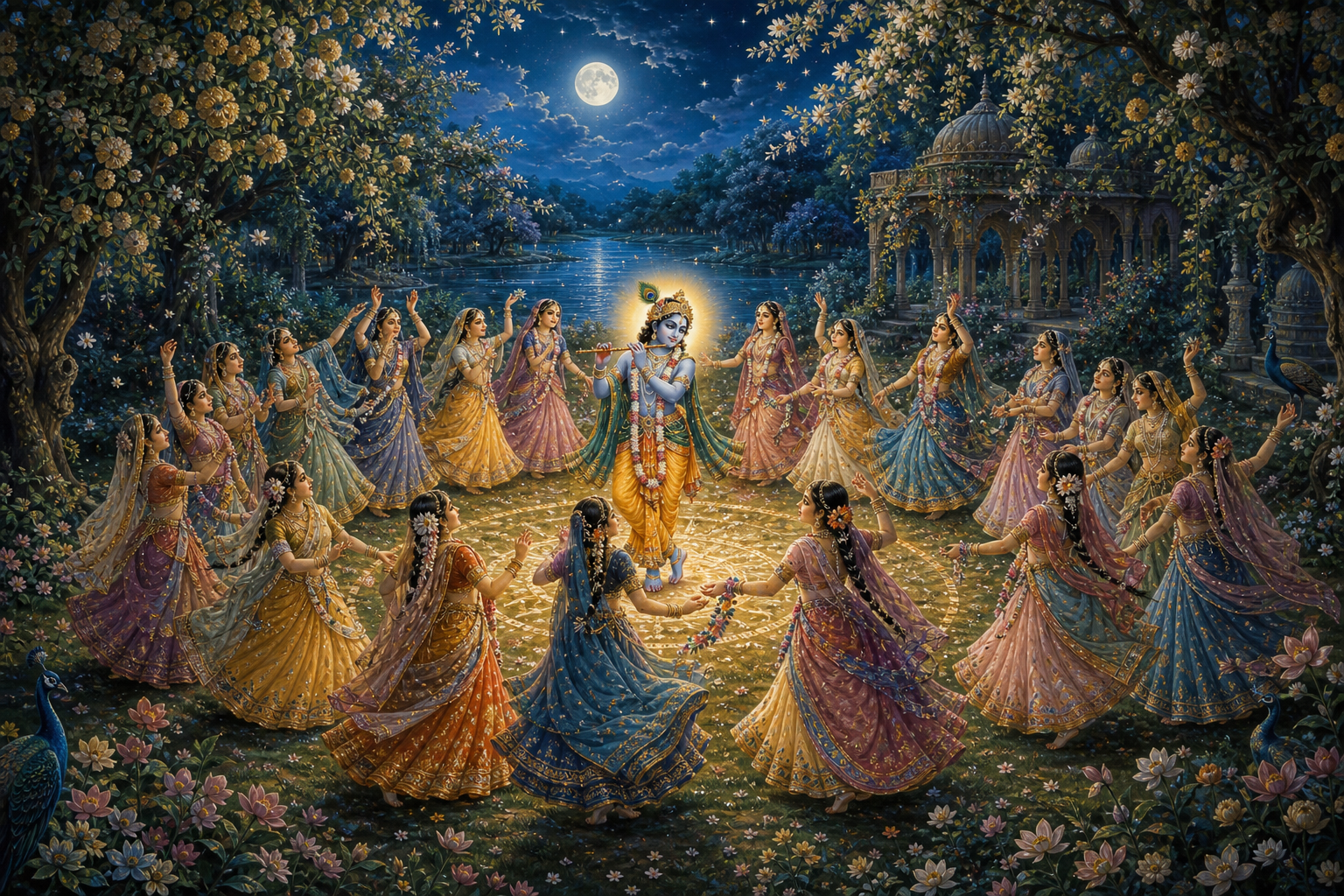
If rasa-lila draws you toward Krishna but leaves you uneasy about its midnight meeting, abandoned obligations and intimate language, do not resolve the tension by reducing it to ordinary romance. The question that opens the lila is not whether desire is intense. It is whose satisfaction that desire serves.
Ordinary desire tries to bend another person toward the self. The gopis move in the opposite direction: comfort, reputation, security and even the hope of reward cease to govern them because their consciousness is fixed on Krishna’s pleasure. That reversal from taking to offering is why rasa-lila is understood as the culmination of divine love.
Read the lila on its own spiritual scale
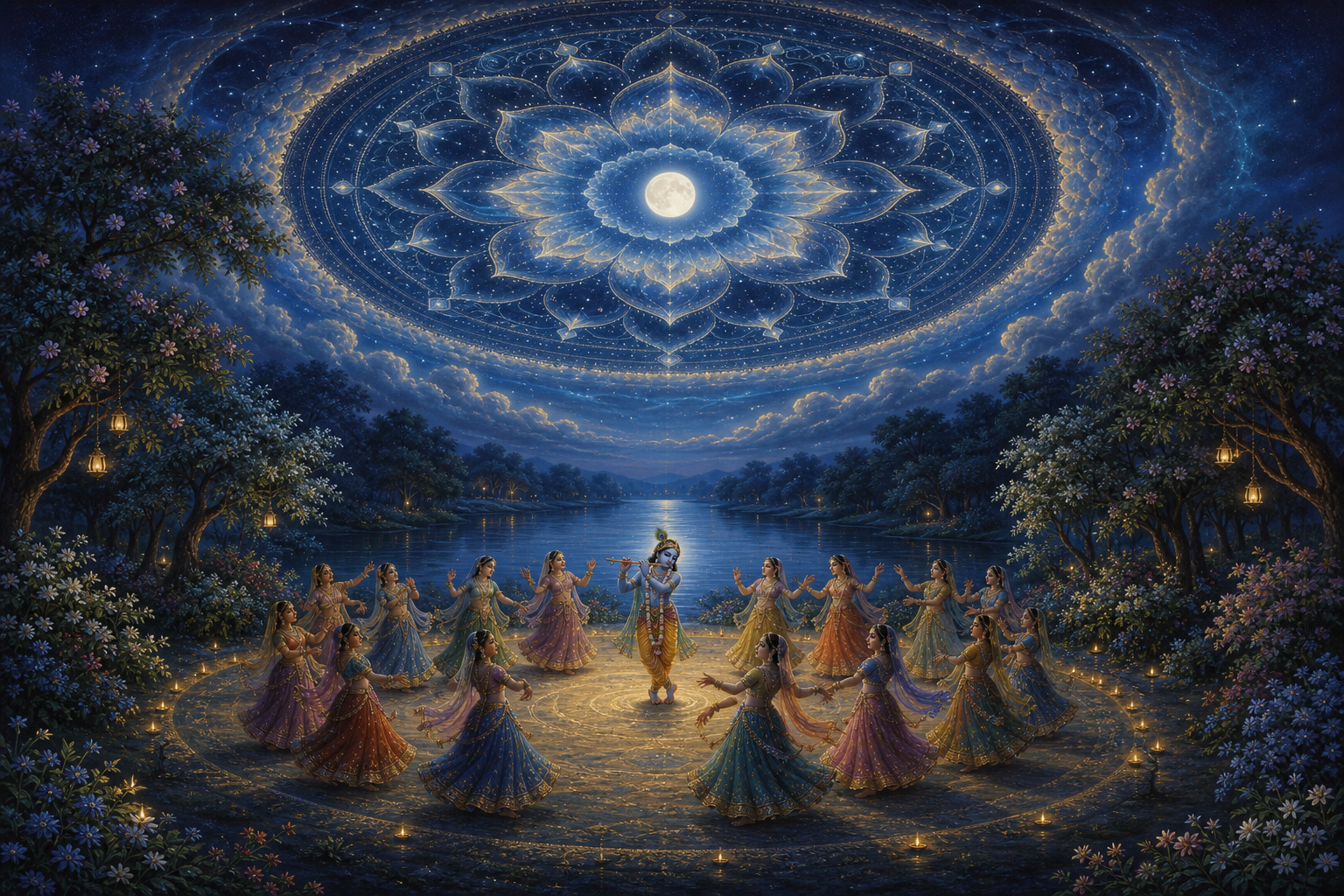
Rasa-lila is Krishna’s moonlit dance with the gopis of Vrindavana. Yet the dance cannot be interpreted correctly if Krishna is treated as an unusually attractive village youth and the gopis as people pursuing forbidden excitement. That reading discards the identities on which the entire event depends.
The lila unfolds through yoga-maya, Krishna’s spiritual potency, in an atmosphere described as manifesting the beauty of the spiritual world. Krishna even arranges for apparent material forms of the gopis to remain in their homes while their spiritual forms answer his call. Whatever questions this raises for a modern reader, the theological claim is plain: this is not an ordinary human encounter governed by ordinary appetite.
The reception of the lila supplies another interpretive safeguard. Sri Caitanya Mahaprabhu and deeply renounced acaryas revered the five chapters of the Srimad-Bhagavatam devoted to rasa-lila as a revelation of the purest spiritual love. Their renunciation does not by itself settle every interpretive question, but it makes a merely sensual explanation inadequate. Those who had deliberately relinquished sensual enjoyment found here the summit of devotion, not a sacred disguise for indulgence.
Transcendence is not a loophole, however. No human being can borrow Krishna’s unique position to exempt personal desire from dharma. If someone invokes rasa-lila to justify deception, coercion, infidelity, sexual access or neglected responsibilities, the direction of the lila has already been reversed. Krishna is being used to serve appetite rather than appetite being surrendered to Krishna.
The flute reveals what already owns the heart
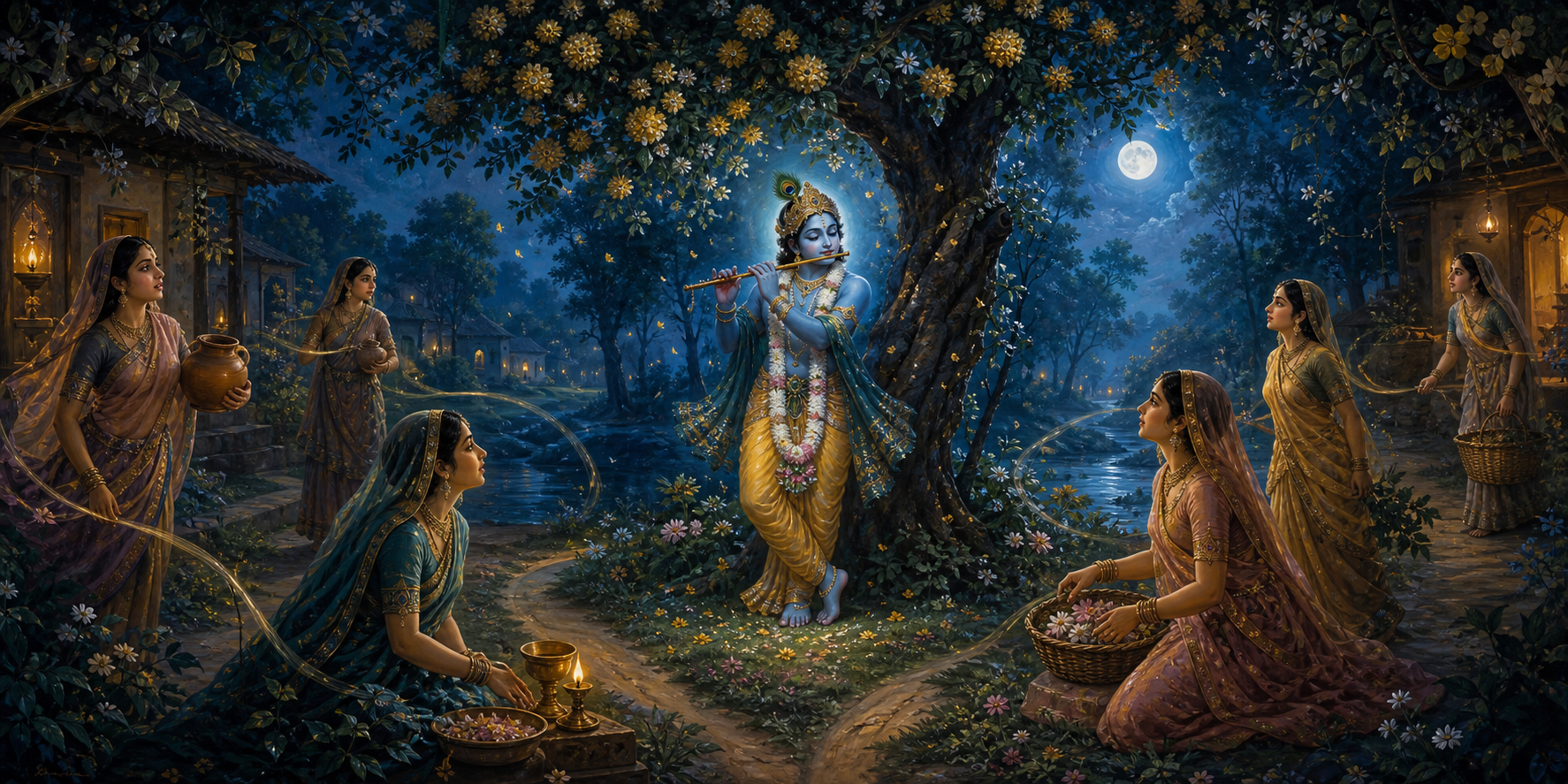
The setting matters because every detail directs attention away from the ordinary. On Sharad Purnima, at the opening of Kartika, the full moon illuminates Vrindavana while the fragrances of jasmine and lotus fill the night. Beneath Vamsivata beside the Yamuna, Krishna plays the fifth note of his flute. Its sound enters the gopis’ ears, reaches their hearts and gathers their consciousness around him.
The gopis are engaged in concrete household work when the call comes. Some are milking cows or tending milk; others are serving relatives, eating, bathing, dressing or putting on ornaments. They leave these activities because remembrance of Krishna and the desire to please him have already absorbed them. The flute does not create a passing fascination. It reveals the governing allegiance of their hearts.
Notice the sequence: sound enters through hearing, awakens what is held in the heart, and only then produces outward action. This is useful when you read the episode devotionally. Do not begin by copying the visible departure. Begin by examining the inward orientation that precedes it.
You can make that examination precise. As you read, mark every action that concerns receiving pleasure and every action that concerns giving pleasure. The imbalance is decisive. The gopis do not ask for Krishna’s wealth, protection, social standing or public recognition. They offer body, mind, speech and life for his satisfaction. The form of the lila may be intimate, but its inner movement is complete self-offering.
This also explains why the flute is a call rather than a possession. Krishna does not force an inward response into the gopis. His music reaches hearts that have already become responsive through remembrance. For your own practice, the relevant question is therefore not whether you have experienced extraordinary emotion. Ask what your ordinary hearing, remembrance and service are teaching your heart to answer.
The deepest renunciation is freedom from self-interest
Vairagya is often imagined as distance from family, possessions or society. Rasa-lila gives the word a more demanding center. Renunciation is not measured simply by what you leave. It is measured by how little private claim remains in what you offer.
The gopis release attachments that are exceptionally difficult to release: domestic security, family approval, reputation and conformity to expected conduct. They enter a dark forest despite the possibility of exclusion from home. Yet the decisive point is not the social cost. Their renunciation arises from the unbroken wish to serve Krishna, without a separate plan for personal gratification.
A dramatic sacrifice can still enlarge the ego. A quiet duty can be deeply renounced when it is done carefully, without possessiveness or demand for praise. This is why literal imitation misses the teaching. The external form of the gopis’ action is exceptional; the inward test applies to every devotee.
- If the sweetness disappeared, would you still perform the service?
- Does your claimed surrender make you more truthful and responsible, or does it give you a religious excuse to evade an inconvenient duty?
- Are you offering the result, or secretly arranging for others to admire the offering?
- When your preference conflicts with another person’s legitimate welfare, do you protect their welfare or rename your preference as devotion?
These questions distinguish surrender from spiritualized self-will. The gopis do not use Krishna to make their own desires absolute. Their desires have been reorganized around him.
Bhagavad-gita 18.66 calls for the surrender of all dharmas to Krishna and gives the assurance of protection from sinful reaction. Rasa-lila displays the radical inward meaning of that surrender: no reserve of the self is kept outside the relationship. It does not teach that every impulse outranks moral responsibility. The object of surrender is Krishna, not whatever the mind happens to want intensely.
Krishna’s refusal and separation test the quality of love
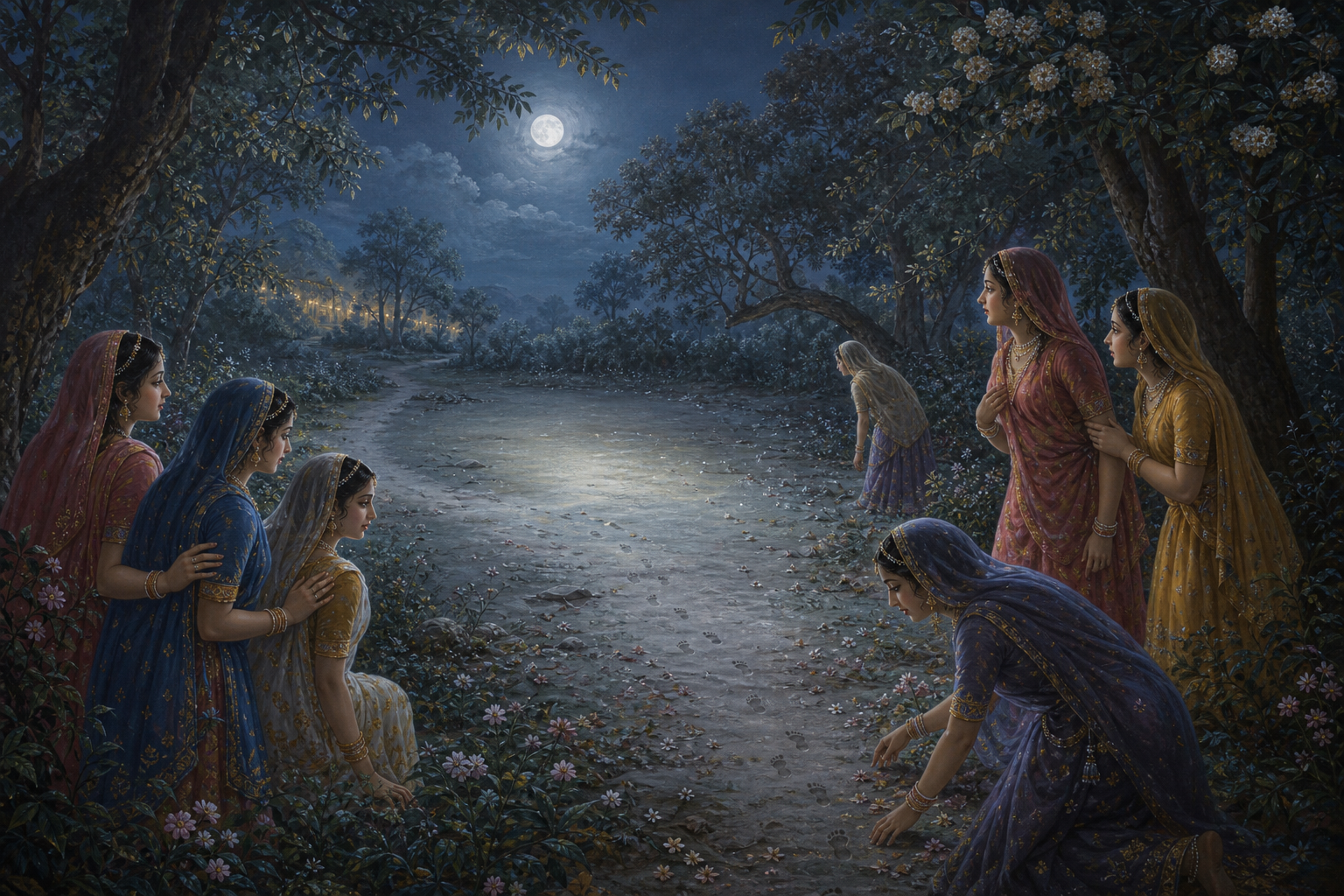
When the gopis arrive at Vamsivata, Krishna does not immediately reward their journey. He welcomes them and then tells them to return home. He points to the darkness and danger of the forest and reminds them of fathers, brothers and husbands. Their answer is not a demand that he gratify them. They say that their hearts have already been given to him and plead not to be sent away.
This apparent refusal performs essential work. It exposes whether the gopis’ movement is a momentary attraction that can be redirected by inconvenience, or a surrender that has reached the center of identity. Divine love is not called supreme merely because it produces sweetness. It remains directed toward Krishna when sweetness is withheld.
Not every gopi reaches the forest in the same way. Some are nitya-siddhas, eternal perfected companions who descend from Goloka for Krishna’s earthly pastimes. Others are identified with the Vedas personified or with sages who encountered Lord Rama in the Dandakaranya forest and longed for an intimate relationship with the Lord. Some devotees still carry a trace of material impurity and are physically prevented from leaving their rooms.
Those who are prevented from going do not cease to participate inwardly. Their intense meditation and separation consume the remaining contamination of the heart. The distinction is important: physical proximity alone does not establish spiritual attainment, and physical obstruction alone does not defeat sincere devotion.
Separation should not be romanticized as though every frustration were purifying. Frustration can make an ordinary desire more possessive. Separation becomes spiritually meaningful here because remembrance grows more selfless, not more demanding. The blocked gopis contemplate meeting Krishna for his pleasure; they do not turn disappointment into a claim against him.
When your own practice feels dry, you do not need to manufacture a dramatic mood. Keep a fixed daily appointment with Krishna. Hear a clearly identified lila, repeat his names according to your discipline, and complete a necessary duty as an offering. Then notice whether the absence of emotional reward weakens your service or purifies its motive. Steadiness is a safer measure than intensity alone.
How to approach rasa-lila without trivializing it
Because rasa-lila stands at the summit of devotional theology, it calls for both reverence and interpretive discipline. You do not have to suppress difficult questions. You do need to ask them without erasing the spiritual identities, motives and setting that make the lila what it is.
- Read the complete movement. Follow the setting, flute call, response, Krishna’s warning, the gopis’ appeal, separation and loving encounter. An isolated dance image cannot carry the theological weight of the sequence.
- State the identities before judging the conduct. Krishna is the Supreme Lord acting through yoga-maya; the gopis are devotees whose central wish is his pleasure. Without those claims, you are discussing a different kind of event.
- Track the direction of desire. At every turn, ask who is expected to enjoy, who is being served, and whether any demand for independent gain remains.
- Keep divine action distinct from human imitation. Krishna’s transcendental position is not transferable to a guru, teacher, performer or devotee. Human conduct remains subject to truthfulness, non-exploitation and responsibility.
- Translate admiration into seva. Choose a needed duty that normally offers you little recognition. Perform it attentively, do not advertise the sacrifice, and dedicate the result to Krishna. This tests the principle of the lila without imitating its external form.
A trustworthy teacher will preserve these distinctions. Be wary of anyone who casts themselves in Krishna’s place, pressures followers to behave as gopis, demands secrecy, or treats moral concern as evidence of deficient faith. Such behavior centers the teacher’s appetite. Rasa-lila centers Krishna and empties the devotee of selfish claim.
Key takeaways
- Rasa-lila belongs to the realm of yoga-maya and cannot be reduced to ordinary romantic conduct.
- The gopis embody divine love because their desire is directed wholly toward Krishna’s pleasure.
- Their greatness lies in freedom from self-interest, not merely in the dramatic things they relinquish.
- Krishna’s initial refusal and the separation of the blocked gopis reveal love that persists without immediate reward.
- The right practical response is selfless service, never literal imitation or exemption from dharma.
When you next approach rasa-lila, pause at each movement and ask: What is being surrendered, what private claim remains, and who is meant to be pleased? If the answer turns toward human appetite, stop; the interpretive boundary has been crossed. If it turns toward Krishna’s satisfaction, carry that insight into an unnoticed act of service. That is where the lila can begin to reorder your own heart.
References
