

You may have arrived with a deceptively simple question: should Pushpaka Vimana be understood as an ancient aircraft, a sacred symbol, or both? The useful answer begins by separating what the Ramayana portrays, what engineers can learn from that portrayal, and what would count as evidence for a historical machine.
You do not have to choose between reverence and rigor. A careful reading preserves the wonder of Pushpaka while preventing a modern analogy from being mistaken for a recovered blueprint. It also reveals something more demanding than a claim about flight: a Dharmic test of who may wield extraordinary power, for what purpose, and under whose authority.
Separate the scriptural claim from the engineering claim
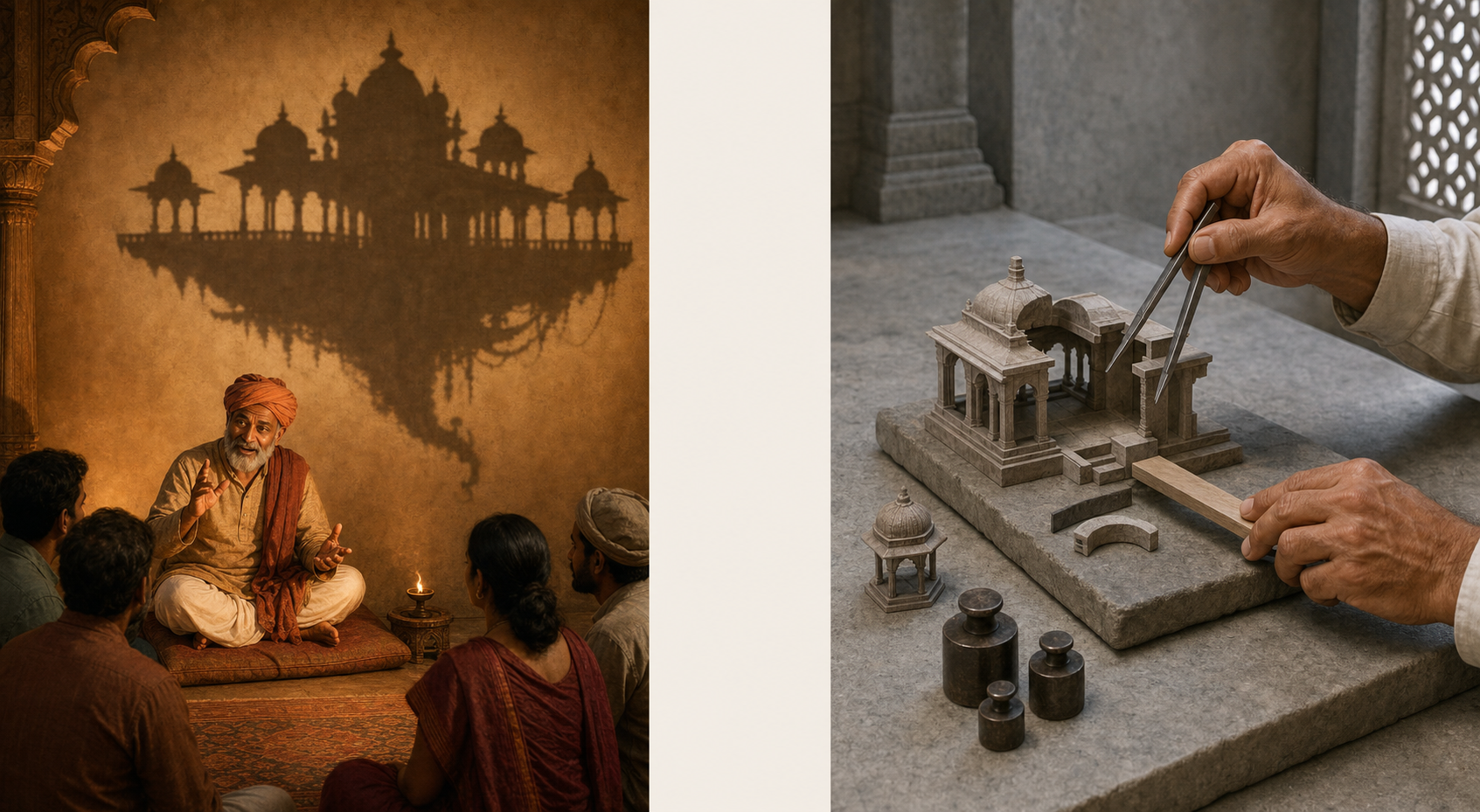
Arguments about vimanas often become confused because three kinds of statement are treated as if they were interchangeable. One concerns what a sacred narrative says. Another interprets that narrative through modern engineering concepts. The third makes a material claim about a machine that once existed. These readings can inform one another, but they do not carry the same burden of proof.
What the Ramayana portrays
Tradition connects Pushpaka with Vishwakarma, the divine architect, and first places it under Kubera’s stewardship. Ravana appropriates it, and Rama later uses it within the restoration of rightful order. In the Yuddha Kanda of Valmiki’s Ramayana, the vimana travels at will, accommodates changing numbers of passengers, and operates with little visible effort.
That is already an extraordinary set of narrative capabilities. It supports discussion of directed flight, adaptive capacity and an unusually simple relationship between intention and control. It does not, by itself, specify thrust generation, structural loads, navigation sensors, material composition or an energy budget. Flight at will is a performance description, not a propulsion diagram.
Where self-restoration belongs
The popular image of a self-reassembling or self-repairing Pushpaka is best handled with greater precision. The motif becomes prominent through later retellings, commentary and cultural memory rather than resting securely on one early verse. That distinction matters. It allows you to appreciate a living tradition’s interpretive development without placing every later elaboration into the earliest textual layer.
Later development does not make a motif worthless. A tradition can draw out implications that an earlier telling left unstated. But if you are teaching, debating or publishing a claim, identify the layer honestly: Valmiki’s narrative foregrounds extraordinary mobility and capacity, while the fully self-restoring craft belongs more clearly to the expanded Pushpaka imagination.
What historical proof would require
An engineering interpretation is not yet an engineering reconstruction. Recognizing a resemblance to autonomous flight or self-healing materials tells you that the narrative can generate fruitful design questions. It does not establish that the corresponding hardware existed in a recoverable historical form.
Before repeating a technical claim about Pushpaka, apply three checks:
- Name the exact capability. Is the claim about flight, changing capacity, intention-responsive navigation or physical self-repair?
- Name the textual layer. Does it belong to Valmiki’s Ramayana, a later Sanskrit or regional retelling, commentary, performance tradition or modern interpretation?
- Name the kind of conclusion. Are you describing scripture, proposing an engineering analogy or asserting a materially testable history?
This method avoids two unhelpful extremes. One turns poetic or sacred description into technical documentation without enough evidence. The other dismisses the narrative because it is not a technical manual. Pushpaka can carry civilizational memory, philosophical insight and engineering imagination even when those forms of knowledge remain distinct.
Use Pushpaka as a design question, not a retroactive blueprint
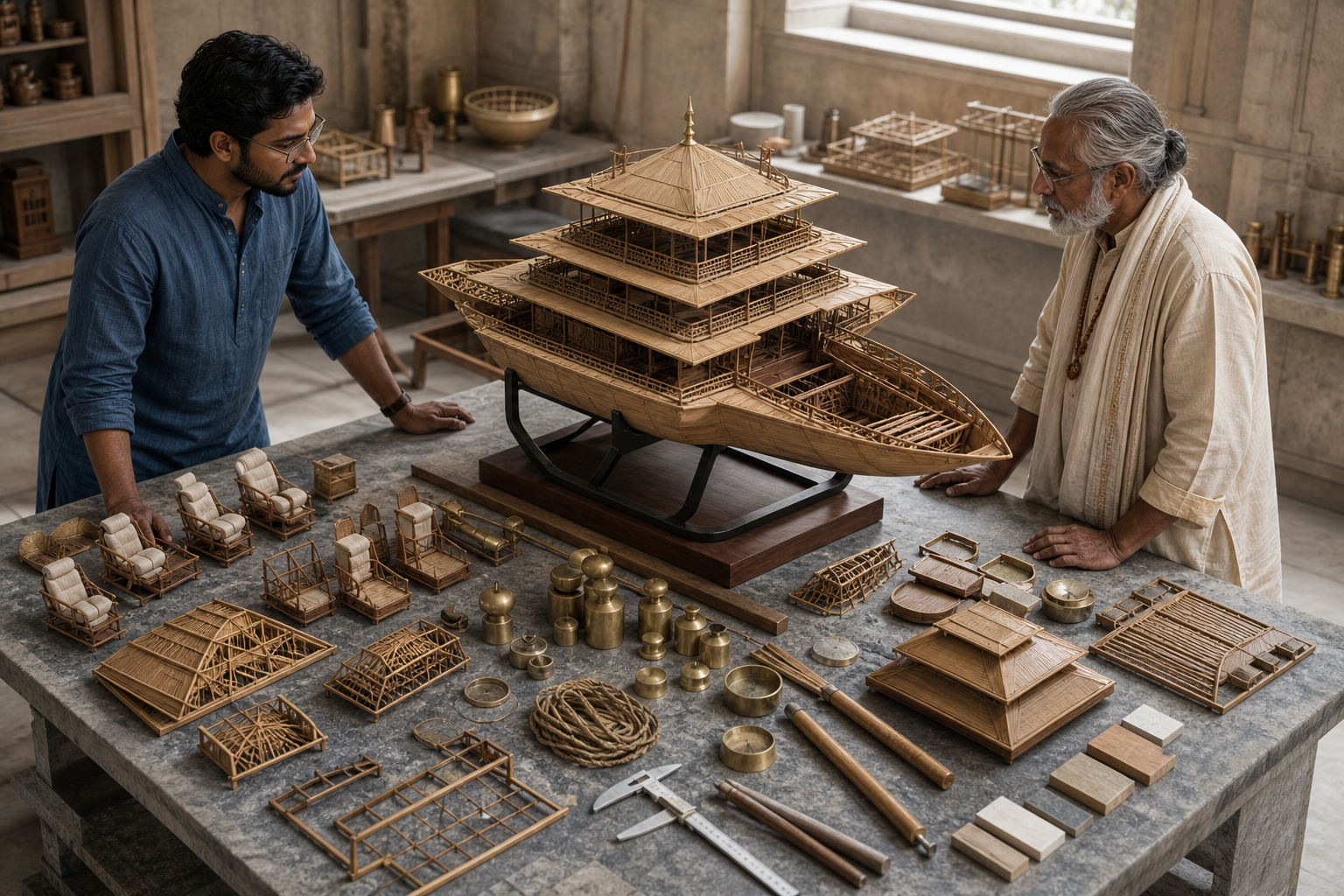
Systems engineering gives you a disciplined way to engage the vimana’s remarkable features. Instead of claiming that a complete modern technology is hidden in the narrative, translate each feature into a requirement, a failure mode and a question that a real designer would have to answer.
| Narrative feature | Engineering lens | Question it should provoke |
|---|---|---|
| Travel at will with little visible effort | Autonomous guidance and a low-burden human-machine interface | How does the system interpret intent, confirm a destination and fail safely? |
| Capacity changes to receive more passengers | Reconfigurable interiors, deployable structures or variable geometry | How do load paths, stability and safe exit change with each configuration? |
| Self-restoration in later tradition | Fault detection, isolation, local repair and recovery | How does the system know it is damaged, repair the right part and verify a safe state? |
| Celestial power associated with cosmic order | Energy stewardship and lifecycle responsibility | Where do energy, waste heat, maintenance burden and discarded material go? |
The distinction between a requirement and a solution is crucial. A craft that travels wherever directed expresses a requirement for controllable mobility. It does not tell you whether the solution uses wings, rotors, buoyancy, propulsion of another kind or a supernatural agency proper to the sacred narrative. Good engineering begins by refusing to invent the missing mechanism.
What a genuinely resilient craft would need
The self-restoring motif becomes technically useful when divided into four system properties:
- Modularity: damaged units can be isolated and replaced without dismantling the whole craft. The interfaces between modules must remain stable, or modularity merely moves the failure elsewhere.
- Redundancy: a critical function has an alternate path when one component fails. Redundancy improves resilience only when a single event cannot disable both paths.
- Graceful degradation: the system preserves essential functions while optional functions are reduced or shut down. For a vehicle, returning safely matters more than maintaining every convenience.
- Autonomy: diagnostics and recovery do not depend on continuous human micromanagement. Autonomy still needs limits, validation and a way for an authorized operator to stop an unsafe response.
You can use these four tests on any complex system. Ask what can fail independently, what backup remains, which function must survive, and how recovery is confirmed. The important word is confirmed. A machine that seals visible damage but cannot determine whether structural integrity has returned is not safely restored.
Modern materials illuminate only part of the idea
Self-healing polymers, microcapsule-based resins, vascularized composites and shape-memory alloys show how a material may seal, rejoin or recover a designed shape after certain kinds of damage. They make local healing and reconfiguration credible engineering goals. They do not amount to a complete aircraft that can diagnose every failure, manufacture missing parts, restore control software and certify itself for flight.
The same discipline applies to Pushpaka’s variable capacity. A narrative cabin that accommodates all who need passage can inspire morphing structures, deployable assemblies and interiors that adapt to their users. It should not be casually converted into a claim of limitless physical volume. The engineering value lies in the demand that the vehicle serve changing human needs without imposing needless burden.
Intention-driven travel also makes a strong human-machine-interface prompt. A practical system would need to distinguish a passing thought from a command, authenticate the person giving it, resolve conflicting instructions and make cancellation possible. The story places intention near the center of control; engineering must add verification because human intention can be incomplete, divided or mistaken.
Minimal visible effort must not be confused with energy from nowhere. An elegant interface can hide enormous mechanical and computational work. Likewise, reading celestial power as harmony with ṛta can inspire efficiency, repairability and low waste, but it does not establish a particular fuel or a zero-emission propulsion system. The sustainable lesson is a design obligation, not a concealed energy formula.
The ownership history is Pushpaka’s real control system
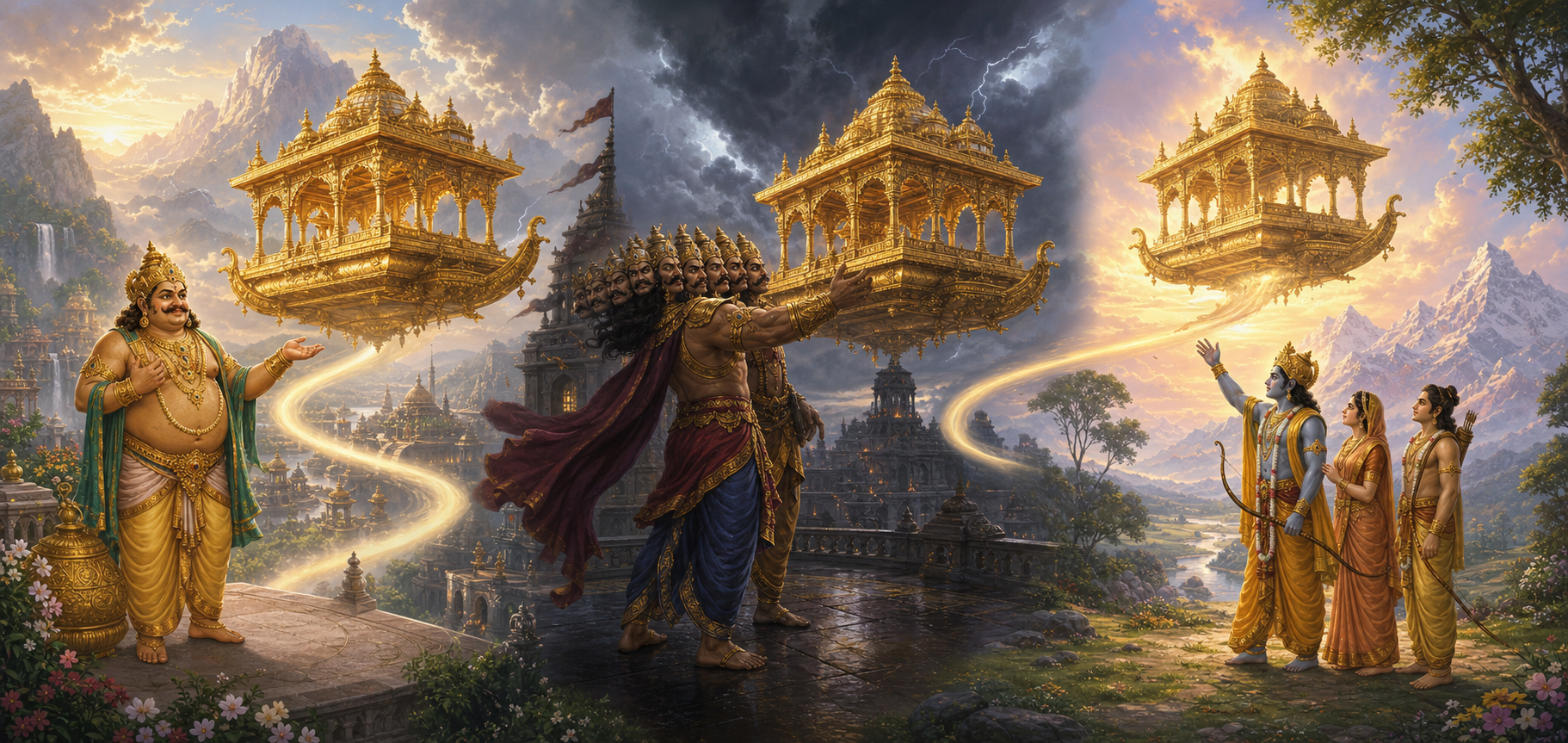
Pushpaka’s most consequential feature may not be airborne motion at all. It is the way the same capability changes moral meaning as its stewardship changes. The craft is associated with divine craftsmanship and Kubera, seized by Ravana, and then placed within Rama’s restoration of dharma. Its performance remains wondrous throughout; the legitimacy of its use does not.
Ravana’s possession demonstrates that capability and entitlement are different things. Having command of a powerful system does not establish a right to command it. Rama’s role makes the inverse point: power becomes Dharmic through rightful purpose, disciplined use and restoration of order, not merely through victory over a previous holder.
This gives Pushpaka immediate relevance to dual-use technology. A machine can transport or dominate, protect or surveil, repair a community or magnify a ruler’s appetite. Technical excellence cannot settle those choices. Governance is not an ethical ornament added after construction; it is part of whether the system is fit to exist and operate.
When you evaluate a powerful technology, apply four Dharmic gates before admiring its performance:
- Legitimate custody: Was the capability acquired lawfully and without coercive appropriation?
- Rightful purpose: Does its use protect and serve, or does it convert superior capacity into domination?
- Accountable command: Who may issue instructions, who can refuse them, and who answers when the system causes harm?
- Restorative end state: Can control be revoked, damage repaired and the capability returned to proper stewardship?
These gates also change design decisions. Legitimate authority requires authentication. Accountability requires records and review. Restraint requires operating limits. Restoration requires maintainability, safe shutdown and a clear transfer of control. Ethical statecraft becomes an engineering specification when it is expressed through such mechanisms.
The self-restoring motif therefore works on two levels at once. Technically, it imagines a system that recovers from disruption. Politically and spiritually, it imagines order capable of recovering after adharma. Repair is not a return to whoever happens to hold power. It is a return to integrity and rightful relation.
Read ascent across Dharmic traditions without flattening them

Pushpaka belongs most directly to the Ramayana world, but aerial ascent has resonances across Dharmic traditions. Comparison is valuable when it identifies a family resemblance. It becomes misleading when Hindu, Buddhist, Jain and Sikh teachings are compressed into one supposedly identical account.
Within Hindu telling, Pushpaka joins extraordinary movement to questions of kingship, custody and the return of moral order. Buddhist vimana narratives in the Khuddaka Nikaya corpus connect luminous abodes or conveyances with moral merit, placing ascent within a karmic register. Jain Ramayana tradition, including the Paumacariya, retains aerial chariots and the Pushpaka association within its retelling of the Ravana cycle. Sikh thought directs the image inward: elevation through Naam is spiritual rather than a claim about a mechanical vehicle.
The common insight is not that every tradition preserves the same aviation record. It is that ascent is rarely morally neutral. Height, luminosity and effortless movement become signs whose meaning depends on merit, discipline, remembrance or rightful rule. The vehicle carries an ethical anthropology: the condition of the traveller matters as much as the power of transport.
If you are presenting these parallels to a mixed audience, use three habits. Name the tradition before stating the motif. Describe a resonance rather than declaring doctrinal identity. Preserve the important difference between a narrative vehicle, a karmically significant abode and a metaphor of inward elevation. Respect grows from specificity, not from making every Dharmic path sound the same.
Treat images as iconography, not automatic schematics
Murals, manuscript illustrations, temple imagery and performance traditions have kept the vision of flying palaces alive. They are evidence of cultural memory, artistic interpretation and continuing devotion. Their mechanical details cannot automatically be treated as recovered engineering drawings.
When an image of Pushpaka is offered as technical proof, ask where and when it was made, which episode or regional tradition it depicts, and whether its mechanical features belong to inherited iconography or modern visualization. A temple image can show how a community imagined sacred flight. A theatrical design can show how performers made the wonder visible. Neither function is diminished by identifying it correctly.
Key takeaways for a rigorous Dharmic reading
- Begin with the exact claim. Flight at will, adaptive capacity and self-restoration are related ideas, but they do not have identical textual footing.
- Keep textual description, engineering interpretation and material history in separate columns. A meaningful analogy is not automatically historical proof.
- Use Pushpaka to generate requirements: fault detection, modular repair, graceful degradation, usable controls and verified recovery.
- Do not translate divine power into a specific propulsion claim. Read harmony with ṛta as an ethical demand for efficient, repairable and responsible systems.
- Place stewardship beside performance. Ravana and Rama show why possession, authority and Dharmic use cannot be treated as synonyms.
- Compare Hindu, Buddhist, Jain and Sikh motifs through carefully named resonances, not by erasing their different scriptures and teachings.
The next time you teach, design or share a claim about Pushpaka, add one sentence of discipline: name the textual layer, the engineering analogy or the moral test you are applying. That small habit protects both intellectual honesty and the sacred narrative from careless overclaiming.
If you build systems, take the challenge further. Write the safe-state, repair and authority requirements before celebrating peak performance. Pushpaka’s enduring question is not simply whether a machine can rise. It is whether power can carry people without becoming domination, survive damage without concealing it, and return itself to right order.