

You may know how to chant Om and still wonder what you are meant to be doing with it. Is it an opening sound, a name of the Divine, a breathing aid, or a complete teaching compressed into one syllable?
Vedic and Upanishadic thought does not force you to choose only one of those meanings. Om joins ritual speech, breath, attention, and the structure of consciousness. Once you see how those layers fit together, you can chant it with greater precision and avoid two common mistakes: treating it as a decorative sound or inflating it into a magic formula.
Why Om is more than a devotional opening
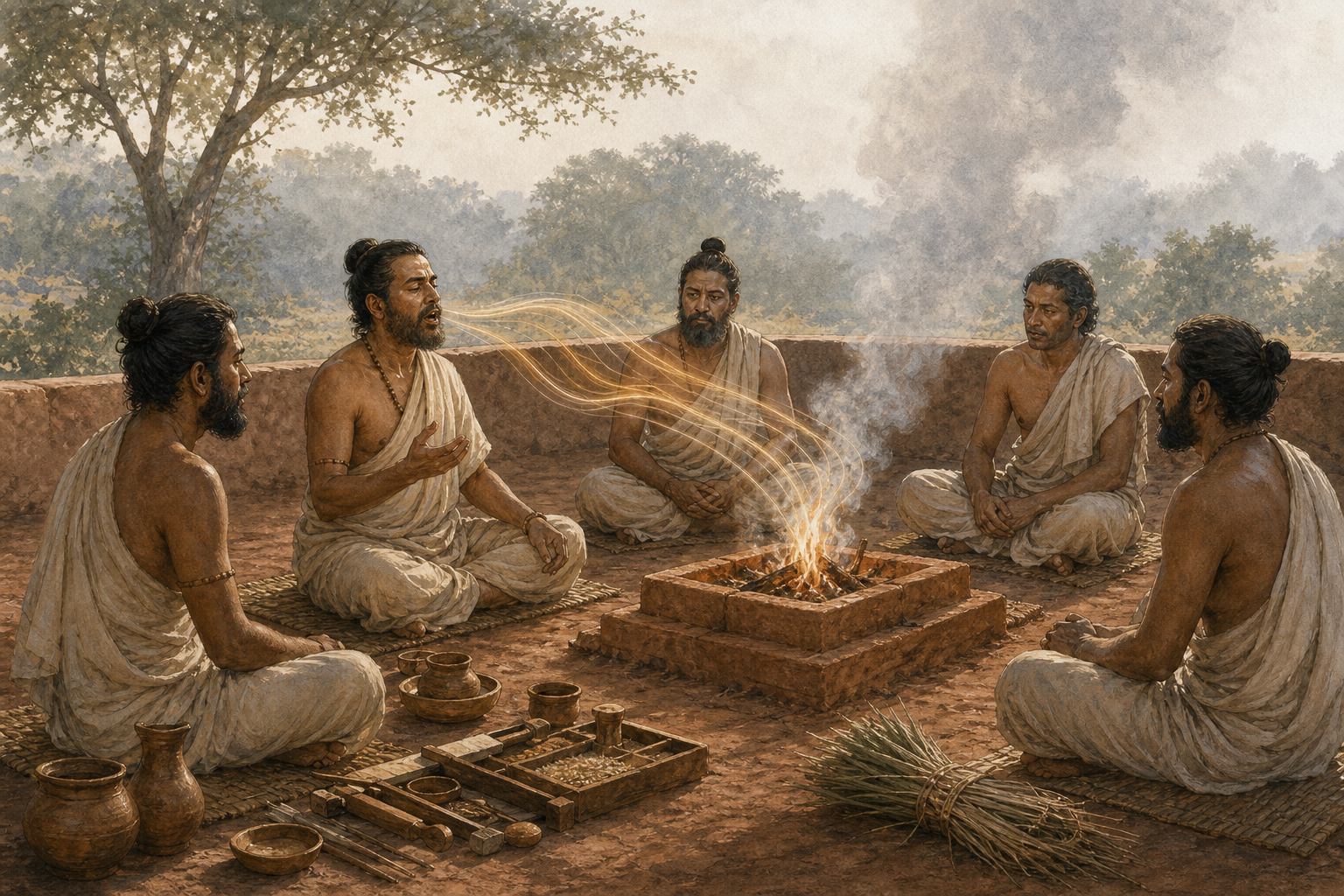
In Vedic practice, ordinary sound becomes mantra through disciplined articulation, intention, and placement within a sacred act. Om, traditionally called the praṇava, can precede and permeate recitation. It gathers the chanter before the longer utterance begins, linking saṅkalpa, or intention, with vāc, or spoken expression.
That function explains why Om can appear as a decisive power in Vedic narrative. In an Atharvavedic scene preserved in the Gopatha Brāhmaṇa, Indra and the devas prevail over asuric forces through the efficacy of Om rather than brute force. The point is not that a particular noise operates like a projectile. The power lies in ordered awareness expressed through consecrated sound.
Indra commonly represents luminous strength, strategic intelligence, and the restoration of order. Asuric forces represent obstruction, obscuration, and division within the symbolic grammar of the scene. Om is effective because it reverses fragmentation. Breath, speech, intention, and attention stop pulling in different directions.
You can apply that insight without pretending that every difficulty is a supernatural battle. Before study, worship, or a difficult conversation, notice whether your breath is hurried, your speech is already rehearsing conflict, and your intention is unclear. Chanting Om becomes meaningful when those scattered movements are recollected around a dharmic purpose.
This also places an ethical boundary around the imagery. Do not use the language of devas and asuras to declare disliked people demonic. The useful contest is between clarity and confusion, restraint and impulsiveness, truthful speech and speech driven by fear or anger. In that reading, Indra’s victory is first an inner achievement that changes how you act in the world.
The Upanishadic movement from sacred sound to consciousness

The Upanishads interiorize the power already present in Vedic recitation. Om is no longer encountered only at the threshold of ritual. It becomes a method for examining what remains constant while sensory experience, mental imagery, and even the ordinary sense of being awake disappear and return.
In the Chāndogya Upaniṣad’s teaching on the udgītha, the devas identify the sacred chant successively with limited faculties such as speech, sight, and hearing. Each limited identification remains vulnerable to affliction. Stability appears when the udgītha is contemplated as prāṇa, the life-power that sustains the faculties rather than merely one faculty among them. The practical correction is exact: do not reduce Om to the voice producing it. Attend also to the living current that supports voice, hearing, and attention.
Prāṇa in this setting is more than the air moving through your lungs, although breathing gives you an immediate way to approach it. If you pay attention only to vocal performance, you may produce a polished sound while remaining mentally dispersed. If you feel the whole exhalation, hear the vibration, and remain present through its ending, chanting becomes an exercise in integration.
In the Māṇḍūkya Upaniṣad, A, U, M, and the silence associated with them map waking, dreaming, deep sleep, and turīya. This is not a claim that three acoustic segments mechanically manufacture an altered state. It is a contemplative map: every familiar condition of experience can be noticed, and none by itself exhausts the Self or the whole of reality.
| Element | Condition of consciousness | What to notice in practice |
|---|---|---|
| A | Waking | Attention moving outward through perception and action |
| U | Dreaming | The mind forming an experienced world from within itself |
| M | Deep sleep | Waking and dream distinctions withdrawing from experience |
| Silence | Turīya, the fourth | The quiet that is not another object produced by the mind |
The final distinction matters. Turīya should not be confused with blankness, sleepiness, or a dramatic trance. Deep sleep has already been represented by M. The silence after the audible syllable asks you to remain attentive without immediately filling the interval with commentary. You are not trying to manufacture the fourth; you are learning not to overlook quiet awareness when the sound has ended.
Sacred power without superstition or flattened theology
Om can be understood on at least three connected levels. Ritually, it consecrates and organizes utterance. Psychologically, it collects attention and can soften reactive momentum. Metaphysically, it points beyond separate experiences toward an underlying wholeness. Trouble begins when one level is made to cancel the others.
If Om is treated only as a relaxation technique, its ethical and metaphysical demands disappear. If it is treated only as an abstract symbol of Brahman, the discipline of breath, sound, and attention may be neglected. If it is treated as a supernatural password, repetition can become mechanical and grandiose. A sound is sacred here because of the reality it discloses and the quality of participation it requires, not because volume or duration forces the universe to obey.
Some contemporary experiments have reported changes compatible with parasympathetic activity, lower subjective stress, and relaxed alertness during Om chanting. Those observations are compatible with steadier breathing and quieter reactivity, but they do not prove Upanishadic metaphysics. Nor does chanting replace medical or psychological care. Its appropriate practical claim is narrower: it can give you a structured way to gather breath and attention before choosing how to respond.
The wider Dharmic world also requires precision. Om or closely related sacred forms appear in Hindu, Buddhist, Jain, and Sikh settings, but shared sonic ancestry does not make their teachings interchangeable. In the Mahāyāna formula Om Maṇi Padme Hūṁ, the syllable participates in a mantra oriented toward compassion and wisdom. Jain understanding can treat Om as a composite salutation to the five supreme beings honored through the Namokāra Mantra. Ik Oṅkār in Sikh remembrance affirms the One Reality underlying plurality.
The responsible conclusion is unity without erasure. These traditions demonstrate a shared Dharmic confidence that disciplined sound can orient human awareness toward truth. They do not all assign the same doctrinal meaning to every sound. When you encounter Om in another tradition, keep the full formula, community, and theological context intact instead of translating everything into a generic idea of cosmic vibration.
A careful three-to-nine-round Om practice

You do not need an elaborate ritual to begin, but you do need a clear intention and an unforced voice. Three attentive repetitions are more useful than a large count performed while distracted. Longer counts such as 27 or 108 belong naturally within sustained japa, ideally with guidance when you are integrating them into prāṇāyāma or a lineage-specific discipline.
- Sit in a stable, comfortable position. Keep the spine naturally tall rather than rigid, and let the jaw and shoulders release.
- Name the immediate intention in one sentence. For example: May my speech in this meeting remain truthful and measured. This prevents the chant from becoming detached from conduct.
- Take an easy inhalation. Chant the whole syllable on the exhalation; do not sound Om while inhaling.
- Let A begin openly, allow it to round into U, and close gently into the nasal resonance of M. The movement should feel continuous rather than like three disconnected syllables.
- Let the hum fade instead of cutting it off. Notice resonance wherever it is naturally apparent, without trying to force a sensation into the chest, throat, or head.
- Rest in the unforced pause after M. Do not hold the breath to prolong the silence. When the body is ready, inhale normally.
- Repeat for three to nine rounds. If you feel vocal strain, breathlessness, pain, or dizziness, stop and return to ordinary breathing.
- After the final round, remain quiet briefly and identify the next dharmic action. The test of the practice is not how unusual you felt; it is whether your next word or decision is clearer.
The articulation moves from openness to rounding to closure, while the silence prevents closure from becoming mere termination. You can therefore use one cycle as a compact lesson: experience arises, changes form, resolves, and leaves a quiet interval that does not need to be filled immediately.
Before study, use the practice to gather attention around the subject rather than to demand instant concentration. Before a disagreement, use it to slow the transition from emotion to speech, not to suppress a legitimate concern. Before pūjā or japa, let it mark the movement from ordinary activity into sacred participation. In every case, Om prepares action; it does not excuse you from acting wisely.
If your teacher or sampradāya gives a particular pronunciation, duration, visualization, or ritual placement, follow that discipline. The open A, rounded U, humming M, and attentive silence provide a useful general form, but inherited practice carries meanings that should not be overwritten by a universalized technique.
Key takeaways
- In Vedic practice, Om joins intention, breath, sacred speech, and ritual order; it is not merely an ornamental prefix.
- Indra’s victory through Om can be read as integration overcoming obstruction, not as permission to demonize other people.
- The Chāndogya teaching directs attention from individual faculties toward prāṇa, the life-power supporting them.
- The Māṇḍūkya map uses A, U, M, and silence to contemplate waking, dreaming, deep sleep, and turīya.
- Om’s presence across Dharmic traditions reveals genuine kinship, but Hindu, Buddhist, Jain, and Sikh usages retain distinct meanings.
- For daily practice, three to nine unforced rounds followed by one clear dharmic action are enough to make the teaching concrete.
The next time you chant Om, decide what you are gathering and what you will do with the clarity that follows. Let the sound open fully, change without strain, resolve into M, and disappear. Then carry the silence into one truthful sentence, one restrained reaction, or one task completed with undivided attention. That is where sacred power becomes lived dharma.