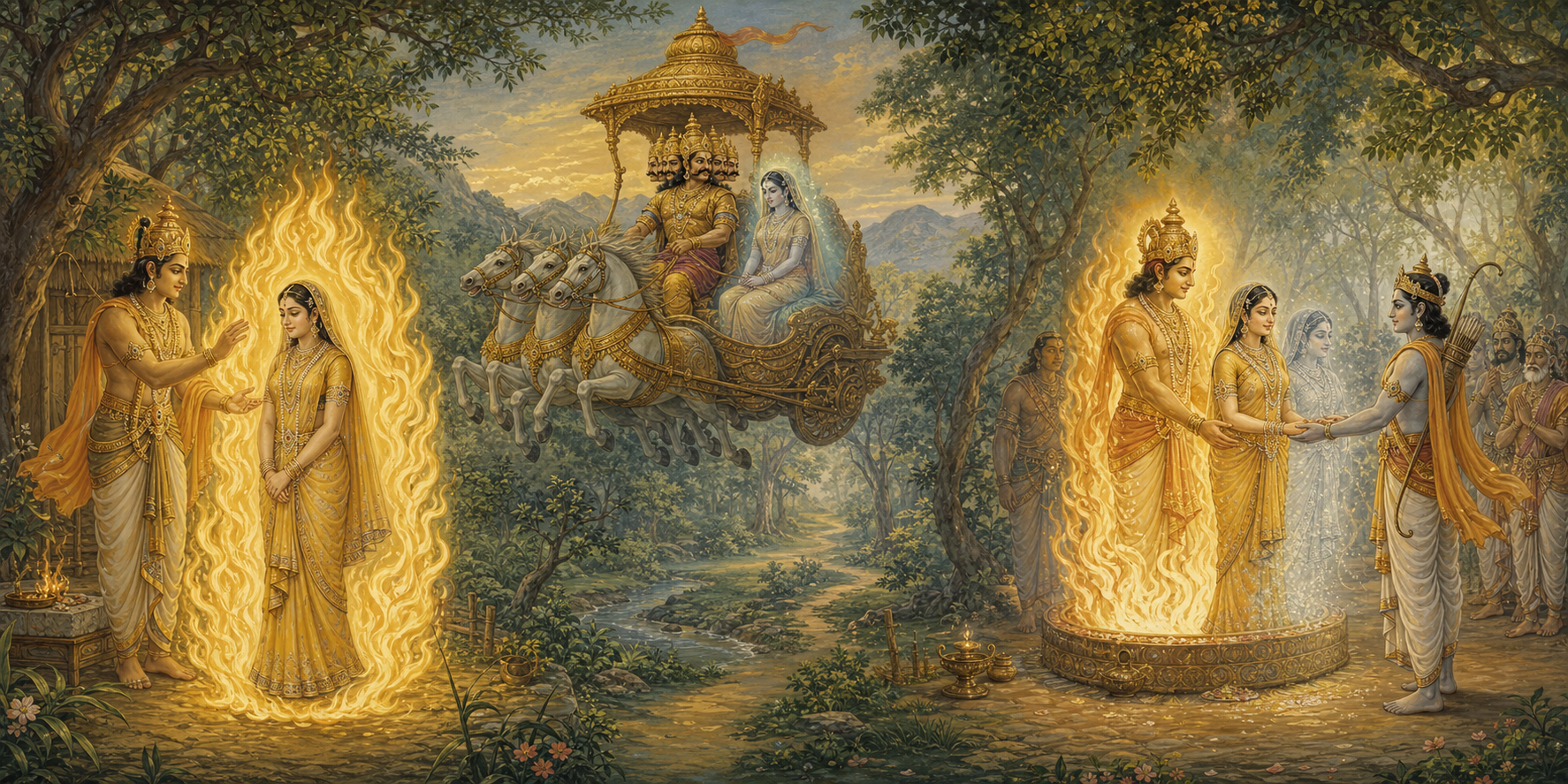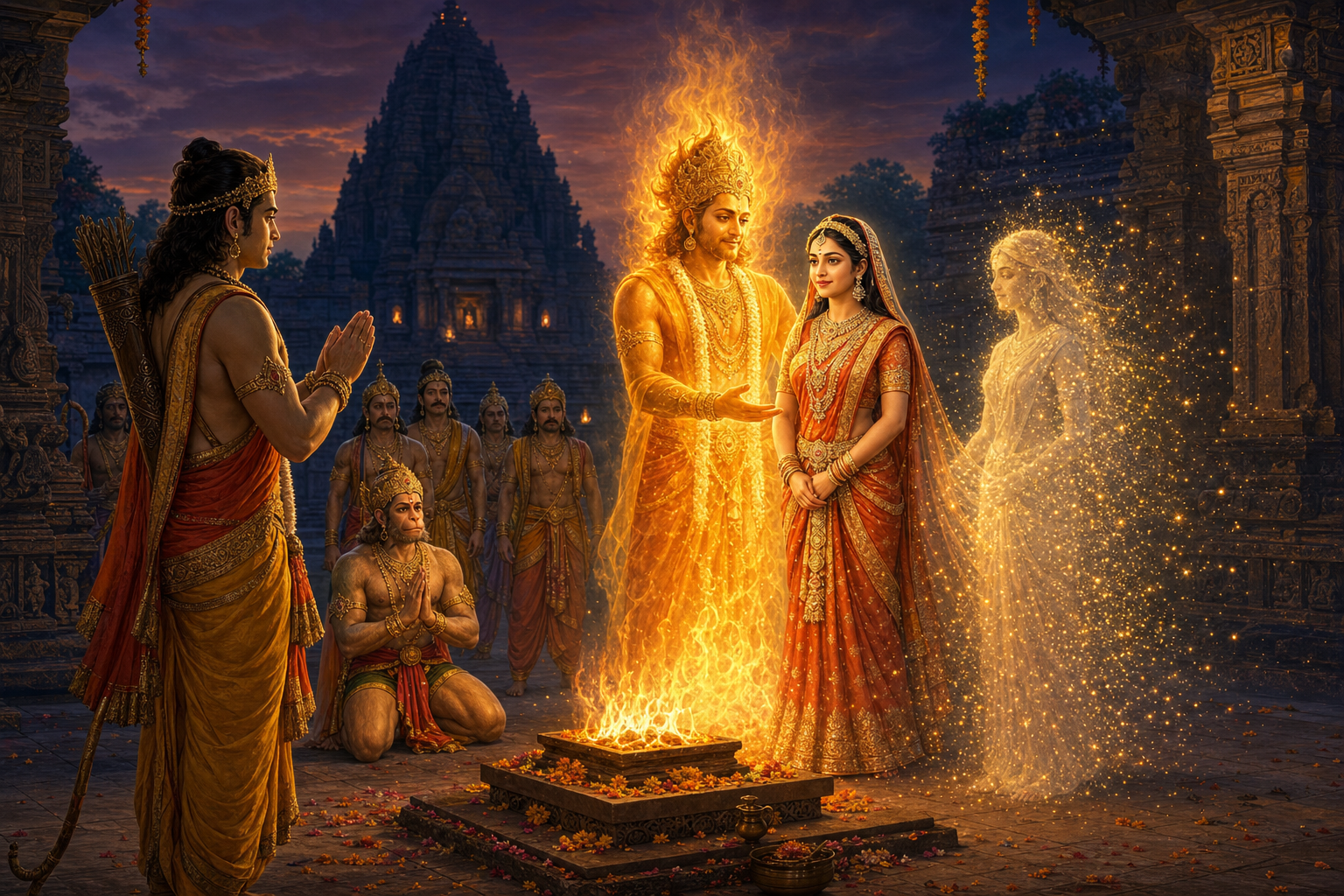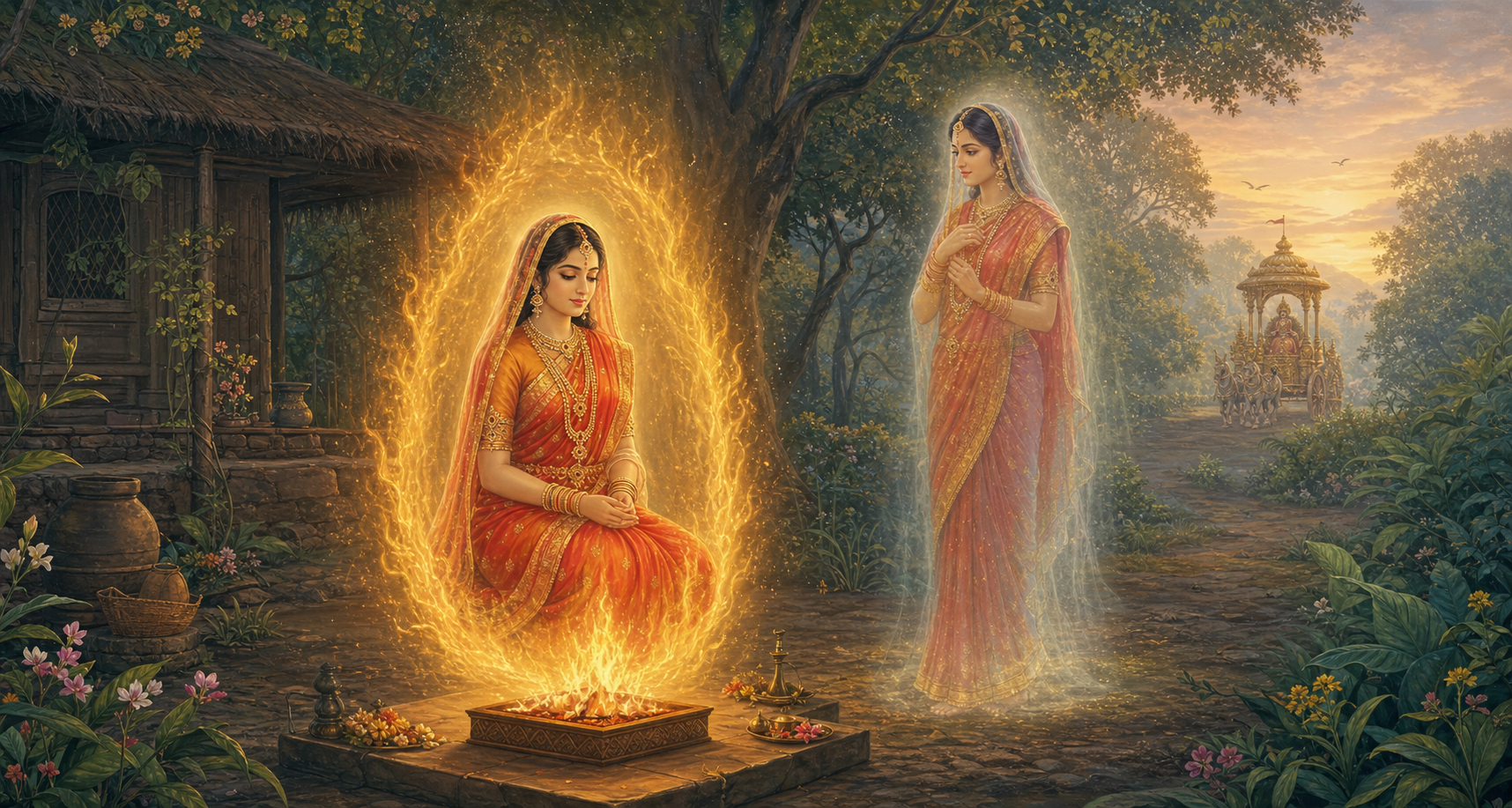
If you are trying to reconcile Ravana’s abduction with Sita’s divine and inviolable nature, the Maya Sita tradition gives a precise answer. In the Puranic telling associated with the Narasimha Purana, Ravana does not carry away the true Sita. He seizes a divinely manifested counterpart while Agni protects the real Sita.
This distinction changes more than the abduction scene. It changes what Lanka represents, what Ravana actually possesses, and what happens during the Agni-pariksha. Once you read the abduction and the fire scene as two halves of one arrangement, an apparent test of Sita becomes a public revelation of truth.
The direct answer: Ravana takes Maya Sita
The safest formulation is straightforward: in the Maya Sita account associated with the Narasimha Purana, Agni shelters the true Sita and a divine substitute undergoes the outward events of abduction and captivity. This substitute is commonly called Maya Sita or Chhaya Sita, the shadow Sita.
The narrative works through four connected movements:
- The true Sita comes under Agni’s protection.
- Maya Sita appears in her place and is carried away by Ravana.
- Ravana’s apparent possession of Sita creates the conditions for the conflict in Lanka and his defeat.
- At the fire scene, the concealed arrangement is disclosed: the true Sita returns from Agni’s protection, and Maya Sita completes her protective role.
The word “Maya” can cause confusion here. Maya Sita is not an illusion manufactured by Ravana, nor is she merely a hallucination. She belongs to a divine arrangement that Ravana cannot perceive. His deception succeeds at the level of appearances, but it fails at the deeper level that matters: he never gains possession of Sita herself.
This lets you answer the question “Was Sita abducted?” without forcing two different textual frames into one sentence. In the familiar outward narrative, Sita’s abduction drives the journey to Lanka and the war. In the Maya Sita interpretation, the person Ravana physically carries away is not the true Sita. The same sequence remains visible, but its theological meaning changes.
That distinction should not be reduced to a convenient escape from a difficult episode. It is a deliberate claim about Ravana’s limitations. He can imitate power, manipulate appearances, and seize what seems vulnerable. He cannot reach Sri, the divine reality embodied by Sita. His supposed triumph is already hollow before Rama’s forces arrive in Lanka.
Agni-pariksha becomes recognition, not investigation
Many readers approach the Agni-pariksha with one pressing question: why should Sita have to prove herself after being Ravana’s captive? The Maya Sita framework does not merely offer a more sympathetic explanation for the ordeal. It assigns the fire scene a different narrative function.
Agni is already involved before the public ordeal. Fire is not introduced at the end as an instrument for discovering whether Sita remained pure. Agni has served as guardian of the true Sita and now serves as the witness through whom the hidden exchange becomes visible. The scene is therefore less an investigation of Sita’s character than a revelation of which Sita endured the outward captivity.
Three roles of Agni become especially important:
- Guardian: Agni shelters the true Sita while the conflict with Ravana unfolds.
- Witness: Agni stands between concealed divine truth and the public world in which Rama must act.
- Revealer: The fire scene makes the distinction between the true Sita and Maya Sita manifest to the assembled community.
This public dimension matters. Dharma is not presented only as something inwardly known by divine beings. Righteous order must also become intelligible to the people who have witnessed the conflict. Sita’s sanctity is not created by the fire; it is disclosed through it.
The same shift clarifies Rama’s role as Maryada Purushottama. Within this interpretation, the scene does not need to be read as Rama privately deciding whether Sita deserves acceptance. Its work is pedagogical and public: the truth protected throughout the Lanka episode must now be revealed within the moral world over which Rama bears responsibility.
What Rama knows at every point can differ among retellings, and there is no need to invent a private psychology that a particular version does not state. Concentrate instead on the visible structure: Agni protects, Ravana mistakes appearance for reality, and Agni finally reveals what Ravana never understood.
This interpretation should also be used with textual discipline. It explains the Agni-pariksha in traditions that contain the Maya Sita mechanism. It should not be imposed as though every Ramayana recension narrates the episode in exactly the same way. If you are discussing a version without the substitution motif, its ethical questions still have to be addressed on that version’s own terms.
Maya here is protective power with a moral purpose
In ordinary conversation, “maya” is often translated too quickly as illusion, with the implication that it is simply false or unreal. That definition is too thin for Maya Sita. Here maya functions as yogamaya: divine power that veils, manifests, and arranges events without surrendering the truth concealed beneath them.
Calling Maya Sita a “fake Sita” therefore flattens the theology. She has a purposeful role within the divine action. She makes it possible for the outward Ramayana narrative to proceed while protecting the true Sita from Ravana. In that sense, she functions as an upaya, a purposeful means through which several ends are accomplished together.
- Sita’s inviolability is preserved without removing the abduction, search, war, and defeat of Ravana from the narrative.
- Ravana’s arrogance is exposed because he cannot distinguish apparent possession from genuine attainment.
- The conditions for Lanka’s downfall arise from Ravana’s own choice to pursue what he believes he can possess.
- The fire scene can reveal divine protection that was active even when it remained invisible to the world.
This is lila with an ethical direction, not spectacle for its own sake. Ravana acts freely from greed, pride, and delusion. The divine arrangement does not make his conduct harmless; it allows his adharma to expose and destroy itself without granting him access to the reality he desires.
The symbolism is exact. Ravana grasps a form and assumes that grasping is the same as possessing. He sees resemblance and mistakes it for essence. He exercises force and mistakes it for victory. Maya Sita turns those mistakes into the inner explanation of his downfall.
You can carry that insight beyond the literal plot without turning the story into a vague metaphor. Adharma repeatedly overvalues control of appearances: a throne, a body, a reputation, or a public display of power. Dharma asks what remains true beneath that display. Ravana can control the visible situation for a time, but he cannot alter Sita’s nature or convert injustice into rightful possession.
The motif should not be used to imply that a person’s dignity depends on escaping all contact with violence. Its theological purpose is to declare Ravana incapable of mastering Sita, not to place a new burden on people who suffer wrongdoing. The moral stain belongs to the aggressor and to adharma. Sita’s personhood is not defined by Ravana’s actions.
Read the variant carefully without flattening the Ramayana
The Ramayana has lived through recitation, commentary, regional retelling, temple teaching, and Puranic interpretation. Textual plurality does not mean that every detail can be projected into every version. It means you should identify which layer of the tradition is answering the question before you.
The basic epic sequence supplies a civilizational narrative: separation, abduction, search, alliance, war, return, and restoration. Puranic interpretation can retain that sequence while making its theological logic more explicit. In the Maya Sita account, the outward events are preserved, but divine concealment explains how Sita’s inviolability and Ravana’s defeat belong to the same moral design.
The motif also belongs to a broader Puranic and Vaishnava conversation. Related tellings are associated with the Padma Purana and Skanda Purana, while Vaishnava interpretation uses the distinction to emphasize Sita as Sri or Lakshmi, inherently beyond Ravana’s power. This wider setting makes it unwise to present Maya Sita as an isolated idea or to claim, without edition-specific evidence, that one surviving formulation must be the earliest.
Manuscript families, recensions, and chapter divisions can differ. If you are preparing a katha, class, discussion, or social-media explanation, use four checks:
- Name the frame. Say that you are discussing the Maya Sita tradition associated with the Narasimha Purana, rather than presenting it as the wording of every Ramayana.
- Read both scenes together. The abduction explains why substitution is needed; the Agni-pariksha reveals why Agni was involved.
- Verify the edition before giving a chapter number. A chapter reference copied from one recension may not map cleanly onto another manuscript or edition.
- Separate sequence from interpretation. Ask first what happens to the true Sita and Maya Sita, then ask what that distinction teaches about Sri, Agni, Rama, and Ravana.
A careful one-sentence explanation is often enough: in the Maya Sita tradition associated with the Narasimha Purana, Agni protects the true Sita while Ravana abducts a divine counterpart, and the fire scene later reveals the exchange. That wording is specific about the claim while honest about the textual frame in which it operates.
This approach avoids two opposite mistakes. The first is to dismiss the variant because it is not identical to every other telling. The second is to use it to erase all ethical or narrative questions raised by versions that do not contain it. Itihasa and Purana can be read in dialogue: one carries the remembered narrative, while the other draws out theological and ritual meanings that communities use to understand it as living dharma.
Key takeaways
- In the Maya Sita telling associated with the Narasimha Purana, Ravana abducts Maya Sita or Chhaya Sita, not the true Sita.
- Agni protects the real Sita and later reveals the concealed arrangement.
- The Agni-pariksha functions primarily as public recognition and restoration, rather than as a private inquiry into Sita’s purity.
- Maya means purposeful divine manifestation here, not a meaningless falsehood or a trick created by Ravana.
- Ravana’s possession is illusory: he captures an appearance while remaining unable to reach Sita as Sri.
- The interpretation should be attributed to its Puranic frame, not imposed upon every recension of the Ramayana.
The next time you read or hear this episode, keep two questions together: what does Ravana think he has seized, and what does Agni finally disclose? Read the abduction and the fire scene as one movement. Maya Sita then becomes a disciplined way to notice how adharma mistakes control for victory, while truth remains protected until it is made visible.