

You may honour Agastya and admire Bhima yet still hesitate at the decisive moment: can a sage’s curse, fulfilled through a violent death, really be called dharmic? Keep that discomfort. It prevents reverence from becoming moral laziness.
The episode becomes useful when you stop treating it as a simple victory of saint over sinner. It asks harder questions. What turns privilege into adharma? When does a consequence correct rather than avenge? What must govern strength before strength can serve dharma?
Read the stable moral structure, not one disputed detail
The first discipline is interpretive honesty. The particulars vary among retellings. Maniman may deride ascetics, violate the sanctity of a water source, or arrogate privileges within or near an ashrama. The encounter is associated in different streams with the Pandavas’ forest wanderings, an Agastya-linked southern setting, or Tumburu Theertham in the Seshachalam hills. Even the name can appear as Maniman, Manimant, or Manimantha.
Those variations matter because no responsible reading should present one local detail as the sole, uncontested version. But variation does not make the ethical core unintelligible. Across the narrative pattern, a powerful attendant of Kubera treats a sacred limit as though rank placed him above it. Agastya declares that Bhima will bring the transgression to its appointed consequence. Maniman’s fall then ends the karmic condition created by his own conduct.
Separate the stable structure from the variable scenery:
- Maniman possesses real power and standing. His fault is not weakness, ignorance, or exclusion.
- His offence expresses contempt for restraint. The exact act varies, but its moral meaning is an elevation of status above tapas and sacred boundaries.
- Agastya’s word gives the offence a definite consequence. The curse is not an outbreak of random destruction.
- Bhima becomes the embodied agent of that consequence. Warrior strength operates within an order established by ascetic insight.
- The encounter terminates a karmic bind. The narrative presents Maniman’s defeat as expiation and release, not suffering without an end.
This distinction gives you a practical rule for reading sacred narratives: do not build an ethical conclusion on the most dramatic version of a disputed detail. Ask what relationship remains constant. Here, the constant relationship is between entrusted power, violated restraint, authoritative judgment, and disciplined force.
Maniman’s offence is a failure of stewardship

Maniman is not merely an unusually strong troublemaker. He belongs to the world of the Yakshas, beings associated with natural abundance, hidden wealth, beauty, and danger. As attendants and guardians of Kubera, Yakshas occupy a position of trust. They stand near prosperity, but proximity is not ownership.
That makes Maniman’s lapse institutional as well as personal. A guardian receives access so that something valuable can be protected. Once he converts access into entitlement, guardianship becomes predation. His splendour intensifies the lesson: external ornament can conceal internal disorder. Ahankara does not always announce itself through loud boasting. It often appears as the quiet assumption that rules binding others no longer bind you.
This is why the apparently small outward offence carries such weight. An ashrama, a sanctified water source, or a path governed by sacred discipline is not just physical property. It embodies vows, limits, and relationships. To violate it because you can is to assert that capacity creates moral permission. Dharma rejects that equation.
You can use Maniman’s failure to examine any role that gives you control over access, resources, reputation, or procedure. Ask three concrete questions:
- What was placed in my care that I have begun to treat as mine without qualification?
- Which limit irritates me mainly because it prevents me from displaying status or control?
- Do people with less power experience me as a guardian of the order or as another obstacle they must appease?
The questions apply before any spectacular fall occurs. That is the point. Maniman’s decisive error is not losing to Bhima; it is forgetting the duty that gave his position legitimacy. If you correct that confusion early, you do not need catastrophe to teach stewardship.
Agastya’s curse corrects power, but it cannot license anger

Agastya represents tapas directed toward order. His wider narrative identity is associated with correcting imbalance, including the mythic humbling of the Vindhya range and the spiritual linking of northern and southern sacred geography. In the Maniman episode, his authority does not come from greater ornament, wealth, or physical force. It comes from disciplined spiritual power.
The curse therefore reverses Maniman’s mistaken hierarchy. Maniman assumes visible power outranks restraint; Agastya’s word places visible power under moral law. The offender will not choose whether his strength exempts him. He will meet Bhima, whose strength is capable of enforcing the limit Maniman denied.
Within the story’s karmic world, the shaapa has a purpose and an endpoint. It identifies the offence, appoints a consequence, names its agent, and culminates in release from the bond created by the offence. That teleology distinguishes correction from uncontrolled rage. Revenge wants the offender to hurt because the offended person hurts. Correction seeks the restoration of an order the offender has violated.
Yet the distinction does not make every moral difficulty disappear. Maniman dies. If you feel that the consequence appears severe beside the outward act described in some versions, you have noticed a genuine interpretive problem. The narrative answers it through a karmic cosmology in which death is not necessarily the annihilation of the being and can complete an expiatory destiny. That explanation belongs to the story’s metaphysical frame; it is not a blank cheque for human punishment.
You are not entitled to imitate a rishi’s curse merely because you believe someone has insulted you, your institution, or even a sacred practice. Ordinary anger does not become brahma-tejas when it acquires religious vocabulary. Nor can a person safely claim that harming another will liberate the victim from karma. The inner status, knowledge, and authority attributed to Agastya cannot be presumed by anyone with a grievance.
This gives us a necessary boundary: read the shaapa as a revelation of moral consequence, not as a procedure for settling present-day disputes. In community life, a dharmic response still requires evidence, proportion, accountable authority, an opportunity to correct conduct where possible, and protection against personal vendetta. If a proposed punishment mainly gratifies humiliation or anger, invoking Agastya does not purify it.
Bhima shows what disciplined strength is for

Bhima is essential to the episode because the story does not oppose spirituality to strength. It opposes ungoverned strength to strength placed in service of dharma. Agastya supplies moral direction; Bhima supplies the capacity to make that direction effective. Brahma-tejas and kshatra are distinct, but they are not enemies.
During the Pandavas’ exile and pilgrimage, Bhima repeatedly confronts beings who endanger his family or fellow travellers, including Hidimba, Baka, Kirmira, and Jatasura. His physical power becomes admirable when it protects, keeps faith with duty, and answers a threat. The gada concentrates that character: direct force, held to a purpose.
Maniman also has strength, but his strength has lost its governing reason. He uses position to magnify the self. Bhima’s force, in this encounter, is directed by a destiny already framed as correction. The contrast is therefore not strong man against strong man. It is ahankara-driven capacity against duty-governed capacity.
Before you describe any forceful act as dharmic, test it against that contrast:
- Protection: Is someone or something genuinely entrusted to your care, or are you defending only wounded pride?
- Direction: Is your action governed by a principle that also limits you, or have you declared yourself the principle?
- Discrimination: Is the response directed at the actual wrong, or will bystanders, dependants, and dissenters be made to suffer?
- Restraint: Will the force stop when protection and order are restored, or does victory require the other person to be degraded?
- Accountability: Can your judgment be examined by others, or must everyone accept your private certainty?
Most everyday conflicts do not place you in Bhima’s position. An insult, disagreement, or challenge to status normally calls for truthful speech, a clear boundary, withdrawal from misconduct, mediation, or an accountable decision process. Casting yourself as the epic warrior too early is often Maniman’s error in another form: the assumption that your power defines the moral field.
The pattern also resonates beyond one Hindu narrative. Buddhist traditions can portray Yakshas as either guardians or menaces whose energy must be restrained. Jain traditions place protective Yaksha-Yakshi figures in service of an ethical order centred on self-mastery and ahimsa. Sikh miri-piri likewise refuses to separate temporal responsibility from spiritual orientation. The forms differ, but the shared warning is clear: power is not self-justifying.
Turn the episode into an accountability practice
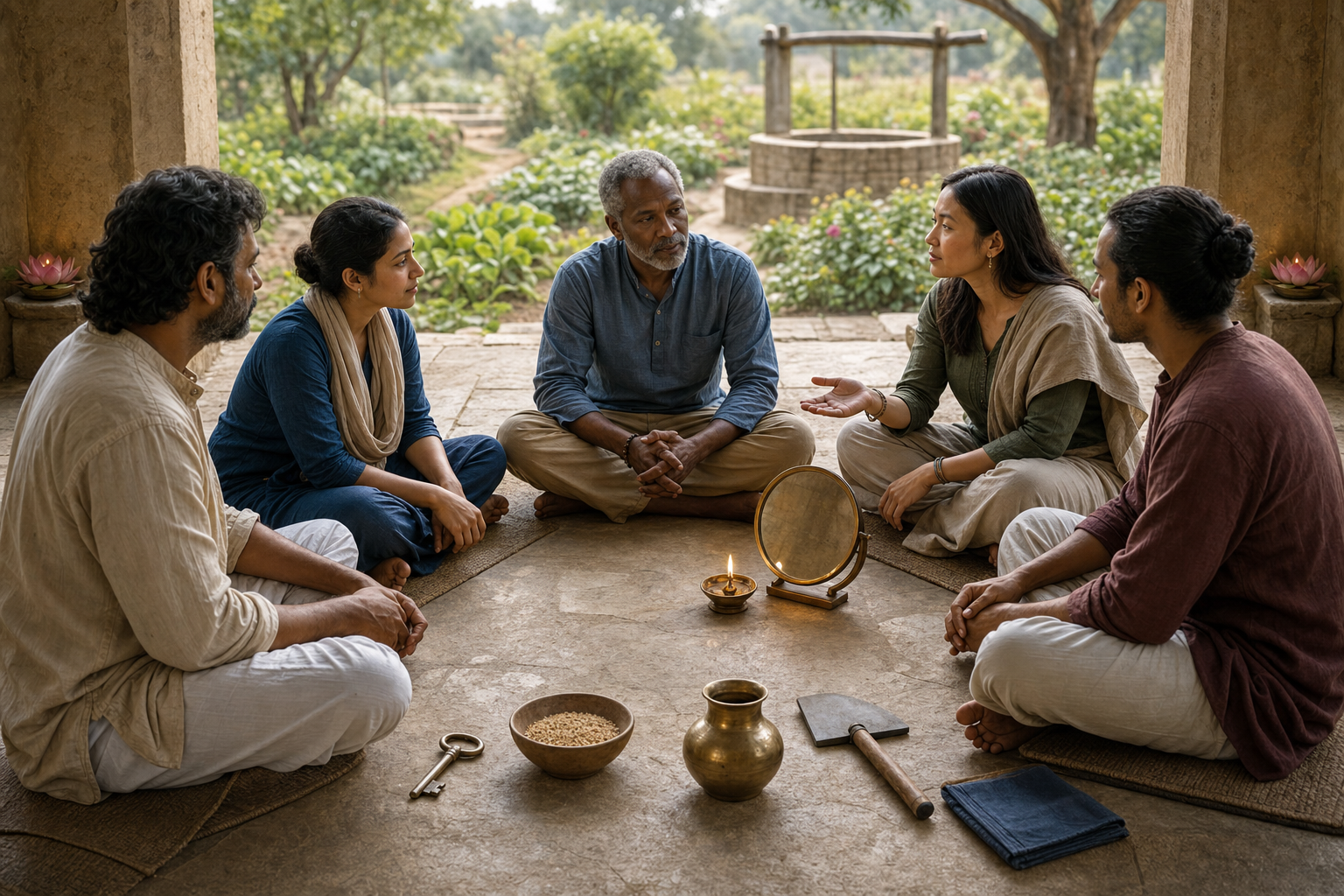
The safest contemporary use of the episode is self-application before accusation. If you begin by assigning Maniman’s role to an opponent and Agastya’s or Bhima’s role to yourself, the story will flatter you without changing you. Begin with the possibility that all three capacities can appear within one person: pride that resists limits, discernment that names the limit, and strength that must be governed.
- Name the trust. Write down the role, resource, relationship, or sacred duty placed in your care. Do not describe what it gives you; describe what it obliges you to protect.
- Find the entitlement. Identify one rule, person, or practice you dismiss because it slows you down or limits your discretion. Ask whether the irritation reveals a real defect or merely resistance to restraint.
- Separate injury from disorder. State what was harmed without mentioning how offended you feel. If you cannot do that, do not yet impose a consequence.
- Choose a restorative endpoint. Define what correction would look like: safety restored, access protected, conduct stopped, trust repaired where possible, or responsibility transferred. If your endpoint is humiliation, you are planning revenge.
- Place strength under review. Name the principle, person, or accountable process allowed to tell you that your response has gone too far. Power with no corrector has already begun moving toward Maniman.
Key takeaways
- The details of Maniman’s offence and the location of his encounter with Bhima vary, so ethical interpretation should rest on the stable narrative structure rather than one exclusive retelling.
- Maniman’s central fault is ahankara expressed through failed stewardship: he treats entrusted status as exemption from sacred limits.
- Agastya’s curse functions within the narrative as a directed consequence leading to expiation, but it does not authorize personal vengeance or religiously framed harm.
- Bhima’s strength is dharmic because it is governed by purpose, protection, and an order beyond his ego.
- The most faithful modern application begins with examining how you hold power, not with labelling an opponent as the condemned Yaksha.
The next time status tempts you to push aside a limit, pause before the breach becomes a battle. Name what has been entrusted to you, accept the restraint that protects it, and choose the smallest firm action that restores the duty. That is how you learn from Agastya and Bhima without pretending to possess their authority.
References
