
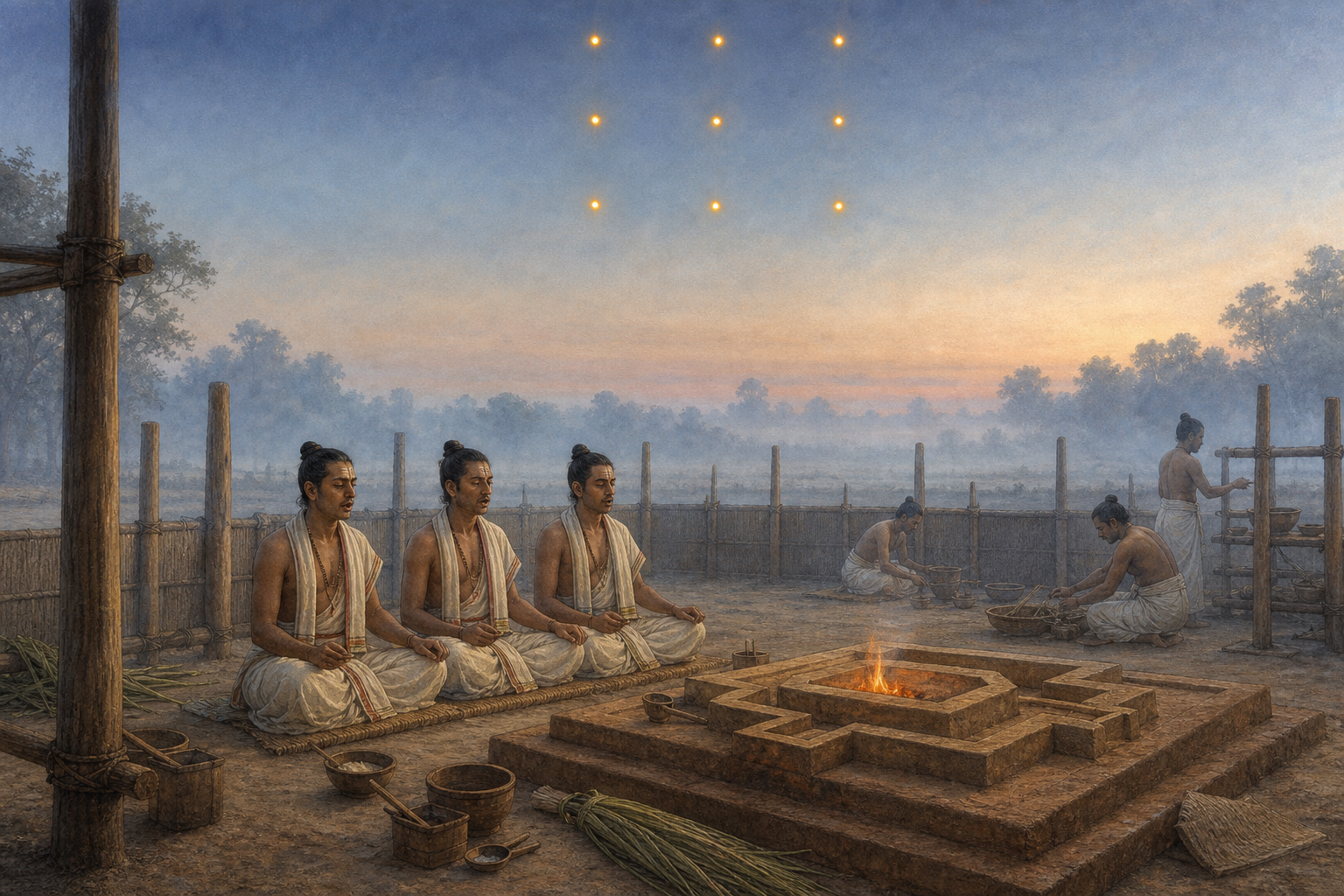
You may have encountered Mahanamni in a list of Sama Veda chants and wondered what you are actually looking at: a mantra, a melody, or a ritual unit. The useful answer is that these dimensions belong together. Mahanamni names a defined group of verses, but their liturgical character emerges through the union of words, musical form, and ritual placement.
This distinction should shape how you approach them. A translation can introduce the verbal meaning, but it cannot teach the chant. A recording can reveal something of the sound, but an isolated clip may not explain where that sound belongs. To understand Mahanamni responsibly, you need to identify the verses precisely and then study how Sama recitation makes them part of a larger rite.
Begin with the exact identity of Mahanamni
Mahanamni is not the name of one free-floating mantra. It designates a sequence of nine verses preserved in Jaiminiya Samhita 2.7. The sequence begins with the words vida maghavan, and the verses are collectively known as the Sakvari verses.
Those identifiers prevent several common confusions. Mahanamni and Sakvari should not automatically be catalogued as two unrelated collections. A passage labelled only by its opening words should not be separated from the nine-verse sequence without checking its context. Most importantly, material from another Sama Veda setting should not be assumed to carry the same textual and melodic details as the Jaiminiya form.
Key takeaways
- Mahanamni refers to nine verses, not merely one short formula.
- The textual location is Jaiminiya Samhita 2.7.
- The opening words are vida maghavan.
- Sakvari is the traditional designation for this group of verses.
- The sequence has a specific place in Vedic liturgy, especially in connection with Ahina sacrifices.
- Words alone do not preserve the complete Sama performance; phonetics, melody, cadence, and ritual placement matter.
If you are making study notes, recording these five fields will keep your references usable: collection name, alternate designation, number of verses, textual location, and opening words. Add the ritual setting as a sixth field whenever you can establish it. This simple discipline is more reliable than saving an unattributed transliteration or audio fragment.
Hear three layers at once: text, melody, and placement
Sama Veda chanting does not treat a verse as prose that happens to be sung. Exact diction carries the wording. Tonal movement and cadence shape its performed form. Ritual placement gives the performance its procedural purpose. Mahanamni becomes intelligible when you keep all three layers in view.
The first layer is textual identity. You should be able to say which verses are being used and where they are preserved. This is the layer served by a reliable text, transliteration, or translation. It answers the question, “What words belong here?” It does not, by itself, answer how the Sakvari verses are to be sung.
The second layer is the Sama performance. Pronunciation, tone, and cadence are not decorative additions placed over an otherwise complete text. They organize the audible form of the verses. A learner who knows the words but guesses the tune has not preserved this layer. A listener should therefore resist reducing the chant to a written lyric.
The third layer is liturgical placement. Even an accurately remembered sound does not explain its ritual function when it is detached from the sequence in which it belongs. In an Ahina setting, Mahanamni participates in an ordered sacrificial arc. It is not background music and should not be interpreted only by the private mood it produces in a modern listener.
This three-layer model gives you a practical test for any presentation of Mahanamni. Ask whether it identifies the verses, preserves or acknowledges the melodic discipline, and explains the ritual setting. If one layer is missing, treat what you have as a partial aid rather than a complete account of the chant.
What the chants do within an Ahina ritual
The Mahanamni verses are especially associated with Ahina sacrifices, observances with a concentrated and time-bounded liturgical arc. Within that setting, the sequence helps sustain order across the rite. Its steady, governed sound also gathers the attention of participants around a shared act.
The opening address to Maghavan places the sequence within the language of soma-related ritual. Yet a dictionary explanation of that address would still leave the main liturgical question unanswered. The ritual force lies not only in whom the words address, but also in how the verses are arranged, voiced, and situated within the observance.
You can understand the function through three closely related effects. The sequence marks and supports procedural continuity. Its stable cadence demands trained attention from the chanters. The resulting sound allows the assembled community to inhabit the same ritual moment. These are not competing explanations: order, discipline, and participation reinforce one another.
This also clarifies what “contemplative” means in this setting. It need not imply withdrawing from ritual action into an isolated inner exercise. Attention is cultivated through exact participation: listening carefully, pronouncing carefully, following the established progression, and allowing individual effort to serve a collective act.
How to study Mahanamni without stripping away its form
If your goal is serious study rather than casual recognition, proceed from identity to sound and from sound to ritual context. Reversing that order often leaves you imitating an attractive melody without knowing which textual or liturgical form you have heard.
- Fix the textual identity. Write down Mahanamni, Sakvari, nine verses, Jaiminiya Samhita 2.7, and vida maghavan. These details give you a way to check whether two references concern the same material.
- Separate reading from chanting. Use a written text to follow the words and structure. Do not treat Roman transliteration as a complete notation of pronunciation or melody.
- Identify the lineage of the performed form. Because these verses belong to the Jaiminiya tradition, ask whether a teacher or recording actually represents that tradition. A generic label such as “Vedic chant” is not enough to establish this.
- Learn the audible form from qualified transmission. Listen for diction, tonal contour, pacing, and the relation between successive phrases. Avoid reconstructing the melody from memory after hearing an isolated excerpt.
- Locate the ritual moment. Ask what comes before and after the sequence and what role it performs in the Ahina arc. This turns an audio object back into liturgy.
- Keep interpretation proportional to the evidence. You may notice attentiveness, steadiness, or communal focus while listening. Do not turn that response into a claim that Mahanamni was designed as a generic relaxation technique.
A good study page should therefore have separate headings for text, performed form, and ritual use. Under “text,” record the location and opening words. Under “performed form,” note whose transmission you are following and which features still require correction. Under “ritual use,” record the Ahina connection and any established information about placement. Keeping these columns separate exposes gaps that polished summaries often conceal.
If you do not yet have access to a qualified teacher, you can still learn the identity and context of the verses. What you should postpone is confident melodic reproduction. That boundary is not exclusion for its own sake; it protects the very features that make a Sama chant more than text read aloud.
Recognize the wider Dharmic principle without flattening it
Mahanamni illuminates a principle familiar across the Dharmic family: sacred sound is joined to disciplined attention and a formative way of life. Hindu mantra, Buddhist paritta, Jain stavan, and Sikh gurbani each show that voiced practice can orient a community toward recollection, ethical seriousness, and inner steadiness.
The resemblance should deepen respect, not erase distinctions. These forms do not share one interchangeable theology, textual history, musical grammar, or ritual purpose. Calling every sacred recitation a “mantra” would obscure more than it explains. The sound practices are related by a broad civilizational regard for disciplined utterance, while each must still be approached on its own terms.
When you explain Mahanamni to someone from another Dharmic tradition, begin with the shared principle and then name the particulars. Say that sound can train attention and bind a community together. Then specify that Mahanamni comprises nine Sakvari verses in the Jaiminiya Sama Veda tradition and has a defined role in Ahina liturgy. Unity becomes credible when it is built from accurate distinctions.
Your best next step is modest and concrete: make a one-page identification record for the verses, then seek guidance rooted in the Jaiminiya tradition before attempting to reproduce their melodic form. Listen for the disciplined relationship among wording, tonal movement, cadence, and ritual sequence. That relationship is where Mahanamni can be encountered as living Sama liturgy rather than as a fragment removed from its home.


References
