
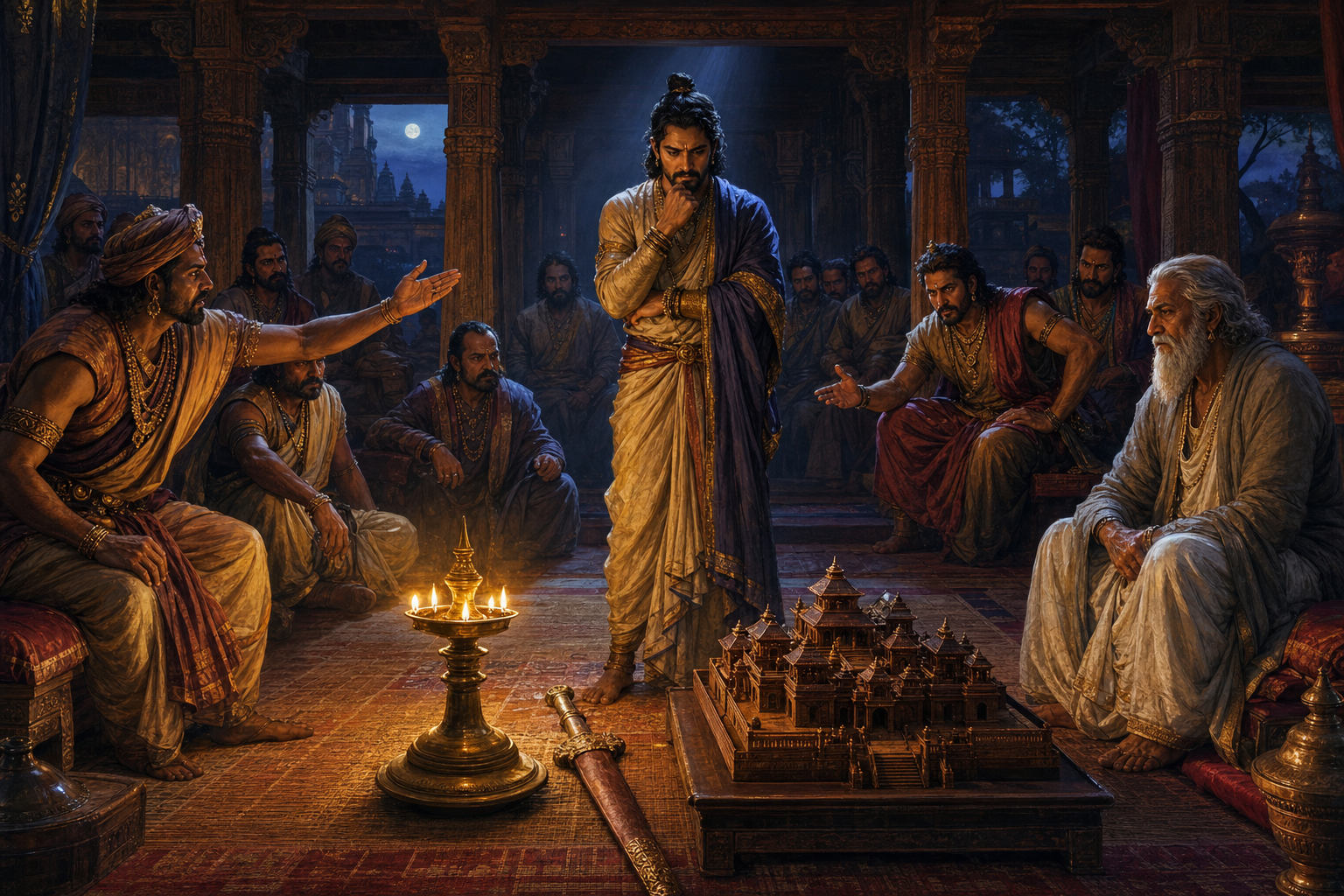
You may face the Mahabharata’s old problem in a modern room: a superior calls a harmful tactic necessary, secrecy is renamed loyalty, and everyone praises the person who can make the plan work. At that moment, success is the wrong first question.
You need to know whether the end is legitimate, whether the means remain within dharma, and what responsibility belongs to you even when you did not give the order. The Lakshagraha conspiracy offers a demanding answer. It shows that dharmic statecraft is neither political innocence nor passive goodness. It is the disciplined use of intelligence, power, secrecy, and courage without turning people into expendable instruments.
Rajadharma begins where plausible deniability ends
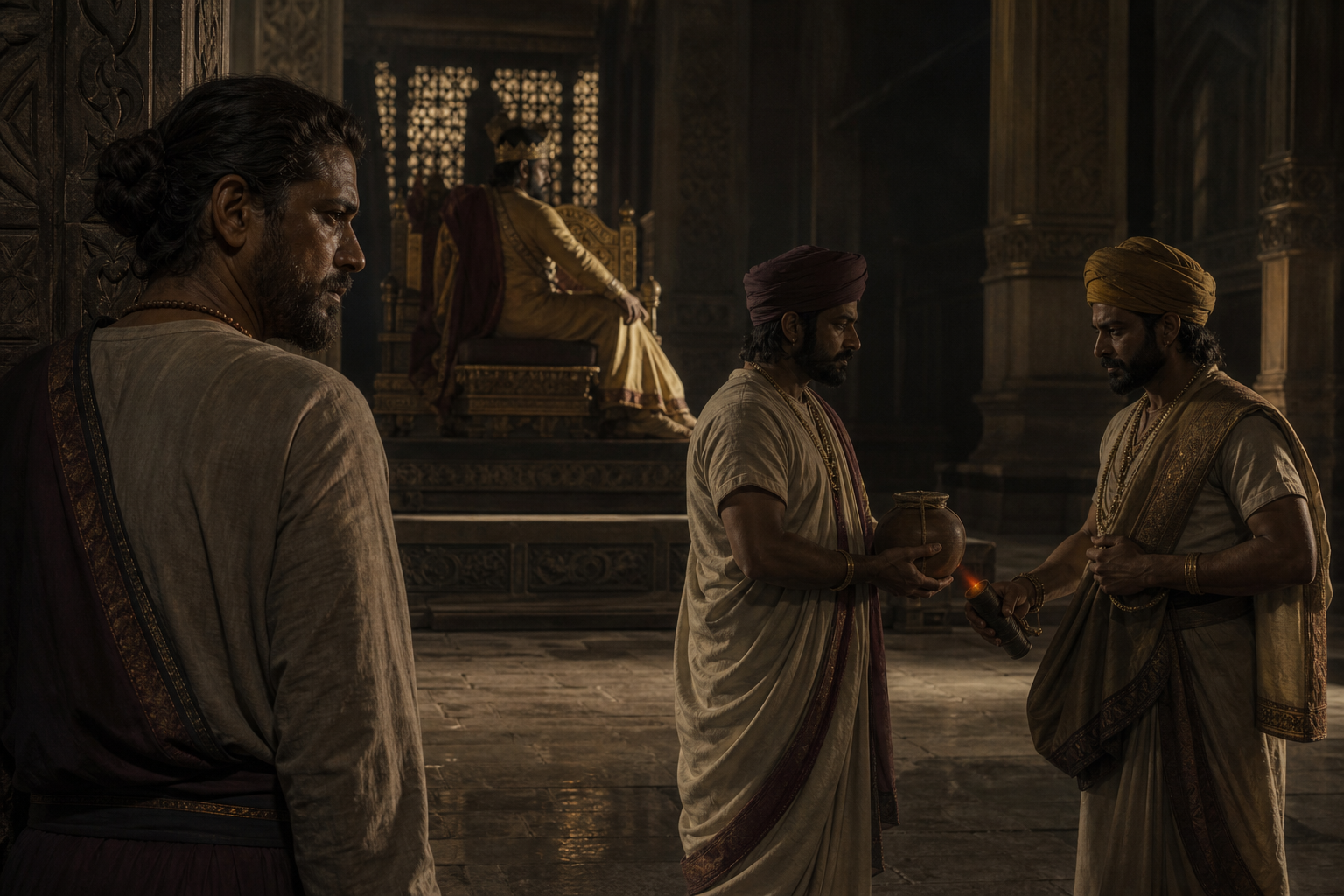
The Lakshagraha conspiracy is not merely a tale about a wicked building. It is a study of how a political system converts private hostility into organized state action. Duryodhana and Shakuni seek the removal of the Pandavas without open conflict. Dhritarashtra’s ambivalence permits the scheme to proceed. Purochana supplies the professional competence needed to turn intent into an apparently accidental disaster.
The palace at Varanavata is designed as hospitality on the outside and entrapment within. Lac resin, oils, ghee, timber, and other combustible materials give the residence an attractive finish while preparing it to burn rapidly. A festive setting helps the conspiracy because lamps, crowds, noise, and confusion can make a planned fire look accidental. The political purpose is not only to kill. It is to kill without accepting responsibility.
That distinction matters whenever you evaluate statecraft. Open force can be unjust, but covert force does not become righteous merely because it leaves fewer signatures. A ruler cannot outsource adharma to an adviser, contractor, official, intelligence operative, party worker, or loyal subordinate. The distance between the command and the deed may protect a reputation; it does not dissolve rajadharma.
Before approving a sensitive political or institutional plan, require clear answers to four questions:
- What public duty authorizes the end? Personal rivalry, fear of succession, embarrassment, and the desire to retain power are not public duties.
- What exactly will the means do? Describe the action in plain language. If a plan sounds acceptable only after replacing words such as deceive, entrap, threaten, or harm with administrative euphemisms, the language is hiding the moral fact.
- Who owns the decision? Identify the person who authorizes it, the people who execute it, and the forum that can review it. An arrangement deliberately built so that no one can be held responsible is already warning you about its character.
- Who bears the danger? Count the people who receive none of the political benefit but carry the physical, social, or reputational risk.
Rajadharma asks more of a ruler than refraining from issuing an explicit evil command. It requires active protection of justice within the machinery of rule. Dhritarashtra’s failure is therefore constitutional as well as personal: authority remains in his hands while intrigue is allowed to govern in his name.
Vidura’s prudence is not the same as Shakuni’s cunning
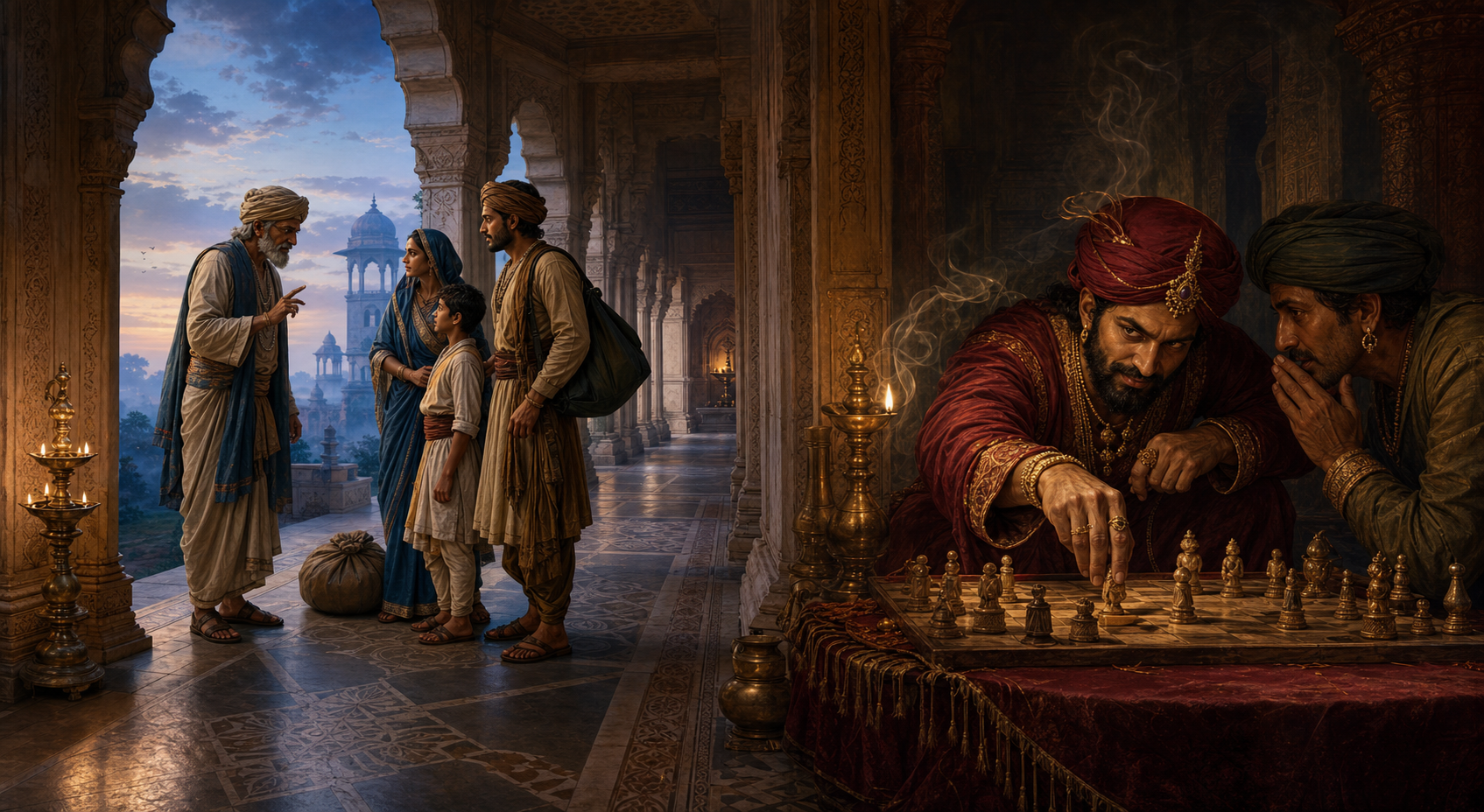
A common mistake is to identify dharma with complete openness and political skill with deception. Vidura breaks that false choice. He recognizes danger in the sudden display of royal hospitality, communicates a coded warning, and helps make possible an escape through a hidden tunnel. He does not lack strategic intelligence. He directs it toward protection rather than predation.
This gives you a precise distinction: secrecy is a method, not a moral category. Its ethical character depends on its purpose, its target, and the accountability that remains possible afterward. Concealing an escape route from an intended killer is not morally equivalent to concealing a murder plan from its intended victims.
| Question | Dharmic prudence | Adharmic cunning |
|---|---|---|
| What is being protected? | Life, justice, legitimate duty, or the vulnerable | Private domination, revenge, or immunity from consequences |
| Why is information restricted? | To prevent imminent misuse or protect those in danger | To deny victims a chance to resist and the public a chance to judge |
| How are people treated? | As persons whose dignity and safety matter | As obstacles, instruments, or expendable cover |
| What happens after the danger passes? | The action can be explained, examined, and judged | The plan depends permanently on denial, destroyed traces, or a disposable agent |
Use this distinction when someone defends a plan by saying that secrecy is normal in politics, diplomacy, security, business, or religious administration. That statement may be true and still irrelevant. The proper questions are: whom does the secrecy protect, whose informed judgment does it prevent, and would the decision-makers accept fair scrutiny once the immediate danger has passed?
Vidura also corrects another misunderstanding: righteous counsel is not limited to delivering a noble speech and then withdrawing. When open protest cannot protect the threatened person, dharmic responsibility may require a workable safeguard. A warning without a means of escape would have been morally sincere but strategically incomplete. The tunnel turns discernment into protection.
That is the standard for an adviser. Do not measure your contribution only by whether you stated the correct principle. Ask whether the people in danger can actually use your counsel. A warning should identify the threat, reach the right person in time, and point toward a feasible protective action.
Orders do not carry your conscience for you
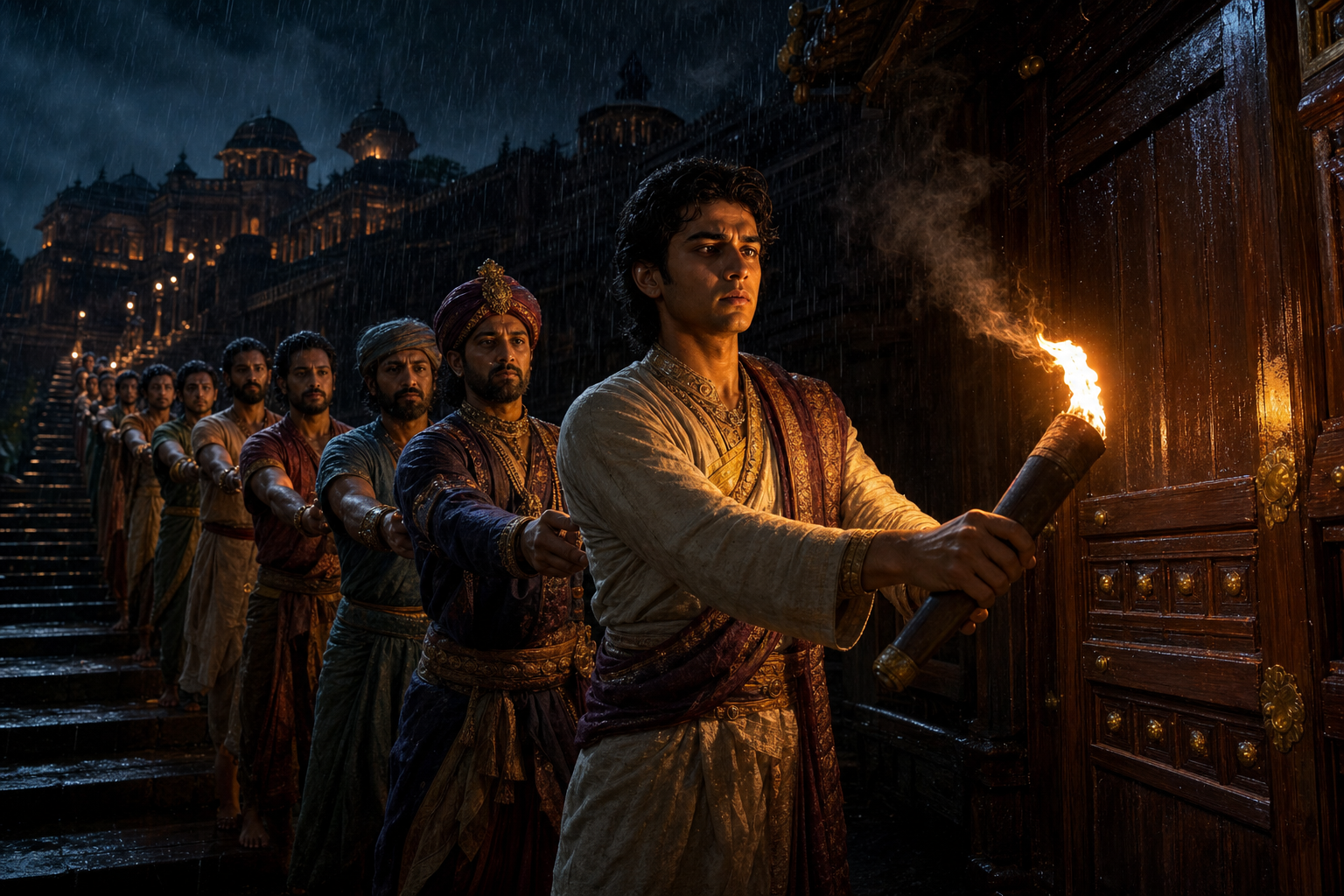
Purochana is politically important precisely because he is not the principal claimant to the throne. He is a capable functionary: trusted, discreet, technically useful, and sufficiently removed from the royal center to provide deniability. His skill makes the conspiracy operational.
In the dominant account, Purochana dies in the blaze. His fate is more than punishment fitted to a villain. It exposes the real position of an operative in an adharmic system. The patron receives the benefit if the scheme succeeds and can disown the agent if it fails. The servant who mistakes usefulness for honor may discover that ruthless loyalty offers neither moral protection nor practical security.
This is why professional competence cannot be separated from moral agency. An engineer may not choose the political objective, and an official may not create the policy, but each still decides whether to make a harmful intention executable. Pressure, hierarchy, dependence, and fear can reduce a person’s freedom. They do not automatically turn participation into innocence.
If an instruction troubles you, work through it in this order:
- Name the requested act. Separate what you are actually being asked to do from the honorable language surrounding it.
- Name the foreseeable harm. Identify who could lose safety, freedom, livelihood, dignity, or a fair chance to respond.
- Test the connection to duty. Ask whether the act serves the institution’s legitimate responsibility or merely the interests of a powerful person within it.
- Question the need for concealment. Sensitive work may require confidentiality. A plan that must be disguised because its real purpose is indefensible presents a different problem.
- State the objection precisely. A specific objection tied to duty, method, and affected people is harder to dismiss than a vague declaration of discomfort.
- Do not supply the missing capability for deliberate harm. If the plan remains intentionally deceptive or destructive, use the safest accountable channel available within your role rather than becoming its indispensable Purochana.
Leaders have a corresponding duty. It is not enough to tell subordinates to act ethically. An institution needs a real path for questioning an instruction, a record of who authorized high-consequence decisions, and a review process that does not punish the first person who names a foreseeable harm. Otherwise, the institution rewards obedience while pretending to value conscience.
Loyalty remains a virtue only while it serves a rightful relationship. Loyalty to a ruler should support the ruler’s duty, not the ruler’s appetite. Loyalty to an organization should protect its honorable purpose, not conceal its corruption. When a command attacks the very dharma that gives the office legitimacy, refusal may be the more faithful form of service.
The forgotten dead are the hardest test of strategy
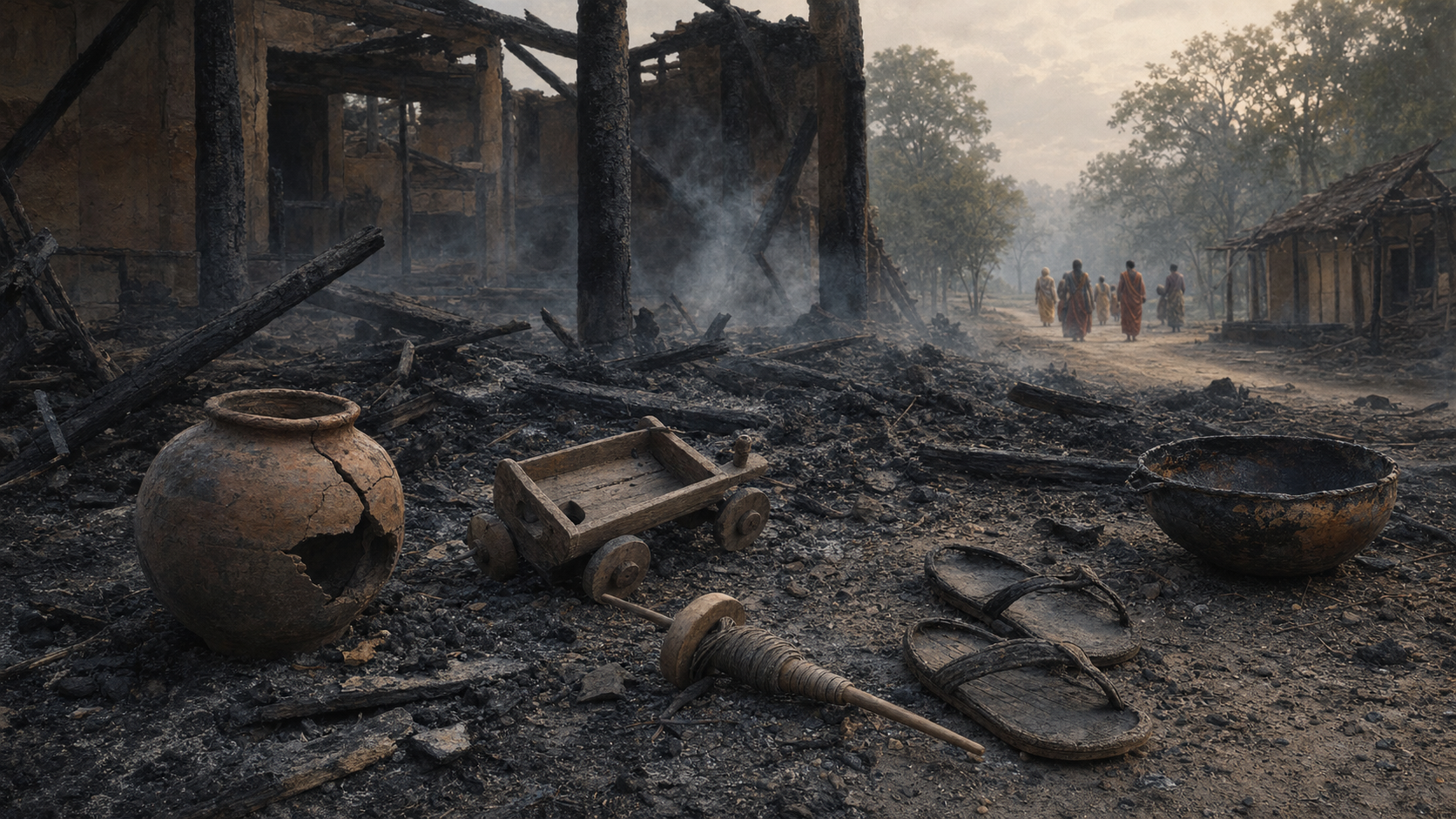
The escape from the lac palace is not morally tidy. A Nishada woman and her five sons die in the fire, and their remains are mistaken for Kunti and the five Pandavas. Narrative traditions differ in some details surrounding the ignition, but the deaths keep the episode from becoming a simple celebration of clever survival.
The intended victims escape an assassination plot, yet other vulnerable people pay the price. That fact does not make the original conspiracy less evil. It does force a harder judgment: defeating an adharmic design does not automatically sanctify every consequence of the counter-strategy. Necessary self-protection and responsibility for foreseeable harm can exist in the same moral field.
This is one of the Mahabharata’s most useful disciplines for public life. Political debate usually counts leaders, factions, victories, and defeats. Dharma makes you count the people whom elite calculations render anonymous. A strategy is morally incomplete until it includes those who do not sit at the table, cannot refuse the danger, and will not be remembered if the plan succeeds.
Run a burden audit before calling any tactic necessary:
- Who is physically closest to the risk? The person making the decision may be far safer than the person implementing or enduring it.
- Who has no voice in the decision? Junior workers, ordinary families, local communities, and politically unrepresented people are easily treated as background.
- Whose suffering is being converted into a useful appearance? The Nishada family’s bodies become evidence for a false conclusion. That is a warning against treating real people as cover for someone else’s strategy.
- What protection exists before harm occurs? Compensation after the fact cannot substitute for considering safety while the plan is still changeable.
- Who will name the loss honestly? If success requires the victims to remain anonymous, the official account is serving power rather than truth.
This concern travels across Dharmic traditions without erasing their differences. Hindu reasoning places artha, the pursuit of political and material ends, within the limits of dharma. Jain and Buddhist commitments to ahimsa sharpen attention to lives that strategy is tempted to instrumentalize. Sikh commitments to sat and seva oppose a politics built from falsehood and the exploitation of those with less power. The shared boundary is clear: a worthy end does not grant unlimited moral permission.
A six-question Lakshagraha test for real decisions
You can apply the episode without pretending that every difficult decision resembles attempted murder. The point is to detect the same moral architecture at an earlier stage: an outwardly benevolent facade, a concealed harmful purpose, fragmented responsibility, a loyal operative, and vulnerable people made to carry the danger.
Before supporting a high-consequence tactic in government, party politics, a workplace, a community body, or a religious institution, write one plain sentence under each of these questions:
- What is the legitimate end? Define the duty being served without referring to the prestige, survival, or convenience of the decision-maker.
- What means are ruled out even if they would work? If your answer is none, you are treating effectiveness as the highest good rather than as one consideration governed by dharma.
- Does the public face contradict the real function? A palace offered as hospitality but built as a trap is the episode’s clearest warning. Look for the same gap between appearance and purpose in your plan.
- Who bears a burden without meaningful choice? Name actual groups rather than hiding them inside words such as collateral, disruption, exposure, or operational necessity.
- Who remains responsible at every handoff? A chain of authority should clarify responsibility. If every participant can say that someone else decided, the design is enabling complicity.
- Can the action survive later truth? Ask whether you could explain the purpose, method, burden, and authorization to a fair-minded reviewer after the immediate pressure has passed.
The answers need not make a decision easy. Statecraft involves incomplete information, competing duties, adversaries, and genuine dangers. Dharma does not abolish those conditions. It prevents difficulty from becoming a universal excuse. It asks you to preserve moral distinctions precisely when pressure makes them inconvenient.
A plan deserves an immediate pause when its charitable appearance is essential to deceiving its target, when deliberate harm is assigned to someone chosen for disposability, or when unnamed outsiders must absorb the risk. Those are not minor communication problems. They reproduce the structure of the lac palace: beauty as concealment, competence as weapon, and distance as an escape from responsibility.
Key takeaways
- Rajadharma includes responsibility for what rulers permit, conceal, delegate, and fail to prevent.
- Strategic secrecy can serve dharma when it protects life and remains answerable to justice; secrecy used to entrap victims and erase accountability is cunning, not prudence.
- A subordinate retains moral agency because professional skill is often what converts an improper desire into an executable plan.
- Any serious decision must count people who receive none of its benefits but carry its risks.
- The practical test is not only whether a tactic works, but whether its end, means, burdens, chain of responsibility, and eventual disclosure can all withstand dharmic judgment.
The next time you are asked to keep a sensitive plan moving, begin before the language of loyalty takes over. Write down the real end, the real means, the least powerful person exposed to harm, and the name of the person who will answer for the outcome. If those facts cannot be stated plainly, do not lend the plan your competence until they can.
Dharma is not the decoration placed on power after victory. It is the discipline that decides which victories are fit to pursue and which forms of service you must refuse.