
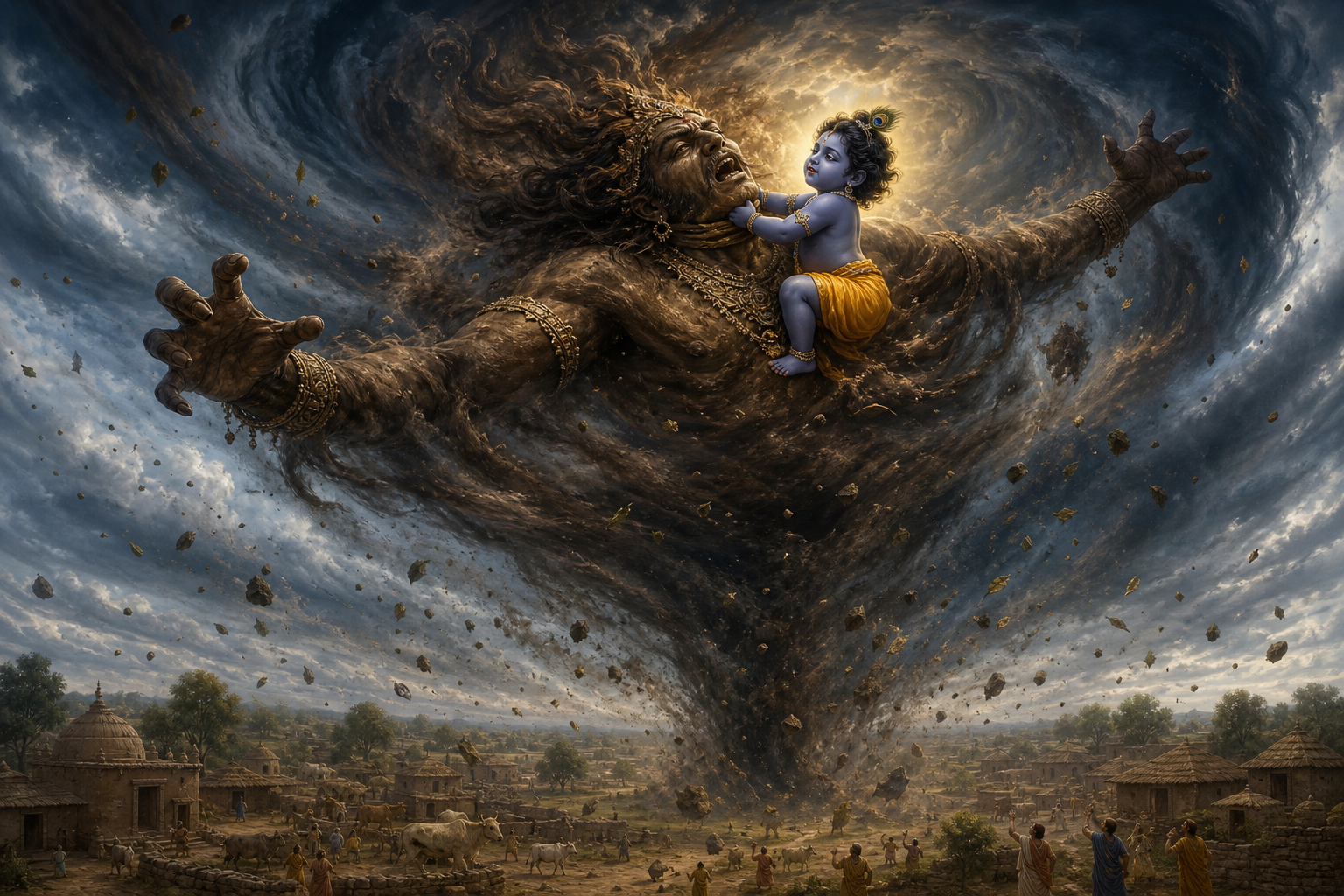
If you remember Trinavarta only as the wind-demon killed by baby Krishna, you remember the outcome but miss the movement of the lila. The episode is built around a problem you already know: fear rises, visibility disappears, and the mind is carried far from its ground.
Its answer is not to become faster than the storm. Trinavarta is defeated when Krishna becomes impossibly heavy and the demon’s own violent breath fails him. For a devotee trying to remain steady amid distraction, panic, or pride, that reversal is the detail to keep: do not chase every gust. Recover your weight through remembrance, disciplined attention, and the next duty that Dharma places before you.
Read the sequence before reaching for the symbolism
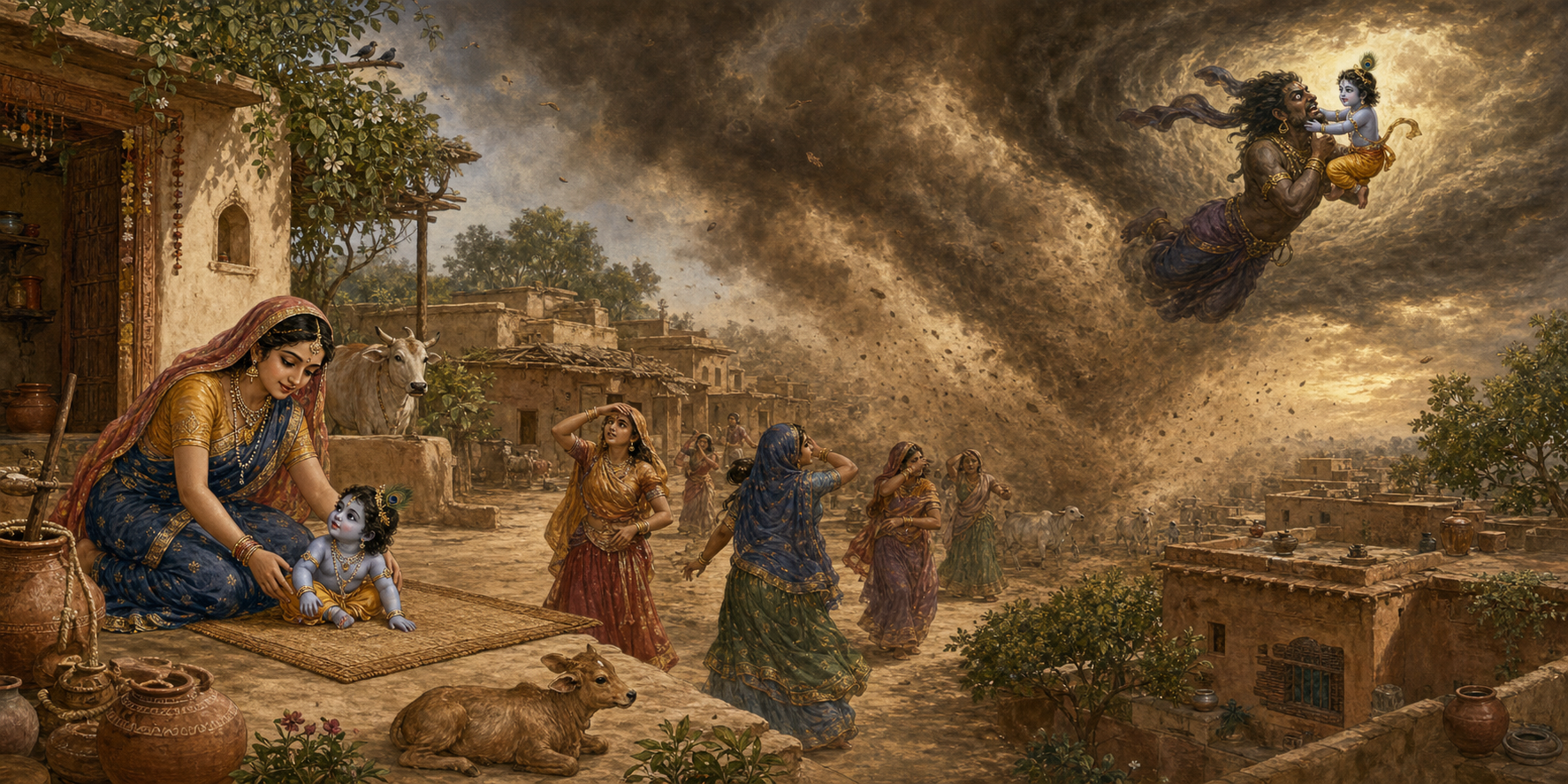
The setting is Gokul, where Kamsa’s fear of the child destined to end his tyranny has already produced one murderous attempt after another. Putana has failed. Krishna’s early childhood continues among Yashoda, Nanda, the cowherds, and the ordinary rhythms of Vraja, but the threat from Mathura has not disappeared.
Yashoda is holding Krishna when He suddenly becomes extraordinarily heavy. Unable to continue carrying Him, she sets Him down and returns briefly to her household work. Then the air changes. Trinavarta enters as a violent whirlwind, filling the surroundings with dust, straw, and debris. Vision is obstructed. The demon seizes Krishna and carries Him upward while those below can no longer see what has happened.
At the height of Trinavarta’s apparent success, the action reverses. Krishna becomes too heavy for the demon to bear. Trinavarta can neither continue rising nor free himself. Krishna clasps his throat, the demon’s breath and strength give way, and the whirlwind collapses. Trinavarta falls outside Vraja, while Krishna remains unharmed upon his body. The villagers find the child and return Him to Yashoda.
Three common misreadings fall away once you attend to that order. Yashoda is not portrayed as an indifferent mother; an unseen assault interrupts ordinary care. Krishna does not survive by chance or because a stronger rescuer arrives; He is the cause of the reversal. And the victory is not a contest of escalating violence. The demon’s chosen power becomes useless in the presence of the child he presumed to carry.
This matters when you tell the lila to children or discuss it in satsang. Do not rush from the abduction to the demon’s fall. Pause at the obscuring dust, the upward flight, and the change in weight. Those details disclose what kind of power Trinavarta represents and what kind of sovereignty Krishna reveals.
Why the whirlwind and Krishna’s heaviness belong together
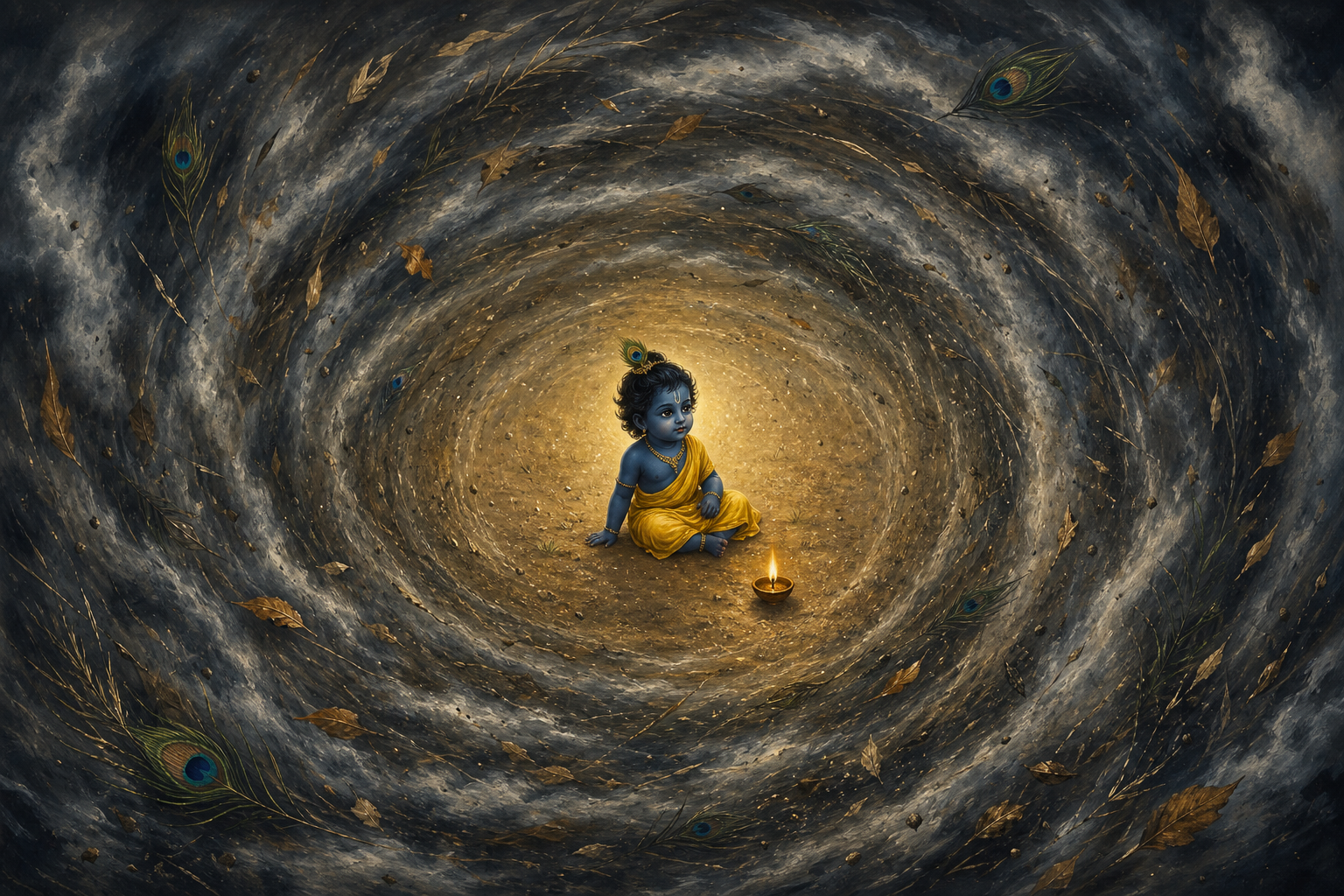
The name Trinavarta can be read through trina, meaning straw, and avarta, an eddy or whirl. His form is therefore precise rather than decorative. A vortex lifts whatever is light and loose. It scatters fragments, clouds perception, and pulls them into movement that has no stable direction of its own.
That makes Trinavarta a powerful image of an agitated mind. One fear catches another. An unverified claim gathers anger. Pride seeks altitude. Attention moves rapidly but arrives nowhere. Like straw in an eddy, thoughts may be busy without being purposeful. The first practical question is therefore not, “How do I defeat every thought?” It is, “What has made my attention so easy to lift?”
The Bhagavad Gita gives the comparison its psychological clarity in 6.34, where the mind is described as restless, turbulent, strong, and difficult to restrain, like the wind. The response in the following teaching is abhyasa, sustained practice, together with vairagya, dispassion. Abhyasa returns attention after it wanders. Vairagya refuses to feed every impulse simply because it has appeared. You need both. Repetition without dispassion can become another compulsion; dispassion without practice can become a noble intention with no force behind it.
Krishna’s increasing heaviness supplies the counter-image. Some devotional interpretations associate it with garima, the yogic power of becoming immensely heavy. Yet the theological point is larger than the display of a siddhi. The infant of Vraja is not a fragment caught inside elemental nature. He is its unshaken center. The same Krishna whom Yashoda loves as Gopala possesses effortless lordship over the force that tries to remove Him.
The contrast can also be read through the Dharmic language of breath. The principal prana-vayus include udana, associated with upward movement. Trinavarta’s ascent presents upward force without right order: it lifts, separates, and suffocates. Krishna does not compete by producing a greater gust. He becomes the gravity the gust cannot master. The storm loses its breath before the weight of the Divine.
Do not let the psychological reading replace the devotional one. Within the Vaishnava understanding, Trinavarta is an asura and Krishna’s victory is a divine lila, not merely a coded lesson about stress. The inner application follows from that sacred reality: because Krishna is the center, remembrance of Him can reorient the devotee. An allegory that removes Krishna leaves only a self-help technique. Bhakti asks for relationship, surrender, and trust as well as mental discipline.
Divine protection does not cancel human responsibility
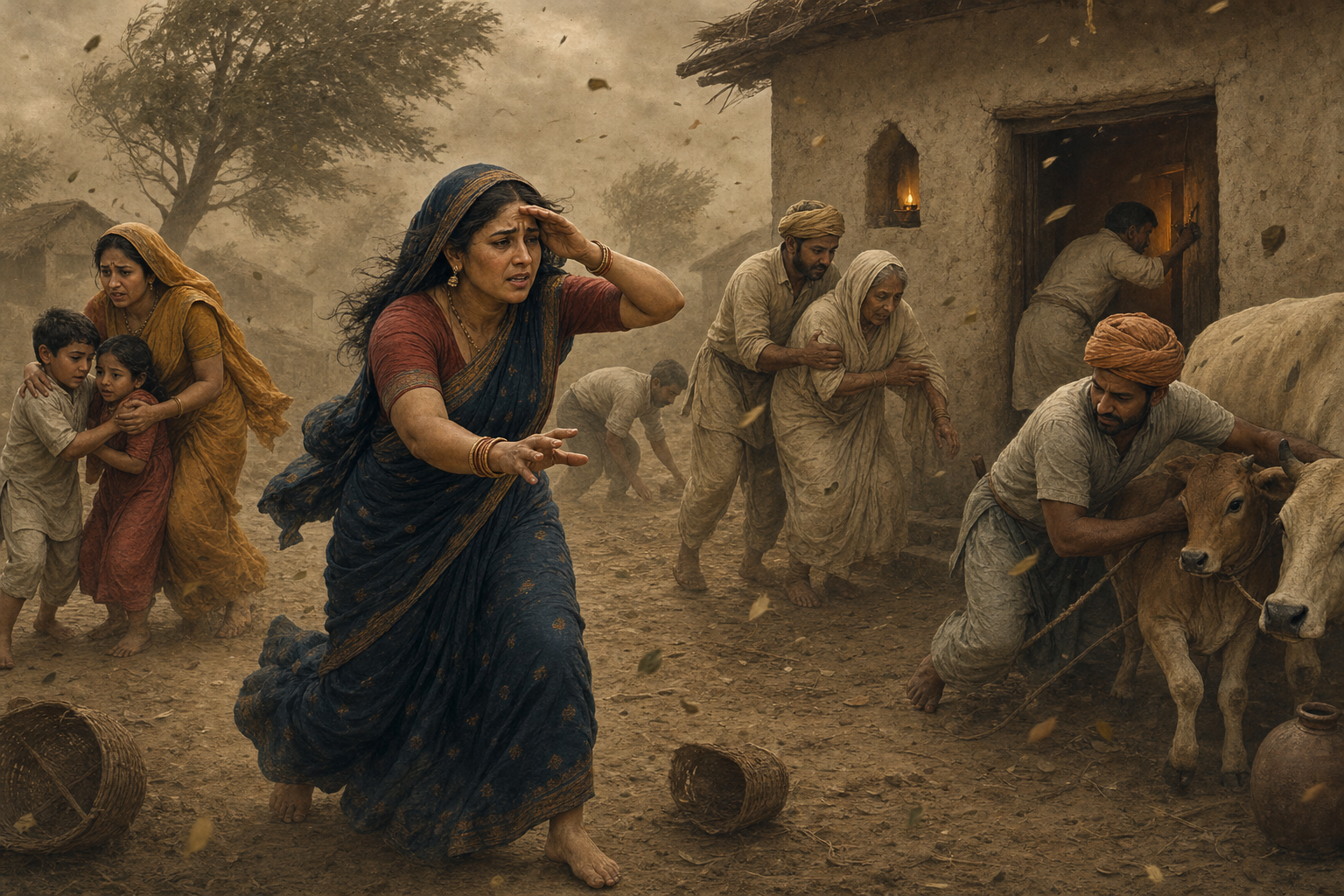
The emotional center of the episode belongs to Yashoda and the people of Vraja. A child vanishes inside a storm. Those who love Him cannot see where He has gone. When He is found unharmed, the community regathers around Him with relief, protective attention, and the familiar cultural concern for harmful sight or drishti.
This is not a promise that devotees will never feel fear. Yashoda’s anguish is not treated as a failure of faith. Her love makes the apparent loss terrible. Bhakti does not require a parent to become emotionally indifferent in order to appear spiritually mature.
Nor does divine protection make vigilance unnecessary. The villagers do not conclude that, because Krishna has returned safely, care no longer matters. They gather, examine what has happened, perform their protective customs, and restore the child to the embrace of His family. Grace returns the community to its Dharma; it does not excuse the community from Dharma.
If you carry responsibility for a family, temple, or community, that distinction is immediately useful. When confusion strikes, deal first with the real danger. Account for the vulnerable. Bring people back into contact. Establish what is known before repeating speculation. Then use prayer, ritual, or Nama-smarana to restore moral and spiritual orientation. Remembrance supports responsible action; it is not a reason to neglect it.
The lila also corrects a subtler mistake: treating protection as personal mastery. No villager claims to have controlled the wind. The community receives Krishna’s return with awe and gratitude. That posture matters after any crisis. Once the danger passes, resist the temptation to turn relief into self-congratulation. Give thanks, examine what duty requires next, and strengthen the bonds that disorder briefly scattered.
A practical response when your mind becomes Trinavarta

You do not need to wait for perfect calm before practising steadiness. Use the episode as a diagnostic pattern whenever attention begins to spiral. The aim is not to suppress every thought or imitate emotional numbness. It is to stop giving disorder unlimited movement.
- Notice the dust. Name the fact that agitation is reducing your ability to see clearly. Separate what you know from what you fear, assume, or have merely heard. If an alarming message triggered the storm, do not forward it while your own understanding remains clouded.
- Recover the ground. Sit or stand steadily and allow the breath to become unforced. Do not turn breathing into another contest for control. The bodily act is simple: stop adding speed while you decide what deserves attention.
- Give attention sacred weight. Repeat one Krishna Nama, mantra, or remembered verse instead of changing practices whenever the mind demands novelty. Consistency is the practical form of abhyasa. The purpose is to return attention to Bhagavan, not to manufacture a dramatic sensation.
- Withdraw fuel from the vortex. This is vairagya in action. Decline the next unnecessary argument, refresh, rumour, or imagined scenario. Dispassion does not deny the existence of a problem; it denies the problem the right to occupy every part of consciousness.
- Complete the nearest Dharmic duty. Care for the person in front of you, verify the claim, finish the promised task, or make the necessary call. A grounded action is more useful than another circuit through the same anxious thoughts.
- Regather if others were scattered. Confusion rarely remains private. Correct anything inaccurate that you passed along, check on those affected, and restore ordinary cooperation. The end of the Trinavarta episode is not solitary triumph but the reunion of Krishna, Yashoda, and Vraja.
This pattern is compatible with several Dharmic disciplines without pretending that their theologies are identical. Buddhist sati and anapanasati cultivate mindful attention to experience and breath. Jain samyama and samayik restrain the passions and renew equanimity. Sikh practice turns toward the Shabad and Naam Simran when the mind is agitated by the five thieves. The shared practical recognition is clear: untrained attention is easily scattered, while disciplined remembrance and restraint restore direction.
For a Krishna bhakta, however, the center of the practice remains personal. You are not merely making yourself heavy through willpower. You are returning to the One whom Trinavarta could not carry away. That changes the mood from self-domination to refuge. Effort remains necessary, but it is offered within relationship rather than treated as proof of independence.
Key takeaways
- Trinavarta’s danger begins by obscuring vision and removing Krishna from the ground; notice the same sequence when fear, pride, or rumour carries your attention away from facts and duty.
- Krishna defeats the whirlwind through unbearable weight, not by creating a larger storm. Steadiness is not slower chaos; it is a different kind of power.
- Abhyasa brings the mind back repeatedly, while vairagya stops feeding every impulse. Use them together.
- The symbolic interpretation should deepen the lila, not erase it. Krishna is Bhagavan and the still center of the episode, not a decorative label for a psychological technique.
- Divine refuge strengthens practical care. In a real crisis, protect the vulnerable, clarify what happened, regather the community, and then restore ordinary duty.
The next time your attention begins to rise with every gust, remember the exact turning point: Krishna gains weight. Return to His Name, release what does not deserve another turn of the mind, and do the duty that is actually yours. Let the storm exhaust itself around a center it cannot move.
References
