

If you are trying to decide whom to trust as a spiritual authority, King Prithu gives you a demanding test. Do not begin with birth, clothing, eloquence, institutional rank or a large following. Ask whether disciplined practice has made truth clearer in that person’s life.
The same test belongs on your own practice. If years of worship and study have not changed how you speak, restrain an appetite, receive correction or hold your attention, Prithu’s instruction shows you where to look.
The instruction is a test, not another title
In Śrīmad-Bhāgavatam 4.21.42, King Prithu describes brahminical culture through a cluster of lived disciplines: faith, austerity, auspicious orientation, silence, control of the mind and senses, and concentrated meditation. Their purpose is not social display. They clarify the real aim of life as a clean mirror reveals a face.
That mirror changes how you understand spiritual knowledge. More information does not automatically produce clearer vision. A person may remember many verses while interpreting everything through pride, anger or appetite. The difficulty is then not the absence of knowledge but the condition of the knower.
Prithu therefore connects knowledge with formation. Śāstra gives direction, but the mind receiving that direction must become steady enough to see without constantly bending the teaching around personal preference. Brahminical culture, in this setting, is the culture that protects that work of clarification.
This matters in public life as much as in private sādhana. Citizens need more than religious slogans from those who claim to guide society. They need people whose speech, restraint and judgement show that truth has authority over them. A ruler may possess force, and a scholar may possess learning, but neither possession by itself guarantees wisdom.
The six disciplines that clean the inner mirror

Prithu’s Sanskrit is compact, but it gives you a practical sequence. Each discipline corrects a different way in which perception becomes clouded.
- Śraddhā, or faith: Let a trustworthy śāstric teaching question you before you question it away. Faith is not permission to believe every religious claim. It is the willingness to practise an authentic teaching without rewriting it whenever it frustrates your preference. When you read, ask: What would obedience to this teaching change in my next decision?
- Tapas, or austerity: Accept a measured discomfort for a higher purpose. Tapas begins where convenience stops ruling the day. If an indulgence repeatedly weakens your prayer, study or duty, place a clear boundary around it. The boundary should support remembrance and service, not become a performance of harshness.
- Maṅgala, or auspicious orientation: Judge choices by what they cultivate, not merely by whether they are immediately pleasant. An action can be legal, popular and gratifying while leaving the mind more agitated or dishonest. Prefer what strengthens truthfulness, devotion, responsibility and the welfare of others.
- Mauna, or disciplined silence: Do not confuse silence with passivity. Mauna governs speech so that truth is not contaminated by vanity, gossip or the urge to win. Before sending a reactive message or repeating an accusation, ask whether it is true, necessary and yours to say. Speaking against adharma may be required; adding humiliation or unverified claims is not.
- Saṁyama, or control of mind and senses: Do not rely on willpower while arranging your surroundings to defeat it. Remove the distraction from the place of worship. Turn off the notification before opening śāstra. Keep one task before the mind instead of feeding every impulse that arrives. Restraint becomes more reliable when your environment supports it.
- Samādhi, or collected concentration: Give the sacred act your undivided attention. During japa, pūjā, meditation or study, do that one thing. When the mind wanders, return it without self-congratulation or despair. Concentration is not proved by an unusual experience; it is trained through repeated return to the object of contemplation.
The disciplines reinforce one another. Faith supplies direction. Austerity creates room to follow it. Auspicious judgement improves the quality of your choices. Silence prevents energy from leaking through careless speech. Sense control gathers the faculties. Concentration steadies them on the goal.
If one element is missing, the imbalance is easy to notice. Faith without restraint becomes sentiment. Austerity without auspicious purpose becomes severity. Silence without truth becomes avoidance. Concentration without ethical discipline can make a person efficient without making that person wise.
Why lineage and religious appearance are insufficient

A family lineage can preserve learning, ritual memory, habits of service and responsibilities carried across generations. That inheritance deserves honest respect. It does not, however, remove the need to embody the qualities attached to the inherited role. A name can be received at birth; clarity, restraint and concentration cannot.
Prithu’s standard protects the brāhmaṇa ideal from being reduced to entitlement. A brāhmaṇa identity names a responsibility before it names a privilege: to preserve sacred knowledge, live under its discipline and help others see the aim of life more clearly. When conduct contradicts that responsibility, demanding deference to the title does not repair the contradiction.
Do not turn this principle into reverse prejudice. The answer to empty hereditary pride is not contempt for hereditary communities. Nor should you assume that a person outside a particular lineage has automatically achieved brahminical character. Apply one standard to everyone: honour genuine inheritance, then look for lived qualification.
Three distinctions will keep your judgement sound. Respect learning without confusing memory with mastery of the mind. Respect ritual without separating it from character. Respect office without granting its holder immunity from accountability. These distinctions allow reverence and discernment to coexist.
They also prevent a common political error. Supporting a dharmic cause does not make every method used in its name dharmic. A speaker may defend temples, traditions or Hindu interests and still be careless with truth, addicted to outrage or unwilling to accept correction. Protection of dharma and the discipline of dharma must remain together.
Use Prithu’s standard on leaders and on yourself
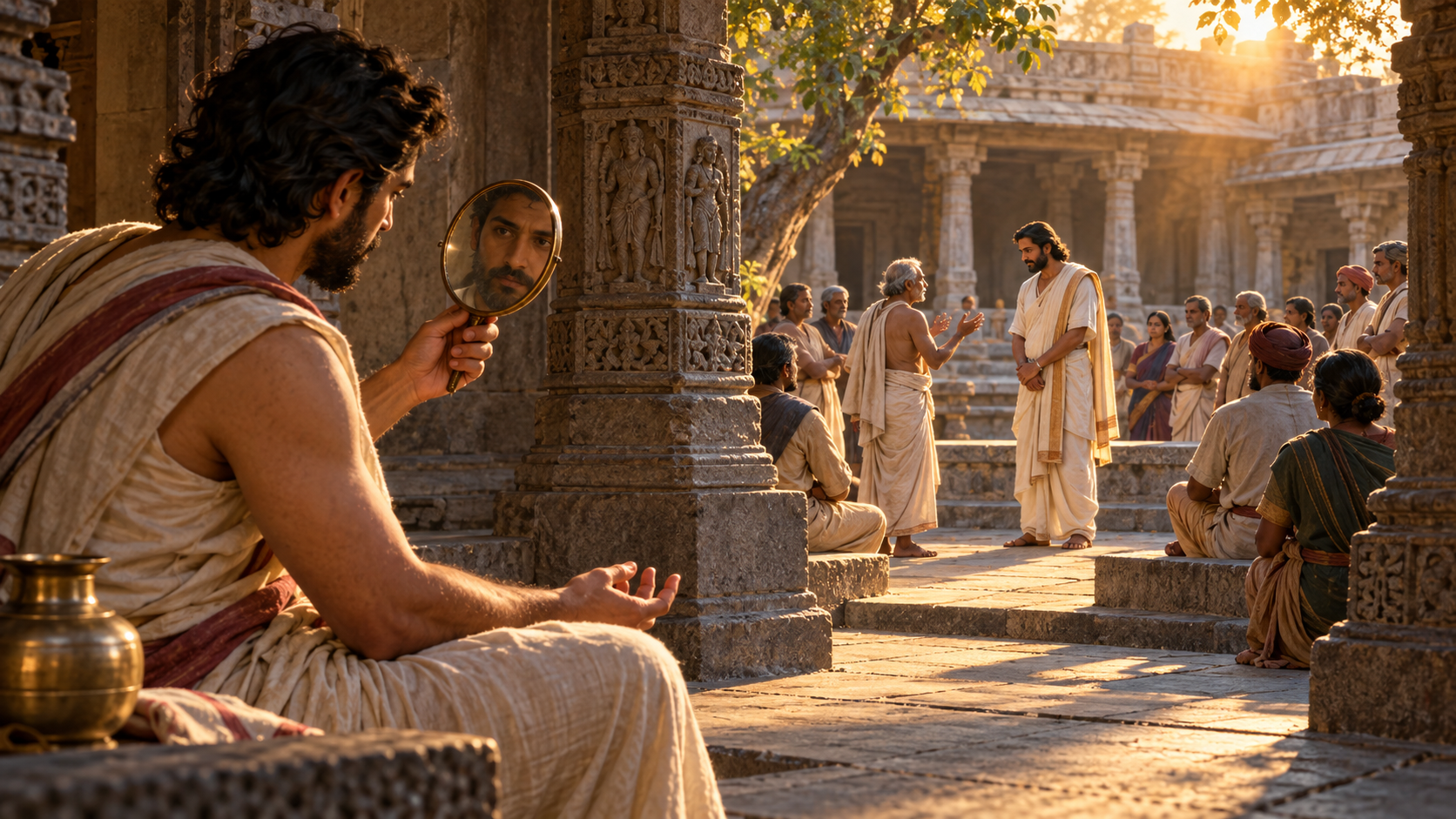
Before granting a teacher, preacher or public religious voice deep influence over your conscience, observe the direction of the person’s life. Do not demand theatrical faultlessness, and do not make a final judgement from one awkward interaction. Look for durable congruence between teaching and conduct, along with an honest response when failure is exposed.
- Relationship to śāstra: Does the person distinguish scriptural teaching, received interpretation and personal opinion, or present every preference as sacred authority?
- Relationship to restraint: Are the disciplines demanded from followers also visible in the leader’s own choices, especially when restraint is inconvenient?
- Relationship to speech: How does the person speak about absent people, opponents and those with less power? Disciplined speech is most revealing when praise is not at stake.
- Relationship to attention: Does the teaching bring your mind toward Bhagavān, sādhana and service, or keep it fascinated with the teacher’s personality, access and status?
- Relationship to correction: When challenged with substance, does the person examine the issue and accept accountability, or use rank, anger and fear to close the question?
These questions are not a licence for cynical fault-finding. Discernment asks whether someone is safe to trust; cynicism enjoys discovering reasons to despise. Keep the difference clear. If you are evaluating a serious allegation, separate established conduct from rumour and allow proportionate evidence to guide your conclusion.
Then turn the mirror around. At the end of your day, examine the place where clarity was lost:
- Where did a known duty lose to personal preference?
- What unnecessary speech left the mind more agitated?
- Which repeated distraction captured the senses most easily?
- What concrete restraint would make the next period of worship or study cleaner?
- Which teaching now requires undivided attention rather than another explanation?
Choose one answer and act on it. If you use Prithu’s teaching only to grade other people, pride becomes another layer of dust on the mirror. Its first jurisdiction is your own speech, appetite, attention and willingness to be corrected.
Key takeaways and your next practice
- King Prithu tests spiritual authority by lived discipline rather than prestige or appearance.
- Faith, austerity, auspicious conduct, silence, self-restraint and concentration work together to clarify the aim of life.
- Lineage can preserve a sacred responsibility, but birth alone cannot prove that its qualifications are present.
- Respect does not require gullibility; examine how a leader handles śāstra, restraint, speech, attention and correction.
- Apply the standard inward before using it to assess anyone else.
Begin where your mirror is visibly clouded. Place one concrete restraint around careless speech, distraction, appetite or the need for recognition before your next act of worship or study. Then return to the teaching with a quieter mind. King Prithu’s counsel becomes useful when it stops describing someone else’s virtue and begins governing your next decision.
References

Leave a Reply
You must be logged in to post a comment.