
If you have encountered Videha in the Ramayana, Mithila as the land of Sita, and Janaka in Upanishadic dialogue, you may have wondered whether these names describe the same person, place, or dynasty. King Nimi’s conflict with Sage Vashishta is the narrative bridge that connects them.
The key is to read the account on its own terms. It is a sacred genealogy, an explanation of names, and an ethical study of competing duties. It should not be flattened into a modern chronological report. Once you keep those functions distinct, the apparent tragedy becomes a carefully structured account of how a broken relationship gave rise to a kingdom identified with philosophical kingship.
Keep the sequence clear: Nimi, Videha, Mithi, Mithila
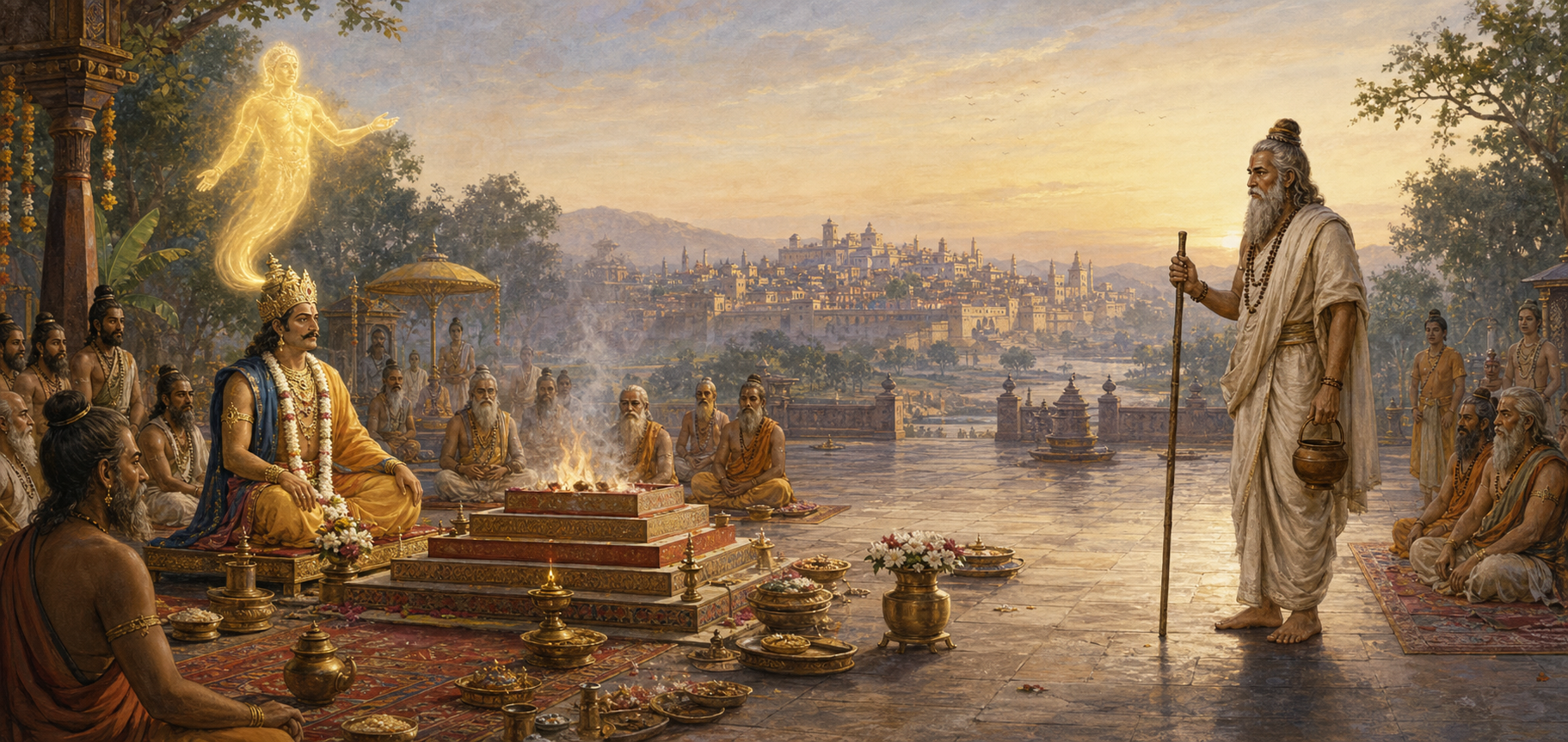
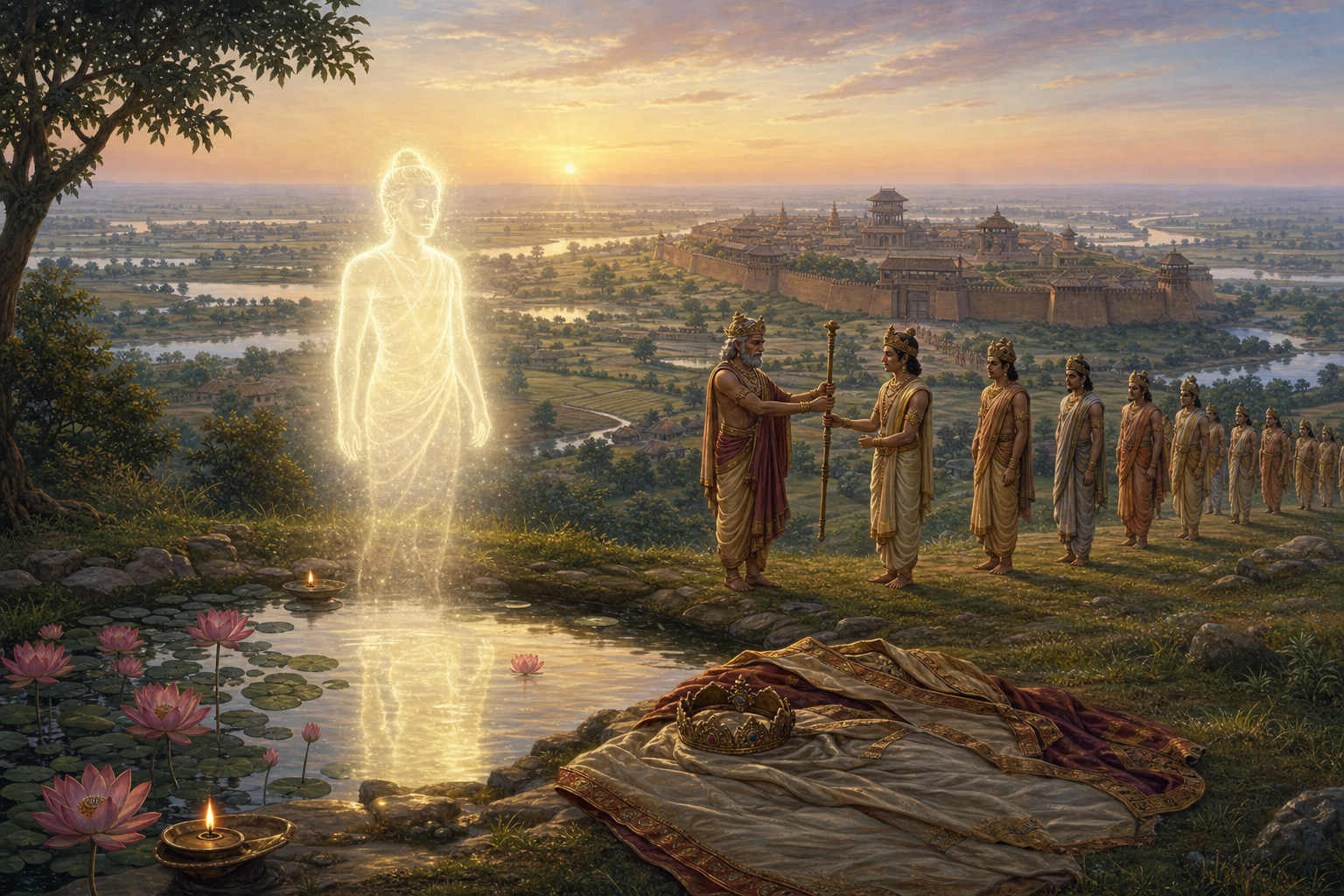
King Nimi belongs to the Suryavamsha, the Solar Dynasty. Seeking spiritual merit and royal radiance, he resolves to conduct a grand yajna for Indra. He follows royal convention and asks Vashishta, the dynasty’s preceptor, to preside. Vashishta, however, has already committed himself to another prolonged rite for Indra and cannot immediately accept Nimi’s invitation.
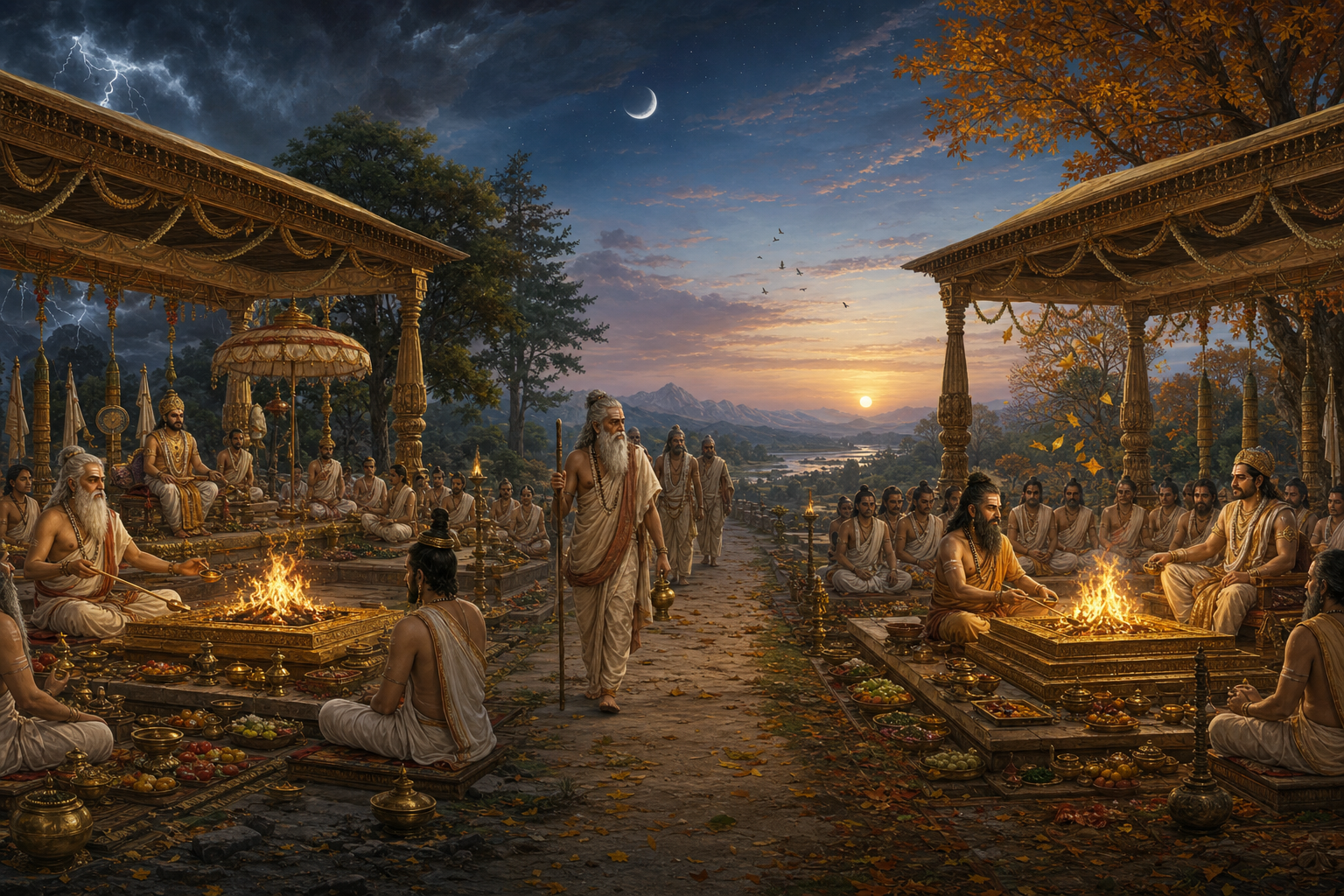
Nimi does not abandon his vow. He appoints Kousika Rishi, known in later tradition as Vishvamitra, and proceeds with the sacrifice. This is not represented as an improvised ceremony performed by an unqualified substitute. The yajna has the required ritual specialists: the Hotr recites Rigvedic hymns, the Adhvaryu handles the physical actions governed by the Yajurveda, the Udgatr sings the Samavedic chants, and the supervising Brahman priest guards the rite against textual or procedural error.
That ritual architecture matters. Nimi does not reject Vedic order; he attempts to fulfil his vow through another recognized sage and a complete sacrificial establishment. When Vashishta learns that the rite has gone forward without him, however, procedural legitimacy does not prevent personal and spiritual conflict.
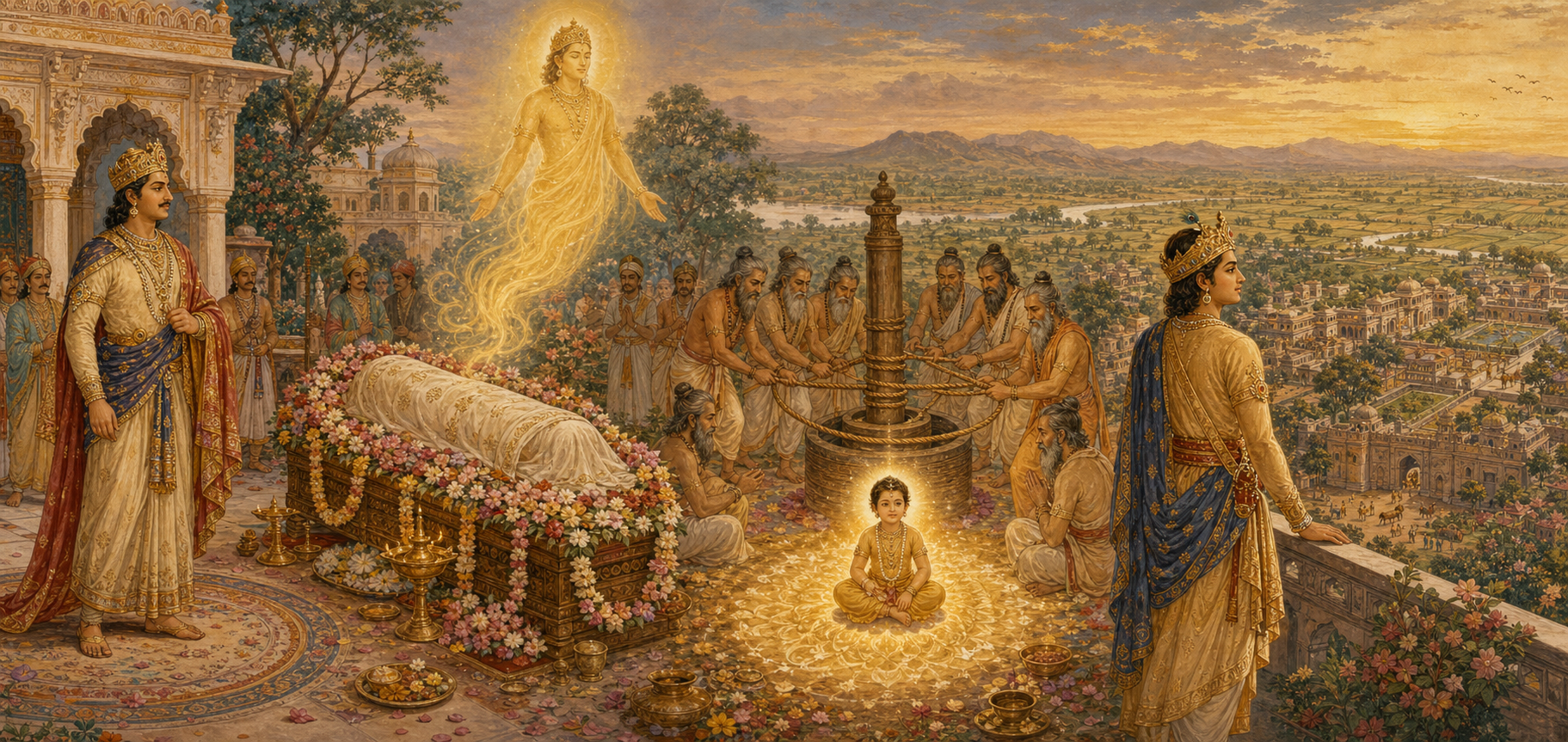
In the well-known form preserved in Bhagavata Purana 9.13 and related Puranic genealogies, Vashishta curses Nimi to lose his body. Nimi answers with a counter-curse that deprives Vashishta of embodied life as well. The exchange creates the first name you need to remember: Nimi becomes videha, bodiless.
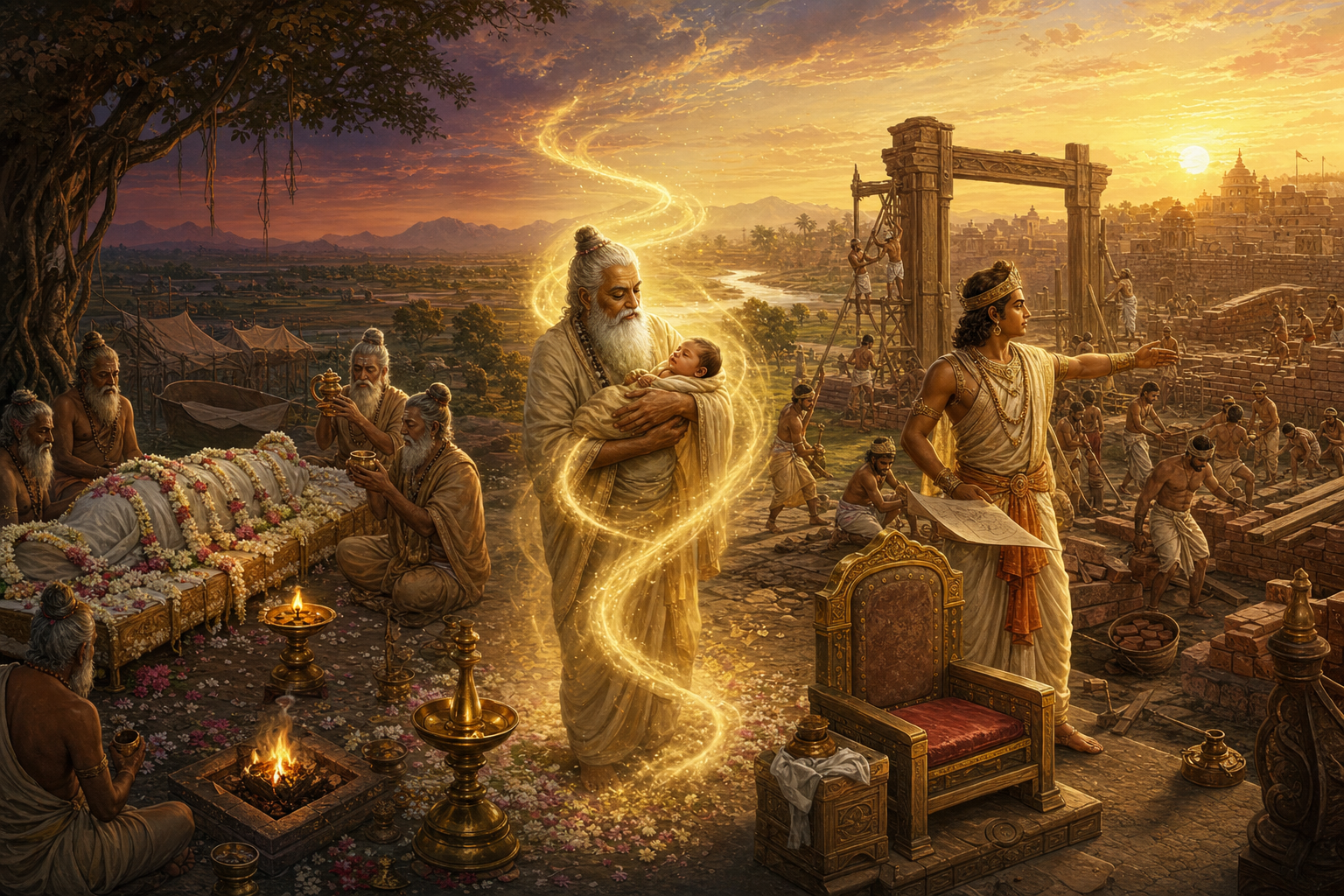
The royal line nevertheless continues. Ritual specialists preserve Nimi’s body and churn it in a generative rite. From it comes Mithi, who establishes Mithila. His descendants are associated with the royal designation Janaka. The clean narrative map is therefore this: Nimi’s bodiless state explains Videha; Mithi is connected with the founding of Mithila; and Janaka identifies the celebrated royal line that follows.
When you recount the story, do not use Videha, Mithila, and Janaka as though they performed the same function. Videha is associated with Nimi’s transformed condition and the realm that bears its memory. Mithila is the city or land founded by Mithi. Janaka is a dynastic or royal designation. The names overlap within one cultural geography, but their explanatory roles remain different.
Why the yajna dispute has no simple villain
It is tempting to decide that either Nimi disrespected his guru or Vashishta reacted unjustly. That choice makes the episode easier, but less instructive. Both figures begin with duties that can be defended.
Vashishta has given his word to an earlier ritual patron. A vow does not become optional merely because a king presents a prestigious second request. Nimi also has a solemn commitment. A royal yajna depends on preparation, timing, officiants, and a declared intention toward the devas. Indefinite delay could compromise the king’s own vow. The conflict is therefore not initially between dharma and adharma. It is between two obligations that cannot be satisfied simultaneously.
This is the point at which you should slow down. The decisive failure is not the existence of competing commitments; such conflicts are unavoidable. The danger lies in allowing timing, authority, and personal honour to remain unresolved until action itself is interpreted as insult. Nimi sees a vow that must proceed. Vashishta sees a hereditary relationship and ritual office displaced in his absence. Once each treats his own legitimate concern as the whole of dharma, mutual correction becomes mutual punishment.
Three Sanskrit ideas help organize the problem: sankalpa, the intention or vow; samyak-sadhana, the use of fitting means; and kala, right timing. A worthy intention cannot repair careless means, and correct procedure cannot by itself heal a failure of communication. Dharma requires these elements to work together.
The practical lesson is precise. When one obligation prevents you from accepting another, disclose the prior commitment and give a usable timeline. When delay would defeat the purpose of a vow, establish whether another qualified person may act. When a substitute is appointed, distinguish harm to the shared undertaking from injury to personal status. These steps do not eliminate disagreement, but they prevent wounded honour from masquerading as moral certainty.
The presence of both Vashishta and Kousika also sharpens the point. Vashishta represents inherited authority and continuity. Kousika, who rises toward recognition as Vishvamitra through tapas and transformation, represents attained spiritual authority. A healthy order needs a way for established lineage and qualified renewal to coexist. If the appearance of another capable guide is treated only as a threat, wisdom becomes territorial.
What becoming videha means in the narrative
Vashishta’s curse makes Nimi bodiless in a direct narrative sense. Yet the devas later offer Nimi an opportunity to return to his physical frame, and he refuses. What begins as deprivation is therefore transformed into a chosen condition. Nimi loses the ordinary vehicle of kingship but does not disappear from cultural memory, cosmic life, or dynastic consequence.
Some retellings say that the bodiless Nimi resides subtly on the eyelids of living beings. They connect his name with nimisha, the brief interval marked by a wink or blink. Because textual traditions vary in sequence and emphasis, this detail should be introduced as one strand of the retelling, not as a feature stated identically in every version.
The name Videha consequently operates on more than one level. Within the genealogy, it recalls the extraordinary state of the founding king. Philosophically, bodilessness can also suggest freedom from identification with the gross body and from the possessive claim that the body exhausts the self. Later Vedantic language about non-attachment, including asanga, makes that resonance especially powerful.
You do not need to claim that the story is a coded statement of a later philosophical school. That would confuse resonance with authorship. The more careful insight is that Nimi’s transformation prepared Videha to function as an apt cultural setting for later reflections on detachment, self-knowledge, and liberation. The kingdom’s name and its philosophical reputation illuminate one another without having to belong to a single historical moment.
Vashishta is not exempt from the consequences of the exchange. Some Puranic tellings connect his renewed embodiment with Mitra, Varuna, and Urvashi, after which he resumes his place as a guide of the Solar Dynasty. The symmetry matters: royal power and spiritual eminence both remain answerable to cosmic law. Neither status prevents forceful speech from returning upon its speaker.
That reciprocity is easy to miss if you read the curses merely as supernatural anger. Their deeper function is to show that tapas, rank, and righteous intention do not cancel accountability. The higher the authority carried by one’s words, the greater the need for restraint before speaking them.
How a broken succession becomes the lineage of Janaka
Nimi’s loss of a body creates an immediate political and ritual problem: a dynasty requires continuity. The specialists attending the king do not allow the royal line to vanish. They preserve his body and employ manthana, churning, as a generative act. Mithi emerges from the king whose ordinary means of producing an heir has been interrupted.
The symbolism is deliberately paradoxical. A bodiless king gives his condition to the identity of a land, while his preserved body yields the founder of a city. Nimi’s personal reign ends, yet Nimi becomes more enduring as a civilizational ancestor. The crisis does not erase his authority; it changes the form through which that authority continues.
Mithi establishes Mithila, and the Videha rulers become celebrated under the designation Janaka. That name later carries two major associations for a reader of Hindu tradition: Sita’s father in the Ramayana world, and the philosopher-king connected with Yajnavalkya’s teachings in the Brihadaranyaka Upanishad. In the memory of Mithila, royal duty, household virtue, and metaphysical inquiry meet in the same lineage.
This development explains why the origin story should not be reduced to a duel of tempers. Its destination is a model of kingship in which a ruler does more than command. Janaka’s court becomes a place where a king can receive a sage, sustain rigorous inquiry, and recognize wisdom that does not depend on political rank. The lineage born from a breakdown in counsel becomes renowned for making room for counsel.
When you assess the claim that this is the origin of Videha, ask what kind of origin is being offered. It is not a dated administrative record of territorial formation. It is a sacred cultural map explaining why a region bears a particular identity, how its dynasty understands its legitimacy, and which virtues its finest rulers are expected to embody. A genealogy can carry historical importance as inherited memory without being forced into the evidentiary form of a modern archive.
The episode’s ethical reach also extends beyond its immediate Hindu setting. Patience and forbearance recall the Buddhist cultivation of kshanti; release from possessiveness resonates with Jain aparigraha; and composure joined to humility is recognizable in the Sikh virtues of sabar and nimrata. These parallels do not make the traditions interchangeable. They show why a conflict over vows, ego, restraint, and accountability remains intelligible across the wider dharmic family.
Key takeaways for reading the story accurately
- Nimi is the Suryavamsha king whose curse makes him videha, or bodiless; the name Videha preserves that defining transformation.
- Mithi emerges after Nimi’s preserved body is churned and becomes the founder associated with Mithila. Videha and Mithila therefore have related but distinct functions in the genealogy.
- Janaka is the royal designation of the later Videha line, linking Mithila with Sita and with the philosophical kingship encountered in the Brihadaranyaka Upanishad.
- Nimi and Vashishta begin with competing duties, not a simple opposition between righteousness and wrongdoing. The collapse occurs when valid commitments become fused with personal honour.
- Kousika’s appointment does not make the yajna casual or ritually empty. The full complement of Vedic officiants makes the dispute one of authority, timing, and relationship rather than basic ritual competence.
- The curses are reciprocal. The king and the sage both experience consequences, reinforcing the principle that neither political nor spiritual status places a person above accountability.
- Nimi’s connection with the eyelids and nimisha belongs to some retellings and should be presented with that qualification.
- The philosophical meaning of bodilessness is best treated as a later resonance of detachment and self-knowledge, not as proof that every later doctrine was already encoded in the episode.
The next time you meet Videha, Mithila, or Janaka in a sacred narrative, pause and ask which layer the name is carrying: transformed ancestor, founded place, or royal ideal. Preserving those distinctions will make the genealogy clearer. Applying its ethical test is harder but more valuable: before defending your vow, make sure timing, means, and speech still serve the dharma that made the vow worth keeping.
References
