
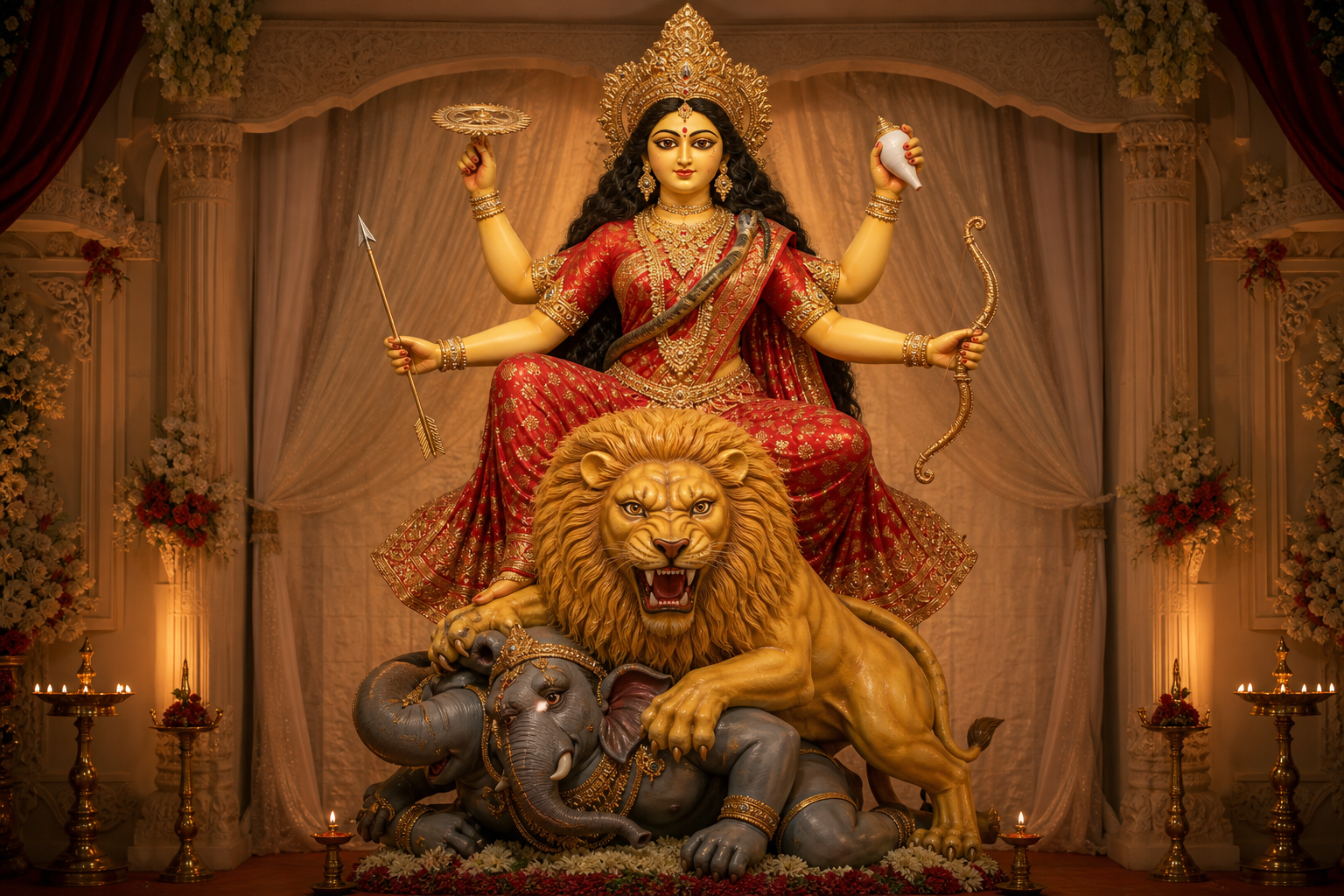
When you stand before a Jagadhatri murti, the elephant head beneath her feet can be the one element that refuses a quick reading. Is it another deity, a defeated asura, or a warning about the human mind?
The clearest answer is layered. The elephant recalls an episode in the Devi Mahatmya in which Mahishasura assumes an elephant form, while Bengal’s Shakta traditions develop that form into an emblem of ahaṅkāra, moha, and undisciplined power. Read in context, it is not a depiction of Ganesha. It is the force that must come under the Goddess’s rule before the world can be sustained.
Read the whole murti before identifying the elephant
Sacred iconography works through relationships. A figure’s identity matters, but so do its position, posture, and relationship to the presiding deity. If you isolate the elephant head from the rest of Jagadhatri’s composition, its familiar animal form can send you toward the wrong conclusion.
Begin at the bottom and move your gaze upward. The elephant has been subdued. Jagadhatri stands above it with composure, and a lion accompanies her. The contrast is deliberate: weight and disruption remain below, while clarity and sovereignty occupy the centre of the image. Her calmness is as important as the defeat beneath her.
Jagadhatri means the Sustainer of the World, and she is understood as a compassionate but unyielding aspect of Durga. That name changes how you should read the scene. The objective is not destruction for its own sake. The Goddess places unruly force within a dharmic order. She can sustain because she is not governed by the confusion she confronts.
This gives you a reliable rule for viewing the murti: do not ask only, “Who is beneath her feet?” Also ask, “What relationship between power and wisdom is being shown?” That second question opens the icon’s spiritual meaning.
The Devi Mahatmya supplies the narrative key
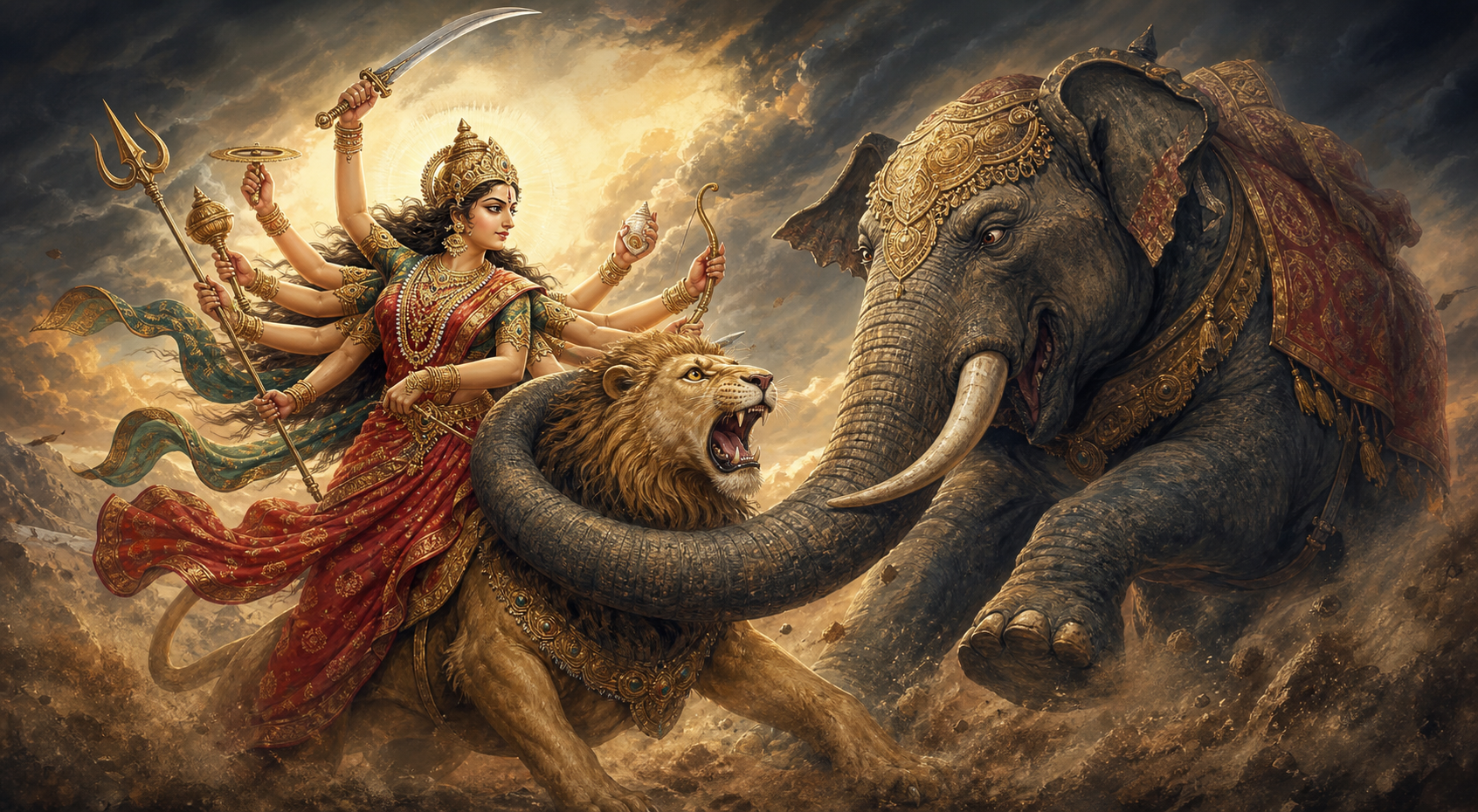
During the battle described in the Devi Mahatmya, Mahishasura does not remain in one stable form. He repeatedly changes his appearance through maya, and one of his guises is an elephant. Durga defeats that manifestation, severing its trunk as she overcomes the asura’s successive transformations.
This episode explains why the elephant cannot be reduced to a decorative mount or a general sign of royalty. Within Jagadhatri’s iconographic setting, it carries the memory of an adversary who survives by changing appearances. The form changes, but the disorder animating it does not.
That detail makes the symbolism unusually practical. Delusion rarely presents the same argument every time. When one excuse fails, another may take its place. Pride can sound like certainty in one moment, injury in another, and duty in a third. The shifting form is itself part of the problem.
Bengal’s regional traditions add another layer by identifying the elephant figure as Karindrasura, whose name conveys the idea of a lord of elephants. You do not have to force the regional name and the Devi Mahatmya episode into a choice between competing explanations. The scriptural battle supplies the underlying pattern; the Bengali Shakta tradition gives that pattern a concentrated visual identity.
When explaining the murti to someone else, keep these layers distinct. Say first that the elephant evokes Mahishasura’s elephant guise. Then note that regional traditions remember the subdued figure as Karindrasura. Finally explain the philosophical interpretation: elephantine force has become the image of ego and delusion brought under divine discipline. This is more accurate than insisting that a single label exhausts the icon.
The elephant signifies power that has lost its proper ruler
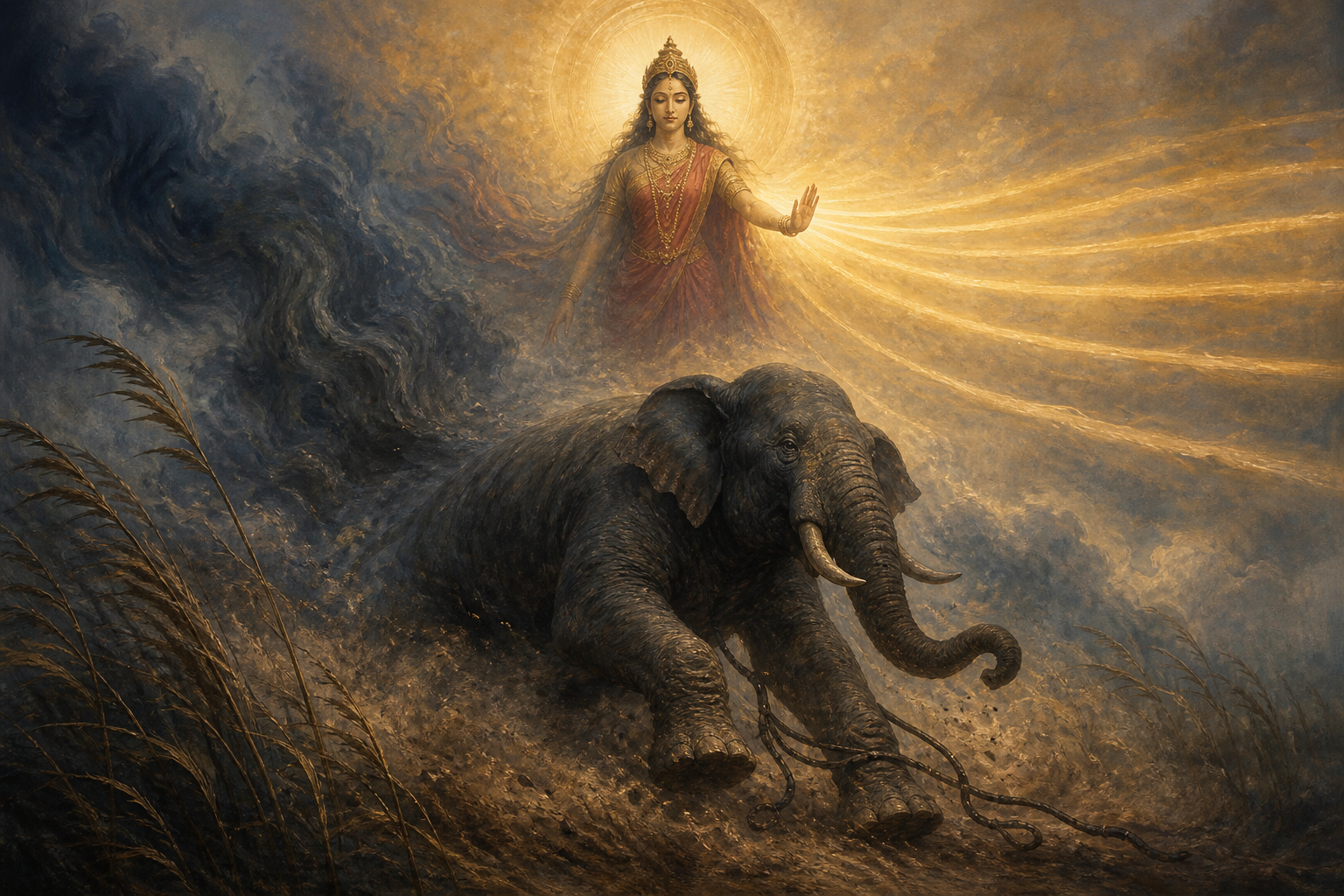
An elephant naturally communicates strength, weight, grandeur, and persistence. Those qualities are not inherently adharmic. The problem begins when strength becomes stubbornness, grandeur becomes self-importance, and persistence becomes refusal to see what is true.
This is why ahaṅkāra and moha are more precise interpretations than the loose English word “evil.” Ahaṅkāra is the ego-making tendency that turns identity, status, or opinion into something that must be defended. Moha is the delusion that prevents clear perception. Together they create a heavy inner momentum: the mind continues in a direction because admitting error feels like losing the self.
Jagadhatri does not teach you to hate strength or cultivate weakness. She teaches the subordination of strength to dharma. The elephant remains a powerful image, but it no longer determines the order of the scene. Wisdom occupies the higher position.
That distinction matters in ordinary decisions. If you are defending a position, ask whether your reasons remain stable. When each objection produces a completely new justification, you may be watching the inner equivalent of Mahishasura’s changing forms. Stop debating each disguise separately and examine what you are protecting: truth, duty, reputation, comfort, or pride.
A useful question before acting is: “Is my strength serving what is right, or is it merely resisting correction?” Jagadhatri’s elephant makes that question visible.
Bengal turns the battle into visual spiritual instruction
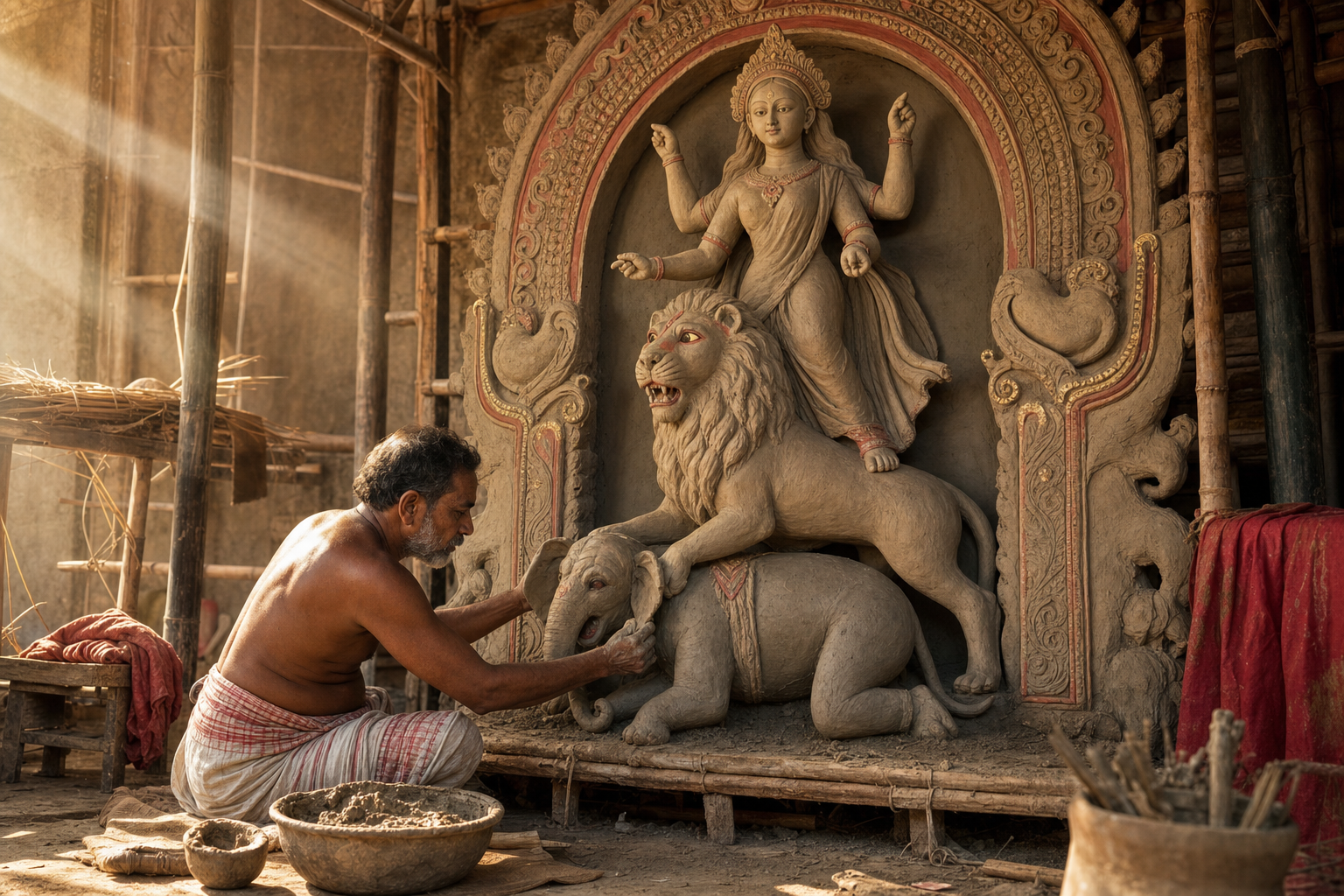
The artisans of Chandannagar and Krishnanagar are known within this tradition for rendering the elephant head with close attention. That detail is not incidental ornament. It ensures that the devotee cannot look only at the radiant Goddess and ignore the condition beneath her sovereignty.
The vertical arrangement teaches before any explanation is offered. Below is force caught in illusion. Above is the serene power capable of restraining it. The image therefore presents victory as self-command, not frenzy. Jagadhatri does not mirror the agitation she defeats.
During darshan, let your eyes follow that movement. Notice the subdued elephant first. Name the quality it evokes in you: heaviness, pride, obstinacy, or a refusal to reconsider. Then look at Jagadhatri’s composed face. The movement of your gaze becomes a movement from entanglement toward discernment.
You can then turn contemplation into conduct:
- Name one situation in which your explanations keep changing but your resistance remains.
- Identify what feels threatened: your status, self-image, comfort, attachment, or control.
- Choose one act that places that force under dharma, such as correcting an error, keeping a neglected obligation, listening without preparing a defence, or apologising without qualification.
- Make the correction firmly but without self-contempt. Jagadhatri’s expression joins compassion to discipline; your response should do the same.
This practice prevents the symbolism from remaining an attractive abstraction. The decisive step is not merely recognising ego in theory. It is allowing clarity to govern what you do next.
The image also has resonances across the Dharmic family without making the traditions identical. Buddhist imagery uses the taming of a wild elephant to represent training the mind. Jain teaching gives central importance to mastery over passions. Sikh teaching confronts haumai through remembrance and righteous action. Jagadhatri’s composition belongs specifically to Shakta theology, yet a Buddhist, Jain, or Sikh viewer can recognise its wider ethical grammar: power becomes trustworthy only when the self is governed.
Questions readers commonly ask about the elephant
Is the elephant head beneath Jagadhatri a form of Ganesha?
No. An elephant feature alone is not enough to establish that identification. In Jagadhatri’s composition, the figure is subdued beneath the Goddess and is connected to Mahishasura’s elephant transformation and, in regional Bengali tradition, to Karindrasura. Its position and narrative role distinguish it from the worshipful iconography of Ganesha.
Is the figure definitely Karindrasura?
Karindrasura is the name preserved in several Bengali traditions. The Devi Mahatmya provides the earlier scriptural pattern through Mahishasura’s elephant guise. It is safest to present Karindrasura as a regional identification that develops the scriptural symbolism, not as a name that must replace every other explanation.
Does the image teach that the ego must be annihilated?
Its more useful lesson is mastery and ethical subordination. Strength, identity, and determination need not disappear; they must cease ruling blindly. Jagadhatri places them under wisdom and dharma. The image calls for disciplined self-government, not hatred of the self.
Why does Jagadhatri appear calm above a defeated enemy?
Her serenity shows that spiritual sovereignty is not reactive. She restrains disorder without becoming disordered. For a devotee, the calm face sets the standard: firmness is clearest when it is not driven by rage, vanity, or the need to humiliate.
The next time you receive Jagadhatri’s darshan, do not stop after naming the elephant. Follow the entire composition from the weight below to the composure above, and carry one correction into your conduct. The murti has completed its instruction when the force you possess begins to serve the dharma you recognise.
References
