

The two source readings approach a shared Vaishnava question from different narrative scales: what does surrender look like when a person holds real duties, knowledge or power? Their examples range from Vamana’s modest appearance and Rama’s acceptance of exile to Brahma’s corrected self-understanding and Sanatana Goswami’s dependence on divine grace.
Read together, the sources suggest that humility is neither low self-regard nor withdrawal from responsibility. It is the discipline of treating ability, authority and learning as entrusted forms of service. Duty gives that humility an outward shape, while surrender keeps duty aligned with the Supreme rather than the ego.
Divine greatness appears without self-assertion
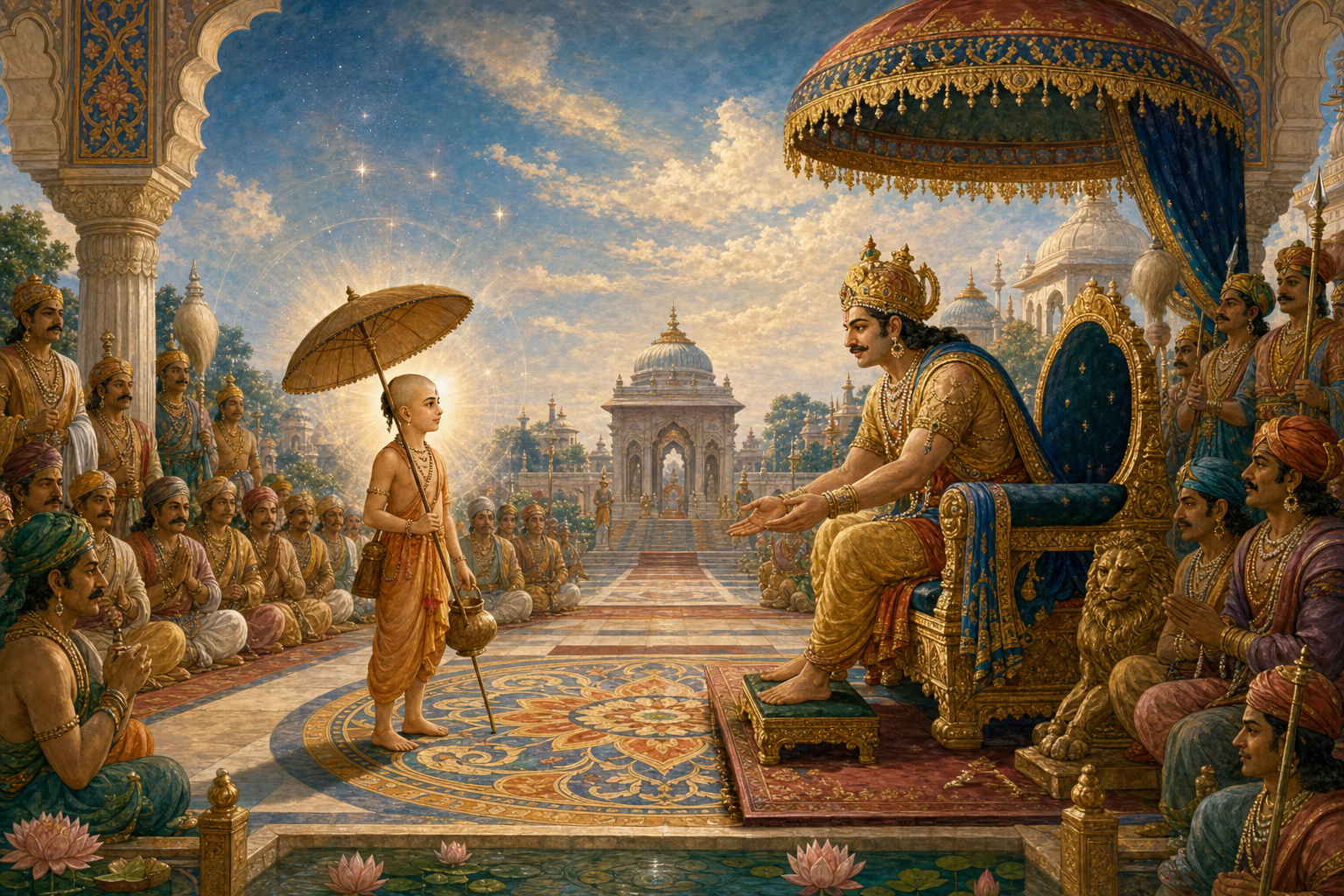
The Vamana source locates humility within the Lord’s own appearance. It reports that Srimad-Bhagavatam 8.18.13 describes the sages joyfully beholding Vamana as a young brahmacari and arranging the appropriate ceremonies with Kasyapa Muni, identified as a Prajapati, at the forefront. The narrative later presents this seemingly small figure asking Bali Maharaja for only three steps of land before revealing the cosmic measure associated with Trivikrama.
In this reading, smallness is not the opposite of power. It is the form through which power becomes morally revealing. Vamana’s restrained request prevents outward grandeur from determining who possesses true authority. The contrast between the unassuming student and the Lord who encompasses the worlds exposes the limits of judgments based on appearance, status and possession.
The Brahma account in the second source reaches a related lesson from the opposite direction. It recounts an episode in which the four-headed Brahma visits Krishna in Dvaraka and is surprised to be asked which Brahma has arrived. Krishna then summons Brahmas associated with other universes, including figures described as possessing many more heads. According to that source, the encounter teaches Brahma that even his immense office is contextual within Krishna’s unlimited reality.
Vamana therefore reveals greatness concealed by humility, while Brahma discovers the limits concealed by greatness. Together, the accounts make a precise theological point: neither modest appearance nor exalted office establishes spiritual measure. What matters is the relationship between a being’s role and the divine source of its power.
Duty turns reverence into disciplined action

The first source emphasizes that the sages do more than admire Vamana. Their joy becomes ordered action as they arrange rites under qualified guidance. Its discussion of samskara, including birth and sacred-thread ceremonies, interprets ritual as a means of placing human life within a framework of refinement, learning, restraint and responsibility. Vamana’s appearance as a brahmacari consequently carries an educational meaning: sacred knowledge is meant to form character, not merely enlarge the intellect.
The second source presents duty under more painful conditions. In its Ram Navami reflection on the Ayodhya Kanda, it reports that Rama accepts fourteen years of forest exile, honors his father’s word, protects sages and continues to oppose adharma. The source interprets this conduct as alignment with providence rather than resignation before circumstance.
The difference between the scenes is instructive. The sages serve by recognizing a sacred moment and organizing an appropriate response; Rama serves by remaining faithful when circumstances strip away royal security and public approval. One scene shows duty as ceremonial stewardship, while the other shows it as moral constancy under loss. In both, devotion becomes visible through conduct.
Surrender is active alignment, not passivity

The sources consistently resist equating surrender with inactivity. The Rama discussion explicitly distinguishes trust in providence from fatalism: Rama does not use divine order as an excuse to abandon responsibility. Acceptance of exile becomes the setting in which he continues to uphold dharma.
The Vamana narrative adds another dimension. As interpreted by the first source, the Lord approaches Bali through a limited request rather than immediate coercion. The resulting encounter turns a question of dominion into a test of ownership, promise and surrender. Divine correction is presented not simply as the defeat of a powerful ruler, but as an invitation to recognize that worldly possession is never absolute.
Sanatana Goswami’s example in the second source brings surrender into the life of a disciple. Although entrusted by Chaitanya Mahaprabhu with major theological and devotional work, he is portrayed as acknowledging that intellectual capacity alone could not make the teachings manifest within him. He therefore seeks grace rather than treating instruction as an achievement already possessed.
These examples distinguish three forms of active surrender: Rama remains obedient while acting within hardship; Bali is confronted with the limits of possession; and Sanatana receives a demanding mission while confessing dependence. Surrender does not eliminate agency in any of these readings. It purifies the basis on which agency operates.
Authority remains sacred when it remembers its source

Brahma and Sanatana Goswami offer the clearest comparison between responsibility shaped by self-importance and responsibility shaped by dependence. The second source does not dismiss Brahma’s devotion or position. It describes him as the first created being within a universe, charged with secondary creation after receiving knowledge and empowerment. The danger arises when an entrusted office begins to appear self-sufficient or universally absolute.
Sanatana’s posture supplies the corrective. His humility does not consist of denying his assignment or refusing to use his learning. It consists of recognizing the distance between receiving spiritual instruction and embodying it. In the source’s presentation, study becomes spiritually fruitful when joined to prayer, purity, service and the mercy of guru and Bhagavan.
The role of Kasyapa Muni in the Vamana account reinforces this principle institutionally. The sages place a qualified elder and Prajapati before them when carrying out the ceremonies. Authority is therefore neither rejected nor treated as personal sovereignty. It is ordered through lineage, accountability and service to a purpose beyond the officeholder.
This synthesis offers a useful test for religious leadership and learning: a sacred role should increase accountability rather than exemption, and knowledge should deepen receptivity rather than close it. Humility protects authority from becoming ownership; duty prevents humility from becoming mere sentiment; surrender keeps both directed toward the Supreme.
Key takeaways
- Vamana’s modest form shows that divine authority need not rely on spectacle or coercive display.
- The sages and Rama demonstrate that devotion matures through appropriate action, whether in ceremony or adversity.
- Brahma’s encounter places even cosmic authority within a reality larger than its holder’s experience.
- Sanatana Goswami models humility as dependence on grace while accepting demanding intellectual and devotional work.
- Vaishnava surrender is active: it reorders power, knowledge and choice as instruments of service.
For contemporary readers, the continuing challenge is not simply to admire these sacred figures but to examine how responsibility is carried. The scriptural pattern points toward institutions, teachers and practitioners whose confidence is answerable to dharma, whose learning remains teachable and whose service does not become a claim of possession.
References
- DharmaRenaissance Blog — Powerful Lessons from Srimad-Bhagavatam 8.18.13 on Vamana and Sacred Duty
- DharmaRenaissance Blog — Brahma’s Astonishing Lesson: Sanatana Goswami and the Power of Sacred Humility