
You open the Mahabharata with a sincere intention and meet an immediate problem: it is too vast to read like an ordinary book, yet too morally intricate to reduce to a contest between heroes and villains. If your only goal is to finish the story, you may remember the battles while missing the education.
A better goal is to let the epic train your judgment. Whether you are reading alone, guiding your family, forming a community study circle, or designing a course, you can use its dilemmas to examine duty, power, loyalty, justice, leadership, and inner freedom. The method below turns that intention into a workable curriculum.
Begin with dilemmas, not with the ambition to cover everything
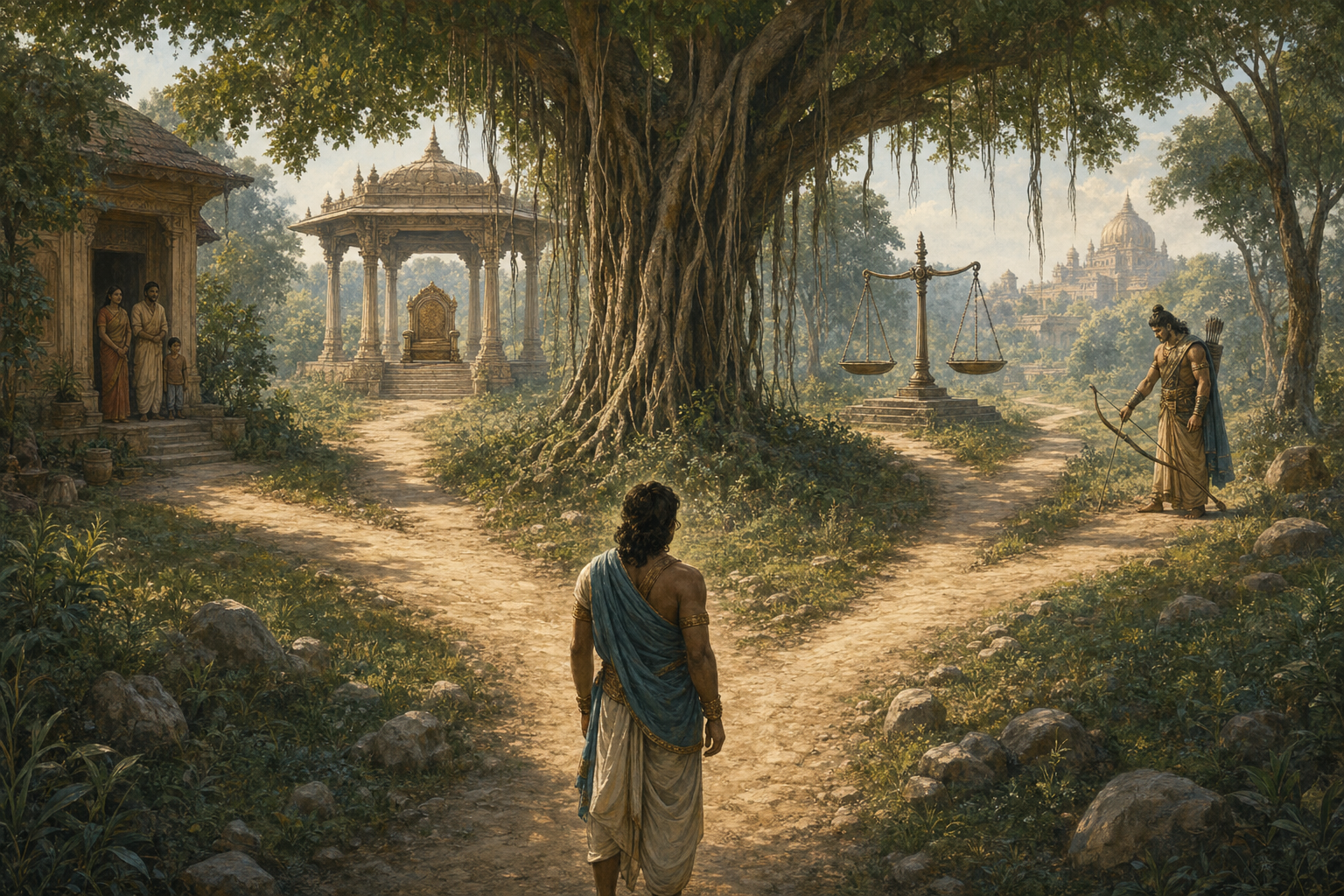
The scale of the Mahabharata explains why many reading plans collapse. It extends across approximately one hundred thousand shlokas and eighteen parvas, combining narrative, philosophy, statecraft, spiritual teaching, family conflict, and reflection on social order. A rushed march from the first page to the last is rarely the best introduction.
Rabindranath Tagore declared that an Indian education remained incomplete without the Mahabharata. His point was larger than literary appreciation. The epic places you inside situations where legitimate obligations collide. Affection conflicts with justice. Gratitude binds a good person to a destructive cause. Truthfulness meets political necessity. A ruler must restrain violence while protecting people from violence. Renunciation attracts someone who still owes a duty to society.
These are not puzzles with an answer printed at the back. They train viveka, the capacity to discriminate among actions that may each possess a partial claim to righteousness. The curriculum therefore begins with four reading disciplines:
- Establish the situation. Identify what happened, what information each person possessed, and which choices were genuinely available.
- Name the competing duties. Do not settle for saying that someone followed dharma. Ask which dharma, attached to which role, and owed to whom.
- Examine power. Notice who could speak, who was ignored, who could stop the harm, and who would bear the consequences of inaction.
- Follow the aftermath. A choice that sounds defensible in isolation may look different once its effects on families, institutions, and the chooser’s own conscience become visible.
This approach also respects the epic as itihasa: moral-historical memory carried through narrative, dialogue, and inherited recollection, rather than a modern chronicle designed only to arrange independently verified events. Historical questions remain legitimate, but they should not displace the educational question: why did this civilization preserve this particular conflict, warning, or act of courage?
Keep separate notes for plot and judgment. In the plot column, record what happened. In the judgment column, record the duties in conflict, your initial verdict, the strongest objection to that verdict, and anything in the aftermath that made you revise it. That separation prevents familiarity with the story from masquerading as moral understanding.
Use a modular reading path through the epic
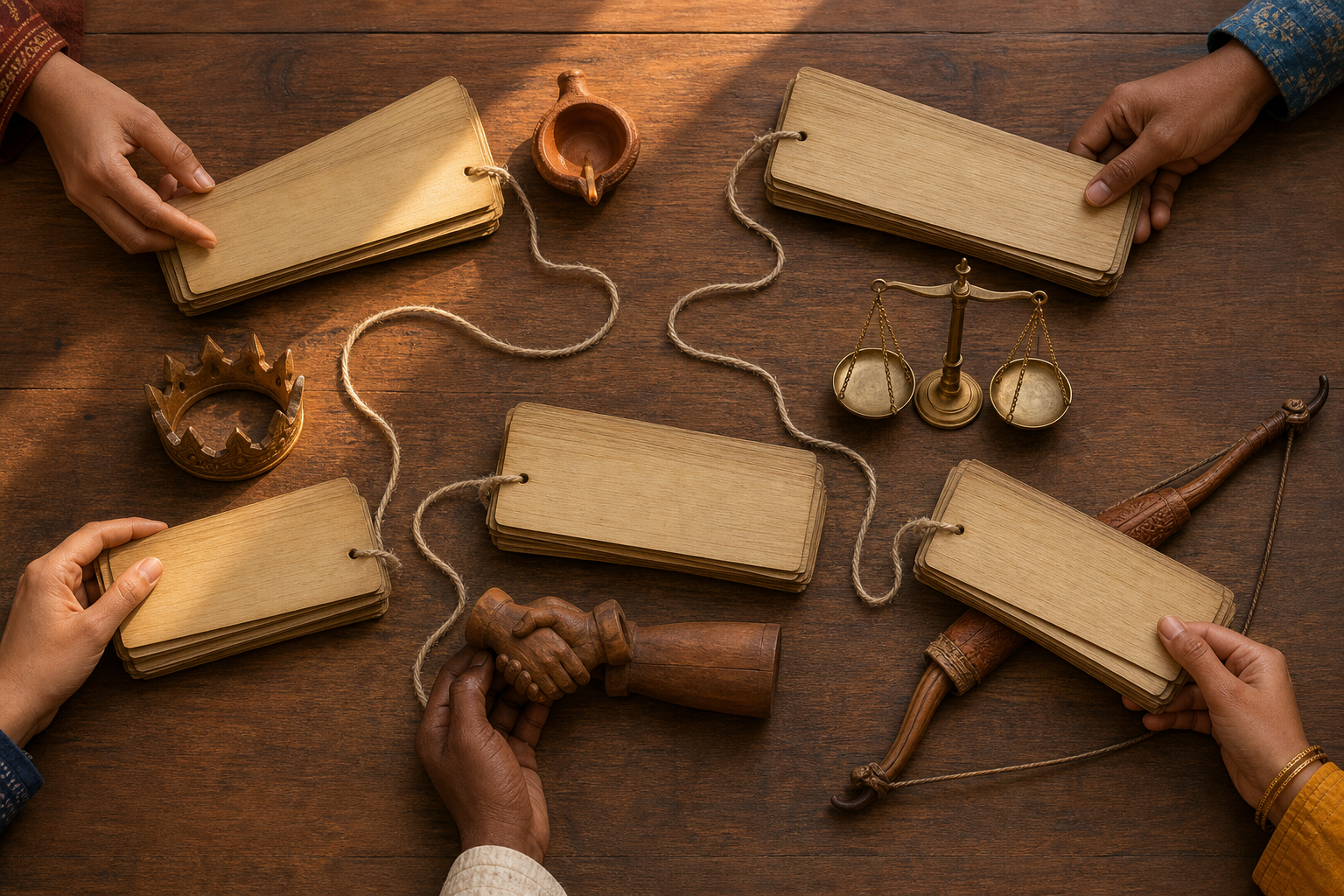
You do not need to begin by assigning the entire Mahabharata. Start with a dependable translation and write its translator, edition, parva, and section at the top of every discussion sheet. This matters because the epic developed through a long history of transmission and redaction. The Critical Edition prepared by the Bhandarkar Oriental Research Institute offers a stable basis for scholarship, while translations and commentarial traditions continue to preserve different interpretive perspectives.
Do not silently combine wording from unrelated translations. If versions differ, place them beside one another and ask whether the difference changes the character’s motive, the moral pressure, or the apparent teaching. Variation can become part of the lesson when it is acknowledged clearly.
The following sequence works as a modular course. Each unit can stand alone, but the order moves from visible injustice to personal discernment, public duty, war, accountability, and liberation.
| Unit | Reading focus | Central question | Work to produce |
|---|---|---|---|
| 1 | Draupadi in the dice-hall crisis | What happens when an institution knows that an injustice is occurring but its most powerful members refuse to intervene? | Map everyone who could speak or act. Distinguish direct wrongdoing, enabling, silence, and resistance. |
| 2 | Arjuna’s crisis and the Bhagavad Gita in Bhishma Parva | How should you act when personal attachment, social role, universal ethics, and fear of consequences pull in different directions? | Write Arjuna’s available options before evaluating Krishna’s counsel. Name the cost of every option, including withdrawal. |
| 3 | Yaksha Prashna in Vana Parva | Which qualities remain dependable when status, possessions, and ordinary security fall away? | Answer each selected question before reading Yudhishthira’s response. Then explain what your disagreement reveals about your priorities. |
| 4 | Vidura-niti in Udyoga Parva | What does truthful counsel require when a leader is attached to a harmful course? | Separate Vidura’s advice into personal discipline, deliberation, speech, alliances, and public responsibility. Identify where ignored counsel becomes chosen failure. |
| 5 | Krishna’s peace embassy in Udyoga Parva | How can a negotiator pursue peace without using peace as an excuse to abandon justice? | Define the minimum just settlement, the signs of good-faith negotiation, the non-negotiable principle, and the point at which further delay protects the aggressor rather than peace. |
| 6 | The war narrative and the erosion of restraints | What moral cost follows when protective rules are weakened for an apparently necessary victory? | Keep a ledger of pledges, restraints, breaches, justifications, and consequences. Judge the act and its rationale separately. |
| 7 | Yudhishthira’s post-war responsibility and Shanti Parva | What does a ruler owe after victory, especially to those made vulnerable by conflict? | Draft a short charter of rajadharma covering restraint, justice, protection of the weak, accountability, and the limits of authority. |
| 8 | Mokshadharma in Shanti Parva and selected teachings from Anushasana Parva | How can public action, ethical restraint, contemplation, and the search for liberation belong to one life? | Choose one discipline for practice. State the attachment it addresses, the duty it must not become an excuse to evade, and the evidence that would show greater inner freedom. |
Move through this path at the speed of comprehension, not at the speed of a syllabus. Stay with a unit until you can state the strongest case for more than one course of action. If everyone reaches the same verdict immediately, the group has probably skipped an obligation, a power imbalance, or an unwanted consequence.
Return later to character arcs rather than treating each scene as self-contained. Draupadi’s insistence on justice exposes the cost of respectable silence. Karna’s generosity cannot be understood apart from his divided loyalty and allegiance. Yudhishthira’s reputation for truth must be read alongside the dice game, the pressures of war, and his burden after victory. Arjuna’s doubt becomes educational because it develops into inquiry rather than disappearing beneath bravado. The person across episodes is the true unit of study.
Turn each meeting into a decision laboratory
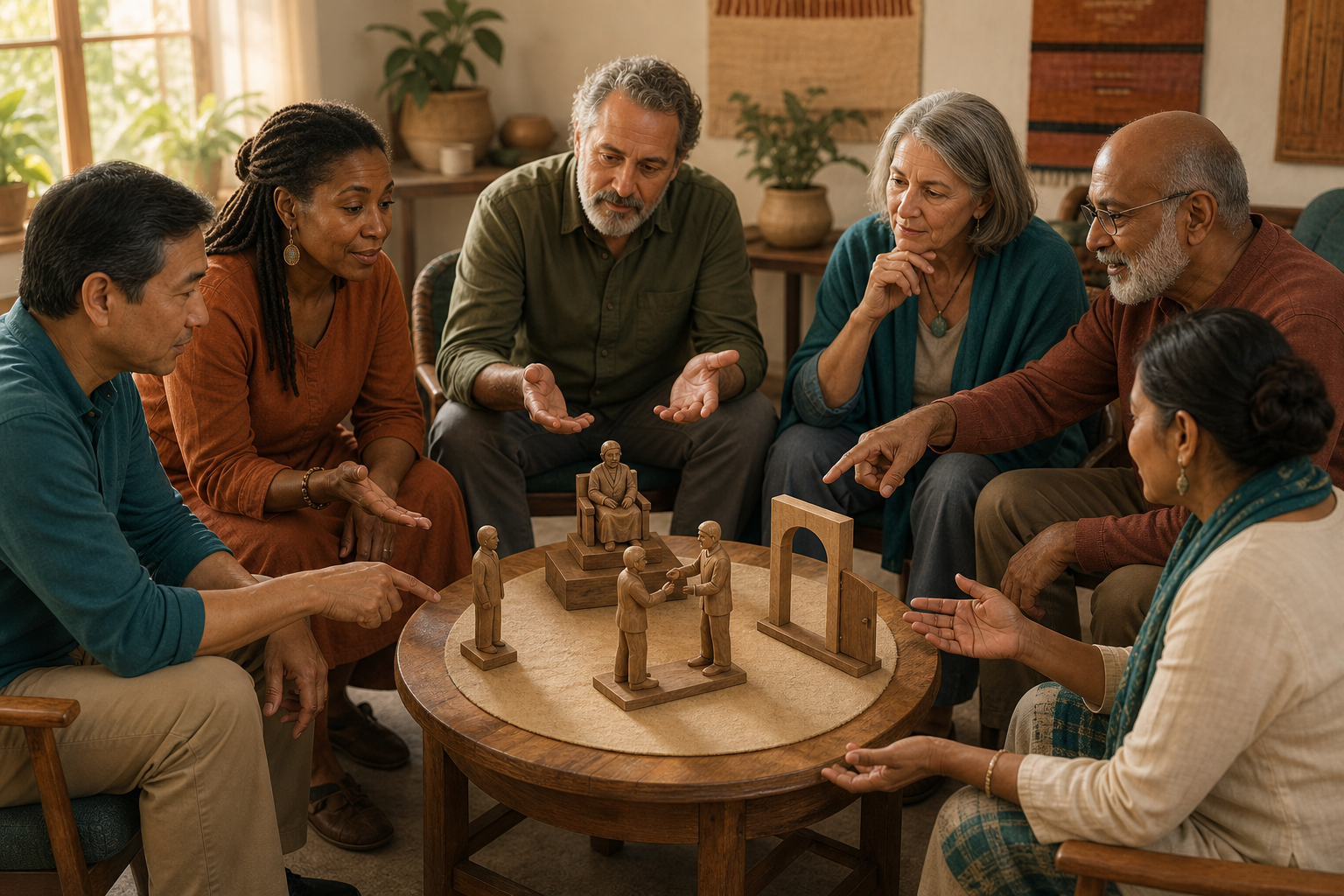
The Mahabharata’s nested dialogues and competing voices already resemble a seminar. Your study method should preserve that dialogic quality. A lecture can explain context, but judgment develops when the reader must reconstruct a conflict, defend a position, encounter a serious objection, and revise a conclusion.
- Frame the case without announcing the lesson. Describe the immediate decision and stop before giving a moral label to the characters.
- Reconstruct roles and relationships. List the obligations created by kinship, office, promises, hospitality, command, discipleship, friendship, and membership in a political community.
- Name the dharmic category being invoked. Decide whether a claim concerns personal vocation, universal ethical restraint, the duty of rule, conduct during crisis, or the pursuit of liberation.
- Assign the strongest opposing arguments. Ask participants to defend a course they initially reject. The purpose is not theatrical debate but protection against caricature.
- Test the crisis claim. If someone invokes apaddharma, ask what makes the situation exceptional, which ordinary restraint is being suspended, who benefits, and when the exception ends.
- Inspect the distribution of harm. Ask whether the decision-maker pays the cost personally or transfers it to someone with less voice or protection.
- Read the consequence before closing the case. Let the later narrative challenge the first verdict. Record whether the result exposes a flawed motive, a neglected duty, or a tragic choice that remained costly despite being defensible.
Require precision whenever the word dharma appears. No participant should be allowed to end an argument with the assertion that dharma demanded an action. The next questions are always: whose duty, arising from which relationship, limited by what wider obligation, and paid for by whom?
The distinction among dharmic categories is especially important. Svadharma asks about the obligations of one’s role and vocation. Sanatana dharma brings the wider ethical horizon into view. Rajadharma asks how political authority must protect and restrain. Apaddharma concerns duties under genuine crisis. Mokshadharma turns toward liberation, contemplation, and freedom from binding attachment. These categories illuminate one another, but none should be used as a slogan that automatically defeats the rest.
The political teaching becomes concrete through matsyanyaya, the condition in which the strong consume the weak as large fish consume small fish. Use it as an institutional diagnostic. Who in this situation cannot protect themselves? What authority could prevent predation? What restraints would stop the protector from becoming another predator? That line of questioning connects the epic’s account of kingship to present concerns about rule, institutional legitimacy, and public accountability without forcing a simplistic one-to-one analogy.
A cross-Dharmic group can deepen the inquiry while respecting real differences among traditions. Buddhist reflection on impermanence and awareness can sharpen questions about attachment. Jain commitment to restraint and ahimsa can intensify scrutiny of avoidable injury. Sikh teachings on humility, disciplined action, and seva can illuminate duty performed without self-glorification. Use these as conversational lenses, not as evidence that Hinduism, Buddhism, Jainism, and Sikhism are interchangeable. Ask where a lens clarifies the episode and where the particular tradition might resist the episode’s apparent logic.
Assess judgment rather than rewarding a predetermined verdict
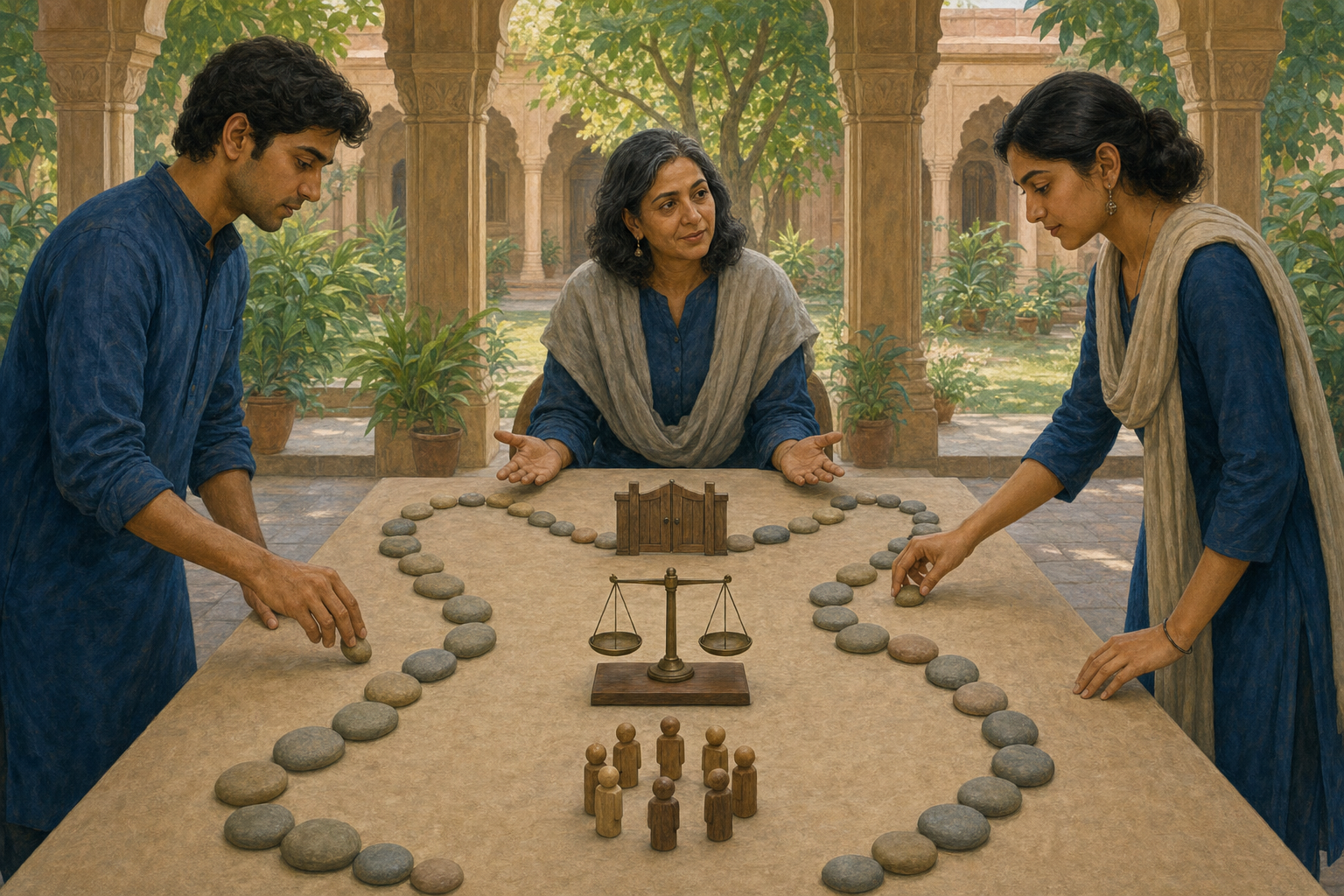
A living curriculum fails when learners discover that the teacher is waiting for one approved answer. The epic’s educational power lies in disciplined judgment under ambiguity. That does not mean every answer is equally sound. It means a conclusion earns credibility by accounting for the relevant duties, facts, power relations, alternatives, and consequences.
Use the same decision ledger for every unit. Consistency lets you see whether your reasoning has become more exact:
- Decision: What choice must be made?
- Knowledge: What does the chooser know, and what remains uncertain?
- Role: Which obligations arise from the chooser’s position and relationships?
- Wider restraint: What must not be done merely because the role permits or encourages it?
- Least protected person: Who is most exposed if this decision is wrong?
- Alternatives: Which serious option has been dismissed too quickly?
- Crisis claim: Is an emergency real, and what would prevent the exception from becoming normal conduct?
- Consequences: What are the immediate, political, relational, and inward costs?
- Repair: If harm cannot be avoided, what accountability or restoration follows?
- Revised judgment: What changed after the aftermath was considered?
A learner is progressing when they can distinguish loyalty from righteousness, describe an opposing position without contempt, identify an institutional failure rather than blaming only one villain, and revise a judgment without pretending that the first answer never existed. Another sign of progress is the ability to acknowledge tragedy: sometimes every available path carries loss, yet the obligation to choose and accept responsibility remains.
In a family setting, let each person answer before an elder explains the traditional interpretation. With younger readers, focus first on promises, fairness, courage, silence, and consequences before introducing the full vocabulary of political and spiritual philosophy. In a community class, rotate the responsibility for opening the case and presenting the strongest objection. In leadership education, require a written decision memorandum that includes the weakest affected party, the rejected alternative, and the conditions under which the decision should be reviewed.
Reverence and inquiry do not have to compete. Reverence without inquiry can turn a demanding epic into decoration. Inquiry without humility can turn morally burdened lives into easy targets for retrospective judgment. The right discipline is sympathetic rigor: understand the pressure fully, question the justification honestly, and refuse to erase the consequences.
Key takeaways
- Treat the Mahabharata as a case-based education in judgment, not merely as a plot to finish or a collection of rules to memorize.
- Begin with selected dilemmas, but return to complete character arcs so that one dramatic scene does not become the whole verdict on a life.
- Name the translation and edition you are using; record textual differences instead of blending them invisibly.
- Whenever someone invokes dharma, ask which duty is meant, whose interests it serves, what limits it, and who will bear its cost.
- Use the aftermath of decisions as part of the lesson. Consequence is one of the epic’s principal methods of moral instruction.
- Measure progress by the reader’s ability to recognize competing obligations, defend an opposing case fairly, and revise a judgment responsibly.
For your next reading, do not schedule the whole epic. Choose one dilemma, identify the decision point, and give every participant the same decision ledger. If you can describe the strongest conflicting duty before delivering a verdict, the Mahabharata has already begun to function as a living curriculum.
References
