
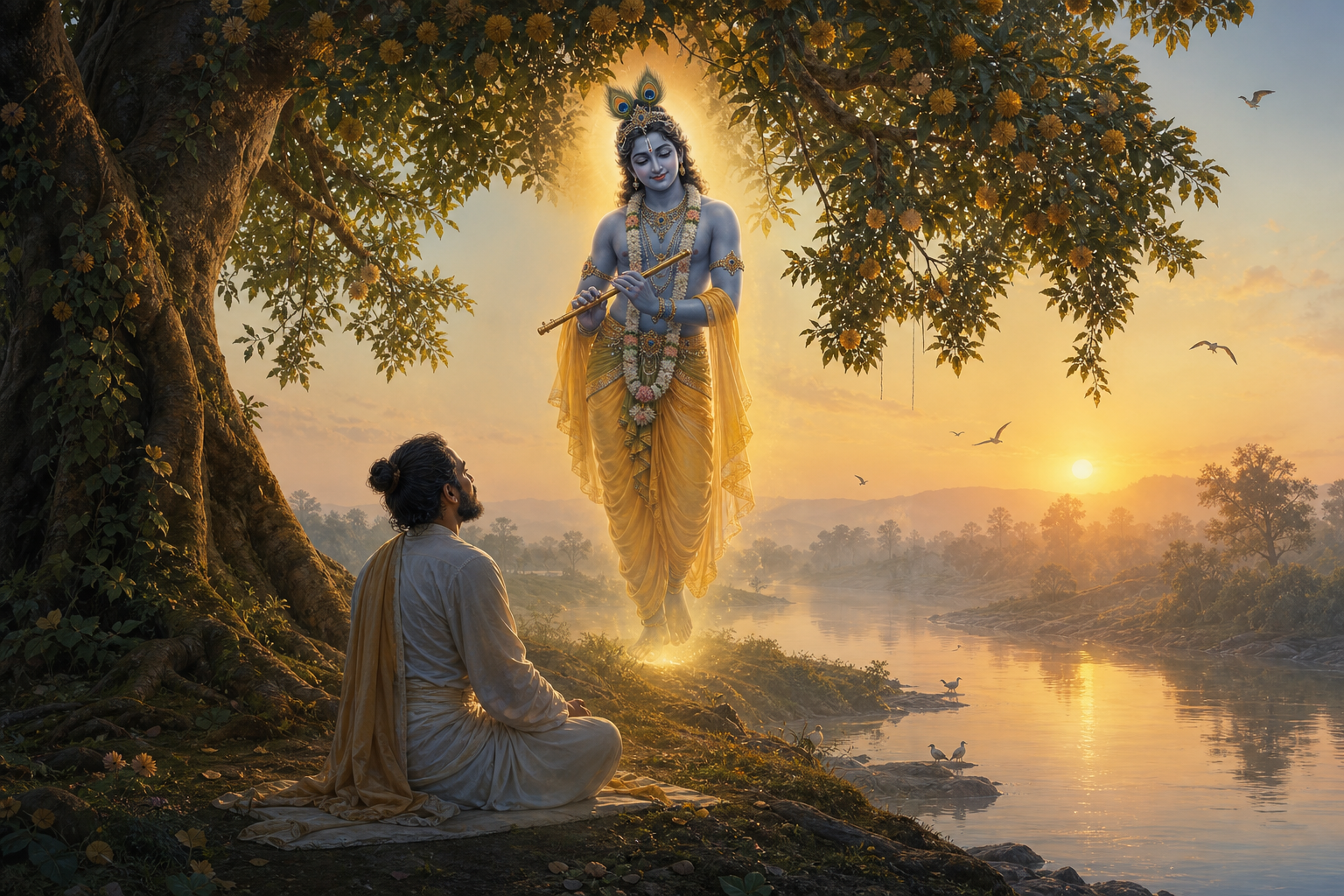
You may read about Krishna, chant his names, and accept that he is the Supreme, yet still wonder what it means to realize him. Are you waiting for a vision, an overwhelming devotional feeling, or enough philosophy to remove every doubt?
The Bhagavatam gives you a more demanding and more workable answer. Realization begins when you recognize Krishna as the ground of your consciousness, give up the claim that anything is independently yours, and let that recognition change how you hear, choose, serve, and love.
Krishna is not an object your mind can contain

Bhagavatam 11.3.37 describes the Supreme as the causeless cause of creation, maintenance, and dissolution. The same Supreme remains present through waking, dreaming, and deep sleep, and gives the body, senses, vital energy, and mind their power to function.
This places Krishna on the other side of an important distinction. He is not merely one more thought appearing inside your consciousness. He is the reality upon whom your capacity to think depends. Your mind can receive a true understanding of Krishna, but it cannot stand outside him, measure him completely, and reduce him to a concept.
That does not make reasoning useless. Bhakti does not ask you to stop thinking. It asks reason to recognize its jurisdiction. You can distinguish a sound interpretation from a careless one, test your conduct against dharma, and remove contradictions from your understanding. What you cannot do is manufacture Krishna through analysis or demand that the unlimited fit within the limits of your present mental categories.
The teaching about waking, dreaming, and deep sleep also corrects dependence on moods. Your awareness of Krishna may be clear one morning and clouded the next. Krishna has not become more real in the first condition or less real in the second. The condition of your attention changes; its divine ground does not.
Use that distinction before you begin your daily practice. Acknowledge that the voice with which you chant, the intelligence with which you study, and the attention with which you listen already operate by Krishna’s power. Then ask that those faculties be used in his service. This short act changes practice from an attempt to produce a spiritual experience into an act of conscious dependence.
The word “mine” reveals the central obstruction

Mother Yashoda’s encounter with Krishna brings the same truth into ordinary relationships. After seeing the cosmos within her child’s mouth, she recognizes how divine maya supports an entire possessive map: Nanda is my husband, Krishna is my son, the wealth of Vraja is mine, and its people belong within my domain. In Bhagavatam 10.8.44, that possessive certainty gives way to shelter in the Supreme Lord.
The problem is not affection. Yashoda’s love for Krishna is not treated as a defect. The problem is the assumption of independent possession: the belief that a person, ability, position, community, or result originates in you, exists for you, and remains under your final control.
Ahankara says that you are the independent doer. Mamata adds that particular people and things are yours in an absolute sense. The two reinforce each other. Once something becomes part of your self-image, any threat to it feels like a threat to your existence. That is why possessiveness often appears as defensiveness, resentment, rivalry, or a need to control an outcome.
Surrender does not require you to abandon practical responsibility. If you support a family, administer a temple, lead a team, own property, or care for someone vulnerable, those duties remain real. You must still protect, maintain, decide, and answer for your conduct. The inner correction is from ownership to stewardship: this has been entrusted to you, so use it according to dharma rather than using it to enlarge yourself.
Use the possessive test when friction appears
A calm moment rarely exposes false ownership. Friction does. When another person disagrees, a plan fails, praise goes elsewhere, or a cherished role changes, pause before defending your position and ask:
- What am I presently treating as absolutely mine?
- What result am I trying to force because it protects my identity?
- Which duty is genuinely mine to perform, and which outcome was never mine to control?
- What action would serve Krishna and the people involved even if it brought me no recognition?
This test does not mean choosing inaction. Sometimes stewardship requires a firm boundary, an unpopular decision, truthful speech, or determined protection of another person. Surrender removes the ego’s claim over the action and its fruit; it does not remove discernment or courage.
Personal devotion goes further than cosmic spectacle

Yashoda’s experience contains a striking paradox. She receives a vision vast enough to overturn ordinary ideas about her child, yet her defining relationship with Krishna remains maternal love. The Bhagavatam does not leave her as a detached observer of cosmic machinery. Awe reveals who Krishna is, but intimate devotion determines how she relates to him.
This protects you from two incomplete approaches. Sentiment without truth can turn Krishna into a projection of your preferences. Metaphysics without relationship can leave Krishna as a remote principle that makes no claim on your life. Realization requires both: Krishna is the unlimited foundation of existence, and Krishna is the personal shelter to whom you can listen, speak, offer, remember, and serve.
For that reason, a dramatic experience is an unreliable spiritual scorecard. A vision, intense emotion, unusual stillness, or sudden insight may affect you deeply, but the ego can quickly turn even a sacred moment into a new identity. You begin thinking that the experience belongs to you, distinguishes you, or proves your advancement. The old possessive structure has merely acquired religious language.
Look instead for quieter changes. Do you remember Krishna sooner when a plan breaks? Can you receive correction without immediately protecting your image? Does service continue when nobody notices it? Are family members and fellow devotees becoming persons to serve rather than extensions of your expectations? Can you offer a successful result without claiming supremacy and accept a failed result without abandoning dharma?
These signs do not earn Krishna or force revelation. They show that hearing is reaching the part of life where ahankara and possessiveness operate. Information about Krishna is becoming a relationship with Krishna.
Turn the teaching into a daily discipline

You do not need to invent a private mystical method. If you have received a mantra or discipline from a qualified guru within a Vaishnava sampradaya, keep that instruction central. The following pattern can help you bring the Bhagavatam’s teaching into the practice you already follow.
- Hear before interpreting yourself. Read or listen to a Bhagavatam passage within a trustworthy teaching tradition. Identify one claim it makes about Krishna before asking how it applies to you. This keeps self-improvement from replacing the actual subject of the text.
- Name the correction. Ask which false assumption the passage removes. Bhagavatam 11.3.37 corrects the idea that consciousness and agency are independently generated. Bhagavatam 10.8.44 corrects the idea that your relationships and resources are absolutely yours.
- Address Krishna personally. Chant or pray as an encounter with the one described by the teaching. When attention wanders, return it without turning distraction into a drama about your spiritual worth.
- Offer a concrete action. Before work, study, caregiving, worship, or a difficult conversation, remember that the capacity to act is given and the result is not independently yours. Then perform the duty as carefully as you can.
- Review the point of resistance. At the end of the day, recall one moment when control, recognition, or possession became more important than service. Decide what a surrendered response would look like if the same pattern returns.
This is abhyasa: repeated practice that retrains attention and intention. Its purpose is not to accumulate spiritual merit while leaving the sense of proprietorship untouched. Each repetition should make the movement from independent control to dependent service more deliberate.
Periods of dryness are especially revealing. If practice seems worthwhile only when it produces a particular feeling, you may still be treating Krishna as the provider of an experience you believe you are owed. Continue hearing, chanting, remembering, and serving without manufacturing emotion. Steadiness allows devotion to become less transactional.
Also watch the ethical direction of your interpretation. If supposed surrender repeatedly makes you contemptuous of ordinary duties, unable to admit error, or dependent on the unexamined will of a human personality, seek guidance from a mature teacher grounded in scripture and disciplined conduct. Realization of Krishna should expose false proprietorship, not give it a sacred disguise.
Key takeaways
- Krishna is not merely an idea within your mind; the Bhagavatam presents the Supreme as the ground upon which mind, senses, and life depend.
- Changing devotional moods do not indicate that Krishna’s reality is changing. They show that your attention is changing.
- False ownership is exposed when you treat relationships, abilities, positions, or results as independently yours.
- Surrender changes possession into stewardship. It does not cancel family obligations, moral judgment, boundaries, or responsible action.
- Cosmic knowledge and personal devotion belong together: truth prevents projection, while loving service prevents philosophy from remaining remote.
- The most useful signs of progress are steadier remembrance, less defensiveness, reduced demand for recognition, and more faithful service.
When you next hear the Bhagavatam, do not stop at asking what you understood. Ask what you are still claiming as independently yours. Name one such claim, offer its use and outcome to Krishna, and then perform the duty in front of you with care. That is how a teaching moves from the page into your relationship with him.
References
- Dandavats — Morning Class SB 10.8.44 – HG Aniruddha Prabhu – 2 August 2026
- Dandavats — His Grace Krishna Kishore Prabhu || SB-11.03.37 || 02-08-2026
