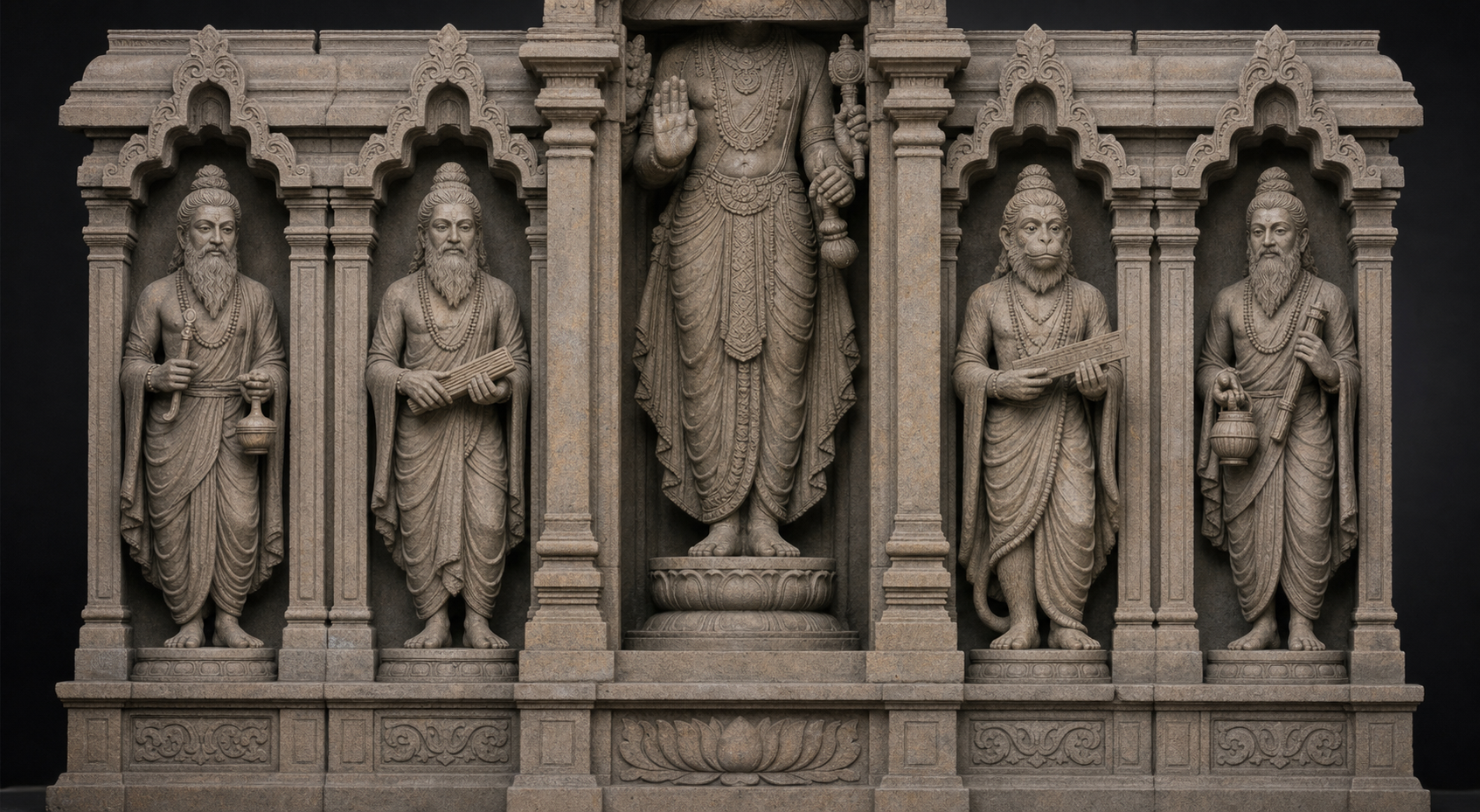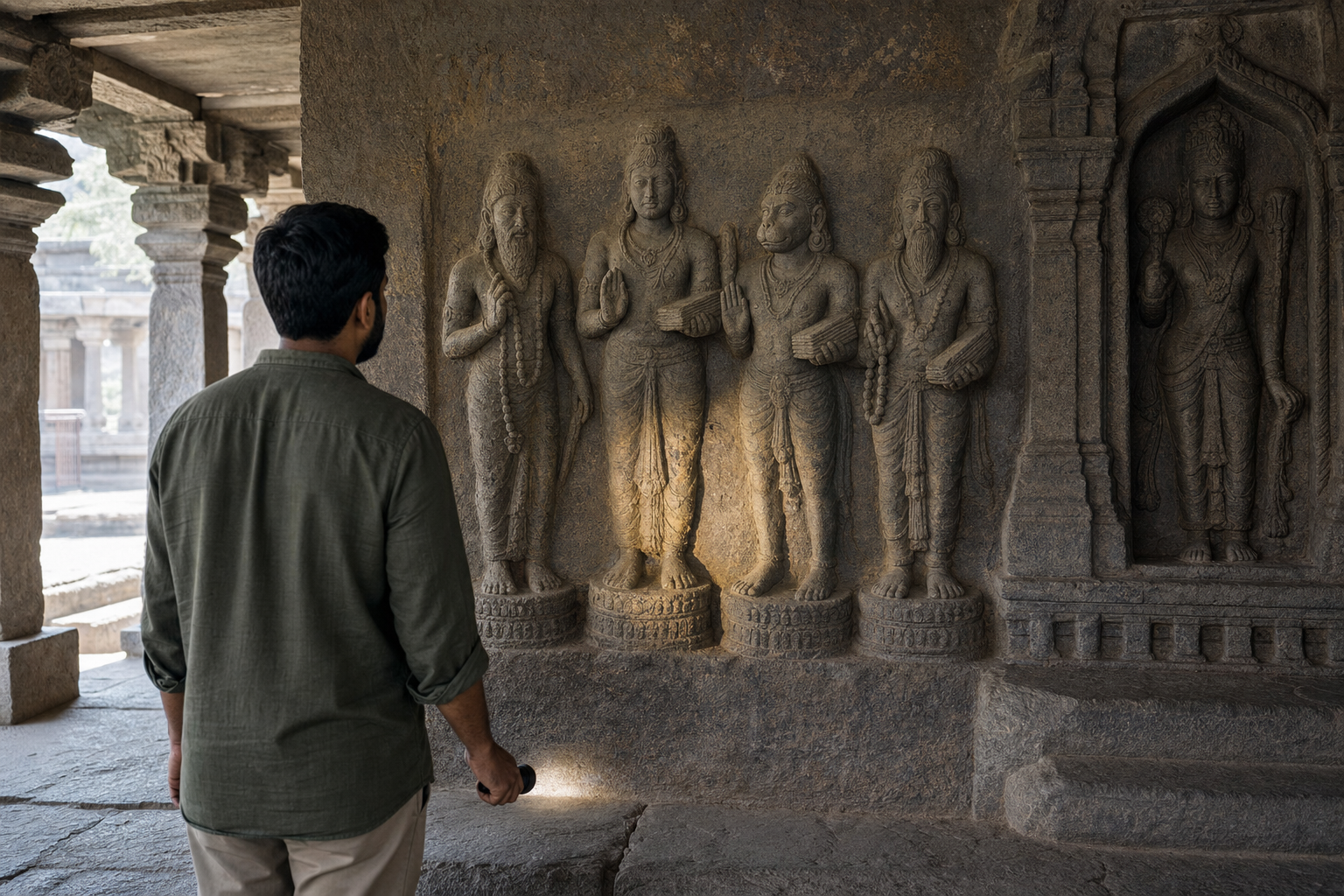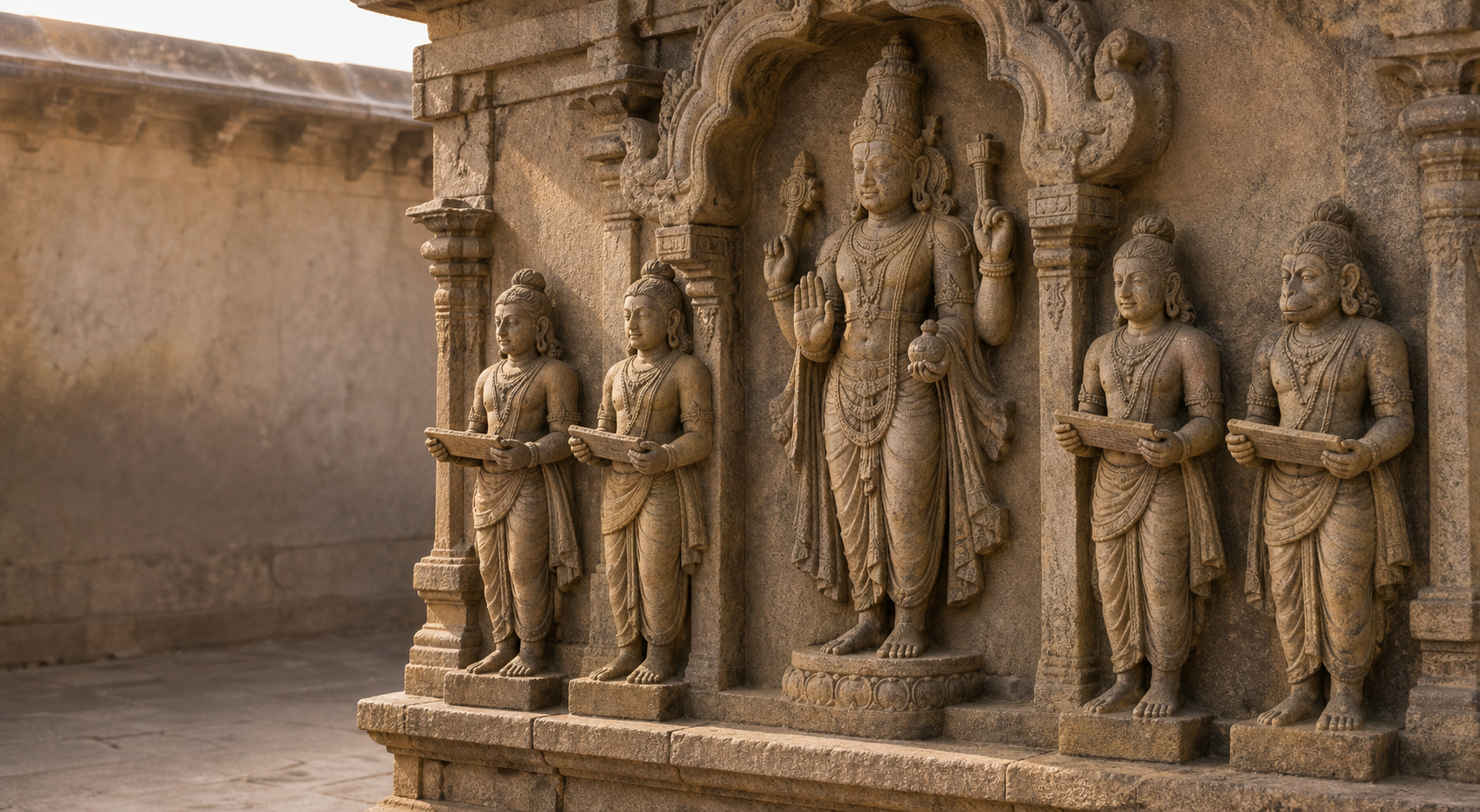
You are looking at a temple frieze: four composed, manuscript-bearing figures stand near a deity, but one has an unmistakably simian face. Is it Hanumān, a guardian, a damaged animal figure, or something more unusual?
In some regional temple programs, that figure may be the Atharva Veda personified as a Veda-Puruṣa. The identification is meaningful, but it is not automatic. You have to read the face together with the companions, attributes, architectural position, inscriptional evidence, and local temple tradition.
Key takeaways: identify the figure before interpreting it
- Start with the group. A simian-faced figure is more plausibly Atharva Veda when it belongs to a coordinated set of four Veda personifications.
- Do not rely on the face alone. Manuscripts, rosaries, ritual implements, scale, posture, placement, and the identities of adjacent figures all matter.
- Keep Atharva Veda and Hanumān distinct. Their imagery can meet through associations of vigilance, mantra, prāṇa, strength, and protection without representing the same being.
- Treat the monkey face as a regional convention. It is not a compulsory or universal form of Atharva Veda throughout Hindu art.
- Rank the evidence. An inscription or a locally preserved identification outweighs a resemblance noticed in isolation.
- Match your language to your certainty. Use probable Atharva Veda when the ensemble fits but decisive local evidence is absent.
First recognize the visual grammar of a Veda-Puruṣa
Hindu temple art does not confine the Vedas to the category of books. Sacred speech can become a visible presence: a Veda-Puruṣa or Vedamūrti who stands before Śiva, Viṣṇu, or the Goddess, or appears as part of an independent Chaturveda ensemble. The sculptor is giving body to transmitted knowledge, recitation, ritual authority, and divine revelation.
This is why the ensemble matters more than any one attribute. Palm-leaf manuscripts signify learning, while rosaries suggest recitation or disciplined practice. Ritual objects may mark liturgical knowledge, and musical emblems can point toward Sāma Veda. Yet manuscripts and rosaries are shared symbols, not exclusive identity cards. A figure does not become Atharva Veda simply because it holds a text.
Instead, look for repetition with controlled difference. Four figures may share their size, stance, dress, and relation to the presiding deity while differing in face or emblem. Within that structure, a simian physiognomy can function as the distinguishing sign for Atharva Veda. The kapi-mukha convention occurs within a variable tradition of Veda personification, not as a uniform formula applied in every temple.
A lone monkey-faced image therefore requires a different standard of proof. If no coordinated set surrounds it, first consider its relation to a gateway, shrine, narrative scene, or group of guardians. Conversely, when one simian-faced figure belongs to four otherwise comparable manuscript-bearing persons, the Chaturveda reading becomes much stronger.
This way of seeing sacred knowledge as active presence has wider Dharmic echoes. Mahāyāna Buddhism personifies liberating wisdom as Prajñāpāramitā; Jain tradition honours canonical knowledge through Śruta-devī; and Sikh reverence for the Guru Granth Sahib recognizes scripture as the living Guru. These are not identical doctrines or interchangeable forms. They do, however, correct a modern category mistake: in Dharmic life, knowledge can be encountered as guide, guardian, teacher, and presence rather than as inert information.
Why a simian face can express Atharvanic knowledge
Atharva Veda has an unusually wide ritual and philosophical range. Known in early references as Atharvāṅgirasah, it has the principal Śaunakīya and Paippalāda recensions. Its hymns address healing herbs, protection, longevity, prosperity, social harmony, and rites of passage. Its textual world also includes the Gopatha Brāhmaṇa, the Kauśika Sūtra for many domestic and protective applications, and the Vaitāna Sūtra for Śrauta ritual.
That practical range does not make Atharva Veda merely a collection of remedies or defensive rites. The Muṇḍaka, Praśna, and Māṇḍūkya Upaniṣads pursue consciousness, ultimate knowledge, and liberation. Atharvanic identity therefore joins prayoga, effective application, to jñāna, liberating knowledge. The icon has to suggest wisdom that can both contemplate the highest truth and act within the vulnerabilities of embodied life.
Vigilance makes protection visible
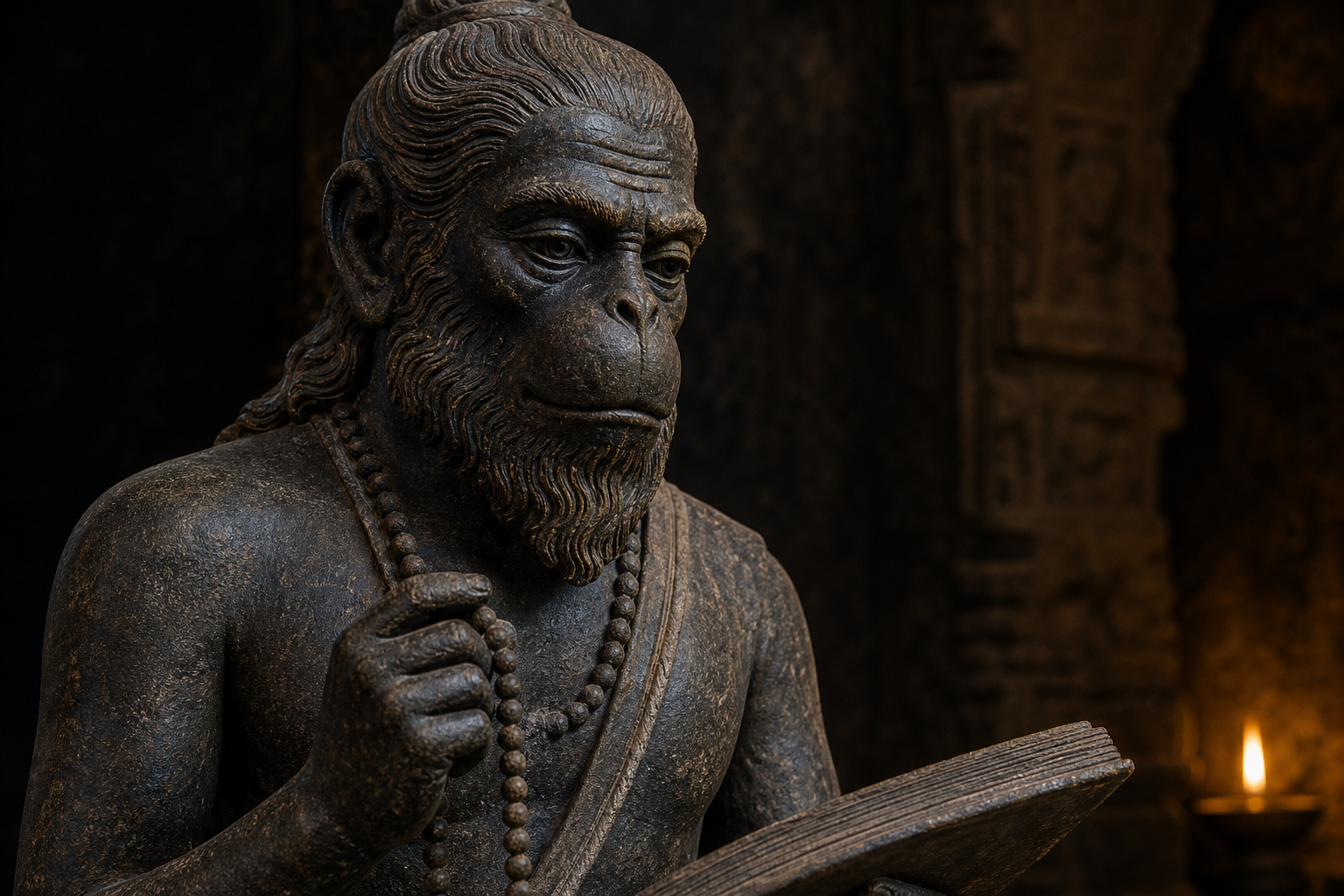
Simian imagery can convey agility, attention, adaptive intelligence, and disciplined force. Those qualities suit a Veda whose ritual repertoire includes rakṣā, śānti, and āyuṣya concerns: safeguarding, pacification, and the sustaining of life. The face turns an abstract function into an immediately readable disposition. This is knowledge awake to danger, prepared to intervene, and oriented toward restoring order.
Temple architecture reinforces that reading when the figure participates in a protective visual zone. Sacred spaces commonly place vigilant beings near boundaries, entrances, projections, and transitions. A kapi-mukha Atharva Veda can join that perimeter without ceasing to be a personification of revelation. Knowledge itself becomes part of the temple’s protective order.
Prāṇa and mantra explain the Hanumān resonance
Hanumān, the son of Vāyu, embodies mastery of energy, disciplined strength, tapas, mantra-śakti, and unwavering bhakti. Atharvanic practice likewise brings mantra, breath, and sanctified materials into procedures intended to steady the body-mind environment. A simian face can place Atharva Veda within this shared symbolic field of prāṇa, concentrated will, and protective sacred sound.
The connection is best understood as resonance, not genealogy or identity. The sculpture need not assert that Atharva Veda is Hanumān. It can borrow a visual language already capable of communicating alertness, life-force, rapid efficacy, and fearless service.
Forest intelligence fits the hymns to healing plants
Atharva Veda’s attention to herbs and restoration gives the simian form an ecological dimension. Monkeys are creatures of groves, branches, roots, fruits, bark, and changing terrain. Their foraging intelligence can serve as a visual analogy for knowledge that is observant, embodied, and intimate with the living landscape.
This does not turn the image into a claim about modern medicine, nor does it make Atharva Veda identical with Ayurveda. The narrower point is iconographic: an earth-wise, forest-associated face fits a sacred corpus in which plants, vitality, protection, and restoration have a prominent place.
A further, more cautious interpretation comes from the Vratya material of Atharva Veda 15. Its social and initiatory concerns can be read alongside the image’s inclusion of forest and threshold energies within a sacred architectural centre. What guards the margin also sustains the centre. This is an interpretive correspondence, however, not a claim that Atharva Veda 15 prescribes a monkey-faced sculpture.
Hanumān is the illuminating comparison and the main trap
The quickest misreading is to see a monkey face and stop at Hanumān. The resemblance is important, but identity has to come from iconographic context. Hanumān commonly appears in his own shrine, near gateways, as a flanking guardian, or within a devotional setting that establishes who he is. A Veda-Puruṣa belongs to a different visual proposition: sacred knowledge has taken personal form, often as one member of a fourfold ensemble.
Three questions keep the comparison under control:
- What company does the figure keep? Four comparable figures support a Chaturveda identification. An independent shrine or clearly Hanumān-centred arrangement points elsewhere.
- What is the figure doing? A manuscript, rosary, or shared Vedic posture matters most when the other members of the group carry related attributes.
- What does the temple call it? An inscription, sthala-purāṇa, archaka’s explanation, or hereditary śilpin tradition can preserve an identity that is not obvious from a photograph.
If the evidence is strong, a careful caption might read: Atharva Veda represented as a kapi-mukha Veda-Puruṣa within a Chaturveda ensemble. If the group fits but no label survives, use: probable monkey-faced personification of Atharva Veda. If only the facial resemblance is available, describe what is visible and leave the identity open.
Avoid three larger claims. Do not say that Atharva Veda is a form of Hanumān, that every traditional image of Atharva Veda must be monkey-faced, or that a single pan-Indian manual mandates the convention. None of those conclusions follows from the visual resemblance.
Regional temple grammar determines how certain you can be
Śilpaśāstra and Āgama traditions supply systems of proportion, image types, ritual relations, and architectural placement, but they also allow regional interpretation. Manuals such as the Mayamata and Mānasāra belong to this wider technical world. Their existence does not prove that every local workshop followed one mandatory facial formula for all four Vedas. Sthapatis and sculptural guilds could adapt a broad theology to the presiding deity, regional style, available material, and inherited temple practice.
That flexibility explains why the kapi-mukha form should be called a recurring regional solution rather than a universal rule. Chola, Hoysala, and Vijayanagara sculptural programs are especially useful settings in which to look for learned ensembles, although comparable visual ideas can occur beyond them. Do not assign a dynasty or region from the monkey face alone.
Architectural position supplies another layer of context. Veda ensembles may occur on maṇḍapa plinths, beneath kapota cornices, in toraṇa spandrels, or inside devakoṣṭha niches. Record the exact location instead of noting only the temple name. A figure on a hall base participates in a different visual sequence from one placed beside the presiding deity or within a doorway composition.
Material also changes what you see. Granite can reduce a delicate facial cue to a few durable planes; chloritic schist permits finer modelling; bronze presents profile, ears, muzzle, and expression differently again. Erosion, lighting, and viewing angle can make a subtle simian physiognomy appear stronger or weaker. This is another reason to examine the complete figure rather than isolating one close-up.
When you document a possible example, rank your evidence in this order:
- Contemporary or historical inscriptional label. Record the original wording and its physical relation to the image.
- Coherent four-Veda ensemble. Note the number, sequence, scale, posture, shared attributes, and exceptional features.
- Temple-specific transmission. Ask the archaka or custodian whether the figure has a received local name and whether that identification appears in a sthala-purāṇa or ritual practice.
- Knowledge from a śilpin lineage. A traditional sculptor may recognize a regional convention that a generic iconography handbook misses.
- Comparison with securely identified local examples. Regional analogies are more useful than distant similarities, but they remain supporting evidence.
- Facial resemblance by itself. Treat this as a prompt for inquiry, not a final identification.
Do not assume a fixed left-to-right order for the four Vedas unless that order is established at the particular site. Relative position can help, but local programs vary. Likewise, the continuing use of Atharvanic mantras in śānti rites, āyuṣ homas, household protection, prosperity prayers, or festival recitation can strengthen the local meaning of an image without proving its identity on its own. Icon, voice, and ritual belong together, but each supplies a different kind of evidence.
On your next temple visit, begin with one permitted wide photograph of the entire ensemble and then take details of the face, hands, attributes, base, and any inscription. Record the figure’s orientation, architectural level, companions, and relation to the main deity. Ask two precise questions: Is this figure locally identified as one of the four Vedas, and what explains its face in this temple’s tradition? That small discipline lets an unusual image open the temple’s theology without forcing a certainty the evidence cannot bear.