
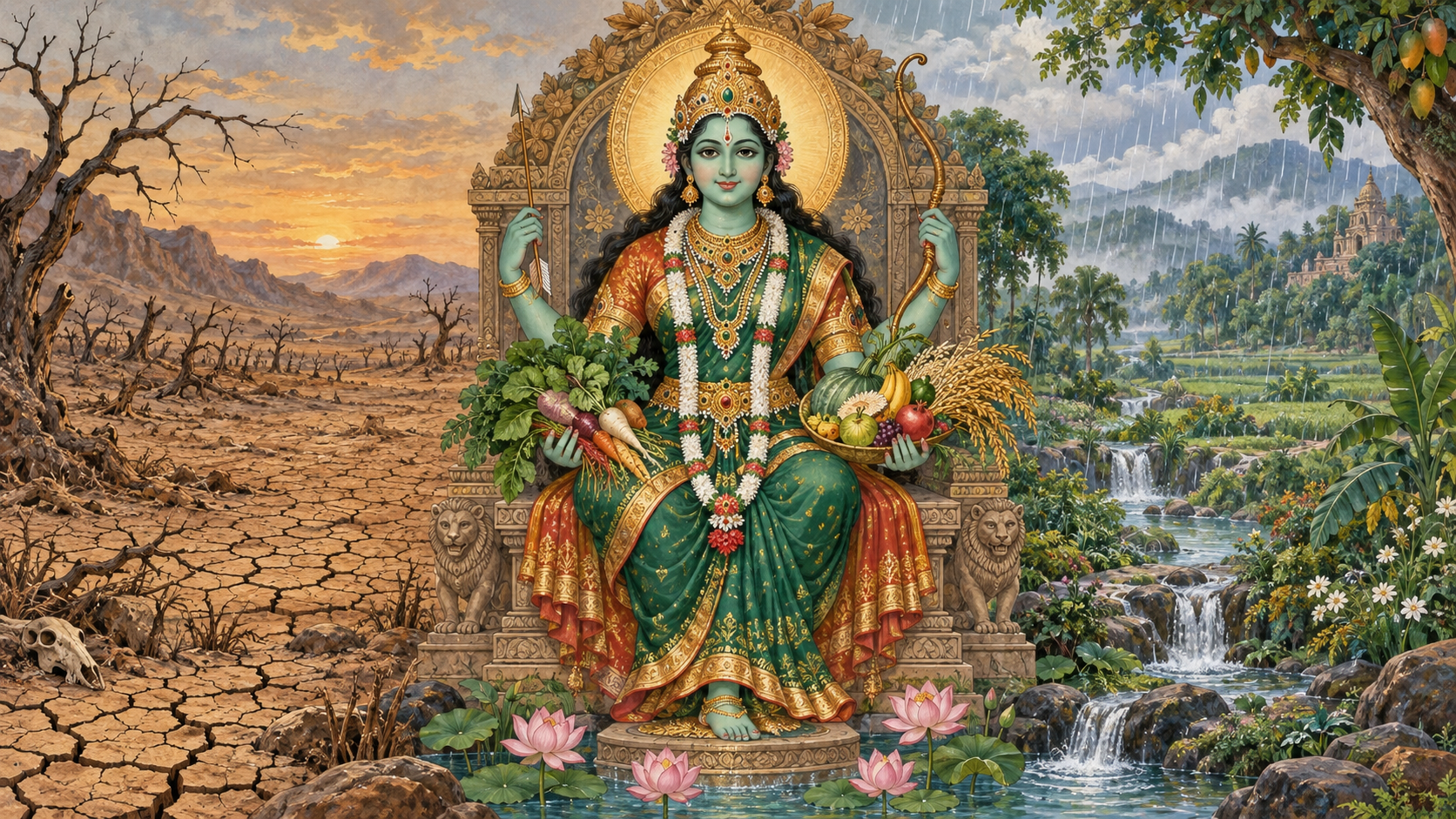
If you are looking at Shakambhari Devi and wondering why vegetables, a lotus and weapons belong in the same sacred image, begin with the crisis she answers. Her form joins hunger, water, compassion and protection. The attributes are not an assortment of auspicious objects; together, they show how the Divine Mother restores a world that can no longer sustain life.
This gives you a reliable way to read a murti, painting or festival alankara. Notice the edible vegetation first, then ask how the eyes, weapons, lotus, complexion and number of arms deepen its meaning. Do not demand that every regional image reproduce every feature literally.
Begin with the crisis that makes her form necessary
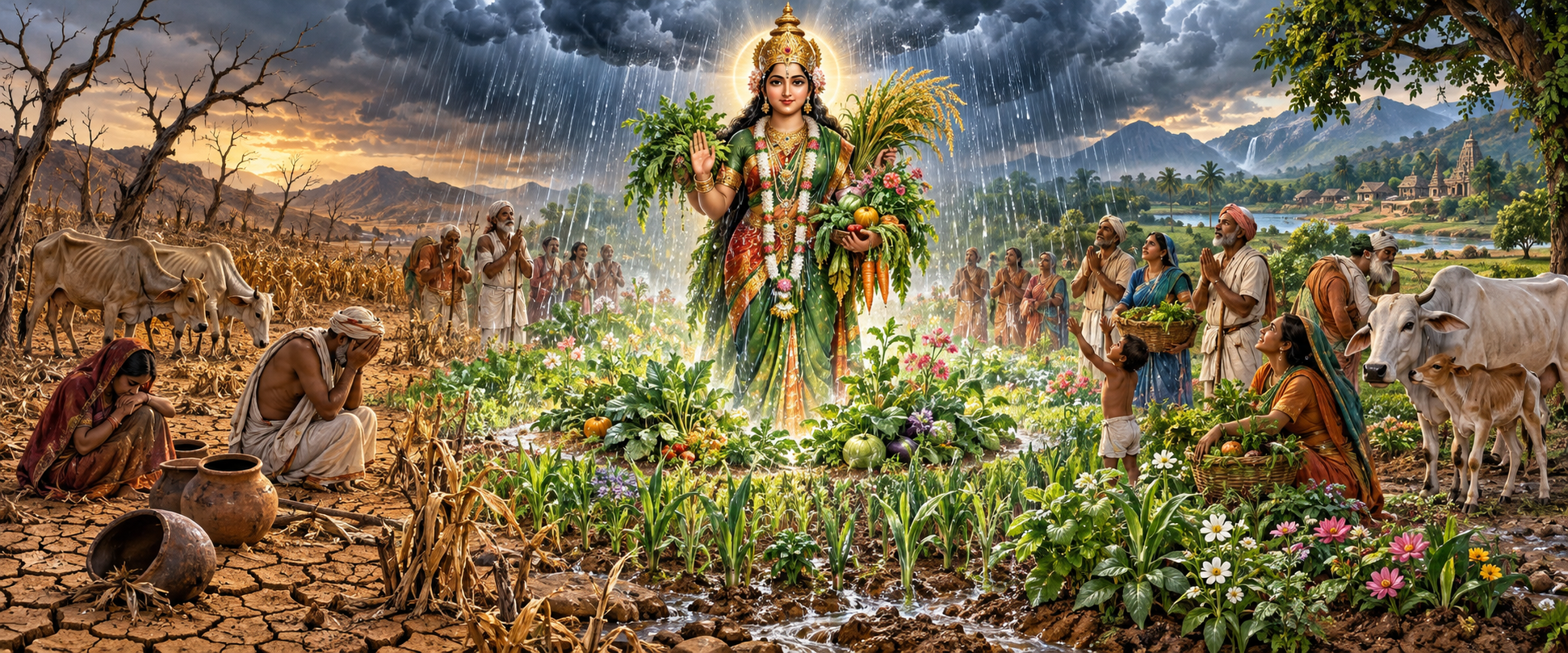
The scriptural identity of Shakambhari Devi belongs to the Shakta understanding of the Supreme Goddess as both the power behind existence and the compassionate Mother who intervenes when creation is imperilled. Her identity is associated with the Devi Mahatmya, also known as the Durga Saptashati or Chandi Patha and contained within the Markandeya Purana, as well as with the Devi Bhagavata Purana.
The Devi Mahatmya presents her manifestation in a prophetic passage: during a devastating absence of rain, the Goddess will sustain the world with vegetation arising through her own being. She will also defeat Durgama, the force associated with that crisis. The Devi Bhagavata Purana gives the episode a fuller narrative setting. Details and emphasis can vary between tellings, but the governing sequence remains clear: beings suffer, the Mother sees them, nourishment returns, and the obstruction is overcome.
That sequence prevents two common misreadings. Shakambhari is not merely an agricultural emblem, because she acts as the sovereign Devi who protects dharma. She is not merely a warrior with unusual accessories either, because her victory is measured by the return of food and life. Her martial and nourishing aspects belong to one response.
The name directs your attention to shaka: edible vegetation, especially greens and plant food. In practical terms, this is the first identifying clue. When a Devi holds or is surrounded by vegetables, fruits, roots, leaves or other produce, the image is asking you to see nourishment as sacred power made visible.
Read the attributes as one visual sentence
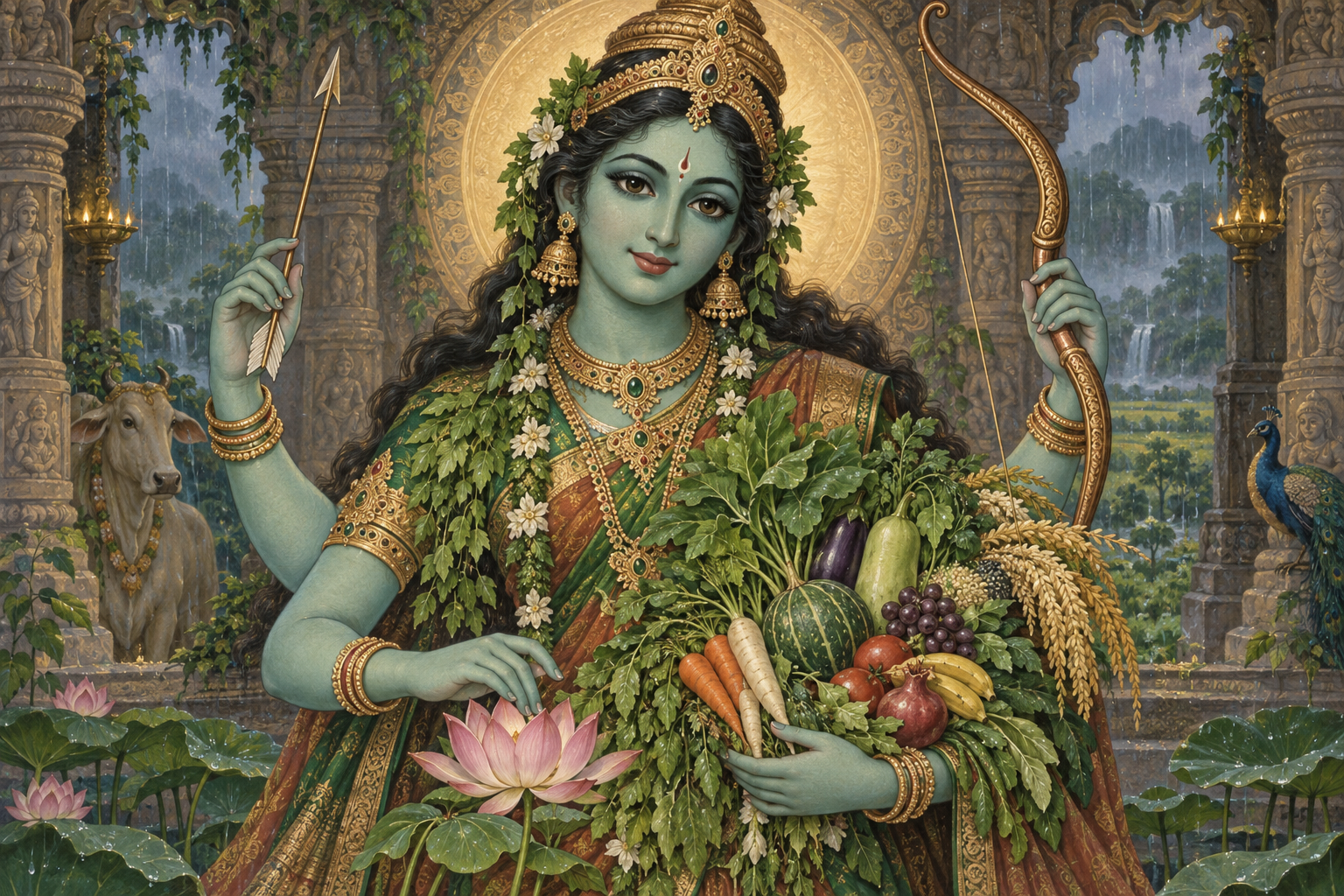
Temple images and paintings do not all follow one modern design sheet. Some forms are four-armed; others may be rendered differently by regional tradition or by a particular alankara. Hand positions, complexion and the amount of produce may also vary. Read the cluster of attributes before treating one detail as decisive.
| Visible feature | What it contributes | How to read it carefully |
|---|---|---|
| Vegetables, fruits, roots or greens | Life restored through edible vegetation | Treat this as the principal identifying feature, not decorative garnish. |
| Bow and arrows | The power to confront the cause of disorder | Read protection and nourishment together; neither cancels the other. |
| Lotus | Divine sovereignty and spiritual auspiciousness | It shows that survival is not the limit of her grace; dharmic and spiritual life must also recover. |
| Multiple arms | Several divine capacities acting at once | Do not reject an image because its arm count differs from another regional representation. |
| Blue, dark or vegetation-associated colouring | Water, rain-bearing depth and renewed fertility | Regard colour as a meaningful convention where it appears, not as a universal identification test. |
The produce is especially important because it is living or freshly gathered food rather than an abstract emblem of prosperity. Grain in a storehouse can indicate accumulated abundance. Shakambhari’s greens, roots and fruits direct attention to the more basic miracle on which any storehouse depends: soil, water and plant life must first become capable of feeding beings.
This also explains why the image should not be reduced to a slogan about diet. The vegetables do not, by themselves, settle every question about what every worshipper must eat. Their central claim is larger: embodied life depends upon nourishment, and the power that restores nourishment is a form of Devi’s compassion.
Shatakshi reveals what divine compassion means

Shakambhari is closely connected with the name Shatakshi, the hundred-eyed Goddess. In the drought narrative, the eyes express her complete awareness of suffering; their tears are associated with the water that relieves the parched world. Seeing and nourishing are therefore consecutive acts. Compassion begins by refusing to overlook distress and becomes complete by sustaining those who suffer.
You should not expect every image to show a face covered with a literal count of one hundred eyes. Sacred iconography often concentrates an expansive divine quality into a name, a narrative memory or a smaller set of visible signs. A conventional face can still belong to Shatakshi-Shakambhari when the identification, vegetation and ritual context establish the form.
The eyes also correct a shallow reading of abundance. Shakambhari does not distribute food because prosperity is pleasant to display. She nourishes because she has seen beings brought to the edge of survival. Her abundance is a response to suffering, not an ornament of privilege.
For a devotee, this turns an iconographic detail into a discipline. To honour the hundred-eyed Mother is to notice hunger that ordinarily escapes attention: the person excluded from a meal, the animal dependent on human care, the household concealing scarcity, or the land whose declining fertility is visible but ignored. The scriptural image does not let seeing remain passive.
Weapons do not contradict the Mother who feeds
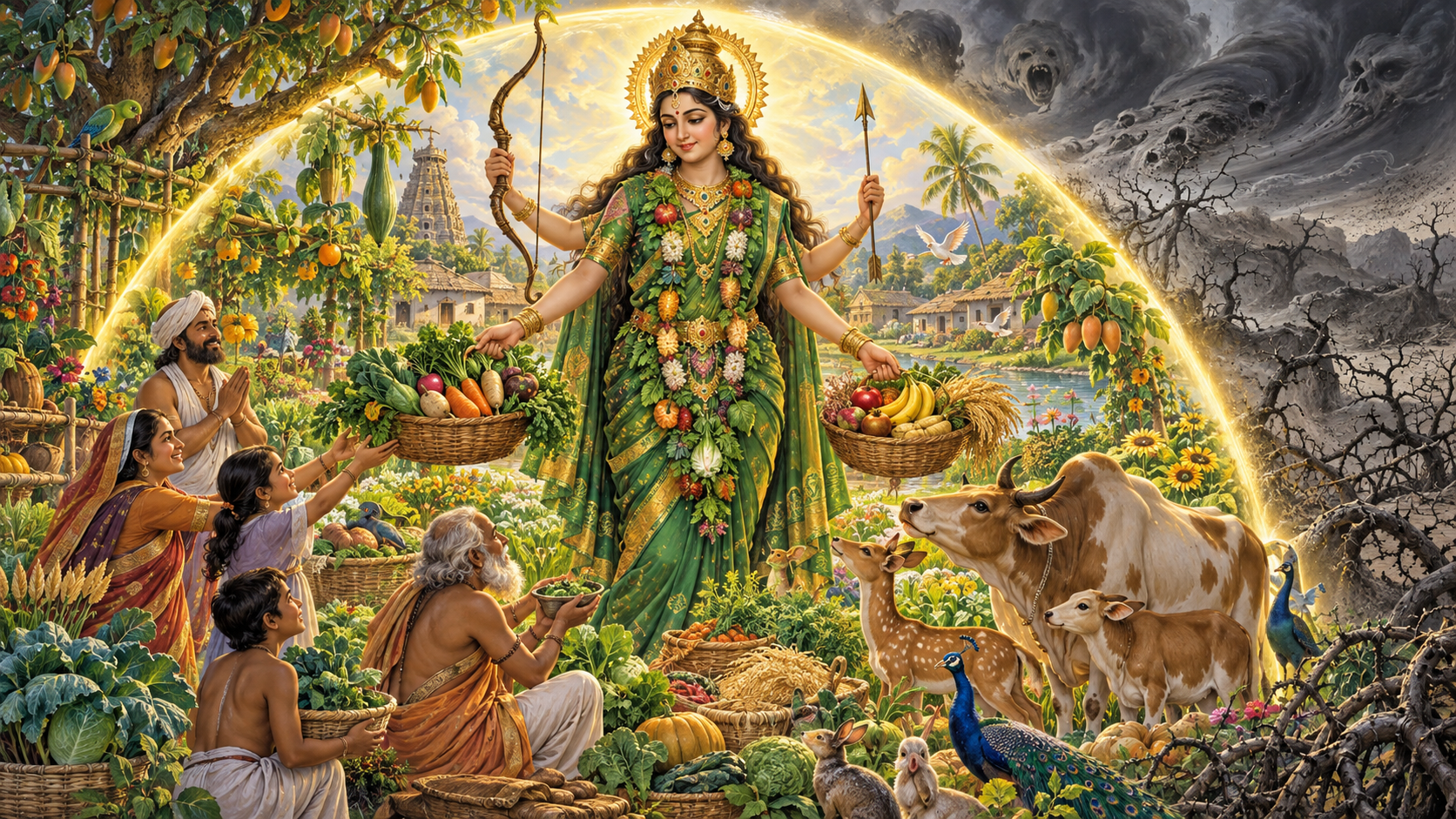
A bow or arrow can appear startling beside vegetables. That tension is deliberate. Hunger is not always answered by producing food alone. The condition that destroys or obstructs life may also have to be confronted. Durgama gives the crisis an adversarial dimension, and the weapons show that the Mother is capable of removing what prevents restoration.
This is a familiar Shakta principle expressed with unusual clarity: compassion is not helplessness. The Devi who gives food is also the Devi who defends the conditions in which food can grow and be shared. Her gentleness toward suffering beings and her severity toward destructive disorder arise from the same commitment to life.
The lotus ensures that the meaning does not stop at material survival. Food and water make embodied life possible, but dharma asks what that life is for. The lotus introduces purity, auspiciousness and spiritual orientation into the restored world. Shakambhari’s gift is not simply more consumption. It is the renewed possibility of worship, duty, learning, generosity and liberation.
An ecological interpretation naturally follows, provided it remains anchored in the theology. Vegetation comes from the Goddess’s own life-giving presence, so the living world cannot be treated as spiritually empty matter. Yet Shakambhari is more than a poetic name for nature. She is conscious Shakti: she sees, nourishes, protects and defeats adharma. Preserve both sides of that understanding.
How to identify the form without flattening local tradition
One vegetable, vessel or weapon is rarely enough to identify a Devi. Use several clues and give local tradition its proper weight. This matters especially during festivals, when an established temple deity may receive Shakambhari alankara without ceasing to be known by her principal local name.
- Read the temple label, invocation or local account before assigning a name from appearance alone.
- Look for living produce as the visual centre. A stray fruit offered at the feet is not the same as vegetation defining the Goddess’s form.
- Ask whether the image evokes drought, rain, Shatakshi or the restoration of food. That narrative setting is stronger evidence than colour by itself.
- Notice whether martial attributes accompany the produce. Their combination strongly expresses Shakambhari’s union of nourishment and protection.
- Separate permanent iconography from temporary decoration. A festival arrangement may interpret a deity through Shakambhari’s mode without claiming that every displayed vegetable is a fixed sculptural attribute.
The distinction from Annapurna is useful but should not be turned into a rigid rule. Annapurna is commonly recognised through prepared nourishment and the act of serving, often expressed through a food vessel and serving implement. Shakambhari places stronger emphasis on vegetation itself and on restoring a world damaged by scarcity. Both reveal the Mother as giver of food, but they bring different moments in the journey from earth to meal into focus.
When documenting a murti, use qualified wording for features that vary. Write that Shakambhari is often represented with produce and martial attributes, rather than declaring that every valid image must display an identical arrangement. If a temple preserves a dhyana verse or an established oral identification, let that local evidence guide your description.
Key takeaways for darshan and interpretation
- Begin with edible vegetation. It is the clearest visual expression of Shakambhari’s identity as the Mother who restores nourishment.
- Connect the form to crisis, not generic abundance. Drought and hunger explain why her gifts appear with urgency.
- Read Shatakshi’s many eyes as all-seeing compassion that notices suffering and responds to it.
- Read the weapons beside the produce. The Goddess protects the conditions that allow beings to live; she does not merely decorate scarcity with symbols of plenty.
- Treat arm count, hand arrangement and colour as potentially variable. Use the full iconographic cluster and the local ritual name.
- Keep ecological meaning within the Shakta frame: the natural world is infused with divine power, while the Goddess remains a conscious, sovereign protector rather than a metaphor alone.
The next time you encounter Shakambhari Devi, pause before trying to inventory every hand. Let the vegetation name the need, the eyes reveal who has been seen, and the weapons show what must be defended. Then carry the darshan into one concrete act: protect food from waste, share nourishment, or attend to a living source of sustenance that your household depends upon.
References

Leave a Reply
You must be logged in to post a comment.