

You have opened a Purana, reached a description of the world, and encountered a difficult question: are you meant to read it as geography, cosmology, sacred symbolism, or some combination of the three? A quick verdict will usually tell you more about the reader’s assumptions than about the passage.
A better approach is to treat Bhuvana Kosha as an ordered account of a world before asking whether it corresponds to a modern map. That change in sequence matters. It lets you examine what the text actually arranges, what kind of relationships it establishes, and where a physical-geographic interpretation is warranted.
Start with what the name can safely tell you
Bhuvana Kosha is a Puranic expression for a compendium of the universe. The related expression bhuvana vinyasa emphasizes the layout or arrangement of that universe. These terms identify a field of description: the worlds, regions, divisions, boundaries, directions, and relationships through which an intelligible cosmos is presented.
Do not let the English word “dictionary” mislead you into expecting an alphabetical reference book. Use “compendium” as the more practical reading cue. A kosha gathers a body of knowledge; vinyasa draws your attention to how its parts are placed in relation to one another. This distinction is best used as a reading heuristic, not imposed as an inflexible rule on every occurrence of the terms.
Geography was not merely decorative knowledge in ancient Hindu life. It was important enough to receive a recognizable place within Puranic learning. The subject could also stand independently: Rajashekhara composed a work titled Bhuvana Kosha, known through its mention in his Kavyamimamsa. That mention shows that the expression could name a distinct intellectual undertaking. It does not, by itself, reveal the detailed contents of Rajashekhara’s work, so you should not attach a particular surviving cosmographic scheme to it without further evidence.
This gives you a useful first principle: Bhuvana Kosha is a subject category, not a guarantee that every Puranic description is doing exactly the same job in exactly the same way.
Read a cosmographic passage in six disciplined passes
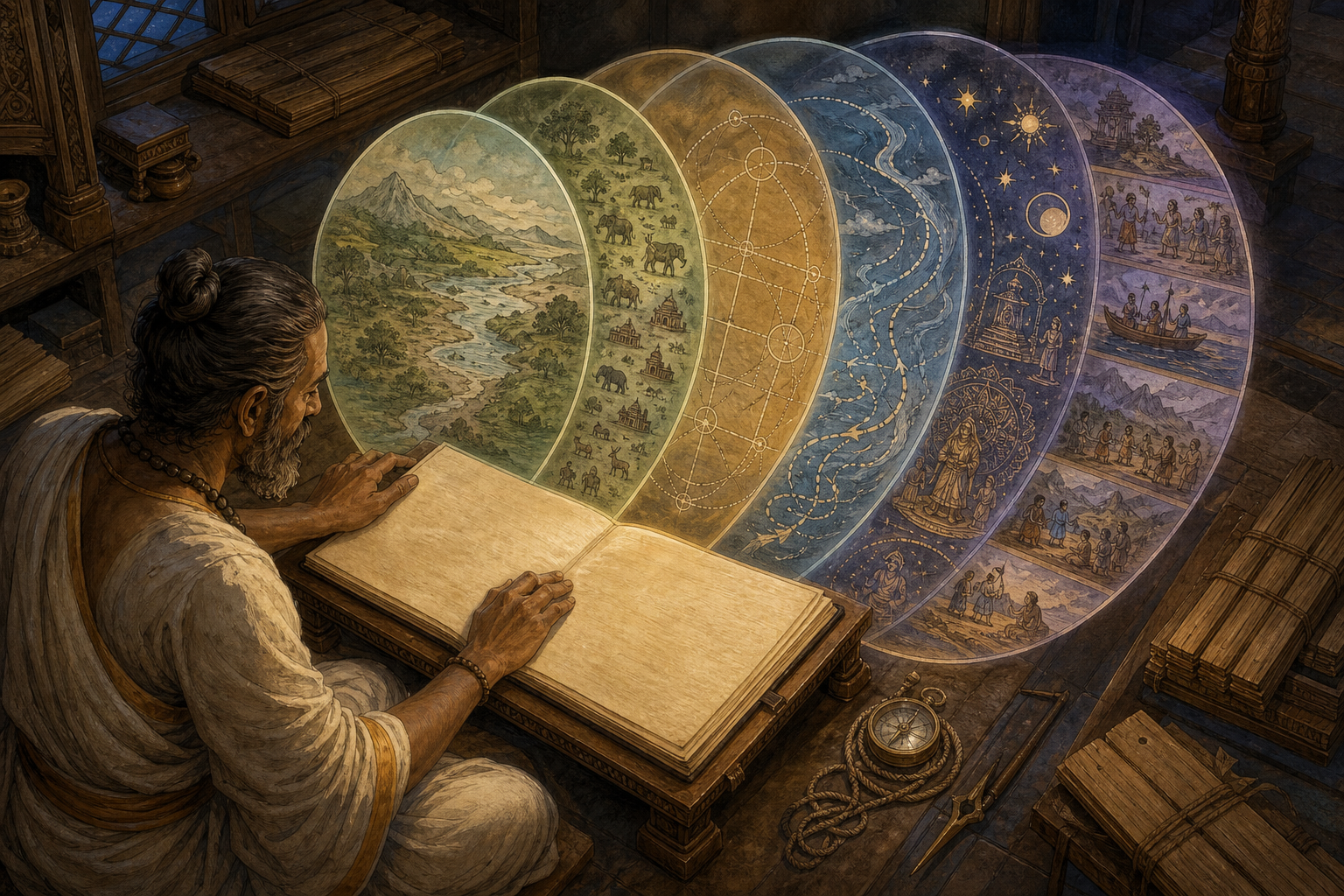
The most common mistake is to begin with identification: “Which modern country is this?” or “Where would this appear on a globe?” Identification may eventually be possible, but beginning there encourages you to force unfamiliar categories into familiar ones. Work from the passage outward instead.
- Define the textual unit. Read the passage together with what immediately precedes and follows it. A description used to orient a narrative may function differently from one presented as a systematic account of the worlds.
- Inventory what is explicitly named. Record places, regions, directions, boundaries, inhabitants, and levels without translating them prematurely into modern equivalents. Keep repeated terms in their original order.
- Extract relationships. Mark only what the passage actually establishes: one region surrounds another, a realm lies above or below another, a boundary separates two domains, or a sequence moves from one division to the next. Relationships often remain clear even when identification does not.
- Classify each statement provisionally. Ask whether it describes physical location, cosmic hierarchy, sacred significance, narrative movement, or more than one of these. These are working labels for your analysis, not categories you should pretend the Purana itself formally announces.
- Test the internal scale before importing an external one. Does the description provide a consistent unit, a sequence, a center, a boundary, or another organizing rule? If the text does not supply what a scaled modern map would require, do not silently invent it.
- Assign a confidence level to your conclusion. Separate what is explicit from what is inferred and what remains unresolved. “The passage places A beside B” is a textual observation. “A must therefore be modern C” is a further claim that needs further evidence.
This method protects two kinds of knowledge at once. It preserves the passage’s own architecture, and it leaves room for geographic investigation where the wording supports it. You do not have to decide in advance that everything is literal, symbolic, historical, or imaginary.
Avoid the false choice between a modern map and a myth

Cartography and cosmography answer different questions
A modern map normally helps you locate, measure, and navigate within physical space. Cosmography has a wider task: it presents the structure of a world and situates its domains in a meaningful order. A text can therefore contain geographic knowledge without behaving like a modern atlas. Failure to provide modern coordinates is not, on its own, proof that a passage contains no geography.
The reverse caution matters just as much. Calling a description cosmographic does not automatically establish that every feature corresponds to a measurable terrestrial location. Ask what kind of claim each line makes. Do not demand cartographic precision from a statement about cosmic order, and do not turn an ordinary directional statement into pure allegory simply because it occurs in a sacred text.
Symbolic does not mean arbitrary
A symbolic reading still needs textual discipline. You should be able to point to repetition, contrast, hierarchy, narrative function, or another feature that supports the proposed meaning. If any element can symbolize anything, interpretation has stopped being interpretation and become invention.
Use a simple test: explain why the proposed meaning fits this element, in this position, in this passage. Then ask what would count against your reading. An interpretation that cannot possibly be corrected is not strong enough to carry a historical or theological conclusion.
Reverence and scrutiny belong together
A pro-Dharmic reading need not choose between uncritical literalism and dismissive ridicule. Reverence asks you to understand the text on its own terms before judging it. Scrutiny asks you not to claim more than the wording and context can support. Both habits defend the tradition from careless interpretation.
Keep three kinds of statements separate in your notes. First, record what the passage explicitly says. Second, state your reasoned interpretation and the evidence for it. Third, label any proposed modern correlation as tentative unless the identification is independently secure. This prevents a plausible suggestion from quietly becoming an alleged scriptural fact.
Use a one-page worksheet for your next passage

You can turn the method into a repeatable practice. Divide one page into seven lines and complete each line without consulting a modern map during the first pass:
- Passage: the exact textual unit and its immediate context.
- Entities: every named world, region, place, boundary, or class of inhabitants.
- Relations: above, below, within, around, between, beside, or in sequence – but only where stated.
- Organizing principle: direction, enclosure, hierarchy, movement, sacred importance, or another observable pattern.
- Function: what the description is doing at this point in the larger narrative or exposition.
- Possible correlations: modern geographic identifications, kept separate from the textual inventory.
- Unresolved questions: missing scale, uncertain translation, ambiguous term, or insufficient context.
Finish with a three-sentence conclusion: “The passage explicitly establishes ___. It appears to organize the world by ___. The proposed geographic identification is strong, possible, or unresolved because ___.” That final sentence forces you to show the bridge between text and conclusion instead of leaping across the gap.
If you cannot complete one of the lines, leave it blank. “Unresolved” is a better result than a confident answer produced from missing evidence. You can then seek a fuller translation, commentary, parallel passage, or textual context with a precise question already in hand.
Key takeaways
- Bhuvana Kosha names a Puranic field of geographic and cosmographic knowledge; bhuvana vinyasa emphasizes the arrangement of the universe.
- Read relationships inside the passage before attempting modern geographic identification.
- Do not judge cosmography solely by the standards of a scaled navigational map.
- Do not call a feature symbolic unless its context, pattern, or function supports that reading.
- Separate explicit description, reasoned interpretation, and tentative correlation in your notes.
- The recognition of Bhuvana Kosha as an independent subject does not make every unsupported reconstruction equally credible.
At your next encounter with Puranic cosmography, resist the urge to solve the entire universe at once. Choose one passage, map its internal relationships, and write down exactly where observation ends and interpretation begins. That small discipline will take you further than either reflexive dismissal or forced certainty.
References
