
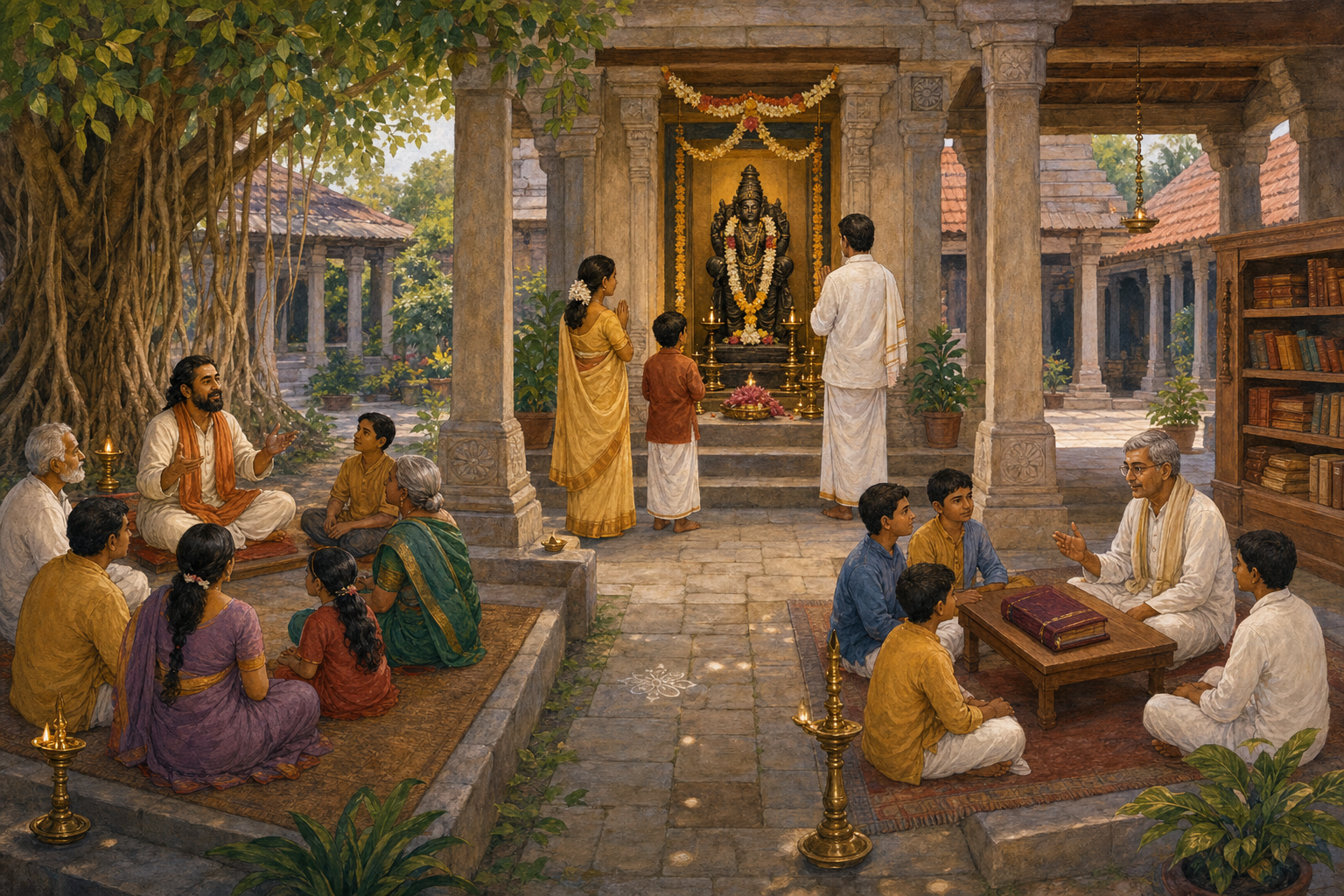
You may understand a Hindu teaching while hearing a katha, stand before a murti and miss what its form communicates, then open a scripture and wonder why the same tradition suddenly sounds procedural. The difficulty is not necessarily inconsistency. You are meeting different ways of teaching.
Once you know what each mode is designed to do, you can read with more care. Narrative lets you enter a transformation. Iconography trains attention through sacred form and presence. Scripture defines a teaching, situates it within a lineage, and orders practice. You need all three without flattening any of them into the others.
Ask what kind of work the teaching is doing
The first mistake is to ask which form contains the real teaching. A katha, a murti, and a ritual text do not merely package the same information in three formats. Each can accomplish something the others cannot accomplish in quite the same way.
A narrative stages a predicament. It shows consciousness under pressure, moving from confidence to confusion, attachment, recognition, or surrender. Its teaching often lies in that movement rather than in a detachable moral at the end.
Iconography concentrates divine qualities into a form that can be beheld, remembered, worshipped, and encountered. Calling every feature a symbol is not enough. In a living tradition, a murti is not merely a diagram about the divine; devotees may approach it through darshana, worship, and a relationship with divine presence.
Scripture gives verbal precision and structure. It can name the goal, set out a discipline, preserve ritual knowledge, and place limits on an interpretation that might otherwise become purely subjective. Yet a passage also belongs to a particular text, tradition, audience, and purpose. It should not automatically be turned into a command for every Hindu.
When you meet a teaching, begin with three diagnostic questions:
- Narrative: What change in standpoint makes the teaching visible?
- Iconography: What does the sacred form direct you to behold, and what relationship does it establish?
- Scripture: What does the passage ask its intended reader or practitioner to understand, perform, or become?
Those questions prevent a common category error: criticizing a story for not behaving like a philosophical definition, treating a murti as if it were an illustrated glossary, or reading a ritual instruction as if it were an independent proverb.
Read a sacred narrative by following the transformation
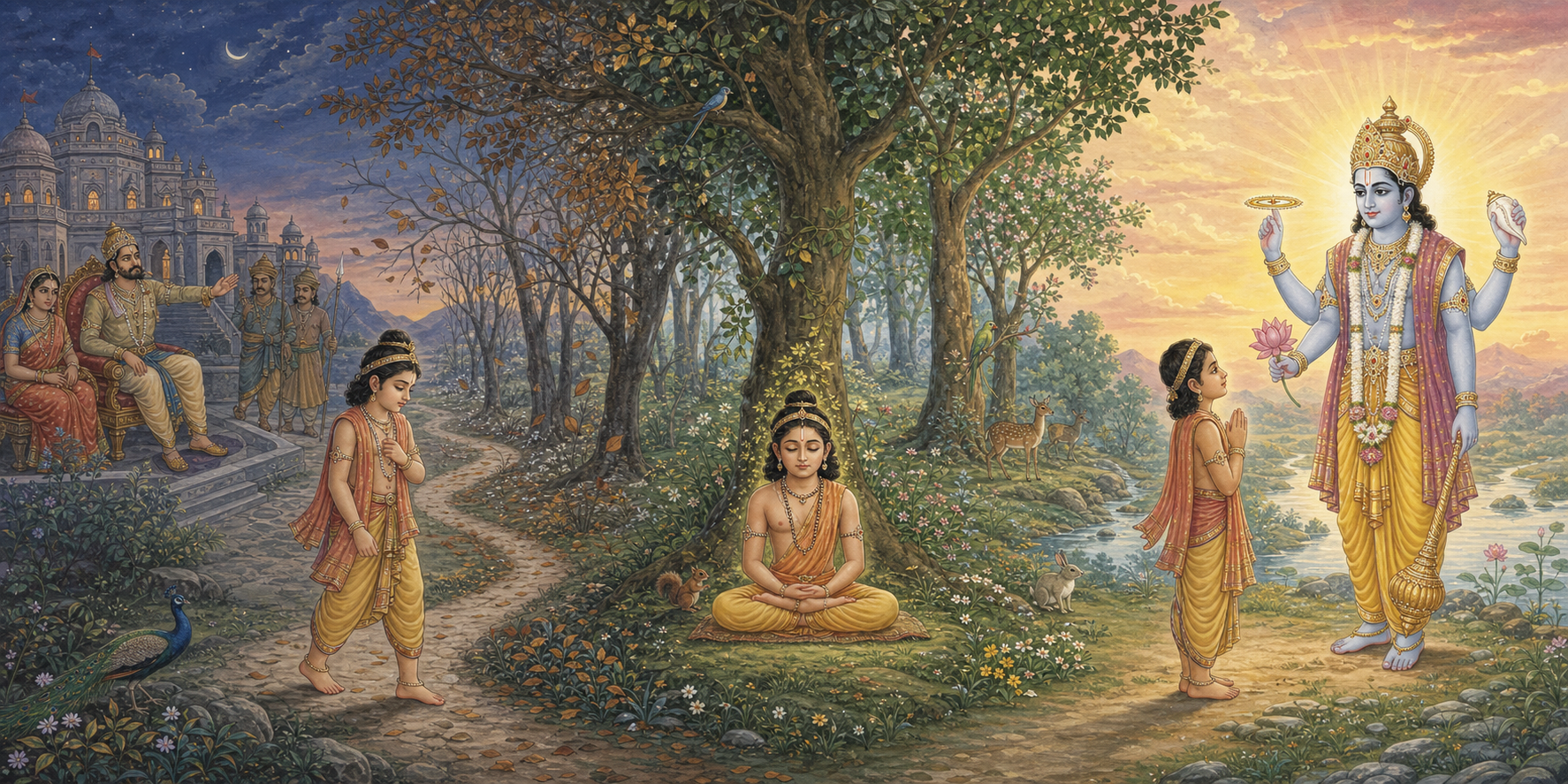
The encounter between Narada and Bhagavan Vishnu gives you a clear example of narrative teaching. Narada asks Vishnu to show him Maya, and the answer comes through an experience in which the sage becomes a woman. The question is not answered by handing Narada a compact definition. The knower himself has to pass through a changed condition.
That narrative choice matters. An abstract explanation could leave Narada standing outside Maya, imagining that he already possessed the distance needed to understand it. An immersive experience tests that confidence. It directs your attention toward the way a particular identity and set of circumstances can fill awareness so completely that the standpoint from which you began is no longer governing perception.
This is a disciplined reading of the episode, not an exhaustive definition of Maya for every Hindu school. Different traditions can give the term different metaphysical weight. The narrative contributes something more immediate: it makes you notice how quickly the experienced world can become total from inside a particular standpoint.
Read this kind of katha in five passes:
- Name the opening certainty. What does the central figure think can be known, controlled, or explained?
- Find the threshold. Mark the moment when the ordinary frame of experience changes.
- Track identification. Notice what the figure begins to experience as self, role, relationship, duty, possession, or world.
- Look for recovered perspective. If the narrative includes recognition or return, ask what becomes visible afterward that could not be seen from inside the experience.
- State an observation before stating a doctrine. Begin with, “This narrative makes me notice…” That phrasing keeps you from inflating one episode into a universal account of Hindu philosophy.
The transformation into a woman also requires interpretive care. A crude conclusion that womanhood itself is Maya confuses the vehicle of Narada’s instruction with the object of the instruction. Narada is the one whose standpoint is being tested. The useful question is what the changed identity does to his awareness, not whether femininity should be treated as a spiritual defect.
You can bring the episode into self-examination without pretending that your life reproduces Narada’s experience. When a professional role, family responsibility, success, loss, or conflict begins to occupy your whole field of attention, ask: What has become so immediate that I can no longer see the standpoint from which I entered it? That question turns the narrative into a tool of discernment without reducing it to a slogan.
Read a murti as presence and as a grammar of form
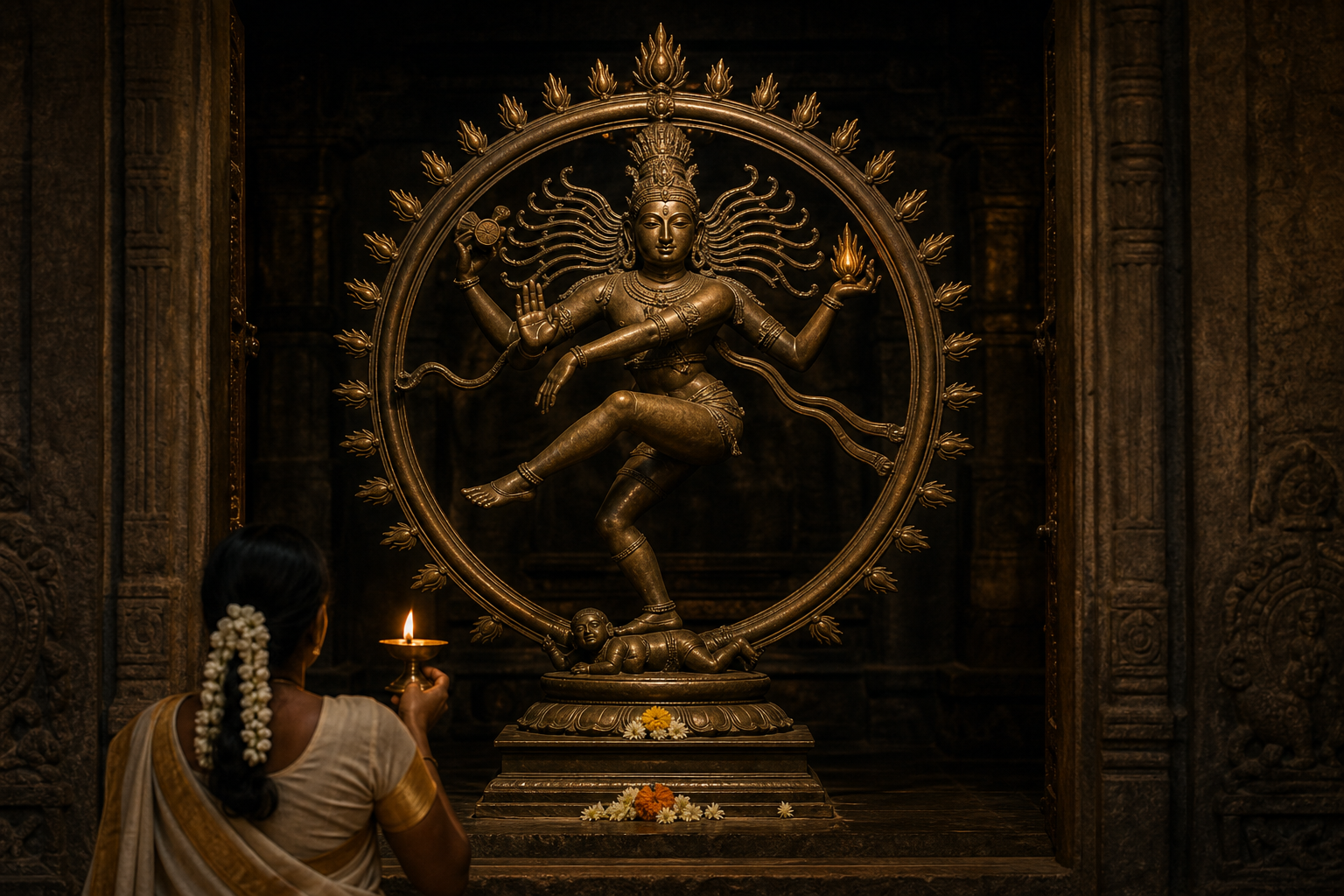
People often rush from seeing a sacred image to decoding it. They identify an object, search for a fixed symbolic meaning, and assume the work is finished. That method misses both the visual composition and the devotional relationship.
Mariamman shows why context must come first. She is a powerful goddess of the Shakta tradition, widely revered across Tamil Nadu, Karnataka, Andhra Pradesh, and diaspora communities in Malaysia, Singapore, South Africa, Mauritius, and Fiji. Such geographic and communal breadth should caution you against assuming that one detached checklist exhausts the meaning of every local form.
Use a four-part method when you encounter a murti or sacred image:
- Establish identity and setting. Record the name used at that shrine, the tradition in which the form is worshipped, and any local account provided by the temple or community. Do not assume that a familiar name makes the local form self-explanatory.
- Observe before interpreting. Note posture, hands, held objects, expression, adornment, surrounding figures, and the arrangement of the shrine. Separate what you actually see from what you expect to see.
- Ask what relationship the whole form creates. Does it invite nearness, reverence, dependence, courage, awe, protection, surrender, or some combination? Do not isolate one feature before attending to the composition.
- Confirm the reading within the tradition. Use the shrine’s liturgy, local sacred narratives, and lineage explanations to distinguish a stable iconographic convention from a local feature or your own association.
This sequence is especially important when a form is unfamiliar. Your first reaction is evidence about your own habits of seeing; it is not yet a reliable explanation of the deity. If a form appears fierce, for example, visual intensity does not by itself establish moral malevolence. You still have to ask what that intensity means within its devotional and theological setting.
It is equally misleading to reduce a Shakta deity to a psychological archetype. An image can carry symbolic meaning while also being approached as Devi in worship. Keep those dimensions together. The symbolism helps you read the form, but it does not give you permission to explain away the presence to which the devotee is responding.
At your next temple visit, try a simple discipline. Spend your first period of attention naming only what is present in the form. Interpret afterward. That pause exposes how often inherited assumptions arrive before observation, and it gives local tradition room to correct them.
Read scripture within its lineage, purpose, and sequence

A sacred text can feel more authoritative than a story or image because its words look precise on the page. Precision, however, does not eliminate context. It makes careful context more necessary.
The Parama Samhita is a Pancharatra work of thirty-one chapters that offers a framework for spiritual practice and divine worship. Those identifiers matter before any individual passage is applied. “Pancharatra,” “Samhita,” and the work’s sustained chapter structure tell you that you are not handling an isolated saying intended to float free of a ritual and theological world.
Use five checks before drawing a conclusion from a scriptural passage:
- Textual location: Name the work, its tradition, and the kind of text you are reading. “A Hindu scripture says” is too vague to support a serious claim.
- Passage function: Decide whether the section is explaining theology, praising the divine, directing worship, describing meditation, specifying qualifications, or promising a result. Different functions should not be read in the same tone.
- Intended practitioner: Ask who is being instructed and what preparation, role, or ritual setting the instruction presumes.
- Immediate sequence: Read what comes before and after. A rule may depend on a definition, qualification, or earlier stage that disappears when one sentence is extracted.
- Level of application: Distinguish an idea you can contemplate from a formal practice that belongs within guided worship. If the passage concerns specialized ritual, seek instruction within the relevant lineage rather than improvising from a translated line.
Retain important Sanskrit terms when an English equivalent narrows them too quickly. You do not need to leave every word untranslated, but you should know when a translation has made an interpretive choice. Record the original term beside the translation and watch whether its meaning shifts as the chapter develops.
Scripture can correct the other modes without displacing them. A memorable narrative may tempt you to overgeneralize; textual context can limit that leap. A striking image may generate a private association; lineage teaching can test it. The correction also works in the other direction. Narrative can reveal the lived stakes of a concept, while worship prevents scriptural study from becoming an exercise in collecting definitions.
These modes also overlap. A scripture may contain narrative, and a murti’s iconography may depend on narratives and ritual prescriptions. Treat “story,” “form,” and “scripture” as teaching functions, not as sealed compartments.
Bring the three modes into dialogue without forcing agreement
Narada’s encounter with Maya, Mariamman’s iconography, and the Parama Samhita are not three versions of one doctrine. Do not manufacture a correspondence simply because all three belong within Hindu traditions. They demonstrate three ways spiritual understanding can be cultivated: transformation enacted in narrative, divine qualities encountered in sacred form, and practice ordered through a lineage text.
When you study one theme across several modes, use a single page with three headings:
- Katha: What transformation makes the teaching felt rather than merely stated?
- Murti: What does the form organize your attention around, and what devotional relationship does it invite?
- Shastra: What terms, practices, qualifications, and boundaries does the textual tradition supply?
Only after filling those headings should you synthesize. First state what genuinely overlaps. Then state what each mode contributes that cannot be replaced by the others. Finally, leave any unresolved tension visible. A tension may signal different lineage priorities, a local tradition, a translation problem, or an assumption that still needs correction. Hiding it creates false clarity.
Key takeaways
- Ask what teaching job the medium performs before extracting a meaning from it.
- Read a katha by tracking changes in standpoint, identity, and recognition, not by hunting for a detachable moral.
- Observe a murti before decoding it, and confirm iconographic interpretations within the deity’s local and lineage context.
- Locate a scriptural passage by text, tradition, function, audience, and sequence before applying it.
- Let narrative, iconography, and scripture correct one another without pretending that they always say the same thing.
At your next temple visit or study session, choose one teaching rather than collecting many symbols. Record what the narrative changes, what the sacred form directs you to behold, and what the relevant text asks a practitioner to understand or do. If the three notes do not align, keep the difference visible and seek a lineage-specific explanation. That is how interpretation becomes more honest, and how study begins to shape practice.
References
- Hindu Blog – When Narada Became a Woman: A Simple Story That Explains Maya
- Hindu Blog – Mariamman Idol Form – Symbolism And Meaning Of Her Iconography
- Hindu Blog – Parama Samhita