
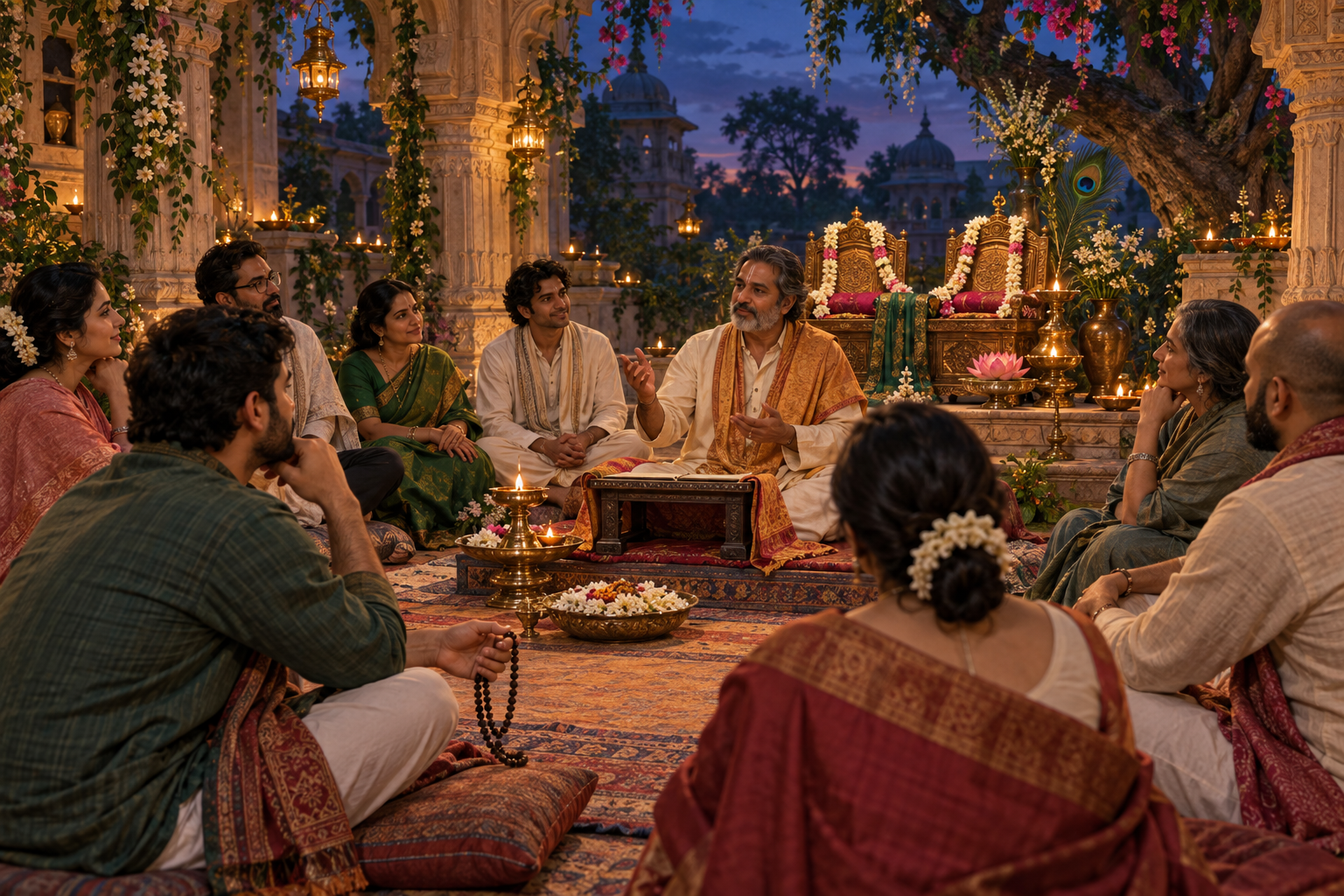
You can leave a Radha-Krishna discourse feeling uplifted and still be unsure what should change when you return to ordinary duties. The missing step is usually not another recording. It is a deliberate way of carrying sacred hearing into remembrance, discernment, and conduct.
Approach the next discourse with a question, listen for the kind of claim being made, and leave with a practice you can actually perform. That simple discipline keeps katha from becoming either passive entertainment or a collection of devotional phrases detached from life.
Begin with a question that devotion can answer

Before you press play or sit down in the assembly, write one question at the top of the page. Make it a question about your relationship with Bhagavan, your understanding of bhakti, or your conduct as a devotee. A narrow question gives your attention somewhere to return when the discourse moves through narrative, scripture, theology, and application.
Useful questions sound like these:
- What does service mean when I want recognition for serving?
- How does remembrance of Radha and Krishna change the way I speak to another person?
- What is the difference between loving devotion and the desire to possess?
- Which part of my present practice has become mechanical?
- What does this teaching ask me to notice about pride, distraction, or impatience?
Biographical details and narrative sequence still matter. They keep interpretation anchored. But if fact-gathering becomes your only mode of listening, you can know the names and events while missing the transformation the speaker is inviting. Keep your question open enough to be corrected. You are not searching the discourse for a sentence that confirms what you already think.
A good pre-listening intention can be written in one line: May I hear accurately, notice where this teaching meets my life, and avoid forcing it into my existing assumptions. That intention is more useful than expecting every session to produce an intense emotion.
Choose the right doorway into the teaching
Radha-Krishna devotion can be approached through a continuing sequence of katha or through a discourse shaped by a sacred occasion. You can enter through an ongoing session such as Krishna Katha at ISKCON Hong Kong. In that format, carry questions from one session to the next and watch for themes that return. Repetition is not wasted material; it can reveal what the teacher considers foundational.
You can also listen through a festival doorway, such as a Radhastami special class framed through Srimad Bhagavatam. Here, listen for the connection among the occasion, the scriptural foundation, and the devotional response being encouraged. Festival teaching often assumes that the listener knows why the day matters, so note any unfamiliar term rather than silently replacing it with your own meaning.
- In continuing Krishna-katha: track recurring teachings, unresolved questions, and the gradual development of an idea.
- In a Radhastami discourse: identify what the observance reveals about devotion and why the speaker has chosen a particular scriptural passage.
- In either setting: distinguish what is being narrated, what is being interpreted, and what you are being asked to practise.
Do not demand that one session provide a complete theology of Radha and Krishna. First identify the doorway. Then judge whether you listened according to the purpose of that doorway.
Separate narrative, theology, and practical instruction

A devotional speaker may move quickly among a sacred event, its theological meaning, and its application to the listener. If those layers merge in your notes, you may later remember an interpretation as though it were a direct scriptural statement, or treat a poetic description as an ordinary behavioral instruction.
Use three labels while listening:
- Narrative: What person, event, relationship, or scriptural setting is being described?
- Meaning: What does the speaker say this reveals about Radha, Krishna, the devotee, or bhakti?
- Practice: What response is being requested from the listener?
When the speaker changes layers, make a new note instead of allowing the ideas to run together. If a claim seems surprising, record the key term as the speaker uses it. Do not translate it too quickly into a familiar English category. A term carrying a particular meaning within a sampradaya may lose that meaning when reduced to a loose synonym.
This distinction becomes especially important when a discourse uses the language of intimate divine love. Radha-Krishna lila should not be flattened into the psychology of ordinary romance, nor should sacred narration be turned into permission for whatever an individual already desires. Ask what devotional disposition is being illuminated and how that disposition disciplines the ego.
If an application appears to give selfish conduct a sacred cover, pause. Revisit the context, check whether you crossed from narration to interpretation without noticing, and ask a qualified teacher how the passage is understood within that lineage. Reverence does not require careless inference.
Practise discernment without becoming a hostile listener
Faithful hearing is attentive, not gullible. Discernment helps you preserve a teaching accurately and prevents a memorable phrase from becoming a universal rule it was never meant to be.
Keep these questions beside your notes:
- Which scripture, passage, or traditional account is being explained?
- Can I tell when the speaker is citing a text, paraphrasing it, or offering commentary?
- Does the practical instruction follow from the teaching that came before it?
- Is the instruction meant for all listeners, or for people in a particular devotional setting?
- Does a technical term carry a lineage-specific meaning that I need to verify?
- Does my interpretation make me more responsible for my conduct, or merely more certain about other people’s faults?
Different sampradayas can use distinct vocabularies and emphases when speaking about Radha-Krishna tattva. Respecting those distinctions is better than blending every phrase into an imagined generic consensus. Whenever possible, record the speaker, community or lineage, scriptural anchor, and sacred occasion alongside the teaching. That context will matter when you return to your notes.
Mark an unfamiliar claim with verify instead of immediately accepting, rejecting, or repeating it. Then seek the surrounding passage or ask a teacher who understands that tradition. This is not suspicion. It is care for meaning.
Convert one insight into practice before the next discourse

A large collection of notes can conceal the absence of application. End each listening session by choosing one insight that reaches your actual conduct. The practice should be observable and within your control.
- Complete the sentence: This discourse is asking me to see…
- Name the inner obstruction that makes that vision difficult: pride, distraction, possessiveness, resentment, or another tendency you genuinely observed.
- Choose one action that expresses the teaching before you listen again.
- Attach the action to a situation that already occurs in your life.
- At the next session, review what you did rather than merely how much you remember.
Suppose you heard divine love described in terms of service rather than possession. Your note might read: Vision: love seeks the beloved’s good. Mirror: I become controlling when I want appreciation. Practice: during the next disagreement, I will ask a sincere question before insisting on my position.
Other applications might be protecting your established time for japa, reading the named scriptural passage in context, offering food with greater attention, making amends for harsh speech, or completing an unnoticed act of service without seeking credit. Select the action that follows from the teaching you actually heard. Do not choose an impressive practice merely because it sounds devotional.
Emotion can accompany sacred hearing, but emotion is not the only measure of it. A discourse may work quietly by correcting a mistaken assumption or exposing a habit you would rather ignore. Judge the fruit by whether remembrance becomes steadier, interpretation becomes more careful, and conduct becomes more aligned with dharma.
Key takeaways for your next listening session
- Arrive with one sincere question about devotion or conduct.
- Identify whether you are hearing continuing katha or teaching shaped by a festival occasion.
- Label narrative, theological meaning, and practical instruction separately.
- Preserve lineage-specific terms until you understand how the speaker is using them.
- Do not turn divine lila into a justification for ordinary desire.
- Mark unclear claims for verification instead of repeating them as settled teaching.
- Leave with one observable practice connected to your daily life.
For your next Radha-Krishna discourse, open a blank page before the recording begins. Write your question at the top and leave space at the bottom for a single practice. What happens between those two lines is the work of attentive hearing.
References
- Dandavats – Krishna Katha | HG Deena Bandhu Prabhu | 14 September 2026 | ISKCON Hong Kong
- Dandavats – Radhastami Special Class Speaker – HH Bhakti Vighna Vinasak Narsimha & HH Bhanu Swamis

Leave a Reply
You must be logged in to post a comment.