
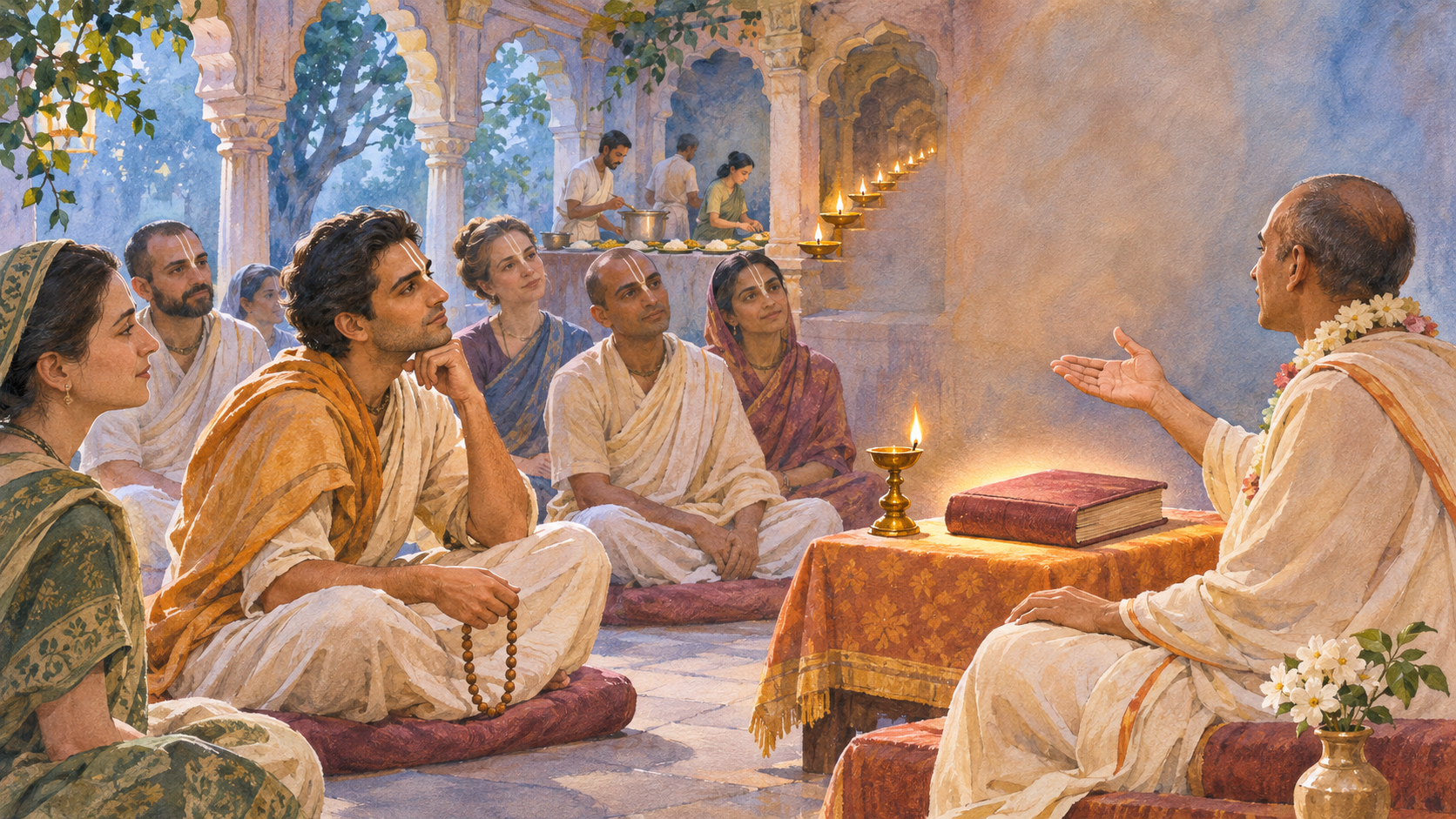
You open an ISKCON discourse because its title names a verse or an acarya. Before long, the speaker has moved through translation, commentary, lineage, devotional memory, and practical counsel. If you cannot tell where one ends and another begins, you may remember the conclusion without understanding how it was reached.
You do not need to choose between reverence and careful listening. A simple method can help you hear the text more accurately, recognize the role of parampara, and leave with an application you can actually explain.
Separate text, explanation, lineage, and application
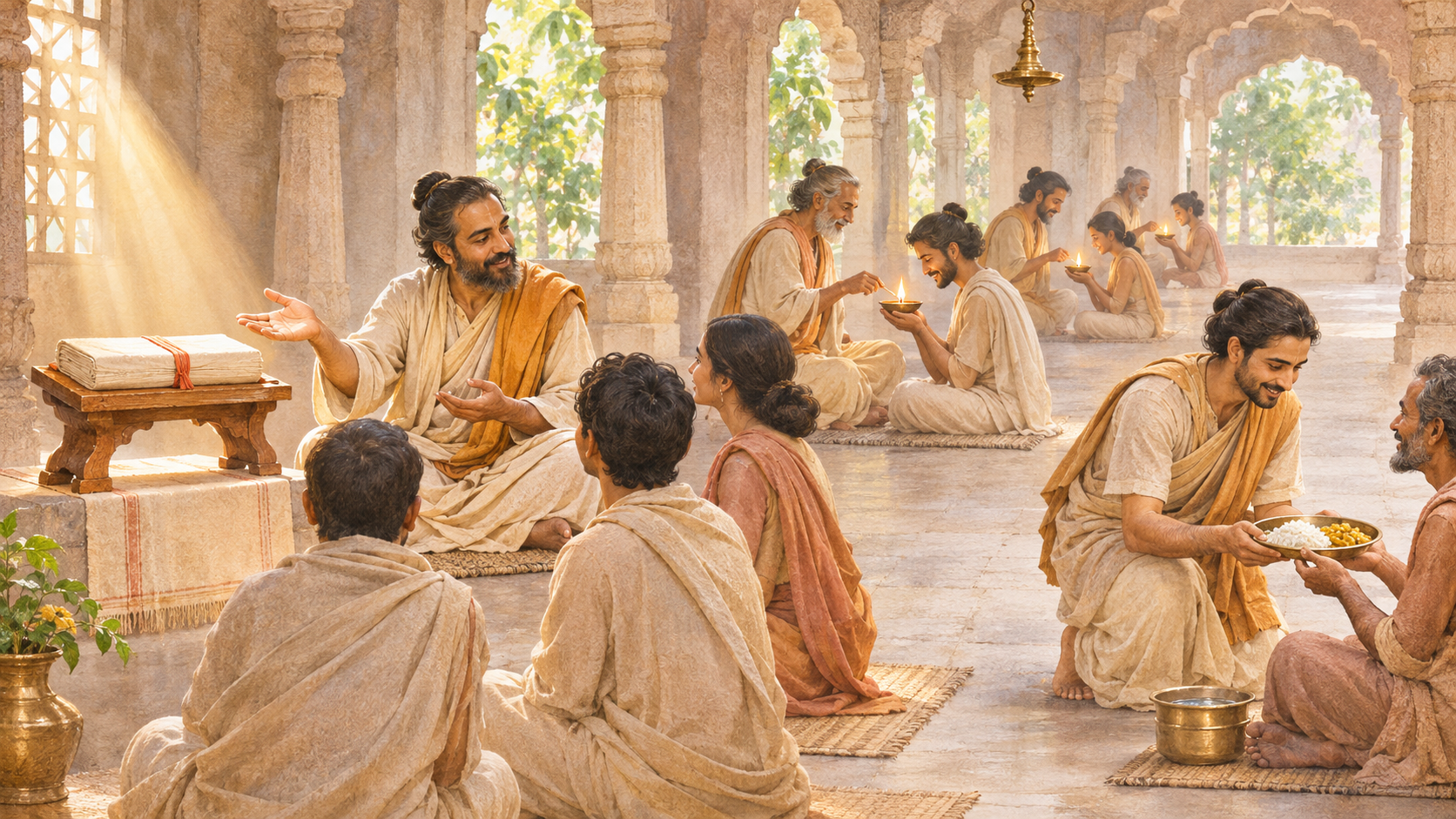
An ISKCON discourse commonly brings several kinds of statement into the same flow. They belong together, but they do not perform the same function. Listen for four layers:
- Text: What does the cited passage state? Record its location and the key words on which the discussion turns.
- Explanation: How does the speaker unfold the passage? This may include context, definitions, relationships between verses, or a paraphrase of the argument.
- Lineage: Which interpretive commitments come through the Gaudiya Vaishnava tradition and its teachers? This layer places the passage within a received theological vision rather than treating it as an isolated sentence.
- Application: What change in attention, conduct, prayer, study, or service is being proposed for you?
Make four headings in your notebook using those labels. Do not try to transcribe everything. Place each important claim beneath the heading that best describes it. When a sentence seems to belong in more than one place, mark the transition: Where did the speaker move from what the passage says to how the lineage understands it, and from that understanding to what you should do?
This distinction prevents two opposite mistakes. The first is to reduce a devotional discourse to textual information and miss its transformative purpose. The second is to treat every illustration, recollection, or practical suggestion as though it were the direct wording of shastra. Careful hearing preserves both authority and proportion.
Adjust your method to the kind of discourse
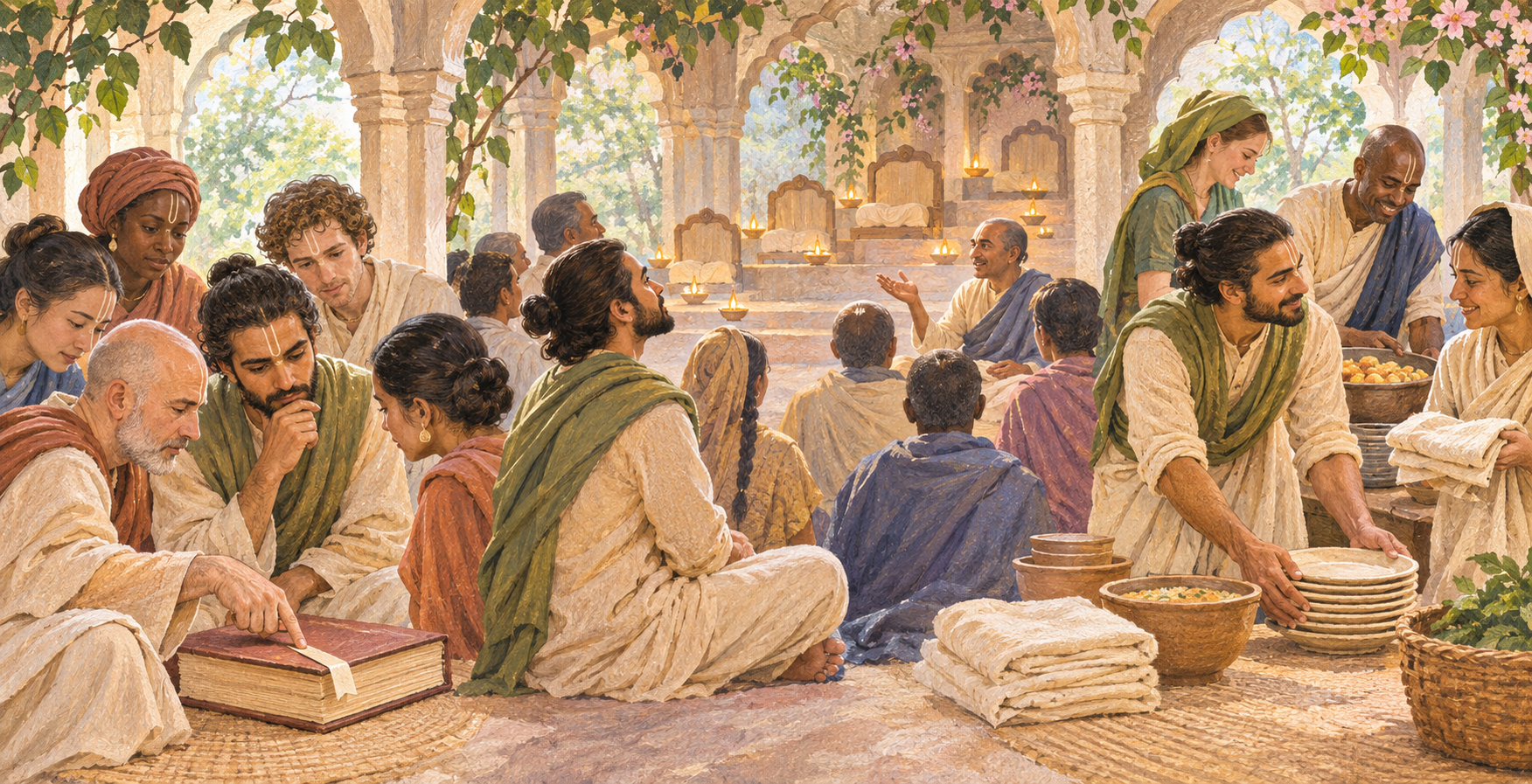
The title usually tells you what preparation will help. A discussion centered on one verse, a sequence of verses, and the life of an acarya each calls for a different first question.
When one verse anchors the session
A discourse announced around Caitanya-caritamrta, Adi-lila 5.98 gives you a precise textual anchor. Read the verse before listening if it is available to you. Then keep three questions visible: Which words receive the most attention? What larger teaching is the verse being used to establish? Which part of the conclusion is an application rather than a translation?
Afterward, read the neighboring passage. A verse number is an address, not a boundary around its meaning. The immediate sequence can show whether an idea is being introduced, developed, contrasted, or concluded.
When several verses form the unit
A session covering Srimad-Bhagavatam 9.15.27-31 invites you to follow movement across a passage. Do not flatten the verses into one undifferentiated message. Note where the action, speaker, question, mood, or conclusion changes. Then ask which transition carries the discourse’s main interpretive weight.
This is especially useful when one memorable sentence dominates your notes. Locate that sentence within the whole sequence. You may find that it states the starting problem, while the later verses supply the resolution.
When the subject is an acarya’s life
A presentation framed as Srila Prabhupada Lilamrita asks you to listen biographically. Record the event, the quality or teaching it illustrates, and the application proposed by the speaker. Keep those three steps distinct.
A life narrative can show what dedication, dependence on Krishna, teaching, or service looked like in a particular circumstance. That does not make every circumstantial detail a universal instruction. Ask what principle the episode embodies and whether the application follows from that principle. This lets devotional memory deepen practice without turning imitation into the measure of fidelity.
Honor spiritual lineage by hearing precisely
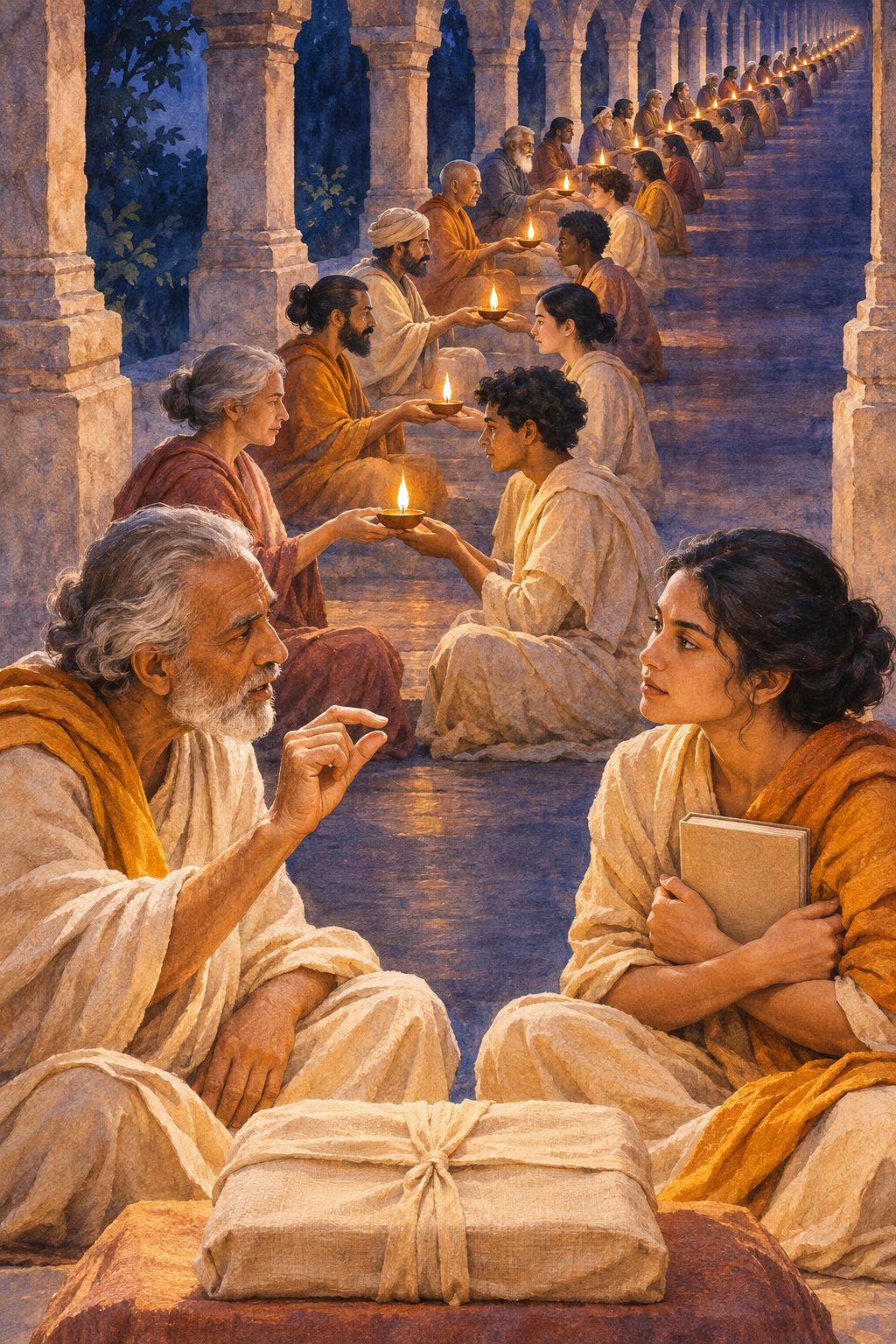
ISKCON discourses are not tradition-neutral lectures. Scripture is heard within a Gaudiya Vaishnava parampara. That lineage supplies a theological frame, a vocabulary, exemplary lives, and a disciplined way of connecting doctrine with bhakti.
Parampara should therefore make interpretation more accountable, not less. A lineage claim is stronger when you can identify the scriptural passage, understand the reasoning that connects it to the conclusion, and recognize how an acarya’s teaching guides that reasoning. The teacher is not being honored by making the chain of thought impossible to examine. Precision protects transmission.
Use these questions when a claim feels important, surprising, or difficult:
- What is the exact passage under discussion?
- Which part is a translation or direct restatement of the passage?
- Which part is an explanation received through the lineage?
- Is a story being used as evidence, illustration, or devotional remembrance?
- Does the practical instruction apply broadly, or is it tied to a particular role and circumstance?
- Can you restate the conclusion without making it stronger than the reasoning supports?
These are not hostile questions. They are forms of attentive shravana. Passive agreement can leave you with a slogan. Careful hearing leaves you able to locate the teaching, understand its lineage setting, and apply it without distortion.
Questions to use when a discourse leaves you unsure
Should you pause to verify every citation?
Usually, no. Constant interruption can break the discourse’s argument and devotional movement. Write down the citation and continue listening. Check it afterward. Pause immediately only when the rest of the discussion depends on exact wording that you cannot follow.
How should you handle rapid movement between shastra, commentary, and advice?
Build a hierarchy rather than a blended transcript. Put the textual statement first, the lineage-based explanation beneath it, and the proposed practice beneath that. Draw an arrow only when you can state the connection. A missing arrow tells you exactly what to revisit.
Does a personal memory of an acarya have the same function as scripture?
No. A recollection can carry genuine devotional and historical value, illuminate character, and show how teaching was embodied. It still functions differently from a cited scriptural passage. Preserve the memory as testimony; then identify the principle it illustrates before deriving a general instruction from it.
How can you tell whether you understood the discourse?
Try to write one sentence containing the main claim, its textual anchor, and its practical consequence. If you can state the application but not the anchor, return to the scriptural portion. If you know the citation but cannot explain why it matters, return to the interpretive transition. If both are clear, choose one modest practice and state why it follows.
For your next discourse, begin with four headings: Text, Explanation, Lineage, and Application. Finish with one claim you can locate and one practice you can justify. That small discipline turns devotional listening into traceable study without draining it of reverence.
References
- Dandavats – Srila Prabhupada Lilamrita By Her Grace Daivi Shakti Mataji || 15-11-2026
- Dandavats – Srimad Bhagavatam 9.15.27-31 by HG Gadadar Pandit Prabhu On 15 NOV, 2026
- Dandavats – Her Grace Urmila Mataji || CC Adi Lila 05.98 || 16-11-2026

Leave a Reply
You must be logged in to post a comment.