
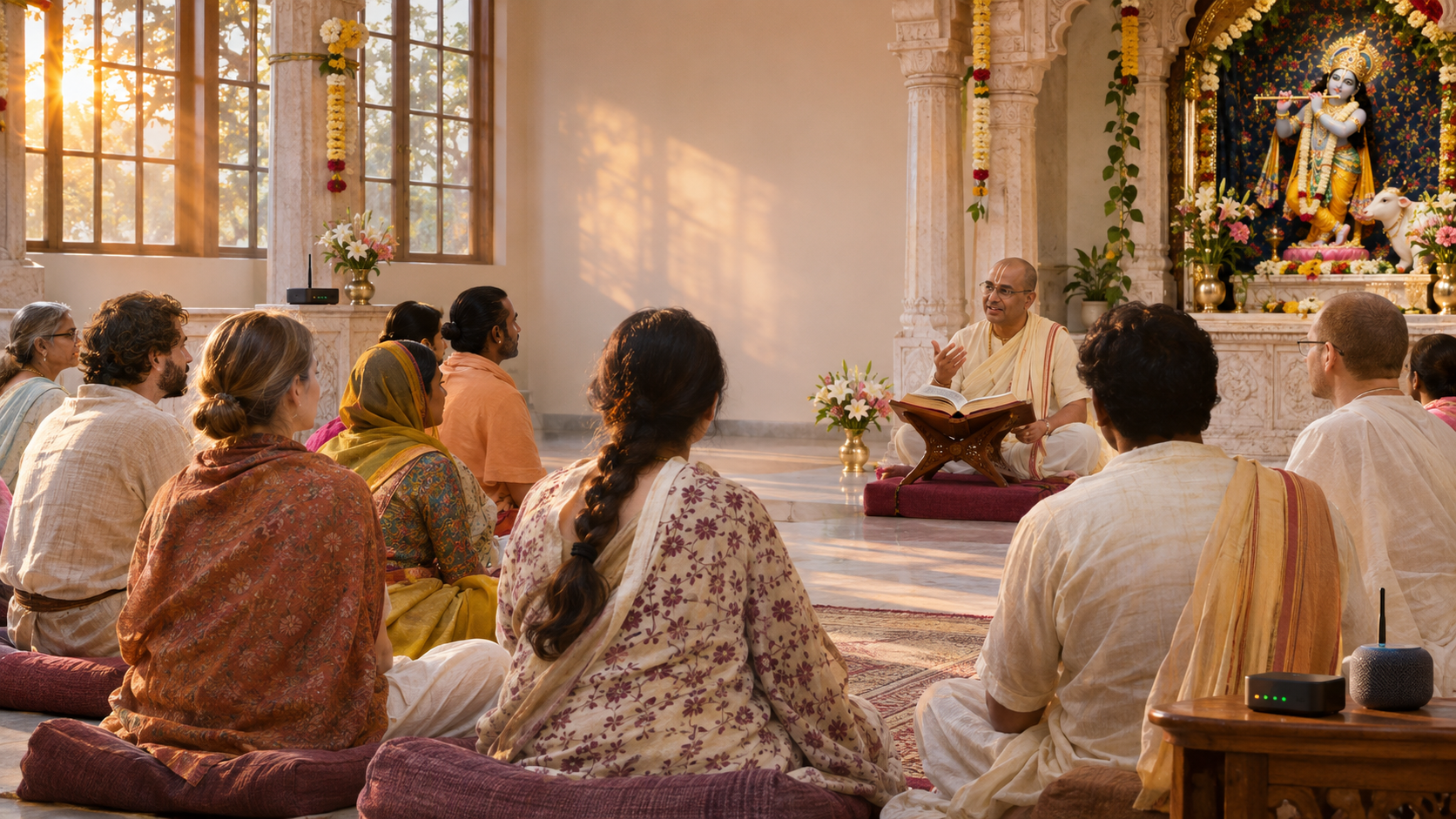
You hear a class from one ISKCON community, then another teacher in another city, and soon your devotional queue is longer than your capacity to absorb it. The problem is no longer access. It is knowing what to hear, how to evaluate it, and what to carry into practice.
A good morning class should not become background audio or another item consumed before the day begins. With a deliberate listening method, you can remain rooted in your local community while learning from the wider devotional fellowship.
The local class and the wider community serve different needs
Morning teaching in ISKCON is both scriptural and communal. The passage supplies a stable point of reference, while the teacher addresses the people actually gathered to hear it. That local setting matters. A class may respond to questions, habits, strengths or difficulties that are especially visible within its own congregation.
The wider range of classes lets you encounter the same teaching tradition through different voices. In Naperville, a class was organized around Srimad Bhagavatam 1.2.10 with Vraja Vihari Prabhu. In Wyndham, Satyabhama Devi Dasi taught from Srimad Bhagavatam 1.8.31 on 21 November 2026. A morning lecture by Janananda Gosvami Maharaj on 20 November 2026 adds another voice to that continuing culture of hearing.
You do not have to choose between loyalty to your home temple and openness to other teachers. Let your local community provide relationship, accountability and opportunities to ask questions. Let classes from elsewhere widen your hearing. The first without the second can become narrow; the second without the first can become detached consumption.
Use a text-teacher-application method

The simplest way to listen carefully is to separate what is often blended together. Keep a page with the labels Scripture, Explanation and Application. Then work through the class in this order.
- Open the exact passage first. Read the verse and the translation available to you before hearing the lecture. Notice the principal subject, action and relationship expressed in the text. This gives you an anchor before the speaker begins making connections.
- Write the teacher’s central claim in your own words. Do not attempt to transcribe everything. Complete the sentence: The main point being developed is… If you cannot complete it after listening, return to the portion where the teacher moves from context to instruction.
- Sort your notes by layer. Place direct points from the passage under Scripture. Put interpretation, theological explanation and connections to other teachings under Explanation. Put recommended changes in conduct, attention or devotional practice under Application.
- Record the reason for the application. An instruction is easier to retain when you can see how it follows from the passage. If that connection remains unclear, preserve it as a question instead of pretending you understood it.
- Close with a concrete response. Choose a phrase to remember, an action to attempt, or a question to bring to a knowledgeable devotee. The aim is not to manufacture a dramatic resolution every morning. It is to let hearing leave a trace in the rest of your day.
This method also protects you from two common errors. You are less likely to treat a memorable illustration as though it were the verse itself, and less likely to collect scriptural language without asking what it requires of you.
Compare teachings without flattening their differences

Classes from different communities are not automatically comparable merely because they are all morning lectures. A teaching on Srimad Bhagavatam 1.2.10 and a teaching on 1.8.31 begin from different passages. Using them to rank speakers or communities would ignore the most important variable: the text each teacher was asked to unfold.
First decide what kind of learning you want. If you want to understand a chapter’s movement, follow teachings on successive passages. If you want to examine interpretation, listen to different teachers address the same passage. If you want broader devotional association, sample different communities while keeping the passage, speaker and date attached to your notes.
When two teachings seem to pull in different directions, test the difference before calling it a contradiction:
- Text: Are both speakers explaining the same passage, or are different passages placing emphasis on different truths?
- Claim: Is the difference theological, or is it merely a difference in wording, illustration or pastoral emphasis?
- Audience: Could an application be directed to a particular community need rather than presented as a universal rule?
- Authority: Did the teacher identify a scriptural or commentarial basis, or are you extending an informal example beyond its purpose?
- Understanding: Can you state each position fairly enough that its speaker would recognize it?
If uncertainty remains, take the exact passage and your written question to a trusted senior practitioner. Ask how the two emphases fit within the siddhanta rather than asking which teacher is wrong. That wording keeps the inquiry focused on truth while avoiding premature judgement.
Make the class part of your morning rather than part of your feed
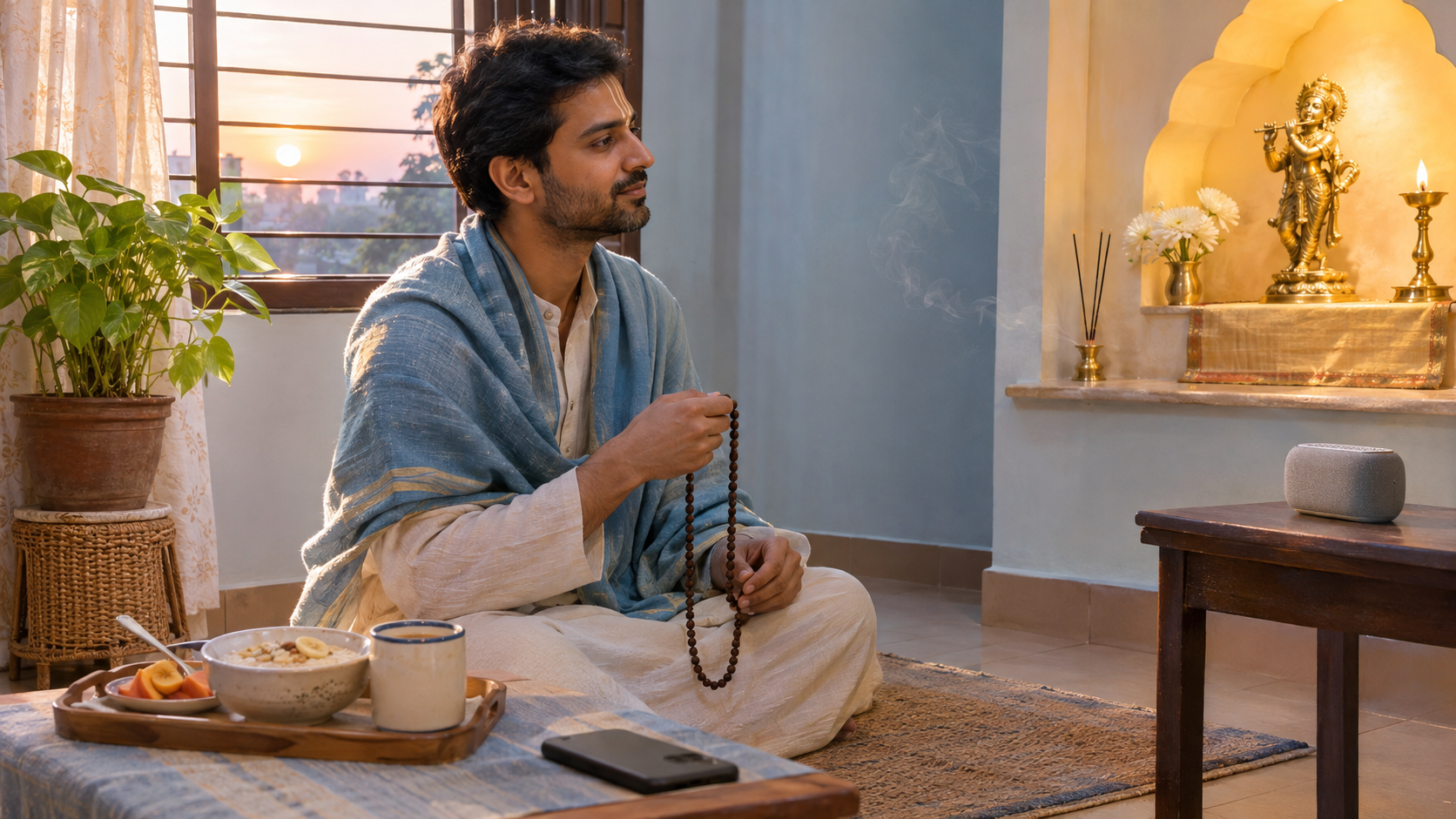
Devotional teaching becomes formative through regular return, not through occasional excess. Attach the class to a dependable part of your morning routine. Keep the same notebook nearby, begin with the passage, and end by writing your response before another recording or notification takes over your attention.
Resist the urge to compensate for a missed morning by accumulating several unheard classes. A growing queue can create the illusion of commitment while weakening attention. Return to the next class with full presence. Save an earlier lecture only when its passage or teacher answers a question you are actively pursuing.
Remote listening also needs a path back to real association. Bring an unresolved question to your local temple, study circle or a devotee qualified to help. Share the passage and the claim you understood before asking for clarification. That is far more useful than saying that you heard something somewhere online.
If you help publish or organize morning classes, make this discipline easier for listeners. Put the passage, speaker, community and date in the title. Clear identification turns an isolated recording into something that can be revisited, compared and studied responsibly.
Key takeaways
- Read the exact scriptural passage before listening, so the teacher’s explanation remains connected to the text.
- Separate Scripture, Explanation and Application in your notes instead of blending them into a general impression.
- Use your local community for relationship and accountability while allowing other ISKCON communities to broaden your hearing.
- Compare teachers only when the passages and questions are genuinely comparable.
- Carry a remembered phrase, a practical response or a well-formed question into the day.
Choose the next morning class by its passage, not by the size of your queue. Open the text first, listen with a page prepared, and finish only when you can name what the teaching asks you to remember or do.
References
- Dandavats — ISKCON Naperville: SB 1.2.10 by HG Vraja Vihari Prabhu
- Dandavats — Wyndham Hare Krishna Morning Class SB 1.8.31 – HG Satyabhama Devi Dasi – 21 November 2026
- Dandavats — Morning Lecture | HH Janananda Gosvami Maharaj | 20 November 2026

Leave a Reply
You must be logged in to post a comment.